How to Cycle a New Saltwater Tank (Without Losing a Single Fish)
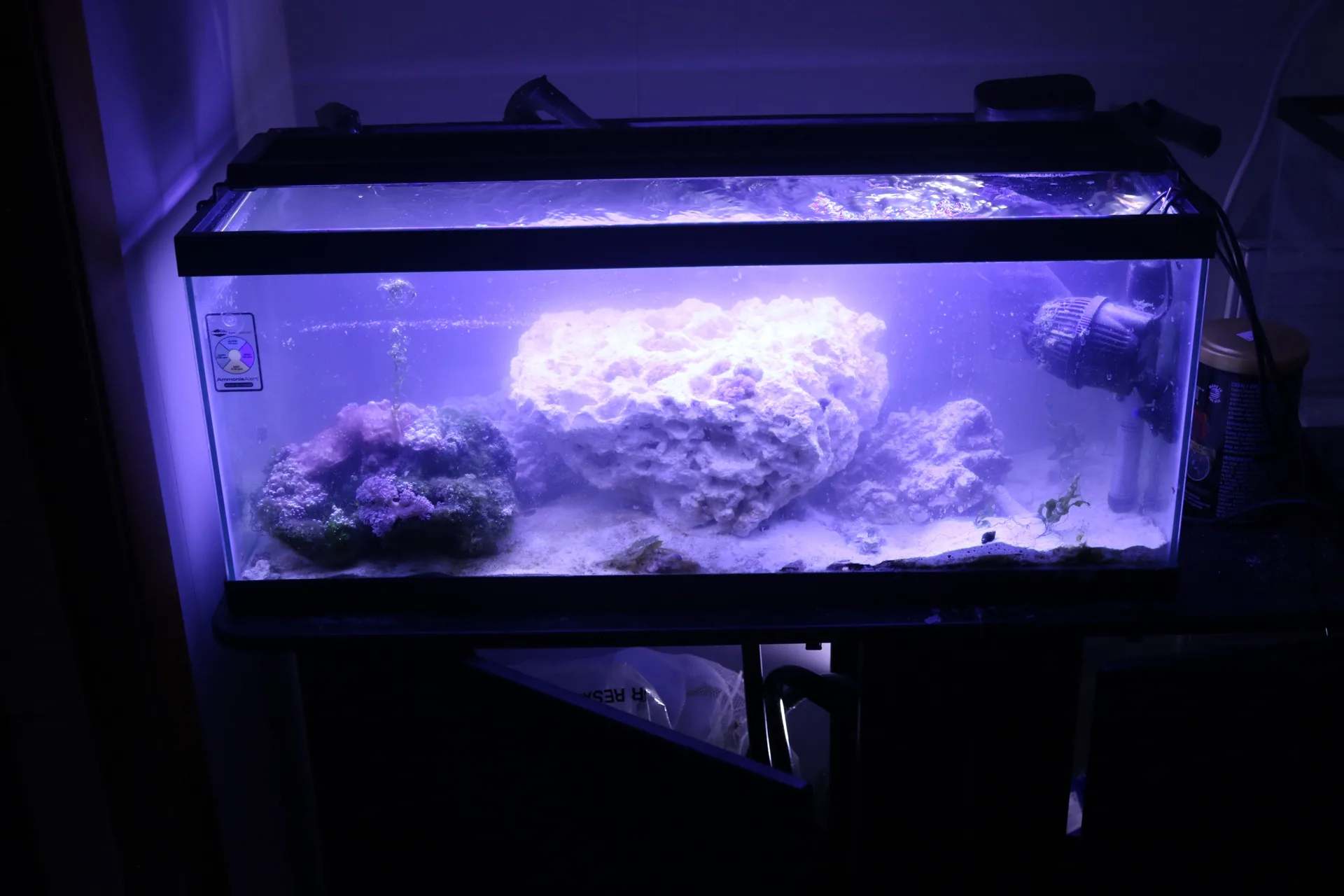
Every new aquarium, freshwater or saltwater, has to “cycle” before it can safely hold animals. It’s the single most important step in starting a tank, and it’s the one people most want to rush. We’ve set up a lot of tanks in 18+ years, and the ones that cycled properly are the ones that went on to do well.
What the cycle is
Fish and leftover food give off ammonia, which is toxic even in small amounts. In an established tank, bacteria living on the rock and in the sand turn ammonia into nitrite (also toxic) and then into nitrate, which is far less harmful and leaves the tank through water changes and algae growth.
A brand-new tank doesn’t have those bacteria yet. “Cycling” simply means growing a big enough colony of them to handle the waste your animals will make. Until then, ammonia and nitrite build up, and that’s what kills fish in new tanks.
Fishless cycling, step by step
We recommend cycling without fish. It’s kinder, and it’s faster because you can feed the bacteria more.
- Set up the tank completely. Rock, sand, saltwater at your target salinity, heater, pumps, and filtration running. Lights can stay off or on a short schedule.
- Add bottled bacteria. A quality bottled nitrifying bacteria product gives the colony a head start. Follow the label.
- Add an ammonia source. Pure ammonia dosed to about 2 ppm is the most controlled option. A pinch of fish food or a raw shrimp works too, just less predictably.
- Test every few days. You’ll see ammonia rise and fall, then nitrite rise and fall, then nitrate climb.
- Keep feeding the bacteria. Whenever ammonia drops near zero, dose it back up to about 2 ppm so the colony keeps growing.
- Check that it’s done. When the tank takes 2 ppm of ammonia down to zero ammonia and zero nitrite within 24 hours, the cycle is complete.
- Do a water change to bring nitrate down, then add your first animals within a few days so the bacteria don’t go hungry.
How long does it take?
Usually two to six weeks. Bottled bacteria and real live rock from an established tank can make it faster. Cold water, a lack of ammonia, or tap water with chloramine can make it slower. There’s no prize for finishing first: a tank that took six weeks is just as good as one that took two.
“Can I use a fish to cycle?”
You can, and plenty of people did years ago, but the fish is sitting in rising ammonia and nitrite the whole time. With bottled bacteria and pure ammonia available today, there’s no good reason to.
What comes after the cycle
Don’t be surprised when brown dust, green film or hair algae shows up in the following weeks. That’s the “ugly phase,” and it’s normal; we wrote about it in Diatoms, Algae and the Ugly Phase. Your first additions should be a small clean-up crew and one or two hardy fish, added slowly. See How Big a Clean-Up Crew Do You Need? and our Top 10 Fish for a Nano Reef.
Tests you’ll want
- Ammonia, nitrite and nitrate test kits for the cycle itself.
- A refractometer (calibrated) for salinity. Aim for around 1.025–1.026 specific gravity, or about 35 ppt.
- Later, for corals: alkalinity, calcium and magnesium.
Our step-by-step guide, How to Start a Saltwater Aquarium, covers the whole setup. And if your numbers look strange partway through, post them in the Support forum; reading a cycle is something we’re happy to help with.