Fish · Wrasse
Banana Wrasse
Thalassoma lutescens
Also called Banana / Lime Wrasse, Sunset Wrasse, Yellow-brown Wrasse, Yellow Wrasse, Lime Green Wrasse, Green Moon Wrasse, Yellow Moon Wrasse, Yellow-green Wrasse, Blue-fin Wrasse
Reviewed by admin on October 29, 2026 · Meet the team
- CareModerate
- Reef safeNo
- TemperamentAggressiveHarasses newcomers, timid fish and other Thalassoma
- Favorite foods
- Mysis shrimp
- Krill and chopped seafood
- Marine pellets
- Max size12 in (30 cm)
- Min tank125 gal
- LifespanNot documented
- IUCN statusLeast Concern
Quick answers
- How big does the Banana Wrasse get?
- Up to 12 in (30 cm).
- What size tank does it need?
- At least 125 gallons.
- How hard is it to keep?
- Care level: Moderate.
- Is it reef safe?
- No. Corals and marine plants are generally left alone, but it actively hunts most mobile invertebrates: ornamental shrimp, crabs and hermit crabs, snails, clams and mussels, sea urchins, brittle stars and worms.
- What does it eat?
- Mysis shrimp
- Krill and chopped seafood
- Marine pellets
- How long does it live?
- Not documented: no published longevity figure was found for this species.
- What are good tankmates?
- Tangs
- Puffers
- Smaller triggerfish
- Larger angelfish
- Other active, robust fish added before it
The 30-second version
The banana wrasse is a big, fast fish. Young fish and girls are bright yellow, just like a banana. Grown-up boys turn blue and green, with pink lines on the face. It can grow as long as a ruler, about 12 inches. It lives on coral reefs in the Indian and Pacific Oceans, from Sri Lanka all the way to Hawaii. It swims in groups over sand, rocks and coral. It eats crabs, shrimp, snails, sea urchins and worms. It also gobbles up eggs that other fish lay on rocks. A girl banana wrasse can turn into a boy as she grows. In a home tank it is bold and busy all day. It needs a very big tank with lots of room to swim. It may pick on new fish, and it will eat small shrimp and crabs. It can jump, so the tank needs a lid.
Water & care
Hardy and an eager eater that usually takes prepared foods readily, but it is a big, fast, high-energy fish. It needs a very large tank (125 gallons is a floor; a six-foot tank of 150 gallons or more is better for an adult) with broad open swimming lanes and secure rockwork it cannot shift. Feed meaty foods at least twice a day, preferably in several smaller meals, especially in the first weeks. A fine, soft sand bed lets it bury itself to rest or when startled; avoid coarse gravel that can scrape its skin. A tight-fitting lid is essential. Add it last and keep only one Thalassoma per tank.
| Parameter | Keep it at | Where that sits on the usual reef range |
|---|---|---|
| Temperature | 72–78 °F | |
| Salinity (SG) | 1.020–1.025 | |
| pH | 8.1–8.4 | |
| Alkalinity | 8–12 dKH |
LiveAquaria and Quality Marine agree on 72-78°F, SG 1.020-1.025, pH 8.1-8.4 and 8-12 dKH. FishBase gives 24-28°C (75-82°F) for its wild habitat. No species-specific calcium, magnesium, nitrate or phosphate values are published; keep normal reef or fish-only targets and keep nitrate low with regular water changes.
Feeding
DietCarnivore
Favorite foods
- Frozen mysis shrimp
- Vitamin-enriched brine shrimp
- Krill and chopped prawn
- Chopped clam, mussel and squid
- Marine pellets and flake
Feed enriched meaty foods at least twice a day; several smaller meals are better, especially while a new fish settles in. Prepared foods are usually accepted readily. Vitamin-enriched frozen foods such as mysis and brine shrimp help keep it in good color. It will also hunt any small invertebrates, worms and crustaceans it finds in the rockwork.
Tank & maintenance
- Minimum tank
- 125 gallons
- Aquascape
- A long tank with broad open swimming lanes, plus secure, stable rockwork with caves and ledges to explore; it probes the rock and can shift loose pieces. A fine, soft sand bed about 1-2 in deep lets it bury itself to rest or when frightened. A tight-fitting lid with gaps around plumbing and cables covered is essential.
- Lighting
- No special requirement; any reef or fish-only lighting.
- Water flow
- A mature system with strong flow and robust filtration (Top Shelf Aquatics). It is a strong, constant swimmer from shallow, exposed reefs.
Routine upkeep
Regular partial water changes and strong filtration, since a large, heavily fed carnivore adds a lot of waste. Check that rockwork stays stable, keep the lid closed and gaps around plumbing covered, and remember the fish may be buried in the sand when you vacuum or stir it. Watch tankmates for harassment, especially after any new addition.
Temperament & tankmates
TemperamentAggressive
Bold and territorial, and more aggressive as it grows. It harasses fish added after it, especially docile or easily intimidated species such as gobies, firefish and flasher wrasses, and is intolerant of other Thalassoma wrasses unless the tank is exceptionally large and all wrasses go in together. Very small fish may be treated as prey. Keep one per tank (LiveAquaria says a mated pair is possible in 125 gallons or more), add it last, and choose active, robust tankmates.
Reef safeNo
Corals and marine plants are generally left alone, but it actively hunts most mobile invertebrates: ornamental shrimp, crabs and hermit crabs, snails, clams and mussels, sea urchins, brittle stars and worms. These hard-shelled animals are its main food in the wild, and very small fish may also be eaten. It may help with bristleworms and mantis shrimp. LiveAquaria, Top Shelf Aquatics and the Saltwater Aquarium Blog all rate it not reef compatible; it suits fish-only tanks, or reefs where the keeper accepts losing invertebrates.
Good tankmates
- Tangs
- Puffers
- Smaller triggerfish
- Larger angelfish
- Other active, robust fish added before it
Avoid
- Other Thalassoma wrasses
- Gobies, firefish, flasher wrasses and other timid fish
- Very small fish it can swallow
- Ornamental shrimp, crabs and hermit crabs
- Snails, clams, sea urchins and brittle stars
- Coarse gravel substrate
Help it thrive
- Plan for an adult of about 12 in: a long tank of at least 125 gallons, better 150 or more.
- Add it last, and keep only one Thalassoma wrasse per tank.
- Use a tight-fitting lid and cover gaps around plumbing; it jumps, especially when startled.
- Give it a fine, soft sand bed to dive into, and avoid coarse gravel.
- Feed several small meaty meals a day, especially while it settles in.
Common ailments
Marine ich (Cryptocaryon irritans)
- Signs
- White, salt-like spots on the body, fins or gills, scratching (flashing), rapid breathing, cloudy eyes, hiding and loss of appetite.
- Prevention
- Quarantine new fish for several weeks in a separate tank, ideally with a sand-filled container so the wrasse can bury itself, and keep water stable.
- Treatment
- Treat in a hospital tank, never in a reef display, with copper, chloroquine phosphate or the tank-transfer method. Leave the display without fish long enough for the cyst stage to finish, since it can last up to 72 days.
Marine velvet (Amyloodinium ocellatum)
- Signs
- A fine dusty sheen on the skin, very fast breathing, gasping at the surface, scratching and lethargy. It can kill within 12 to 48 hours.
- Prevention
- Strict quarantine, and disinfect nets, buckets and equipment between tanks.
- Treatment
- Act immediately: a temperature- and pH-matched freshwater dip for quick relief, then copper or chloroquine phosphate in a hospital tank. Leave the display fallow with no fish.
Skin scrapes from coarse substrate or loose rock
- Signs
- Scraped snout or skin and frayed fins, usually in tanks with crushed coral, gravel or sharp rock that the fish dives into or brushes against.
- Prevention
- Use fine, non-abrasive sand rather than crushed coral or gravel, and secure the rockwork so it cannot shift.
- Treatment
- Keep the water very clean and watch the wounds; move the fish to a hospital tank and treat any secondary bacterial infection there if needed.
This is general hobby guidance, not veterinary advice. Quarantine new arrivals and treat in a separate tank whenever you can.
Risks of owning one
- Eats ornamental shrimp, crabs, snails, clams, sea urchins, brittle stars and very small fish.
- Grows to about 12 in and needs a very large tank; it outgrows most home aquariums.
- Aggressive toward newcomers, timid fish and other Thalassoma wrasses, more so as it grows.
- A strong jumper, especially when startled.
- Wild-caught only; no captive breeding is known.
Breeding
DifficultyNot achieved Captive-bredRare or wild-caught
No captive spawning or rearing has been reported, and all aquarium fish are wild-caught. In the wild it is a pelagic spawner (FishBase) and can change sex from female to male (Fishes of Australia). The bright blue-green males are terminal-phase fish; yellow initial-phase fish include females and some males.
- No captive breeding method has been published for this species.
- Because it grows large and is aggressive, home aquariums normally keep a single fish; LiveAquaria says a mated pair can share a tank of 125 gallons or more.
- All fish sold are wild-collected.
Deep dive The science, history and family tree
The science
Thalassoma lutescens is a large julidine wrasse (family Labridae) of the Indo-Pacific. Initial-phase fish are yellow, with a reddish vertical mark on each scale and wavy orange to red lines on the head; terminal-phase males keep a pink and green head but are abruptly blue to blue-green behind the pectoral-fin base. The dorsal fin has 8 spines and 13-14 soft rays, the anal fin 3 spines and 11 soft rays. It reaches about 30 cm total length. The range extends from Sri Lanka to Ducie Island, north to southern Japan and Hawaii and south to southeastern Australia, Lord Howe Island, the Kermadec Islands and Rapa; in the tropical eastern Pacific it is replaced by T. grammaticum. It lives in groups on clear outer lagoon and seaward reefs, over sand, rubble and rich coral at 1-30 m, and is common on shallow, exposed reefs. The diet consists mainly of hard-shelled benthic invertebrates, including crabs, shrimps, gastropods, bivalves, brittle stars and sea urchins, plus polychaete worms and fish eggs. It is a pelagic spawner capable of female-to-male sex change, and is assessed as Least Concern by the IUCN.
- Appearance
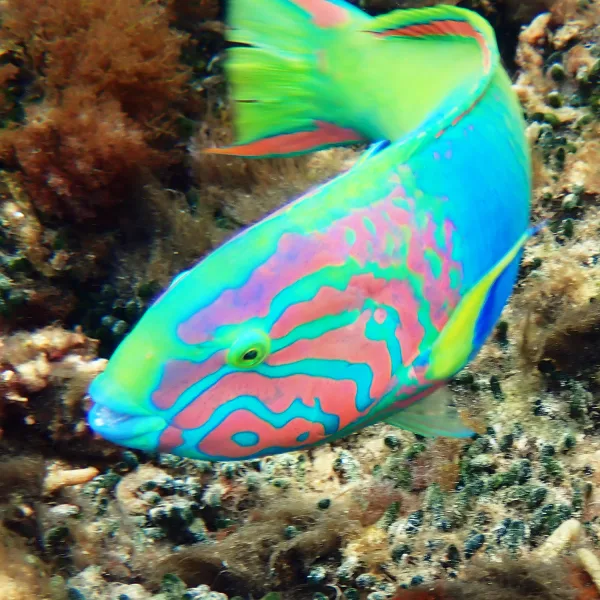
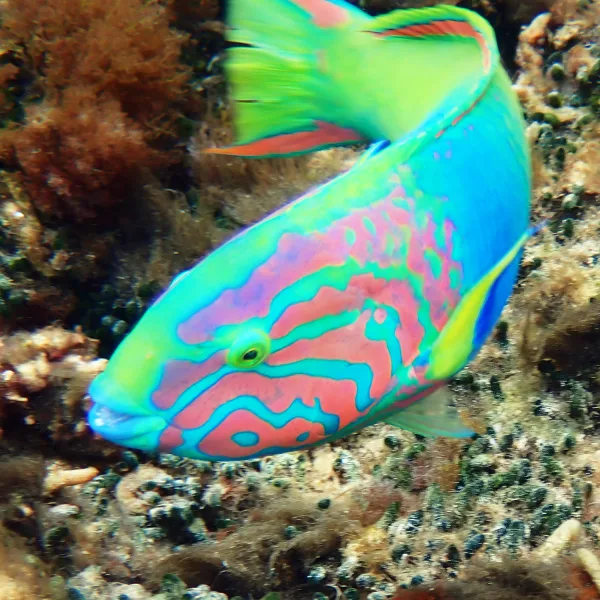
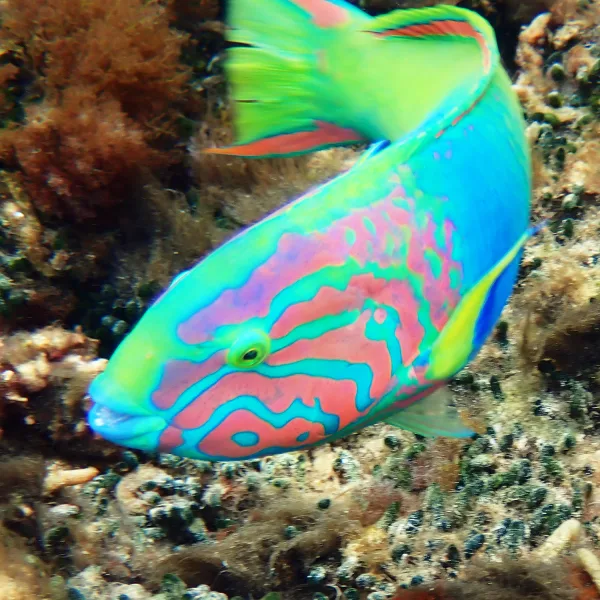
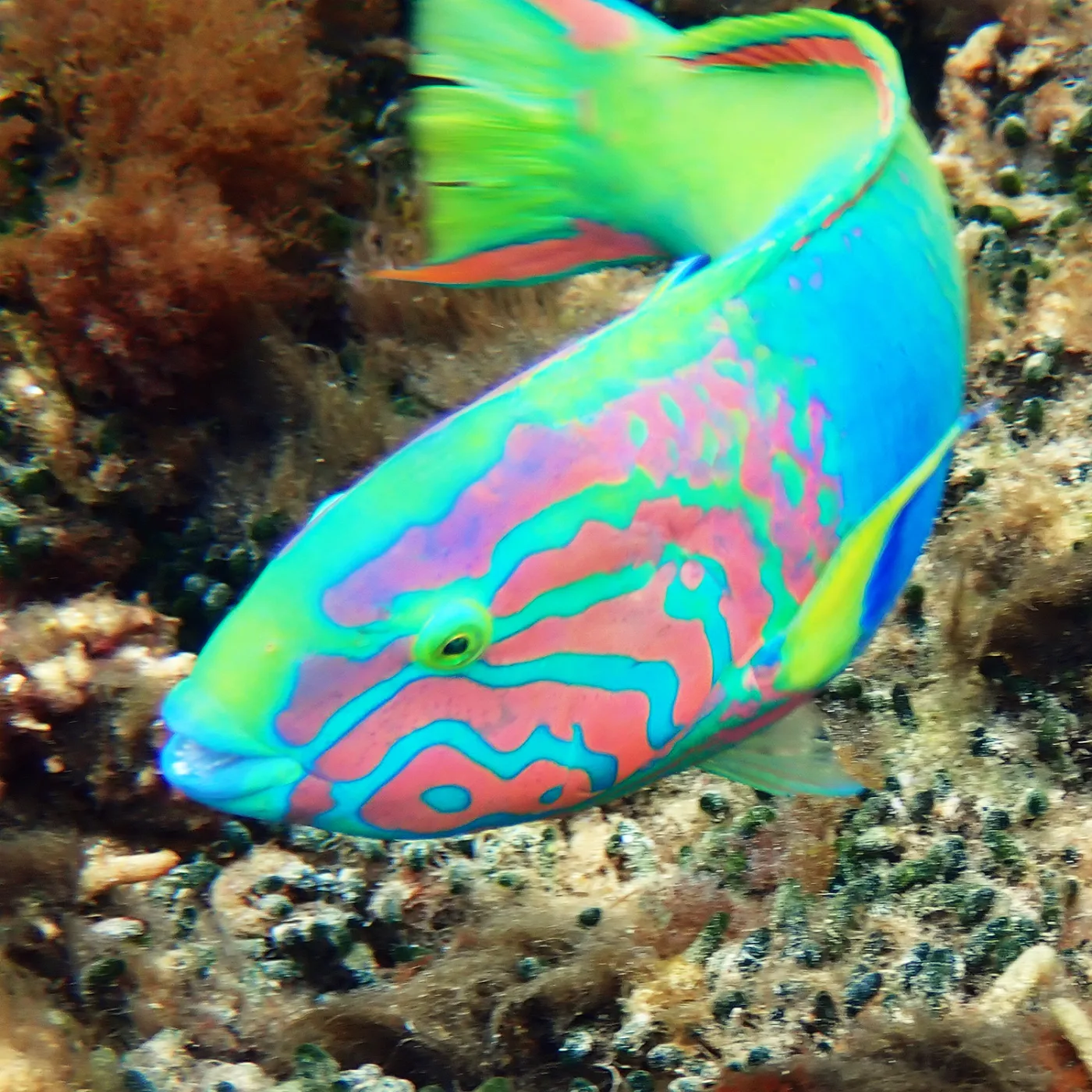
- Initial-phase fish (females and young males) are bright yellow to yellow-green with fine reddish vertical lines on the body and wavy orange to red lines on the head: the 'banana' coloring. Terminal-phase males keep the pink-and-green striped head, but behind the pectoral fins the body turns abruptly blue to blue-green, becoming green toward the tail, and the tail becomes lunate. Small juveniles are greenish above with a black stripe from behind the eye to the tail base and a white belly. The pectoral fins are yellow with blue tips. Look-alike: the lunare or moon wrasse (T. lunare), often seen with it on the reef, has a purple to magenta center in the pectoral fin instead of a blue rear edge, and a yellow crescent in the tail.
- Native range
- Indo-Pacific: Sri Lanka east to Ducie Island, north to southern Japan and Hawaii, and south to southeastern Australia, Lord Howe and Norfolk Islands, the Kermadec Islands and Rapa. Replaced in the tropical eastern Pacific by T. grammaticum. Type locality: Tahiti (lectotype). Quality Marine's listing offers regional options from the central Pacific, Australia and the Coral Sea, Melanesia and eastern Asia.
- Habitat
- Clear outer lagoons and seaward reefs, over open sand and rubble as well as dense coral, at about 1-30 m; common in shallow, exposed areas. Usually seen in groups. It is one of the more common wrasses in the Solitary Islands Marine Park off New South Wales, and very common at Lord Howe Island.
- Size
- 12 in (30 cm). FishBase, Fishes of Australia and Wikipedia give 30 cm total length; LiveAquaria, Quality Marine and Top Shelf Aquatics say about 12 in, and Top Shelf notes that some references say closer to 10 in. Terminal-phase males are larger than initial-phase fish.
- Lifespan
- Not documented: no published longevity figure was found for this species.
- Conservation
- Least Concern. Assessed Least Concern by the IUCN. Not evaluated by CITES. FishBase lists it as of minor importance to commercial fisheries and as commercial in the aquarium trade. All aquarium fish are wild-collected; no captive breeding is known
In the aquarium vs in the wild
In your aquarium
A large, bold and colorful display fish for big fish-only tanks, or reefs where invertebrate losses are acceptable; it also eats bristleworms and mantis shrimp.
On the reef
A predator of hard-shelled bottom invertebrates (crabs, shrimps, snails, bivalves, brittle stars and urchins) and polychaete worms on shallow Indo-Pacific reefs, and a raider of fish egg nests.
History
G. T. Lay and E. T. Bennett described the species in 1839 as Julis lutescens, in the zoology of Captain F. W. Beechey's Pacific voyage; the lectotype comes from Tahiti. It was later moved to Thalassoma, a genus named by Swainson in 1839, whose name FishBase glosses as 'the colour of the sea'. Its common names are confusing. FishBase and Wikipedia call it the sunset wrasse, a name also used for the eastern Pacific T. grammaticum. Fishes of Australia lists green moon wrasse, yellow moon wrasse, yellow-brown wrasse and several more. In the aquarium trade it is mostly sold as the banana wrasse, and sometimes as the lime green wrasse. It is popular as a hardy, bold fish for large fish-only systems, but it is wild-caught only.
Evolution & relatives
Wrasses (Labridae) are one of the largest marine fish families, with more than 600 species in about 81 genera, and the parrotfishes are nested inside the family. Fossil wrasses are known from the Early Eocene of Monte Bolca in Italy. Westneat and Alfaro's 2005 DNA study found a large crown radiation of julidine wrasses (WoRMS subfamily Julidinae), with the cleaner wrasses nested inside it. Within that group, studies have repeatedly placed the two bird wrasses (Gomphosus) inside Thalassoma (Bernardi and colleagues, 2004), and the two genera hybridize in the wild. A 2025 classification of wrasses proposed moving all Thalassoma species into Gomphosus, but WoRMS still accepts Thalassoma lutescens. Wild hybrids between T. lutescens and the saddle wrasse (T. duperrey) are known from Johnston Atoll. On the site's tree the banana wrasse sits on the julidine wrasse branch with the lunare wrasse, bird wrasses, Halichoeres and cleaner wrasses, separate from the six line and fairy wrasses (Cirrhilabrinae).
Family tree, from kingdom down
- Kingdom Animalia Animals Animals are living things made of many cells that must eat food to live. Fish, corals, crabs, snails and sea stars are all animals.
- Phylum Chordata Chordates Chordates have a stiff rod running down their back at some point in their lives. In fish and people, this rod is replaced by a backbone.
- Subphylum Vertebrata Vertebrates Vertebrates are animals with a backbone and a skull. Fish, frogs, birds and people are all vertebrates.
- Infraphylum Gnathostomata jawed vertebrates
- Parvphylum Osteichthyes bony fishes
- Gigaclass Actinopterygii ray-finned fishes
- Superclass Actinopteri
- Class Teleostei Teleost fishes Teleosts are bony fishes with thin, bendy fin rays and jaws that can push forward. Almost all of the fish in the world are teleosts.
- Order Eupercaria (unplaced) Unplaced eupercarian fishes Eupercaria is a huge group of fish with spiny fins. Scientists found it by studying DNA, and it holds wrasses, grunts, butterflyfishes and many more. 'Incertae sedis' means 'place not sure': scientists have not yet agreed which order wrasses belong in.
- Family Labridae Wrasses Wrasses are a huge family of colorful fish that swim by flapping their front fins. Many change color, and some change from female to male.
- Subfamily Julidinae Julidine wrasses
- Genus Thalassoma
- Species Thalassoma lutescens
See it on the Tree of Life Compare with another species
Closest relatives
- Thalassoma lunare Lunare Wrasse (Moon Wrasse) Same genus; a look-alike often seen with it, told apart by pectoral fin color
- Thalassoma grammaticum Sunset Wrasse Same genus; replaces it in the tropical eastern Pacific
- Thalassoma duperrey Saddle Wrasse Same genus; hybridizes with it at Johnston Atoll
- Gomphosus varius Bird Wrasse Bird wrasses are nested within Thalassoma in DNA studies Read guide · Compare
Older scientific names: Julis lutescens.
Fun facts
- Females and young fish are banana yellow, but big terminal-phase males turn blue-green behind a pink-and-green striped head.
- Off northern New South Wales it joins in a seasonal feeding frenzy on damselfish eggs stuck to the rocks.
- FishBase calls it the sunset wrasse, a name it shares with a different fish, the eastern Pacific T. grammaticum.
- DNA studies place the long-snouted bird wrasses inside its genus, Thalassoma.
- It can change sex from female to male as it grows.
Learn more
- FishBase: Thalassoma lutescens, Sunset wrasse fishbase.se
- Wikipedia: Thalassoma lutescens en.wikipedia.org
- Wikipedia: Thalassoma en.wikipedia.org
- Saltwater Aquarium Blog: Types of wrasse saltwateraquariumblog.com
Sources
- FishBase species summary: Thalassoma lutescens fishbase.se
- WoRMS taxon record 273585 marinespecies.org
- Fishes of Australia: Green Moon Wrasse, Thalassoma lutescens fishesofaustralia.net.au
- Solitary Islands Underwater Research Group: Thalassoma lutescens surg.org.au
- LiveAquaria: Banana Wrasse liveaquaria.com
- Quality Marine: Banana Wrasse qualitymarine.com
- Top Shelf Aquatics: Banana Wrasse care guide topshelfaquatics.com
- Top Shelf Aquatics: Lime Green Wrasse topshelfaquatics.com
Scientific names and classification follow the World Register of Marine Species (AphiaID 273585). Checked by our team. Last updated October 29, 2026.