 Only 2 left
Fish · Wrasse
Bird Wrasse
Gomphosus varius
Also called Green Bird Wrasse, Black Bird Wrasse, Brown Bird Wrasse, Birdnose Wrasse, Bird-nose Wrasse, Clubnosed Wrasse
Reviewed by admin on October 29, 2026 · Meet the team
- CareModerate
- Reef safeNo
- TemperamentSemi-aggressiveEats small fish and inverts; steals food
- Favorite foods
- Mysis shrimp
- Chopped seafood
- Carnivore pellets
- Max size12 in (30 cm)
- Min tank125 gal
- LifespanNot documented
- IUCN statusLeast Concern
Quick answers
- How big does the Bird Wrasse get?
- Up to 12 in (30 cm).
- What size tank does it need?
- At least 125 gallons.
- How hard is it to keep?
- Care level: Moderate.
- Is it reef safe?
- No. Generally leaves healthy coral alone, so it can live in a large coral tank, but it hunts mobile invertebrates.
- What does it eat?
- Mysis shrimp
- Chopped seafood
- Carnivore pellets
- How long does it live?
- Not documented; no published longevity data or reliable aquarium records were found.
- What are good tankmates?
- Tangs of suitable size
- Rabbitfish
- Larger angelfish
- Robust wrasses of different shape
- Triggerfish with a compatible temperament
The 30-second version
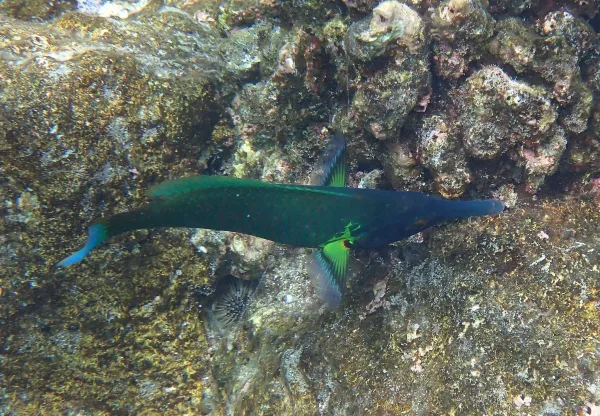
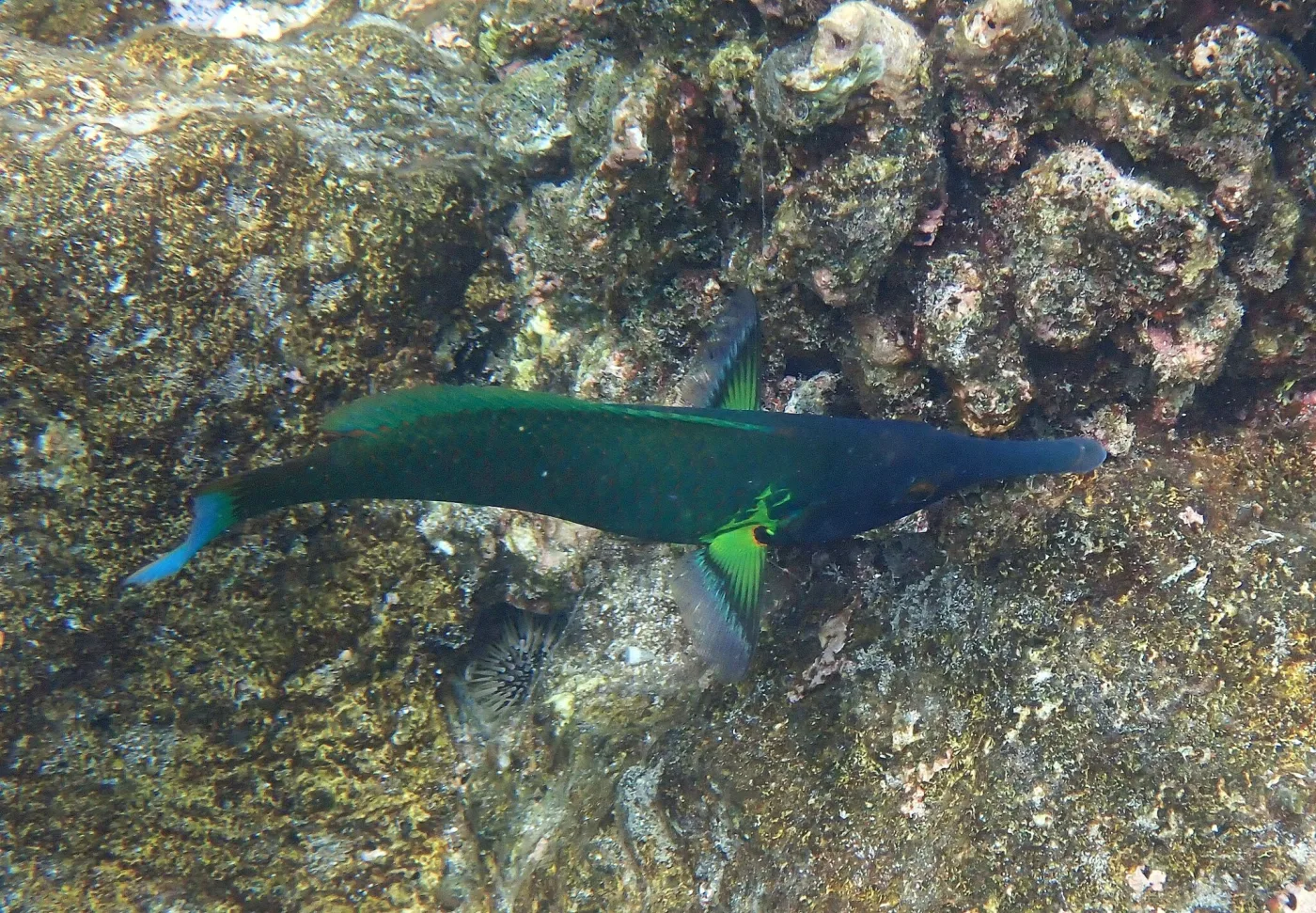
The bird wrasse has a long, thin nose. It looks like a bird's beak. It swims by flapping its side fins like wings. That is how it got its name. It lives on coral reefs in the Pacific Ocean, from Japan to Hawaii and down to Australia. It pokes its long nose into cracks in the reef. There it finds crabs, shrimp and other small animals to eat. Baby bird wrasses do not have the long nose yet.Girl bird wrasses are white in front and dark in the back. A girl can turn into a boy as she grows up. Boys are bright green, with a yellow mark behind the head. The green fish we sell is a boy. A bird wrasse can grow as long as a ruler, so it needs a very big tank. It is a great jumper, so the tank needs a tight lid.
Water & care
Hardy and easy to feed, but it is a big, fast predator that needs a large tank from the start. Plan for a fish of nearly a foot: at least 125 gallons with plenty of open swimming room and rockwork to shelter and sleep in. It does not bury in sand, so substrate depth does not matter. A tight-fitting lid is essential. Feed a varied meaty diet with vitamin-enriched frozen foods, and choose tankmates that are bold and too large to swallow.
| Parameter | Keep it at | Where that sits on the usual reef range |
|---|---|---|
| Temperature | 72–78 °F | |
| Salinity (SG) | 1.020–1.025 | |
| pH | 8.1–8.4 | |
| Alkalinity | 8–12 dKH |
Ranges from LiveAquaria (72-78°F, SG 1.020-1.025, pH 8.1-8.4, 8-12 dKH). Top Shelf Aquatics suggests 75-80°F and SG 1.024-1.026 and stresses stability and oxygen over exact numbers; FishBase gives 24-28°C (75-82°F) in the wild. In a reef tank keep normal reef targets for the corals; the fish has no special calcium, magnesium or phosphate needs. A large carnivore adds a heavy bioload, so keep nitrate low with regular water changes; no species-specific limit is published.
Feeding
DietCarnivore
Favorite foods
- Vitamin-enriched frozen mysis shrimp
- Enriched brine shrimp
- Krill and chopped shrimp, clam, mussel and squid
- Carnivore pellets
- Marine flake
Feed one or two good-sized meaty meals a day, and smaller meals more often for young fish (Top Shelf Aquatics). Vary the menu and include vitamin-enriched frozen foods. Its long snout is built for grabbing long, thin prey, which it breaks into bite-size pieces. Because it eats fast, make sure slower tankmates also get food.
Tank & maintenance
- Minimum tank
- 125 gallons
- Aquascape
- A long tank with plenty of open swimming space and live rock with caves and ledges for refuge and sleeping at night. Any sand bed or bare bottom works, since it does not bury. A tight-fitting lid or mesh cover with no gaps is essential.
- Lighting
- No special requirement; any reef or fish-only lighting.
- Water flow
- Moderate to strong, varied flow with good oxygenation; it is a powerful, constant swimmer.
Routine upkeep
Routine fish-only or reef upkeep, with regular partial water changes to handle the waste of a large, heavily fed carnivore. Remove uneaten meaty food. Keep the lid sealed, including gaps around plumbing. Watch feeding time to make sure slower tankmates are not starving, and check the clean-up crew, since snails, crabs and shrimp may slowly disappear.
Temperament & tankmates
TemperamentSemi-aggressive
Usually ignores robust fish but can intimidate small or timid tankmates, and it is most aggressive toward fish of similar shape or color, or when open space is short. It is a very fast, greedy feeder that out-competes slower fish and even steals food from tankmates' mouths. Small, slender fish may be eaten. Keep one male per tank; to keep a pair, add the female first.
Reef safeNo
Generally leaves healthy coral alone, so it can live in a large coral tank, but it hunts mobile invertebrates. Ornamental shrimp, small crabs, hermit crabs, snails, brittle stars and other small invertebrates are likely to be eaten, and it may nibble clams. It breaks up larger prey by bashing it against rock, and Reef Builders' author watched one kill a stowaway crab this way. LiveAquaria and other retailers rate it not reef compatible for this reason. Skip it if your clean-up crew or ornamental shrimp matter to you.
Good tankmates
- Tangs of suitable size
- Rabbitfish
- Larger angelfish
- Robust wrasses of different shape
- Triggerfish with a compatible temperament
- Bold fish too large to swallow
Avoid
- Ornamental shrimp, small crabs and hermit crabs
- Snails, brittle stars and other small invertebrates
- Small, slender fish it can swallow
- Garden eels and other timid fish
- Slow or shy feeders
- Another male bird wrasse
Help it thrive
- Start with a tank of at least 125 gallons; juveniles grow into fish of nearly a foot.
- Use a tight-fitting lid or mesh cover; it is a prolific jumper.
- Feed varied meaty foods at least once or twice a day, more often for young fish.
- Choose bold tankmates that are too large to swallow and can compete at feeding time.
- Keep one male; if you want a pair, add the female first.
Common ailments
Marine ich (Cryptocaryon irritans)
- Signs
- White, salt-like spots on the skin, fins or gills, scratching (flashing), rapid breathing, cloudy eyes, ragged fins, lethargy and loss of appetite.
- Prevention
- Quarantine new fish in a separate tank for several weeks before adding them to the display, and keep water stable.
- Treatment
- Treat in a hospital tank, never in a reef display: copper or chloroquine phosphate, hyposalinity, or the tank-transfer method. Give this large wrasse a big enough hospital tank with cover. Leave the display without fish long enough to outlast the cyst stage, which can last up to 72 days.
Marine velvet (Amyloodinium ocellatum)
- Signs
- Flashing, itching, labored breathing and gathering near the surface, then lethargy and loss of appetite; some fish show a fine, dusty sheen. Heavy infections can kill in 12 to 48 hours.
- Prevention
- Strict quarantine, and disinfect nets, buckets and equipment between tanks.
- Treatment
- Act at once: a temperature- and pH-matched freshwater dip for quick relief, then copper or chloroquine phosphate in a hospital tank. Leave the display fallow with no fish.
This is general hobby guidance, not veterinary advice. Quarantine new arrivals and treat in a separate tank whenever you can.
Risks of owning one
- Eats ornamental shrimp, crabs, hermit crabs, snails, brittle stars and small, slender fish.
- Jumps out of open tanks.
- Outgrows small and medium tanks; it needs at least 125 gallons as an adult.
- Out-competes and harasses slow or timid tankmates at feeding time.
- Wild-caught only; no captive-bred supply is known.
Breeding
DifficultyNot achieved Captive-bredRare or wild-caught
A protogynous wrasse that pairs to spawn and releases floating (pelagic) eggs. At Finger Reef in Guam, bird wrasses form resident spawning aggregations every day when local numbers are high. While aggregated they use a lek-like system, with males defending temporary courtship territories, and away from aggregations they live in harems. Spawning there peaked around full moon and high tide, and males that courted more also defended their territories harder. No report of captive spawning or larval rearing was found.
- Keep one male with one or more females in a very large tank; add the female first.
- Condition the fish with frequent, varied meaty foods.
- Watch for courtship and pair spawning; in the wild it peaks around full moon and high tide.
- Any eggs will float; collecting and rearing them has not been documented for this species.
Deep dive The science, history and family tree
The science
Gomphosus varius is a large julidine wrasse (family Labridae, subfamily Julidinae) of the Pacific and eastern Indian Ocean. Adults are recognized by an extremely long, slender, beak-like snout, which small juveniles lack. The body is fusiform and laterally compressed, with a truncate caudal fin (dorsal fin VIII,13; anal fin III,11). Maximum size is about 30 cm standard length (32 cm total length). The species is a protogynous hermaphrodite with strong sexual dichromatism: terminal-phase males are green to bluish green with a bluish head and a yellow bar behind the head, while females are whitish in front with dark-edged scales, grey to black toward the rear, and have a red-orange upper snout. It lives in coral-rich lagoon and seaward reefs at 0-35 m, from Cocos-Keeling and the Rowley Shoals east to Hawaii and the Tuamotus. It is usually solitary and feeds mainly on small benthic crustaceans, also taking brittle stars, molluscs and small fishes. Natural hybrids with Thalassoma lunare and T. duperrey are documented. It is assessed as Least Concern by the IUCN.
- Appearance
- A slim, torpedo-shaped wrasse with an extremely long, thin, beak-like snout and a square-cut tail. Mature males (sold as green bird wrasses) are green to bluish green with a bluish head and a bright yellow to yellow-green bar behind the head at the pectoral fin base; how intense the green is varies between fish, with maturity and in the mating season. Females (sold as black or brown bird wrasses) are smaller and duller: whitish with black speckles on the front half, grey to black toward the tail, with a red-orange upper snout and a dark line through the eye. Juveniles are white with a greenish to brownish back, two black stripes along the side and a short snout. The look-alike Indian Ocean species, the green birdmouth wrasse (G. caeruleus), is sold as a blue-green bird wrasse and differs in color and range.
- Native range
- Pacific and eastern Indian Ocean: from Cocos-Keeling and the Rowley Shoals east through the Hawaiian, Marquesas and Tuamotu islands, north to southern Japan and south to Lord Howe and Rapa islands. In Australia it ranges from Rottnest Island to Ashmore Reef in the west and from the northern Great Barrier Reef to the Solitary Islands in the east, with juveniles south to Bermagui. Replaced by G. caeruleus in the Indian Ocean. Type locality: Tahiti.
- Habitat
- Coral-rich areas of lagoons and seaward reefs, and rocky reefs, from the surface to about 35 m (usually 2-30 m). Usually solitary, sometimes in small groups, swimming above the bottom by day and probing coral and rock crevices for prey. Juveniles sometimes live in seagrass beds.
- Size
- 12 in (30 cm). FishBase gives 30 cm standard length as the maximum and Fishes of Australia 32 cm total length. LiveAquaria lists 11 in and Reef Builders 'nearly a foot' for aquarium fish. Females stay smaller than males.
- Lifespan
- Not documented; no published longevity data or reliable aquarium records were found.
- Conservation
- Least Concern. Assessed Least Concern by the IUCN (FishBase shows the 2008 assessment). Not evaluated by CITES. Widespread and common; taken in minor commercial fisheries and collected for the aquarium trade. FishBase rates its vulnerability to fishing as moderate
In the aquarium vs in the wild
In your aquarium
A large, active show fish for big fish-only tanks and large reefs without small invertebrates, kept for the green male's color and its bird-like swimming.
On the reef
A daytime predator of small bottom-living crustaceans, brittle stars, molluscs and small fishes, which it picks out of coral and rock crevices with its long snout.
History
Lacepède described the bird wrasse in 1801 in his Histoire naturelle des poissons, from Tahiti; some references give the year as 1802. Quoy and Gaimard named the same fish Gomphosus tricolor in 1824, a name now treated as a synonym. The genus name comes from the Greek gomphos, 'nail' or 'pin', for the beak-like snout. The species name varius means 'different' or 'variable', for the male's colors, which were described as a combination of red, yellow and blue. In the aquarium trade the sexes are sold under different names: green males as green bird wrasses, and females as black or brown bird wrasses. It has long been offered as a hardy, easy-to-feed fish, but its adult size and appetite for invertebrates make it a fish for large tanks.
Evolution & relatives
Bird wrasses belong to the julidine wrasses (WoRMS subfamily Julidinae), the large tropical group that also includes Thalassoma, Halichoeres and the cleaner wrasses. The genus Gomphosus has two or three species: G. varius in the Pacific, G. caeruleus in the Indian Ocean, and a Red Sea form, G. klunzingeri, treated as its own species, as a subspecies of G. caeruleus, or as a synonym. DNA work by Bernardi and colleagues (2004) found that the bird wrasses sit inside the genus Thalassoma, which makes Thalassoma unnatural as currently drawn. That fits the wild hybrids between the bird wrasse and the moon wrasse (T. lunare) and the saddle wrasse (T. duperrey). In 2025 a proposal was made to move all Thalassoma species into Gomphosus, the older name; WoRMS still accepts both genera. On the site's tree, the bird wrasse sits on the julidine branch with Thalassoma, the melanurus wrasse and cleaner wrasses, apart from the six line and fairy wrasses (Cirrhilabrinae).
Family tree, from kingdom down
- Kingdom Animalia Animals Animals are living things made of many cells that must eat food to live. Fish, corals, crabs, snails and sea stars are all animals.
- Phylum Chordata Chordates Chordates have a stiff rod running down their back at some point in their lives. In fish and people, this rod is replaced by a backbone.
- Subphylum Vertebrata Vertebrates Vertebrates are animals with a backbone and a skull. Fish, frogs, birds and people are all vertebrates.
- Infraphylum Gnathostomata jawed vertebrates
- Parvphylum Osteichthyes bony fishes
- Gigaclass Actinopterygii ray-finned fishes
- Superclass Actinopteri
- Class Teleostei Teleost fishes Teleosts are bony fishes with thin, bendy fin rays and jaws that can push forward. Almost all of the fish in the world are teleosts.
- Order Eupercaria (unplaced) Unplaced eupercarian fishes Eupercaria is a huge group of fish with spiny fins. Scientists found it by studying DNA, and it holds wrasses, grunts, butterflyfishes and many more. 'Incertae sedis' means 'place not sure': scientists have not yet agreed which order wrasses belong in.
- Family Labridae Wrasses Wrasses are a huge family of colorful fish that swim by flapping their front fins. Many change color, and some change from female to male.
- Subfamily Julidinae Julidine wrasses
- Genus Gomphosus Bird wrasses
- Species Gomphosus varius
See it on the Tree of Life Compare with another species
Closest relatives
- Gomphosus caeruleus Green Birdmouth Wrasse Same genus; Indian Ocean sister species that replaces it west of Cocos-Keeling
- Gomphosus klunzingeri Same genus; Red Sea form whose rank (species, subspecies or synonym) is disputed
- Thalassoma lunare Moon Wrasse (Lunare Wrasse) Same subfamily (Julidinae); DNA places Gomphosus inside Thalassoma, and wild hybrids are documented
- Thalassoma duperrey Saddle Wrasse Same subfamily (Julidinae); hybridizes with the bird wrasse in Hawaii
Older scientific names: Gomphosus tricolor.
Fun facts
- It 'flies' through the water by flapping its pectoral fins like wings, which helped give it its name.
- Young bird wrasses have short snouts; the long beak grows as they mature.
- It sometimes mates with other kinds of wrasse in the wild, producing hybrids with the moon wrasse and the saddle wrasse.
- In Guam, bird wrasses gather at the same reef every day to spawn, and males defend small courtship territories like birds at a display ground.
- The genus name Gomphosus comes from the Greek for 'nail' or 'pin', after its beak-like snout.
Learn more
- FishBase: Gomphosus varius, Bird wrasse fishbase.se
- Fishes of Australia: Birdnose Wrasse fishesofaustralia.net.au
- Reef Builders: Gomphosus varius, this wrasse is for the birds reefbuilders.com
- The ETYFish Project: Labriformes part 2 (name meanings, incl. Gomphosus) etyfish.org
Sources
- FishBase species summary: Gomphosus varius fishbase.se
- WoRMS taxon record 218975 marinespecies.org
- Wikipedia: Gomphosus varius en.wikipedia.org
- Fishes of Australia: Birdnose Wrasse, Gomphosus varius fishesofaustralia.net.au
- LiveAquaria: Bird Wrasse liveaquaria.com
- Reef Builders: Gomphosus varius, this wrasse is for the birds (Jeff Kurtz, 2013) reefbuilders.com
- Top Shelf Aquatics: Green Bird Wrasse (Male) topshelfaquatics.com
- Kawahigashi 2021, Reproductive behavior of Gomphosus varius at a spawning aggregation site (University of Guam thesis) uog.edu
Scientific names and classification follow the World Register of Marine Species (AphiaID 218975). Checked by our team. Last updated October 29, 2026.
Shop this species
Search the shop →
Only 2 left