 Sold out
Aquacultured
Fish · Tang
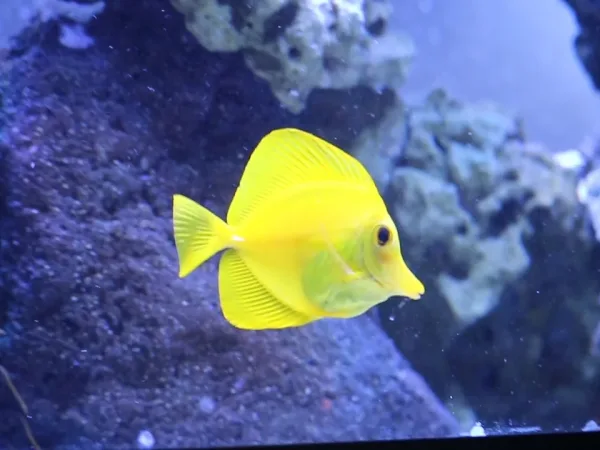
Yellow Tang
Zebrasoma flavescens
Also called Hawaiian Yellow Tang, Yellow Sailfin Tang, Lemon Sailfin, Yellow Surgeonfish, Lauʻīpala (Hawaiian)
- CareModerate
- Reef safeYes
- TemperamentSemi-aggressiveTerritorial toward other tangs; mostly ignores other fish
- Favorite foods
- Nori / seaweed sheets
- Marine algae / spirulina
- Mysis shrimp
- Max size8 in (20 cm)
- Min tank125 gal
- LifespanVery long-lived for an aquarium fish
- IUCN statusLeast Concern
Quick answers
- How big does the Yellow Tang get?
- Up to 8 in (20 cm).
- What size tank does it need?
- At least 125 gallons.
- How hard is it to keep?
- Care level: Moderate.
- Is it reef safe?
- Yes. Does not eat corals, clams, shrimp, crabs or snails.
- What does it eat?
- Nori / seaweed sheets
- Marine algae / spirulina
- Mysis shrimp
- How long does it live?
- Very long-lived for an aquarium fish: wild yellow tangs in Hawaii have been aged at up to 41 years from growth rings in their ear stones (otoliths).
- What are good tankmates?
- Clownfish
- Gobies and blennies
- Cardinalfish
- Wrasses and anthias
- Dwarf angelfish in larger tanks
The 30-second version
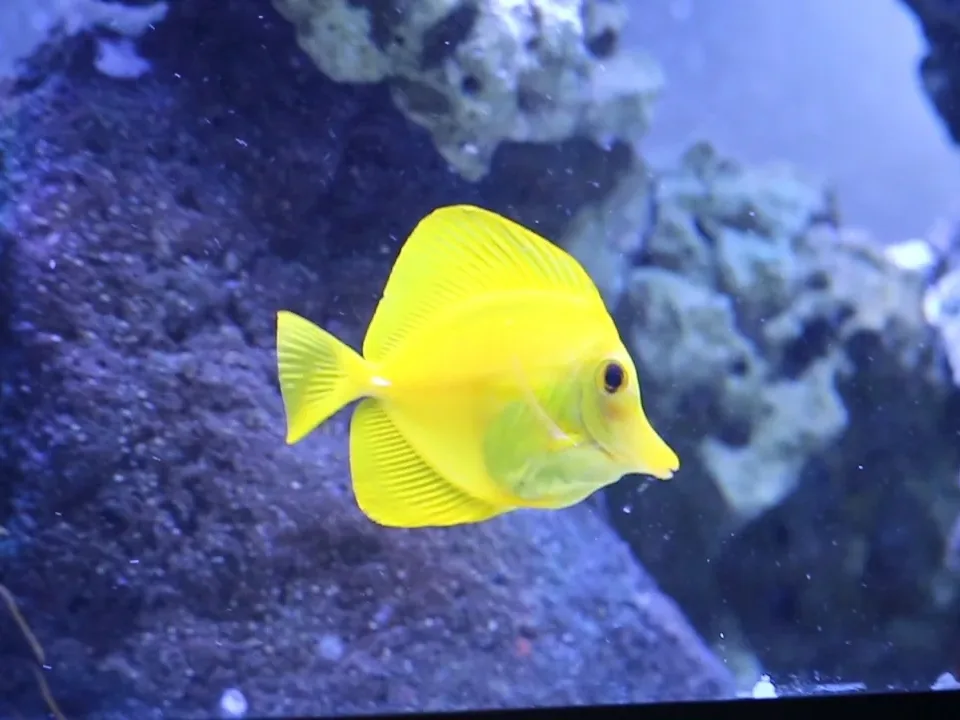
The yellow tang is a bright yellow fish. Its body is flat and round, like a pancake, and it has a pointy snout. It lives on coral reefs in the Pacific Ocean, mostly around Hawaii. All day it swims around and nibbles tiny algae off the rocks. Algae are like little sea plants. Eating them keeps the reef tidy, so corals have room to grow. Near its tail it has a small white spine as sharp as a tiny knife. It uses it to keep itself safe. At night its bright color fades and a pale stripe shows up, a bit like putting on pajamas. Some wild yellow tangs have lived for more than 40 years! At home they need a big tank with lots of room to swim, and they need seaweed to eat every day.
Water & care
Hardy once settled and eats readily, but it is not a small-tank fish. It needs at least 125 gallons with long open swimming lanes, a mature system with algae to graze, and strict quarantine, because tangs catch marine ich and velvet easily. Feed marine algae every day. Captive-bred fish are noticeably easier: they arrive already eating pellets and used to aquarium life. LiveAquaria lists the species as Easy; we rate it Moderate because of the large tank it needs, its disease risk and its territorial behavior toward other tangs.
| Parameter | Keep it at | Where that sits on the usual reef range |
|---|---|---|
| Temperature | 72–78 °F | |
| Salinity (SG) | 1.020–1.025 | |
| pH | 8.1–8.4 | |
| Alkalinity | 8–12 dKH | |
| Calcium | 350–450 ppm | |
| Magnesium | 1,150–1,350 ppm | |
| Nitrate | 0–30 ppm | |
| Phosphate | 0–0.1 ppm |
Ranges are LiveAquaria's general marine fish guidelines (fish-only column); calcium and magnesium matter for the tank, not for the fish itself. In a reef with corals keep specific gravity 1.023-1.025, magnesium 1250-1350 ppm and nitrate and phosphate as low as your corals need. Wild habitat water is about 75-82 °F (24-28 °C). Stability matters more than hitting exact numbers. Avoid dusty lignite-based activated carbon, which studies have linked to head and lateral line erosion in surgeonfish.
Feeding
DietHerbivore
Favorite foods
- Dried marine seaweed sheets (nori, red, green and brown algae) on a clip
- Spirulina and algae-based pellets and flakes
- Frozen herbivore formulas
- Natural algae growing on live rock
- Mysis shrimp in small amounts
Offer marine seaweed daily (LiveAquaria's minimum is at least three times a week) plus small portions of herbivore pellets or frozen food two or three times a day. A little meaty food is fine, but most of the diet should be marine algae; a well-fed tang is calmer and resists disease better. A pinched-in belly or a visible spine outline means it is underfed.
Tank & maintenance
- Minimum tank
- 125 gallons
- Aquascape
- Plenty of live rock with caves and crevices for sleeping, but leave long, open swimming lanes; a long tank suits it better than a tall one. The tank should be mature enough to grow algae it can graze.
- Lighting
- No special needs. Normal reef or fish-only lighting is fine and helps grow algae for grazing.
- Water flow
- Moderate to strong, well-oxygenated water.
Routine upkeep
Regular partial water changes, clean mechanical filtration, and a protein skimmer that keeps the water well oxygenated. Clip fresh seaweed daily and watch the fish at feeding time for white spots, dusty-looking skin, cloudy eyes, fast breathing or pitting on the head. If you run activated carbon, use rinsed, hard pelleted carbon rather than dusty lignite carbon.
Temperament & tankmates
TemperamentSemi-aggressive
Territorial toward other tangs, especially other sailfin tangs (Zebrasoma) of similar shape. Keep one per tank unless several are added at the same time to a very large system. It is usually peaceful with non-tang fish. Add it last so it does not treat newcomers as intruders. In fights it slashes sideways with its tail spine.
Reef safeYes
Does not eat corals, clams, shrimp, crabs or snails. It grazes filamentous and film algae on rock and glass and is widely used to help control nuisance algae. Like any herbivore it will also eat ornamental macroalgae you may want to keep.
Good tankmates
- Clownfish
- Gobies and blennies
- Cardinalfish
- Wrasses and anthias
- Dwarf angelfish in larger tanks
- Corals and clean-up crew invertebrates
Avoid
- Other Zebrasoma tangs (scopas, purple, sailfin) unless the tank is very large and they are added together
- A second yellow tang added after the first has settled
- Large predators that can swallow it
- Tanks under 125 gallons or without open swimming space
Help it thrive
- Buy captive-bred if you can: these fish already eat prepared foods and are used to aquarium life.
- Quarantine every new fish for at least 2-4 weeks (longer is safer) in a separate tank before it goes into the display.
- Feed marine seaweed every day; a well-fed tang is less aggressive and has a stronger immune system.
- Add the yellow tang after peaceful fish are settled, and avoid adding other tangs later.
- Give it a long tank with open swimming room plus rockwork caves to sleep in.
Common ailments
Marine ich (white spot, Cryptocaryon irritans)
- Signs
- Salt-grain white spots on the body, fins and gills, scratching against rocks, rapid breathing, cloudy eyes, clamped fins and loss of appetite.
- Prevention
- Quarantine all new fish before they enter the display, keep water stable, and feed a varied algae-rich diet.
- Treatment
- Move fish to a hospital tank and treat with copper or chloroquine phosphate (follow the product's directions), hyposalinity (SG about 1.009) or the tank-transfer method; none of these belong in a reef display. Leave the display fishless long enough for the parasite to die out (its cyst stage can last up to about 72 days).
Marine velvet (Amyloodinium ocellatum)
- Signs
- Fine gold or gray dusty coating, very fast breathing, hiding, and rapid decline; it can kill within days.
- Prevention
- Quarantine and observation of every new fish; never add fish straight from a store tank that has had losses.
- Treatment
- Act fast: a temperature- and pH-matched freshwater dip for quick relief, then copper treatment in a hospital tank following the product's directions, and leave the display fishless while the parasite dies out.
Head and lateral line erosion (HLLE)
- Signs
- Small pits or eroded patches around the face and head and along the lateral line, sometimes spreading to the fins. Rarely fatal but disfiguring.
- Prevention
- Varied, algae-rich diet, good water quality, and avoiding dusty lignite activated carbon (linked to HLLE in surgeonfish studies).
- Treatment
- Remove lignite carbon, make large water changes and improve diet; moving the fish to an aquarium that has never had HLLE is the most commonly reported cure.
Black spot disease (Paravortex turbellarian flatworms)
- Signs
- Small black dots scattered over the body and fins, often with scratching; yellow tangs show it clearly.
- Prevention
- Quarantine new tangs and inspect them closely before adding them to the display.
- Treatment
- A temperature- and pH-matched freshwater dip to knock off the worms, followed by praziquantel treatment in a hospital tank, following the product's directions.
This is general hobby guidance, not veterinary advice. Quarantine new arrivals and treat in a separate tank whenever you can.
Risks of owning one
- The tail spine is razor sharp and can cut hands during netting or maintenance; it can also snag in nets. Move it with a container where possible.
- Territorial: it can bully or seriously injure tangs added after it.
- An unquarantined tang can bring ich or velvet into a display, and treating a reef tank for these parasites is very difficult.
- Cramped in a small tank it becomes stressed, aggressive and disease-prone; it needs a large system for its whole life.
- Potentially a decades-long commitment, given that wild fish reach 40+ years.
- Wild collection is controversial; buy captive-bred or legally sourced fish, and never release aquarium fish into the wild.
Breeding
DifficultyVery hard Captive-bredWidely available
A pelagic spawner that releases floating eggs in groups or pairs, often linked to the full moon. Breeding is not realistic in a home aquarium. Hawaii Pacific University's Oceanic Institute produced the first known captive-bred yellow tangs (announced October 2015) after more than a decade of work, and Biota now produces them commercially with the Institute.
- Condition a group of adult broodstock in a large system; at the Oceanic Institute, long-held adults spawned monthly for several days around the full moon, releasing tens of thousands of eggs per spawn.
- Collect the floating eggs and move them to larval rearing tanks.
- Feed first-feeding larvae copepod nauplii; in trials they ignored rotifers and early Artemia was too large.
- Add a mix of copepod sizes and then newly hatched Artemia nauplii as larvae grow (around days 35-50 in Oceanic Institute trials).
- Expect a pelagic larval stage of about two months (wild larvae settle around day 60) before metamorphosis into juveniles.
- Wean juveniles onto prepared foods and grow them out before sale.
Deep dive The science, history and family tree
The science
Zebrasoma flavescens is a laterally compressed, disc-shaped surgeonfish (family Acanthuridae) with an elongated, protruding snout, tall sail-like dorsal and anal fins, and a single sharp, white, scalpel-like spine on each side of the caudal peduncle. The dorsal fin has 5 spines and 23-26 soft rays; the anal fin has 3 spines and 19-22 soft rays. Living fish are uniformly bright yellow by day, while at night a brownish patch with a pale horizontal band appears. It reaches about 20 cm total length, and males grow larger than females (mean asymptotic lengths of about 179 mm versus 156 mm in Hawaii). The species occurs in the western and central Pacific, including the Ryukyu, Mariana, Marshall, Marcus, Wake and Hawaiian islands. Adults live singly or in loose groups in coral-rich lagoon and seaward reef habitats from just below the surge zone to about 46 m. In Hawaii, young fish use deeper coral-rich reef and shift to shallow, turf-dominated reef as they grow, with males making this move at a larger size and older age than females. It is a grazing herbivore that crops filamentous algae. Spawning occurs year-round, with activity linked to the full moon, both in groups and as pair-spawning by territorial males; eggs and larvae are pelagic, and larvae drift for roughly two months before settling on the reef. Otolith studies validated with tetracycline marking have aged wild fish at up to 41 years. It has been the primary reef fish taken for the aquarium trade in Hawaii, and stray individuals recorded in Florida, Mexico and the Mediterranean probably came from aquarium releases.
- Appearance
- Solid lemon-yellow, oval, very flat body with a long snout and tall, rounded dorsal and anal fins; a white scalpel spine sits in a groove on each side of the tail base. At night or when stressed it looks duller, with a brownish patch and a pale horizontal band along the side. Young captive-bred juveniles can show a few faint vertical bars at first. It is hard to confuse with other fish: its closest relatives share the sailfin body shape but not the color, for example the purple tang (Zebrasoma xanthurum, purple with a yellow tail) and the scopas tang (Zebrasoma scopas, brown).
- Native range
- Western and central Pacific Ocean: the Hawaiian Islands (where it is most abundant), the Ryukyu Islands of southern Japan, and the Mariana, Marshall, Marcus and Wake islands. Individuals reported off Florida, on Mexico's Riviera Maya (2024) and once in the Mediterranean (2008) are outside the native range and probably came from released aquarium fish.
- Habitat
- Coral-rich areas of lagoons and seaward reefs, from below the surge zone down to about 46 m (150 ft), usually 3-46 m, in water of about 24-28 °C (75-82 °F). Occurs singly or in loose groups. In Hawaii, juveniles settle in deeper coral-rich habitat and move into shallow reef dominated by algal turf as adults.
- Size
- 8 in (20 cm). FishBase gives a maximum of 20 cm (about 8 in) total length; LiveAquaria lists 8 in. Males grow larger than females. Store specimens are usually sold at around 2.5-3.25 in.
- Lifespan
- Very long-lived for an aquarium fish: wild yellow tangs in Hawaii have been aged at up to 41 years from growth rings in their ear stones (otoliths). With good care, aquarium specimens can live well over a decade, but solid published data on captive lifespan are limited.
- Conservation
- Least Concern. IUCN Least Concern (assessed 2010). Not listed by CITES. Hawaii, historically the main source and where it was the top aquarium-trade export, has had no legal commercial aquarium collection since court rulings that followed the 2017 Hawaii Supreme Court Umberger decision (statewide halt by December 2020). In 2025-2026 the state proposed reopening West Hawaii under limits that included a 100,000 yellow tang per year quota. On 28 August 2026 the Board of Land and Natural Resources sent the proposal back to staff without approving it, so collection remains closed. Captive-bred yellow tangs from Biota, produced with Hawaii Pacific University's Oceanic Institute, are now a major legal source
In the aquarium vs in the wild
In your aquarium
A classic centerpiece fish for reef and fish-only tanks, and a practical algae grazer that helps keep film and filamentous algae in check.
On the reef
A grazing herbivore that crops filamentous turf algae, helping keep algae from overgrowing reef surfaces, and prey for larger reef predators. It is an important Hawaiian reef fish and was historically Hawaii's most collected aquarium species.
History
English zoologist Edward Turner Bennett described the species in 1828 as Acanthurus flavescens; it was later placed in Zebrasoma, a genus William Swainson named in 1839. It became one of the most popular marine aquarium fishes, and Hawaii, especially West Hawaii, supplied most of the trade. Concern about declines in the late 1990s led to a network of West Hawaii marine protected areas closed to aquarium collecting, and yellow tang life-history research there guided management. After the 2017 Hawaii Supreme Court Umberger decision required environmental review, commercial aquarium collection was halted statewide by December 2020, and prices rose sharply. Meanwhile the Oceanic Institute announced the first captive-bred yellow tangs in October 2015, and Biota went on to sell them commercially. Proposals to reopen West Hawaii collection with quotas were debated through 2025-2026, and in August 2026 the state Land Board sent them back for more work.
Evolution & relatives
Surgeonfishes (Acanthuridae) belong to the order Acanthuriformes, which in current classifications also includes rabbitfishes, the Moorish idol, butterflyfishes and angelfishes. Fossil surgeonfishes are known from the Eocene onward, and the famous Monte Bolca deposits in Italy contain early members of several surgeonfish tribes. A nine-gene timetree (Sorenson et al. 2013) splits the family into the unicornfishes (Nasinae) and Acanthurinae, which arose about 42 million years ago, with most living species appearing since the Early Miocene (about 21 million years ago). Zebrasoma forms the tribe Zebrasomini together with Paracanthurus, the blue hippo tang, separate from the Acanthurini (Acanthurus surgeonfishes and Ctenochaetus bristletooths) and the Prionurini (sawtails). The yellow tang's closest relatives are the other sailfin tangs: scopas, purple, sailfin, Red Sea sailfin, gem and black longnose tangs.
Family tree, from kingdom down
- Kingdom Animalia Animals Animals are living things made of many cells that must eat food to live. Fish, corals, crabs, snails and sea stars are all animals.
- Phylum Chordata Chordates Chordates have a stiff rod running down their back at some point in their lives. In fish and people, this rod is replaced by a backbone.
- Subphylum Vertebrata Vertebrates Vertebrates are animals with a backbone and a skull. Fish, frogs, birds and people are all vertebrates.
- Infraphylum Gnathostomata jawed vertebrates
- Parvphylum Osteichthyes bony fishes
- Gigaclass Actinopterygii ray-finned fishes
- Superclass Actinopteri
- Class Teleostei Teleost fishes Teleosts are bony fishes with thin, bendy fin rays and jaws that can push forward. Almost all of the fish in the world are teleosts.
- Order Acanthuriformes Surgeonfishes, angelfishes and kin This order of fishes includes surgeonfishes, marine angelfishes and rabbitfishes. Many have deep, flat bodies and graze on reefs.
- Family Acanthuridae Surgeonfishes and tangs Surgeonfishes have a sharp spine, like a tiny knife, on each side of the tail. Most graze on algae on reefs.
- Genus Zebrasoma Sailfin tangs Sailfin tangs have tall fins on their back and belly that they can raise like sails. They graze on algae.
- Species Zebrasoma flavescens
See it on the Tree of Life Compare with another species
Closest relatives
- Zebrasoma scopas Scopas Tang Same genus (sailfin tangs); very similar body shape
- Zebrasoma xanthurum Purple Tang Same genus
- Zebrasoma velifer Sailfin Tang Same genus
- Zebrasoma desjardinii Red Sea Sailfin Tang (Desjardin's Tang) Same genus
- Zebrasoma gemmatum Gem Tang Same genus
- Zebrasoma rostratum Black Longnose Tang Same genus
- Paracanthurus hepatus Blue Hippo Tang Same tribe (Zebrasomini), different genus Read guide · Compare
- Acanthurus leucosternon Powder Blue Tang Same family, different tribe (Acanthurini) Read guide · Compare
Older scientific names: Acanthurus flavescens.
Fun facts
- Scientists aged wild yellow tangs by counting yearly growth rings in their ear stones (otoliths); the oldest was 41 years old.
- At night a yellow tang dims and shows a brownish patch with a pale stripe, then turns bright yellow again in the morning.
- The name 'surgeonfish' comes from the scalpel-like spine on each side of the tail base.
- Surgeonfishes are the only known hosts of Epulopiscium, a giant gut bacterium thought to help them digest algae.
- Its larvae drift in the open ocean for about two months, which is a big reason it took researchers more than a decade to raise them in captivity.
- In Hawaiian it is called lauʻīpala.
Learn more
- FishBase: Zebrasoma flavescens fishbase.se
- Wikipedia: Yellow tang en.wikipedia.org
- LiveAquaria: Yellow Tangs remain a great choice for your marine aquarium liveaquaria.com
- Reef Builders: An update on the captive bred yellow tang (2015) reefbuilders.com
- Earthjustice: The latest on commercial aquarium collection in Hawaii earthjustice.org
Sources
- WoRMS: Zebrasoma flavescens (Bennett, 1828) marinespecies.org
- FishBase species summary: Zebrasoma flavescens fishbase.se
- Claisse et al. 2009, Habitat- and sex-specific life history patterns of yellow tang in Hawaii (Mar Ecol Prog Ser 389:245-255) int-res.com
- Wikipedia: Yellow tang en.wikipedia.org
- LiveAquaria: Yellow Tang, Hawaii (product page) liveaquaria.com
- LiveAquaria: Proper water parameters for home aquariums liveaquaria.com
- LiveAquaria: The importance of a quarantine tank liveaquaria.com
- Global Seafood Alliance: O.I. advances yellow tang culture globalseafood.org
- Reef Builders: Captive bred yellow tangs from Biota are the only option (2021) reefbuilders.com
- Hawaii Tribune-Herald: BLNR delays decision on aquarium fishing (Aug 2026) hawaiitribune-herald.com
- Civil Beat: A do-or-die moment for one of Hawaii's most contested trades (Mar 2026) civilbeat.org
- Earthjustice: The latest on commercial aquarium collection in Hawaii earthjustice.org
- Wikipedia: Head and lateral line erosion en.wikipedia.org
- Reef Builders: HLLE and the activated carbon connection reefbuilders.com
- Wikipedia: Cryptocaryon en.wikipedia.org
- Sorenson et al. 2013, A multi-locus timetree of surgeonfishes (PubMed) pubmed.ncbi.nlm.nih.gov
- Wikipedia: Acanthuridae en.wikipedia.org
- Wikipedia: Acanthuriformes en.wikipedia.org
Care facts
The care facts on this guide and its product pages (care level, reef safety, temperament, size, tank, diet, flow, purpose, foods, acclimation and origin) combine 15 independent sources, checked October 25, 2026.
- Yellow Tang (Hawaii) LiveAquaria
- Captive-Bred Yellow Tang - Zebrasoma flavescens Top Shelf Aquatics
- Zebrasoma flavescens Reef Exclusive
- TANG - YELLOW Zebrasoma flavescens Aquatics Unlimited
- Yellow Tang (Zebrasoma flavescens) Species Profile AquariumDomain.com
- Yellow tang care guide: fish size, facts, photos, tank mates Saltwater Aquarium Blog (author Albert B Ulrich III)
- Zebrasoma flavescens FishProfiles.com
- Yellow Tang (Zebrasoma flavescens) Easy Clean Aquatics
- Zebrasoma flavescens, Yellow tang : fisheries, aquarium FishBase
- Zebrasoma flavescens (Lemon sailfin) Animal Diversity Web (University of Michigan)
- Yellow Tang Tidal Arc
- Yellow Tang (Section 1 Overview) Furry Critter Network
- Yellow Tang Fish Tank Advisor
- Yellow Tang Fishkeeper
- Yellow Tang care guide Gensou
Scientific names and classification follow the World Register of Marine Species (AphiaID 219683). Last updated October 29, 2026.
Shop this species
Search the shop →Sold out right now. We restock weekly, so check back soon.
Sold out
Aquacultured