 Sold out
Fish · Tang
Powder Blue Tang
Acanthurus leucosternon
Also called Powder Blue Surgeonfish, Powderblue Surgeonfish, Blue Surgeonfish
- CareExpert
- Reef safeYes
- TemperamentSemi-aggressiveVery aggressive toward other tangs and look-alikes
- Favorite foods
- Nori / seaweed sheets
- Herbivore pellets
- Mysis shrimp
- Max size9 in (23 cm)
- Min tank180 gal
- LifespanPoorly documented
- IUCN statusLeast Concern
Quick answers
- How big does the Powder Blue Tang get?
- Up to 9 in (23 cm).
- What size tank does it need?
- At least 180 gallons.
- How hard is it to keep?
- Care level: Expert.
- Is it reef safe?
- Yes. Does not eat corals or invertebrates.
- What does it eat?
- Nori / seaweed sheets
- Herbivore pellets
- Mysis shrimp
- How long does it live?
- Poorly documented.
- What are good tankmates?
- Clownfish
- Gobies, blennies and cardinalfish
- Wrasses and anthias
- Dwarf angelfish in large tanks
- Corals and invertebrates
The 30-second version
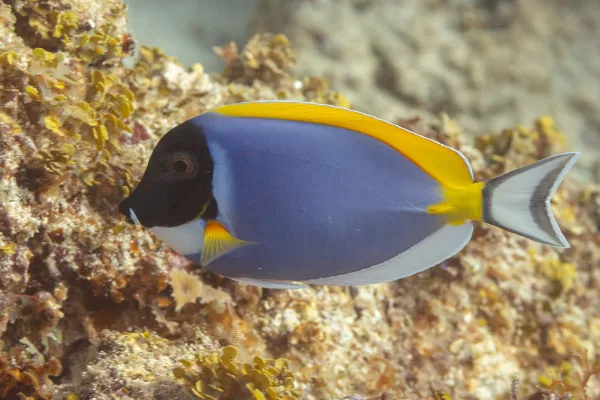
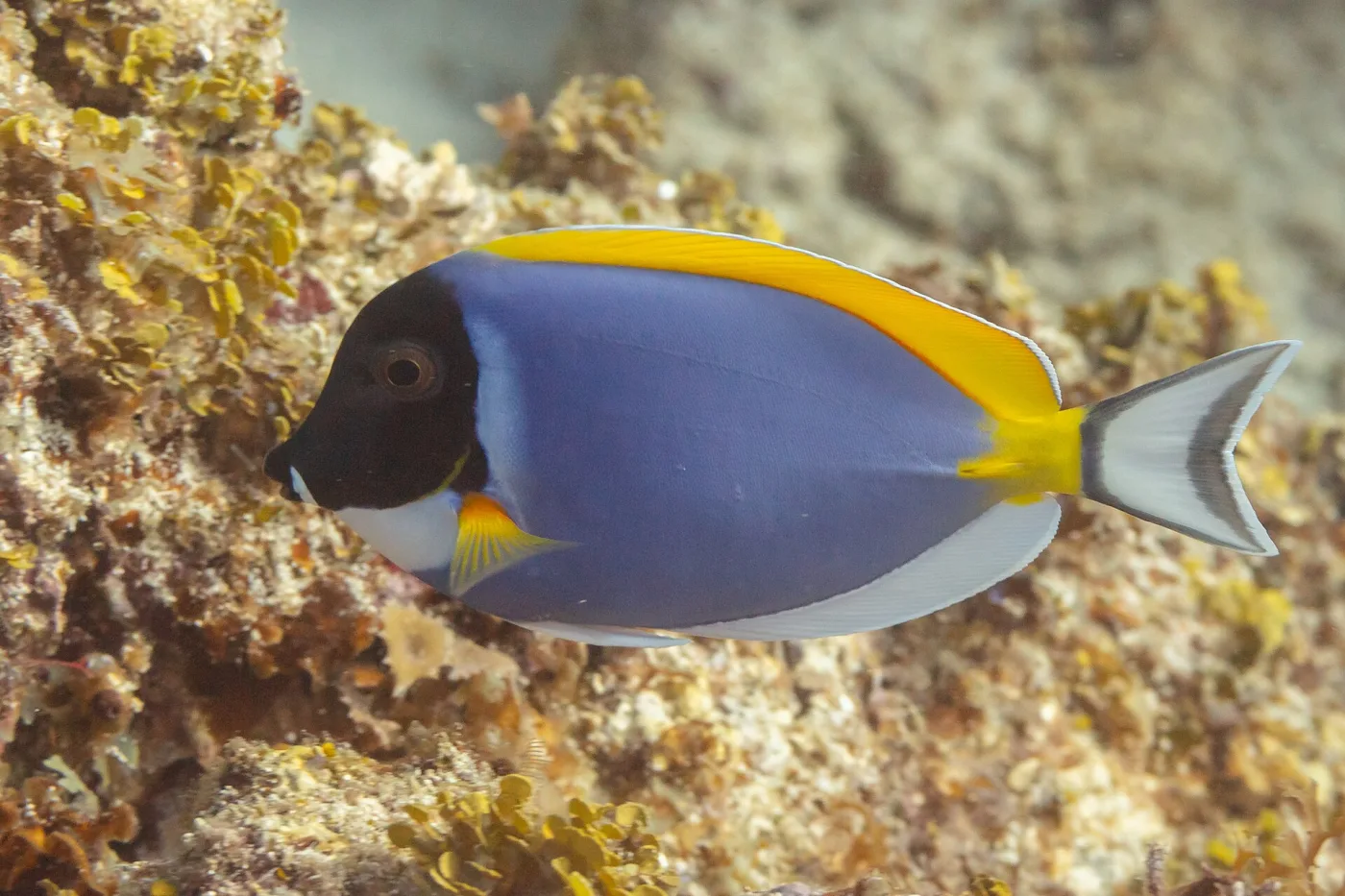
The powder blue tang is one of the prettiest fish on the reef. Its body is sky blue, its face is black, its throat is white, and the fin on its back is bright yellow. It lives in the warm Indian Ocean, in clear, shallow water on coral reefs. All day it pulls tiny algae off the rocks. It can even eat where waves are strong, because it tugs food loose with a twist of its head instead of its whole body. It guards its best food spots and chases off other algae eaters. In fish tanks it is famous for being hard to keep. It gets white-spot sickness very easily, it needs a huge tank, and it often fights with other tangs. This fish is for experts, not beginners.
Water & care
One of the most demanding common tangs. Reef Builders reports that infection with marine ich after introduction to a new tank is 'virtually 100%', many specimens arrive starved and battered after long-distance shipping, and most die within a short time of purchase. It needs at least 125 gallons (a 6-foot or longer tank is better), a system mature for six months or more, strong flow and oxygenation, an oversized protein skimmer, frequent water changes, light stocking, and a long, careful quarantine. Choose only active, uninjured fish that are already eating. Top Shelf Aquatics rates it Moderate; we rate it Expert.
| Parameter | Keep it at | Where that sits on the usual reef range |
|---|---|---|
| Temperature | 72–78 °F | |
| Salinity (SG) | 1.020–1.025 | |
| pH | 8.1–8.4 | |
| Alkalinity | 8–12 dKH | |
| Calcium | 350–450 ppm | |
| Magnesium | 1,150–1,350 ppm | |
| Nitrate | 0–30 ppm | |
| Phosphate | 0–0.1 ppm |
Ranges are LiveAquaria's general marine fish guidelines. Calcium and magnesium matter for the tank rather than the fish. In a coral reef, keep specific gravity 1.023-1.025 and nutrients as low as your corals need. Wild water is about 73-82 °F (23-28 °C). Stable, very clean, highly oxygenated water is more important than any single number. Avoid dusty lignite activated carbon, which has been linked to head and lateral line erosion in surgeonfish.
Feeding
DietHerbivore
Favorite foods
- Dried marine algae sheets (nori, red and green seaweed) on a clip
- Frozen herbivore formulas
- Spirulina and algae-based flakes and pellets
- Natural algae growing on live rock
- Small amounts of mysis shrimp
Feed a varied herbivore diet several times a day, with marine seaweed offered at least three times a week (daily is better); a good crop of algae on the rock helps. It loses weight quickly if underfed, and even after an ich infection is cured it can be hard to keep at a healthy weight.
Tank & maintenance
- Minimum tank
- 180 gallons
- Aquascape
- A long tank (6 feet or more is better) with open swimming room and rockwork with algae to graze. The system should be mature, ideally six months or older.
- Lighting
- No special needs; reef lighting that grows algae on the rock is a bonus.
- Water flow
- Strong water movement and high dissolved oxygen, including good surface agitation.
Routine upkeep
Frequent water changes, an oversized protein skimmer, strong flow with surface agitation, and light stocking to keep water quality high. Feed several times a day and watch body condition closely. Inspect daily for white spots, cloudy eyes, fast breathing or a pinched belly.
Temperament & tankmates
TemperamentSemi-aggressive
Usually ignores small, peaceful fish, but can be hyper-aggressive toward other tangs and surgeonfish, especially those of similar shape and color, and toward other algae grazers it sees as competitors. Keep it as the only tang unless the system is very large, and if mixing tangs, add them at the same time.
Reef safeYes
Does not eat corals or invertebrates. It grazes algae on rock and is widely kept in reef aquariums; the danger it poses to a reef is disease (ich), not coral damage.
Good tankmates
- Clownfish
- Gobies, blennies and cardinalfish
- Wrasses and anthias
- Dwarf angelfish in large tanks
- Corals and invertebrates
Avoid
- Other Acanthurus tangs, especially Achilles, whitecheek, powder brown and another powder blue
- Similar-shaped or similar-colored fish
- Any tang added after the powder blue
- New tanks (under about 6 months old) and tanks under 125 gallons
Help it thrive
- Quarantine for at least a month in a separate tank of about 29 gallons or more, ideally with a mature biofilter, and treat for ich there rather than in the display.
- Buy only active, uninjured specimens that you have seen eating at the store.
- Add it to a large, mature, lightly stocked tank before any other tangs, or skip other tangs entirely.
- Feed several times a day and keep algae growing on the rock for constant grazing.
- Keep oxygen high with strong flow and surface agitation.
Common ailments
Marine ich (white spot, Cryptocaryon irritans)
- Signs
- Salt-grain white spots, scratching, rapid breathing, cloudy eyes and loss of appetite. Powder blues are among the most ich-prone fish in the hobby.
- Prevention
- Long quarantine in a separate tank, minimal stress, excellent water and nutrition.
- Treatment
- Treat in a hospital tank with copper or chloroquine phosphate (follow the product's directions), hyposalinity (SG about 1.009) or the tank-transfer method; reef-safe 'cures' and UV sterilizers are not reliable. Leave the display fishless long enough for the parasite to die out (its cyst stage can last up to about 72 days).
Marine velvet (Amyloodinium ocellatum)
- Signs
- Fine gold or gray dusty coating, very rapid breathing, hiding and fast decline.
- Prevention
- Quarantine and observation of every new fish.
- Treatment
- A temperature- and pH-matched freshwater dip for quick relief, then copper treatment in a hospital tank following the product's directions, with the display left fishless.
Wasting and starvation
- Signs
- Pinched belly, visible spine outline, faded color; common in newly imported fish and in fish recovering from ich.
- Prevention
- Choose fish that are already eating, feed several times a day, and keep algae growing in the tank.
- Treatment
- Offer varied algae foods many times a day, soak dry foods in a vitamin supplement (following the product's directions), and reduce competition from other fish.
Head and lateral line erosion (HLLE)
- Signs
- Pits and eroded patches on the face and along the lateral line.
- Prevention
- Varied algae-rich diet, good water quality and avoiding dusty lignite activated carbon.
- Treatment
- Remove lignite carbon, make large water changes and improve diet; moving the fish to an aquarium that has never had HLLE is the most commonly reported cure.
This is general hobby guidance, not veterinary advice. Quarantine new arrivals and treat in a separate tank whenever you can.
Risks of owning one
- Very likely to bring marine ich into a tank, which can spread to every fish and is hard to treat in a reef display.
- High death rate in the first weeks after import, so losses are common even for careful keepers.
- Can bully or injure other tangs and similar-looking fish.
- Sharp tail spines can cut hands during netting or maintenance.
- Needs a large, mature, heavily filtered system, which is a big cost and space commitment.
- All specimens are wild-caught; choose healthy, well-handled fish from trusted suppliers.
Breeding
DifficultyNot achieved Captive-bredRare or wild-caught
In the wild it spawns in pairs (described as monogamous) and releases pelagic eggs; it matures at about 13.8 cm. We found no record of captive rearing, and no captive-bred powder blues are sold. Related surgeonfish have now been hatchery-reared using live copepod larval foods over about two months: the yellow tang and blue hippo tang, and within Acanthurus the elongate surgeonfish (A. mata) and, in 2024, the convict tang (A. triostegus), the first of the genus proposed for commercial sale.
Deep dive The science, history and family tree
The science
Acanthurus leucosternon is an oval, laterally compressed surgeonfish with a crescent-shaped tail and a sharp, erectile scalpel spine on each side of the caudal peduncle. Its sides are pale to powder blue, the head is black, the mouth, throat, anal and pelvic fins are white, and the dorsal fin and the base of the tail are yellow; the name leucosternon means 'white breast'. Unlike many surgeonfishes it keeps the same color pattern from juvenile to adult. The dorsal fin has 9 spines and 28-30 soft rays; the anal fin has 3 spines and 23-26 soft rays. Adults commonly reach about 19-23 cm. The species lives in the tropical Indian Ocean from East Africa to the Andaman Sea, southwestern Indonesia (to Bali) and Christmas Island, on shallow, clear coastal and island reefs, mostly reef flats and upper seaward slopes from the surface to about 25 m, in water of 23-28 °C. Adults graze benthic algae, especially small, scattered growths in crevices. They are territorial and aggressive toward other surgeonfishes, but may also feed in large shoals when food is plentiful. Spawning is in pairs, and it has been described as monogamous; maturity is reached at about 13.8 cm. High-speed video shows that it pulls algae loose by rotating its head and closed jaws downward rather than flicking its body sideways, which may let it feed in strong surge. Where its range meets that of the Pacific whitecheek tang (A. nigricans) at Christmas and Cocos (Keeling) islands, the two hybridize.
- Appearance
- Powder-blue body, black head, white chin and throat, white anal and pelvic fins, and a bright yellow dorsal fin and tail base. Juveniles look like small adults. Look-alikes: the whitecheek or gold rim tang (Acanthurus nigricans), which is darker blue-black with a white cheek patch, and hybrids between the two from Christmas and Cocos (Keeling) islands, which show in-between colors. The powder brown tang (A. japonicus) shares part of the name but is brown with a white face patch.
- Native range
- Tropical Indian Ocean: East Africa east to the Andaman Sea, southwestern Indonesia (to Bali) and Christmas Island, including Sri Lanka (the type locality).
- Habitat
- Shallow, clear coastal and island coral reefs, mostly reef flats and upper seaward slopes from the surface to about 25 m (80 ft), in water of 23-28 °C (73-82 °F). Usually solitary and territorial, but it forms large feeding schools where food is plentiful.
- Size
- 9 in (23 cm). Top Shelf Aquatics gives an adult size of about 9 in, and Wikipedia an average length of about 23 cm. FishBase gives a common length of 19 cm but a maximum of 54 cm total length, which is far larger than any other source and is treated here as doubtful.
- Lifespan
- Poorly documented. Many wild-caught fish die within weeks of import from disease and shipping stress; fish that settle in commonly live about 7-10 years or more according to hobby care guides. No published age study for this species was found.
- Conservation
- Least Concern. IUCN Least Concern (assessed 2010). Not listed by CITES. All specimens in the trade are wild-caught from the Indian Ocean; no captive-bred powder blue tangs are known to be available. FishBase notes it is also netted and sold fresh as food in places, while Wikipedia says it is rarely harvested for anything but the aquarium trade
In the aquarium vs in the wild
In your aquarium
A striking centerpiece fish for large, mature reef or fish-only systems, and a steady algae grazer, but only for experienced keepers.
On the reef
A territorial grazing herbivore that crops small algae on shallow reef flats and slopes, helping keep algae in check where corals grow. It is prey for larger reef predators.
History
Edward Turner Bennett described the species in 1833 from Sri Lanka. Achille Valenciennes later described the same fish as Acanthurus delisiani (1835), a name now treated as a synonym. It has been a sought-after display fish for decades but also has a long reputation as an 'ich magnet'; in 2020 Reef Builders listed it among the common fish that new reefkeepers should avoid. In 2007 researchers used genetics to test hybrids between the powder blue and the whitecheek tang at Christmas and Cocos (Keeling) islands, and in 2024 a high-speed video study by Mihalitsis and Wainwright described its unusual way of pulling algae loose.
Evolution & relatives
The powder blue tang belongs to Acanthurus, the largest surgeonfish genus, in the tribe Acanthurini with the bristletooth tangs (Ctenochaetus), which molecular work places inside Acanthurus. It is part of the Acanthurus nigricans species complex with the whitecheek tang (A. nigricans), the powder brown tang (A. japonicus) and the Achilles tang (A. achilles). The powder blue is the Indian Ocean member, and where it meets the Pacific whitecheek tang at Christmas and Cocos (Keeling) islands the two interbreed. Genetic work suggests fertile hybrids mate back into the rarer powder blue population, carrying whitecheek mitochondrial DNA into it. The surgeonfish subfamily Acanthurinae arose about 42 million years ago, with most living species appearing since the Early Miocene (about 21 million years ago), and surgeonfishes belong to the order Acanthuriformes with rabbitfishes, the Moorish idol, butterflyfishes and angelfishes.
Family tree, from kingdom down
- Kingdom Animalia Animals Animals are living things made of many cells that must eat food to live. Fish, corals, crabs, snails and sea stars are all animals.
- Phylum Chordata Chordates Chordates have a stiff rod running down their back at some point in their lives. In fish and people, this rod is replaced by a backbone.
- Subphylum Vertebrata Vertebrates Vertebrates are animals with a backbone and a skull. Fish, frogs, birds and people are all vertebrates.
- Infraphylum Gnathostomata jawed vertebrates
- Parvphylum Osteichthyes bony fishes
- Gigaclass Actinopterygii ray-finned fishes
- Superclass Actinopteri
- Class Teleostei Teleost fishes Teleosts are bony fishes with thin, bendy fin rays and jaws that can push forward. Almost all of the fish in the world are teleosts.
- Order Acanthuriformes Surgeonfishes, angelfishes and kin This order of fishes includes surgeonfishes, marine angelfishes and rabbitfishes. Many have deep, flat bodies and graze on reefs.
- Family Acanthuridae Surgeonfishes and tangs Surgeonfishes have a sharp spine, like a tiny knife, on each side of the tail. Most graze on algae on reefs.
- Genus Acanthurus Acanthurus surgeonfishes This is the biggest group of surgeonfishes, with sharp tail spines. The powder blue tang belongs here.
- Species Acanthurus leucosternon
See it on the Tree of Life Compare with another species
Closest relatives
- Acanthurus nigricans Whitecheek Tang (Gold Rim Tang) Same genus and species complex; hybridizes with the powder blue at Christmas and Cocos (Keeling) islands
- Acanthurus japonicus Powder Brown Tang Same genus and species complex
- Acanthurus achilles Achilles Tang Same genus and species complex Read guide · Compare
- Acanthurus coeruleus Atlantic Blue Tang Same genus
- Ctenochaetus strigosus Kole Tang Same tribe (Acanthurini); bristletooths sit inside the Acanthurus family tree Read guide · Compare
- Zebrasoma flavescens Yellow Tang Same family, different tribe (Zebrasomini) Read guide · Compare
Older scientific names: Acanthurus delisiani, Hepatus leucosternon, Rhombotides leucosternon.
Fun facts
- Its scientific name, leucosternon, means 'white breast'.
- High-speed video showed it pulls algae loose by rotating its head and closed jaws downward, keeping its body steady so strong surge does not knock it around.
- At Christmas and Cocos (Keeling) islands, where the Indian and Pacific oceans meet, it interbreeds with the whitecheek tang, producing hybrids with mixed colors.
- Unlike many surgeonfish, it looks the same as a juvenile and as an adult.
- It is usually a loner that defends a feeding territory, but it can form big feeding schools when algae is plentiful.
Learn more
- FishBase: Acanthurus leucosternon fishbase.se
- Wikipedia: Powder blue tang en.wikipedia.org
- Reef Builders: The powder blue tang, an iconic beauty demanding exceptional care reefbuilders.com
- Reef Builders: Powder blue tang feeding mechanism minimizes exposure to high water flow reefbuilders.com
Sources
- WoRMS: Acanthurus leucosternon Bennett, 1833 marinespecies.org
- FishBase species summary: Acanthurus leucosternon fishbase.se
- Wikipedia: Powder blue tang en.wikipedia.org
- LiveAquaria: Powder Blue Tang (product page) liveaquaria.com
- Top Shelf Aquatics: Powder Blue Tang (product page) topshelfaquatics.com
- LiveAquaria: Proper water parameters for home aquariums liveaquaria.com
- Reef Builders: The powder blue tang, an iconic beauty demanding exceptional care reefbuilders.com
- Reef Builders: Powder blue tangs and emperor angelfish, two common fish new reefkeepers should avoid reefbuilders.com
- Reef Builders: Powder blue tang feeding mechanism minimizes exposure to high water flow reefbuilders.com
- Marie et al. 2007, Hybridization of reef fishes at the Indo-Pacific biogeographic barrier (Coral Reefs 26:841-850) researchonline.jcu.edu.au
- Reef Builders: Speciation and hybridisation of the Acanthurus nigricans complex reefbuilders.com
- Sorenson et al. 2013, A multi-locus timetree of surgeonfishes (PubMed) pubmed.ncbi.nlm.nih.gov
- Wikipedia: Head and lateral line erosion en.wikipedia.org
- Wikipedia: Cryptocaryon en.wikipedia.org
- Wikipedia: Acanthuridae en.wikipedia.org
- CORAL Magazine: Captive-bred species first, convict tangs (2024) coralmagazine.com
Care facts
The care facts on this guide and its product pages (care level, reef safety, temperament, size, tank, diet, flow, purpose, foods, acclimation and origin) combine 12 independent sources, checked October 25, 2026.
- Acanthurus leucosternon summary FishBase
- Powder Blue Tang LiveAquaria
- Powder Blue Tang Top Shelf Aquatics
- Powder Blue Tang Care Guide: Ich Risk and Husbandry Gensou
- Acanthurus leucosternon Reef Exclusive
- The Powder Blue Tang: an iconic beauty demanding exceptional care Reef Builders
- Powder Blue Tang Care Guide Reef Chasers
- Powder Blue Tang Aquarium Depot
- Powder Blue Tang: Care, Acclimation, Reef Compatibility & More light.fish
- Powder Blue Tang - Acanthurus leucosternon Top Shelf Aquatics
- Powder Blue Tang care guide Pod Your Reef
- Tang - Powder Blue Aquatics Unlimited
Scientific names and classification follow the World Register of Marine Species (AphiaID 219628). Last updated October 25, 2026.
Shop this species
Search the shop →Sold out right now. We restock weekly, so check back soon.
Sold out