 Sale
Fish · Tang
Blue Hippo Tang
Paracanthurus hepatus
Also called Regal Blue Tang, Pacific Blue Tang, Palette Surgeonfish, Blue Tang, Hippo Tang, Hepatus Tang, Yellow Belly Blue Tang (Indian Ocean form), Dory
- CareModerate
- Reef safeYes
- TemperamentSemi-aggressiveMild; clashes mainly with its own kind and other tangs
- Favorite foods
- Mysis / meaty foods
- Nori / marine algae
- Herbivore pellets
- Max size12 in (31 cm)
- Min tank180 gal
- LifespanMore than 30 years in the wild
- IUCN statusLeast Concern
Quick answers
- How big does the Blue Hippo Tang get?
- Up to 12 in (31 cm).
- What size tank does it need?
- At least 180 gallons.
- How hard is it to keep?
- Care level: Moderate.
- Is it reef safe?
- Yes. Does not eat corals or invertebrates and is kept in many reef aquariums.
- What does it eat?
- Mysis / meaty foods
- Nori / marine algae
- Herbivore pellets
- How long does it live?
- More than 30 years in the wild.
- What are good tankmates?
- Clownfish
- Gobies, blennies and cardinalfish
- Wrasses and anthias
- Different-shaped tangs in very large tanks
- Corals and clean-up crew invertebrates
The 30-second version
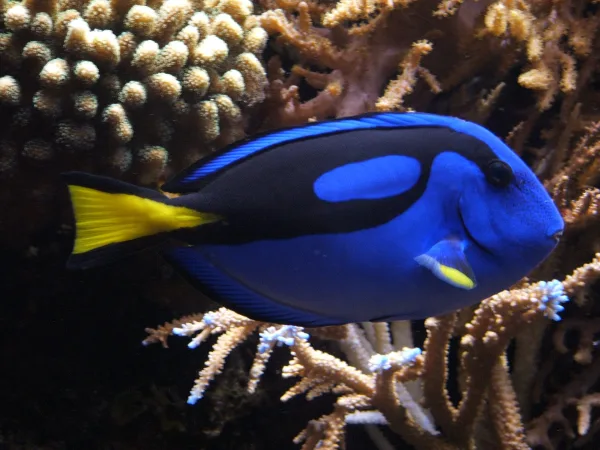
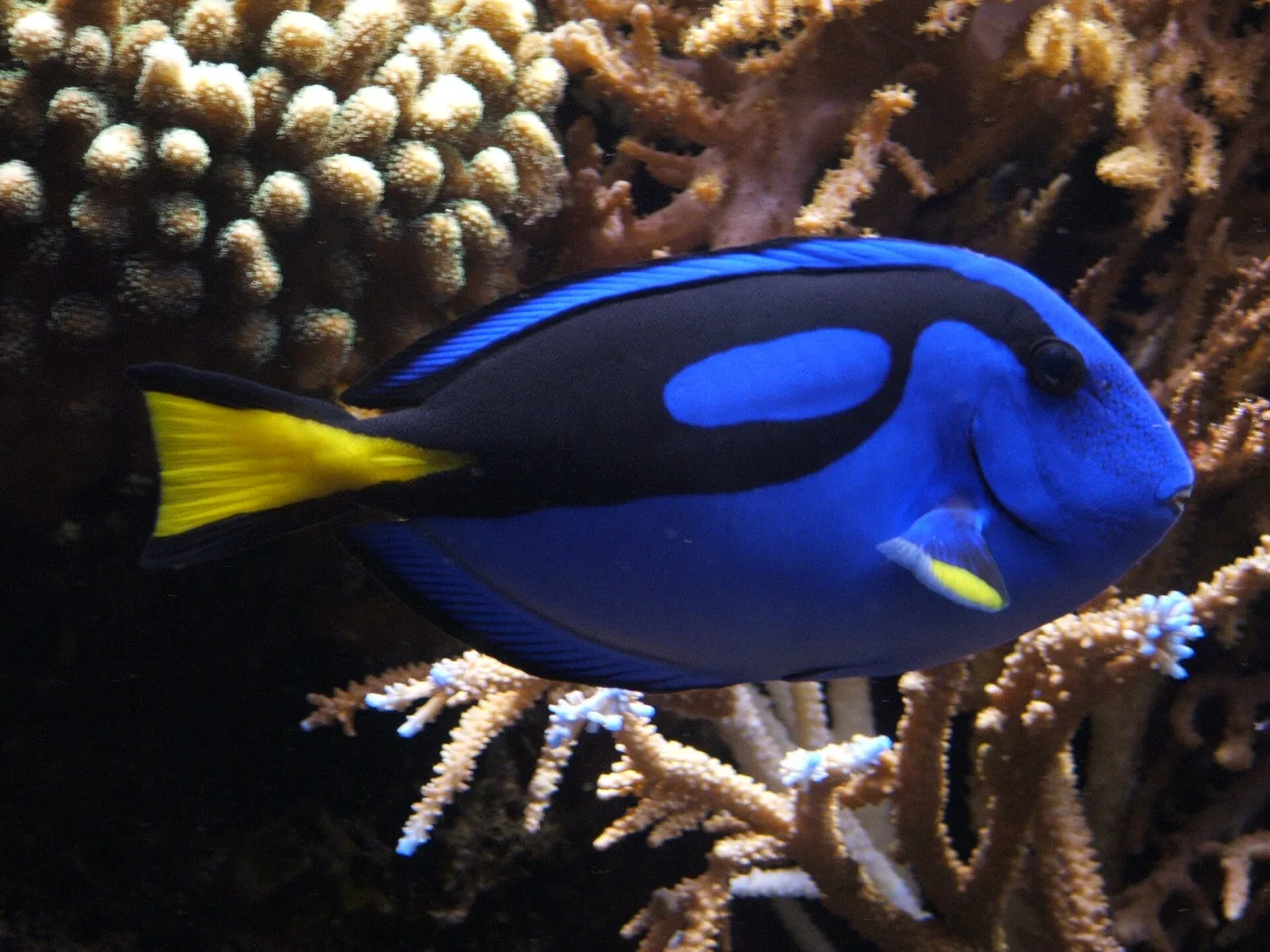
Dory in the movies Finding Nemo and Finding Dory is a blue hippo tang. This fish is bright blue with a black mark shaped a bit like a painter's paint tray, and its tail is yellow. It lives on coral reefs in the Indian and Pacific Oceans. It eats tiny floating animals. It also nibbles algae, which are like little sea plants. When a young blue tang gets scared, it zips into the branches of a coral and wedges itself in tight to hide. Near its tail it has a sharp spine, so never grab one. Blue tangs can grow to about a foot long, so they need a really big tank. They also get sick with skin bugs easily. That is why they are best for people who have kept fish before.
Water & care
Not a beginner fish. It grows to about 12 inches, needs at least 180 gallons and a tank about 6 feet long, and is more prone than most fish to marine ich, other skin parasites, lateral line erosion and fin erosion. Excellent, stable water quality, strong oxygenation, a varied diet with both plankton-type foods and marine algae, and careful quarantine are essential. Captive-bred specimens are a better choice where available.
| Parameter | Keep it at | Where that sits on the usual reef range |
|---|---|---|
| Temperature | 72–78 °F | |
| Salinity (SG) | 1.020–1.025 | |
| pH | 8.1–8.4 | |
| Alkalinity | 8–12 dKH | |
| Calcium | 350–450 ppm | |
| Magnesium | 1,150–1,350 ppm | |
| Nitrate | 0–30 ppm | |
| Phosphate | 0–0.1 ppm |
Ranges are LiveAquaria's general marine fish guidelines; LiveAquaria's blue tang page gives the same temperature, pH, dKH and specific gravity. Calcium and magnesium matter for the tank rather than the fish. In a reef with corals keep specific gravity 1.023-1.025, magnesium 1250-1350 ppm and nutrients as low as your corals need. This species is sensitive to poor water quality, so stability and frequent water changes matter. Avoid dusty lignite activated carbon, which has been linked to head and lateral line erosion in surgeonfish.
Feeding
DietOmnivore
Favorite foods
- Frozen mysis shrimp and other plankton-type frozen foods
- Dried marine seaweed sheets (nori, red and green algae) on a clip
- Spirulina and algae-based pellets and flakes
- Frozen herbivore formulas
In the wild it eats mostly zooplankton plus some algae, so feed both: meaty plankton-type foods and marine algae. Offer seaweed at least three times a week (daily is better) and several small feedings a day rather than one large one. A varied diet supports its immune system and reduces aggression.
Tank & maintenance
- Minimum tank
- 180 gallons
- Aquascape
- A long tank (about 6 feet or more) with lots of open swimming space plus rockwork caves and crevices it can wedge into to sleep or hide.
- Lighting
- No special needs; any reef or fish-only lighting is fine.
- Water flow
- Moderate to strong, well-oxygenated water with a good protein skimmer.
Routine upkeep
Frequent partial water changes, strong filtration and protein skimming, and high oxygen levels. Feed several times a day. Check daily for white spots, pitting on the head or along the lateral line, frayed fins or fast breathing, and act early. If you use activated carbon, choose rinsed, hard pelleted carbon instead of dusty lignite carbon.
Temperament & tankmates
TemperamentSemi-aggressive
One of the less aggressive tangs toward other fish, but often aggressive toward other blue tangs. Keep one per tank, or add a whole group at the same time to a very large system. It may squabble with other tangs, especially in cramped tanks. It uses its tail spine in fights.
Reef safeYes
Does not eat corals or invertebrates and is kept in many reef aquariums. It eats plankton-type foods and grazes some algae.
Good tankmates
- Clownfish
- Gobies, blennies and cardinalfish
- Wrasses and anthias
- Different-shaped tangs in very large tanks
- Corals and clean-up crew invertebrates
Avoid
- Another blue tang added later (groups only if added together to a very large system)
- Large predators that can swallow it
- Highly aggressive tangs in tanks too small to give each its own space
- Tanks under 180 gallons or shorter than about 6 feet
Help it thrive
- Choose captive-bred fish when you can; they are used to aquarium foods and conditions.
- Quarantine for at least several weeks in a separate tank; this species catches ich more easily than most.
- Feed both plankton-type meaty foods and marine algae every day.
- Plan for a full-grown 12-inch fish: buy for the adult size, not the 2-inch juvenile in the store.
- Give it hiding places to wedge into; a secure blue tang is a calmer, healthier blue tang.
Common ailments
Marine ich (white spot, Cryptocaryon irritans)
- Signs
- Salt-grain white spots, scratching on rocks, rapid breathing, cloudy eyes, hiding and poor appetite. Blue tangs are notorious for it.
- Prevention
- Strict quarantine, stable water, good nutrition and low stress.
- Treatment
- Treat in a hospital tank with copper or chloroquine phosphate (follow the product's directions), hyposalinity (SG about 1.009) or the tank-transfer method; do not medicate a reef display. Leave the display fishless long enough for the parasite to die out (its cyst stage can last up to about 72 days).
Head and lateral line erosion (HLLE)
- Signs
- Pits and eroded patches on the face and head and along the lateral line; LiveAquaria notes blue tangs are prone to lateral line disease and fin erosion.
- Prevention
- Varied diet rich in marine algae, excellent water quality, and avoiding dusty lignite activated carbon.
- Treatment
- Remove lignite carbon, make large water changes and improve diet; moving the fish to an aquarium that has never had HLLE is the most commonly reported cure.
Marine velvet (Amyloodinium ocellatum)
- Signs
- Fine gold or gray dusty coating, very rapid breathing, hiding and fast decline.
- Prevention
- Quarantine and observation of every new fish.
- Treatment
- A temperature- and pH-matched freshwater dip for quick relief, then copper treatment in a hospital tank following the product's directions, with the display left fishless.
This is general hobby guidance, not veterinary advice. Quarantine new arrivals and treat in a separate tank whenever you can.
Risks of owning one
- Sharp tail spines can cut deeply when the fish is stressed or netted; FishBase lists the species as venomous.
- Grows to about 12 inches and needs a 180-gallon-plus tank for life; many are bought as tiny juveniles for tanks that are far too small.
- Very prone to ich; an unquarantined blue tang can infect a whole display.
- Lying on its side or wedging into rocks is often normal resting behavior, but it can also be a sign of illness, which confuses new owners.
- Most specimens are still wild-caught, so ask about the source or choose captive-bred.
Breeding
DifficultyVery hard Captive-bredWidely available
A pelagic group spawner with no parental care. The University of Florida Tropical Aquaculture Laboratory reared the first captive-bred Pacific blue tangs in 2016 (27 juveniles), adapting the Oceanic Institute's yellow tang methods. Biota announced commercial-scale production in January 2025 using larval methods developed with Hawaii Pacific University's Oceanic Institute, and Surge Marine Life began selling captive-bred fish from Kenyan (Indian Ocean) broodstock in May 2025. Not practical in a home aquarium.
- Condition a group of adults in a very large system; breeding groups gather and disperse several times before spawning.
- Collect the small floating eggs, which hatch in about a day.
- Larvae live on their yolk for about three days while the eyes and mouth develop.
- Rear larvae on live plankton using methods adapted from the Oceanic Institute's yellow tang protocol; earlier attempts never got larvae past 21 days.
- Juveniles develop blue and black coloring at around day 52 after hatching (University of Florida run), then are weaned onto prepared foods.
Deep dive The science, history and family tree
The science
Paracanthurus hepatus is the only species in its genus. It is an oval, strongly compressed surgeonfish with a royal blue body, a bold black band running from the eye to the tail that loops to enclose a blue patch (the 'palette'), and a bright yellow caudal fin. A sharp, scalpel-like spine sits on each side of the caudal peduncle. The dorsal fin has 9 spines and 19-20 soft rays; the anal fin has 3 spines and 18-19 soft rays. It reaches about 31 cm total length, and males are generally larger than females. Fish from the west-central Indian Ocean have a yellow belly, while Pacific fish are blue below. The species ranges across the Indo-Pacific from East Africa and the Mascarenes to Kiribati, north to southern Japan and south to the southern Great Barrier Reef, New Caledonia and Samoa. It lives on clear, current-swept terraces of seaward reefs at 2-40 m (usually 10-40 m), forming loose aggregations 1-2 m above the bottom; juveniles and subadults stay close to isolated heads of Pocillopora eydouxi and hide deep among the branches when alarmed. FishBase describes it as relatively uncommon and highly localized. Its diet is mainly zooplankton with some algae. It is a broadcast spawner whose small, floating eggs hatch in about a day, with no parental care. FishBase lists the species as venomous, and its tail spines can inflict deep cuts. The flesh has a strong odor and can cause ciguatera, so it has little food value, but it ranks among the most traded marine aquarium fishes.
- Appearance
- Electric royal-blue body with a thick black 'palette' marking from the eye to the tail, and a yellow tail fin. The Indian Ocean form (often sold as Yellow Belly Blue Tang) has a yellow belly; Pacific fish are blue underneath. Its colors shift with mood and light: under stress the blue can deepen while the black markings pale, and it looks slightly paler at night. Few fish look similar. Do not confuse it with the Atlantic blue tang (Acanthurus coeruleus), a different surgeonfish that shares the name 'blue tang'.
- Native range
- Indo-Pacific: East Africa (including the Mascarene Islands) east to Kiribati, north to southern Japan and south to the southern Great Barrier Reef, New Caledonia and Samoa; also Sri Lanka and the Philippines.
- Habitat
- Clear, current-swept terraces of seaward reefs at 2-40 m (usually 10-40 m). Adults form loose groups that hover 1-2 m above the bottom and feed on plankton in the current. Juveniles and subadults live around isolated branching Pocillopora eydouxi coral heads and dive into the branches when threatened.
- Size
- 12 in (31 cm). FishBase maximum 31 cm (about 12 in) total length; LiveAquaria lists 12 in. Males are generally larger. Juveniles are often sold at a few inches long, so plan the tank for the adult size.
- Lifespan
- More than 30 years in the wild. In aquariums usually 8-20 years, with an average of about 12-14 years according to Animal Diversity Web; disease shortens many captive lives.
- Conservation
- Least Concern. IUCN Least Concern (assessed 2010), although Animal Diversity Web notes that collection for the aquarium trade has affected wild populations. Not listed by CITES. Most fish in the trade are still wild-caught. A study cited on Wikipedia found that Finding Dory (2016) caused a short spike in online searches but no significant rise in imports. Captive-bred fish are now available: Biota reached commercial-scale production of Pacific blue tangs in January 2025, and Surge Marine Life began selling captive-bred Indian Ocean yellow-belly fish in May 2025
In the aquarium vs in the wild
In your aquarium
A showpiece display fish in large reef and fish-only tanks, made famous by Dory. It adds active open-water swimming and color rather than serving as a dedicated algae controller.
On the reef
A planktivore that feeds on zooplankton in the current above the reef and also grazes some algae; juveniles depend on branching Pocillopora coral heads for shelter. It is prey for larger reef predators.
History
Carl Linnaeus described the species in 1766 as Teuthis hepatus, and Pieter Bleeker created the genus Paracanthurus for it in 1863. Older aquarium books sometimes used the synonym Paracanthurus theuthis. It has long been a staple of the marine aquarium trade and is one of the most traded marine aquarium species. Its fame grew with the character Dory in Finding Nemo (2003) and Finding Dory (2016), which raised concern about demand for wild fish. In July 2016 the University of Florida announced the first captive-bred blue tangs, and by 2025 Biota and Surge Marine Life were selling captive-bred fish.
Evolution & relatives
The blue hippo tang is the only member of its genus. Within the surgeonfish family it belongs to the tribe Zebrasomini together with the sailfin tangs (Zebrasoma, including the yellow tang), so its closest living relatives are sailfin tangs rather than the Acanthurus surgeonfishes. Surgeonfishes belong to the order Acanthuriformes, along with rabbitfishes, the Moorish idol, butterflyfishes and angelfishes. A nine-gene timetree (Sorenson et al. 2013) dates the origin of the subfamily Acanthurinae, which contains all the tangs, to about 42 million years ago, with most diversification since the Early Miocene (about 21 million years ago). Fossil surgeonfishes are known from the Eocene, including early tribe members from Monte Bolca, Italy.
Family tree, from kingdom down
- Kingdom Animalia Animals Animals are living things made of many cells that must eat food to live. Fish, corals, crabs, snails and sea stars are all animals.
- Phylum Chordata Chordates Chordates have a stiff rod running down their back at some point in their lives. In fish and people, this rod is replaced by a backbone.
- Subphylum Vertebrata Vertebrates Vertebrates are animals with a backbone and a skull. Fish, frogs, birds and people are all vertebrates.
- Infraphylum Gnathostomata jawed vertebrates
- Parvphylum Osteichthyes bony fishes
- Gigaclass Actinopterygii ray-finned fishes
- Superclass Actinopteri
- Class Teleostei Teleost fishes Teleosts are bony fishes with thin, bendy fin rays and jaws that can push forward. Almost all of the fish in the world are teleosts.
- Order Acanthuriformes Surgeonfishes, angelfishes and kin This order of fishes includes surgeonfishes, marine angelfishes and rabbitfishes. Many have deep, flat bodies and graze on reefs.
- Family Acanthuridae Surgeonfishes and tangs Surgeonfishes have a sharp spine, like a tiny knife, on each side of the tail. Most graze on algae on reefs.
- Genus Paracanthurus Palette tangs There is only one kind of fish in this group: the blue tang, with its royal blue body and yellow tail.
- Species Paracanthurus hepatus
See it on the Tree of Life Compare with another species
Closest relatives
- Zebrasoma flavescens Yellow Tang Same tribe (Zebrasomini); closest genus to Paracanthurus Read guide · Compare
- Zebrasoma scopas Scopas Tang Same tribe (Zebrasomini)
- Zebrasoma velifer Sailfin Tang Same tribe (Zebrasomini)
- Acanthurus leucosternon Powder Blue Tang Same family, different tribe (Acanthurini) Read guide · Compare
- Acanthurus coeruleus Atlantic Blue Tang Same family, different tribe; shares the common name 'blue tang'
- Zanclus cornutus Moorish Idol Different family (Zanclidae) in the same order, Acanthuriformes
Older scientific names: Teuthis hepatus, Acanthurus hepatus, Paracanthurus theuthis, Acanthurus theuthis.
Fun facts
- Dory from Finding Nemo and Finding Dory is a blue hippo tang.
- It is the only species in its genus, Paracanthurus.
- Blue tangs from the Indian Ocean have yellow bellies, while Pacific blue tangs are blue underneath.
- When frightened, blue tangs hide in coral or rock crevices and may lie on their sides, which can fool predators and worry aquarium owners.
- Its colors shift with mood: under stress the blue can deepen while the black markings turn paler, and the blue changes during dominance contests between males.
- It is not a good food fish: the flesh has a strong odor and can cause ciguatera poisoning.
Learn more
- FishBase: Paracanthurus hepatus fishbase.se
- Wikipedia: Paracanthurus (regal blue tang) en.wikipedia.org
- LiveAquaria: Blue Tangs species spotlight liveaquaria.com
- Animal Diversity Web: Paracanthurus hepatus animaldiversity.org
- University of Florida: First-ever method to farm Pacific blue tang (2016) archive.news.ufl.edu
Sources
- WoRMS: Paracanthurus hepatus (Linnaeus, 1766) marinespecies.org
- FishBase species summary: Paracanthurus hepatus fishbase.se
- Wikipedia: Paracanthurus en.wikipedia.org
- Animal Diversity Web: Paracanthurus hepatus animaldiversity.org
- LiveAquaria: Blue Tang (product page) liveaquaria.com
- LiveAquaria: Blue Tangs species spotlight liveaquaria.com
- LiveAquaria: Proper water parameters for home aquariums liveaquaria.com
- University of Florida News: UF researchers discover first-ever method to farm Pacific blue tang archive.news.ufl.edu
- Reef Builders: Biota achieves commercialization of captive-bred Pacific blue tangs (2025) reefbuilders.com
- CORAL Magazine: Surge Marine Life captive-bred yellow-belly blue tang (2025) coralmagazine.com
- Wikipedia: Head and lateral line erosion en.wikipedia.org
- Wikipedia: Cryptocaryon en.wikipedia.org
- Sorenson et al. 2013, A multi-locus timetree of surgeonfishes (PubMed) pubmed.ncbi.nlm.nih.gov
- Wikipedia: Acanthuridae en.wikipedia.org
Care facts
The care facts on this guide and its product pages (care level, reef safety, temperament, size, tank, diet, flow, purpose, foods, acclimation and origin) combine 17 independent sources, checked October 25, 2026.
- Blue Tang: Saltwater Aquarium Fish for Marine Aquariums - LiveAquaria LiveAquaria
- Blue Hippo Tang Care Guide | Top Shelf Aquatics Top Shelf Aquatics
- Blue Hippo Tang :: 31506 Quality Marine
- Hippo Tang Paracanthurus Care Guide: Blue Tang Husbandry - Gensou Premium Aquascaping Gensou Premium Aquascaping
- Blue Hippo Tang (Paracanthurus Hepatus) Caresheet Aquariadise
- Paracanthurus hepatus, Palette surgeonfish : fisheries, aquarium FishBase
- Paracanthurus hepatus Species | Tropical Fish Hobbyist Magazine Tropical Fish Hobbyist Magazine
- Blue Hippo Tang Care Guide: Paracanthus hepatus Saltwater Aquarium Blog (Albert B Ulrich III)
- Blue Tang Care, Information, & Pictures (Hippo Tang) Build Your Aquarium
- TANG - BLUE HIPPO Paracanthurus hepatus Aquatics Unlimited
- How to Beat Those Pacific Blue Tang Blues Reef Builders
- Paracanthurus hepatus, Palette surgeonfish FishBase
- Blue Tang Biota
- Tang - Blue Hippo Captive Bred Aquatics Unlimited
- Captive bred blue tang Reef Builders
- Blue tang aquarium trade (2016) National Geographic
- Innovative Marine AccuDrip Acclimation Kit - How To Bulk Reef Supply
Scientific names and classification follow the World Register of Marine Species (AphiaID 219676). Last updated October 25, 2026.
Shop this species
Search the shop →
Sale