Fish · Tang
Achilles Tang
Acanthurus achilles
Also called Achilles Surgeonfish, Redtail Surgeonfish, Redspot Surgeonfish, Baby Achilles Tang
Reviewed by admin on October 29, 2026 · Meet the team
- CareExpert
- Reef safeYes
- TemperamentSemi-aggressiveFights other tangs, mostly other Acanthurus
- Favorite foods
- Nori / seaweed sheets
- Herbivore pellets
- Mysis shrimp
- Max size9.4 in (24 cm)
- Min tank180 gal
- LifespanNot documented in the sources we checked
- IUCN statusLeast Concern
Quick answers
- How big does the Achilles Tang get?
- Up to 9.4 in (24 cm).
- What size tank does it need?
- At least 180 gallons.
- How hard is it to keep?
- Care level: Expert.
- Is it reef safe?
- Yes. Leaves corals and invertebrates alone and grazes algae from the rock.
- What does it eat?
- Nori / seaweed sheets
- Herbivore pellets
- Mysis shrimp
- How long does it live?
- Not documented in the sources we checked; no published longevity study or reliable captive lifespan figure was found.
- What are good tankmates?
- Peaceful community fish such as clownfish, gobies and cardinalfish
- Wrasses and anthias
- Dwarf angelfish in a large tank
- Tangs from other genera with a different shape, in very large systems
- Corals and invertebrates
The 30-second version
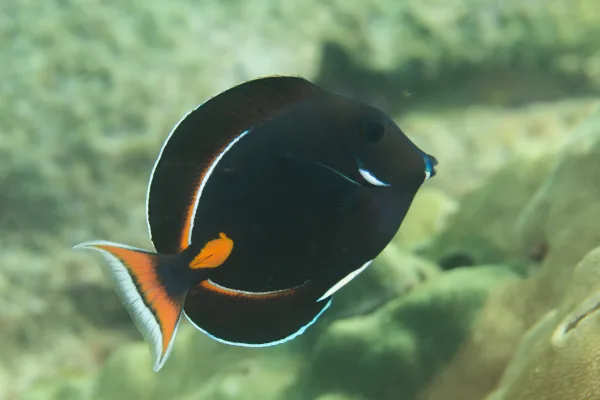
The Achilles tang is a black fish with a big orange spot near its tail. The spot is shaped like a drop of fire. Its tail is orange too, with a white edge. It lives on reefs near islands in the Pacific Ocean, like Hawaii. It likes the top of the reef, where waves crash and the water is full of air. All day long it nibbles algae, the tiny plants that grow on rocks. Like all tangs, it has a sharp spine on each side of its tail. It can flick the spine out like a small knife to keep other fish away. In a fish tank it is hard to keep. It needs a huge tank, strong water flow and lots of algae to eat. It also gets white spot sickness very easily. This fish is for experts.
Water & care
One of the hardest common tangs to keep. LiveAquaria sells it as 'Expert only' with a 180-gallon minimum, and Quality Marine says the main challenge is getting it to eat and that no tank under 120 gallons should be considered even for a small fish. Reef Builders (2008) warns it is very prone to protozoan parasites (such as marine ich) soon after it is added to a tank. Buy only a fish you have seen eating, quarantine it, and give it a large, mature, very stable tank with strong, turbulent flow, high oxygen and plenty of algae to graze.
| Parameter | Keep it at | Where that sits on the usual reef range |
|---|---|---|
| Temperature | 72–78 °F | |
| Salinity (SG) | 1.020–1.025 | |
| pH | 8.1–8.4 | |
| Alkalinity | 8–12 dKH |
Ranges are from LiveAquaria's product page. Calcium, magnesium, nitrate and phosphate are left null because no species-specific values are published; keep normal reef targets in a reef tank. Stable, very clean and well-oxygenated water matters more than any one number.
Feeding
DietHerbivore
Favorite foods
- Dried seaweed (nori) on a clip
- Algae-based pellets
- Spirulina-enriched brine shrimp or mysis
- Natural turf algae on live rock
- Frozen marine herbivore foods
Offer algae every day: LiveAquaria asks for dried seaweed at least three times a week, and Quality Marine suggests a quality pellet plus algae daily. Add some meaty frozen food for variety. Feed several small meals a day so it can graze, and watch its belly; underfed tangs lose weight quickly. Make sure the fish is eating before you buy it.
Tank & maintenance
- Minimum tank
- 180 gallons
- Aquascape
- A long tank with a large footprint and plenty of open swimming room, plus rockwork that grows algae to graze. The system should be mature and very stable.
- Lighting
- No special need for the fish; bright light that grows algae on the rock is helpful.
- Water flow
- Strong, turbulent flow like a surge zone, with lots of surface movement for oxygen.
Routine upkeep
Frequent water changes, strong flow, good surface movement and strong filtration to keep water clean and oxygen high. Keep algae growing on some rock, feed several times a day, and check every day for white spots, fast breathing or a pinched belly.
Temperament & tankmates
TemperamentSemi-aggressive
LiveAquaria says it is aggressive toward other tangs and surgeonfish but peaceful with other fish. It is territorial and may also be bullied by tangs already in the tank, and it is stressed by aggressive tankmates. Keep one per tank, and do not mix it with other Acanthurus, especially look-alikes in the whitecheek group.
Reef safeYes
Leaves corals and invertebrates alone and grazes algae from the rock. LiveAquaria and Quality Marine list it as reef compatible. The main reef risk is disease: an ich outbreak is hard to treat in a reef display. Quality Marine also notes that the strong surge and open space it needs do not suit every coral or reef fish.
Good tankmates
- Peaceful community fish such as clownfish, gobies and cardinalfish
- Wrasses and anthias
- Dwarf angelfish in a large tank
- Tangs from other genera with a different shape, in very large systems
- Corals and invertebrates
Avoid
- Another Achilles tang
- Other Acanthurus tangs, especially the whitecheek, powder blue and powder brown
- Aggressive fish that will stress it
- Small or new tanks
Help it thrive
- Buy only a fish you have watched eat at the store.
- Quarantine it in a separate tank and treat any parasites there, not in the display.
- Give it a large, mature tank with strong, turbulent flow and plenty of open space.
- Feed algae every day plus a quality pellet, in several small meals.
- Keep it as the only Acanthurus tang in the tank.
Common ailments
Marine ich (white spot, Cryptocaryon irritans)
- Signs
- Small white spots on the body and fins, scratching on rocks, fast breathing, cloudy eyes and loss of appetite.
- Prevention
- Quarantine for several weeks, buy a fish that is eating, and keep water stable and clean.
- Treatment
- Treat in a hospital tank with copper, chloroquine phosphate or the tank-transfer method, following the product's directions. Leave the display without fish for several weeks so the parasite dies out.
Marine velvet (Amyloodinium ocellatum)
- Signs
- A fine dusty coating, very fast breathing, hanging near the surface and fast decline. Heavy infections can kill very quickly.
- Prevention
- Strict quarantine and separate nets and buckets for each tank.
- Treatment
- Act at once: a freshwater dip matched for temperature and pH for quick relief, then copper or chloroquine phosphate in a hospital tank, following the product's directions.
Wasting and refusing food
- Signs
- Pinched belly, visible spine outline and faded color, often in new fish that will not eat aquarium foods.
- Prevention
- Buy fish that already eat and keep algae growing in the tank.
- Treatment
- Offer seaweed, algae pellets and spirulina-enriched frozen foods many times a day, and remove fish that compete with it for food.
This is general hobby guidance, not veterinary advice. Quarantine new arrivals and treat in a separate tank whenever you can.
Risks of owning one
- Very prone to marine ich soon after it is moved, which can spread to every fish in the tank.
- New fish can be hard to get eating; Quality Marine calls getting one to eat half the battle.
- Fights other tangs, especially other Acanthurus.
- The sharp tail spines can cut hands during netting.
- Needs a very large, mature and costly system with strong flow.
Breeding
DifficultyNot achieved Captive-bredRare or wild-caught
In the wild it spawns in open water, and the larvae drift with the currents for up to about 9 weeks. Quality Marine says Achilles tangs have spawned in captivity, but there is no commercial way to raise the young, which would need large amounts of live phytoplankton and zooplankton. No captive-bred fish are sold.
Deep dive The science, history and family tree
The science
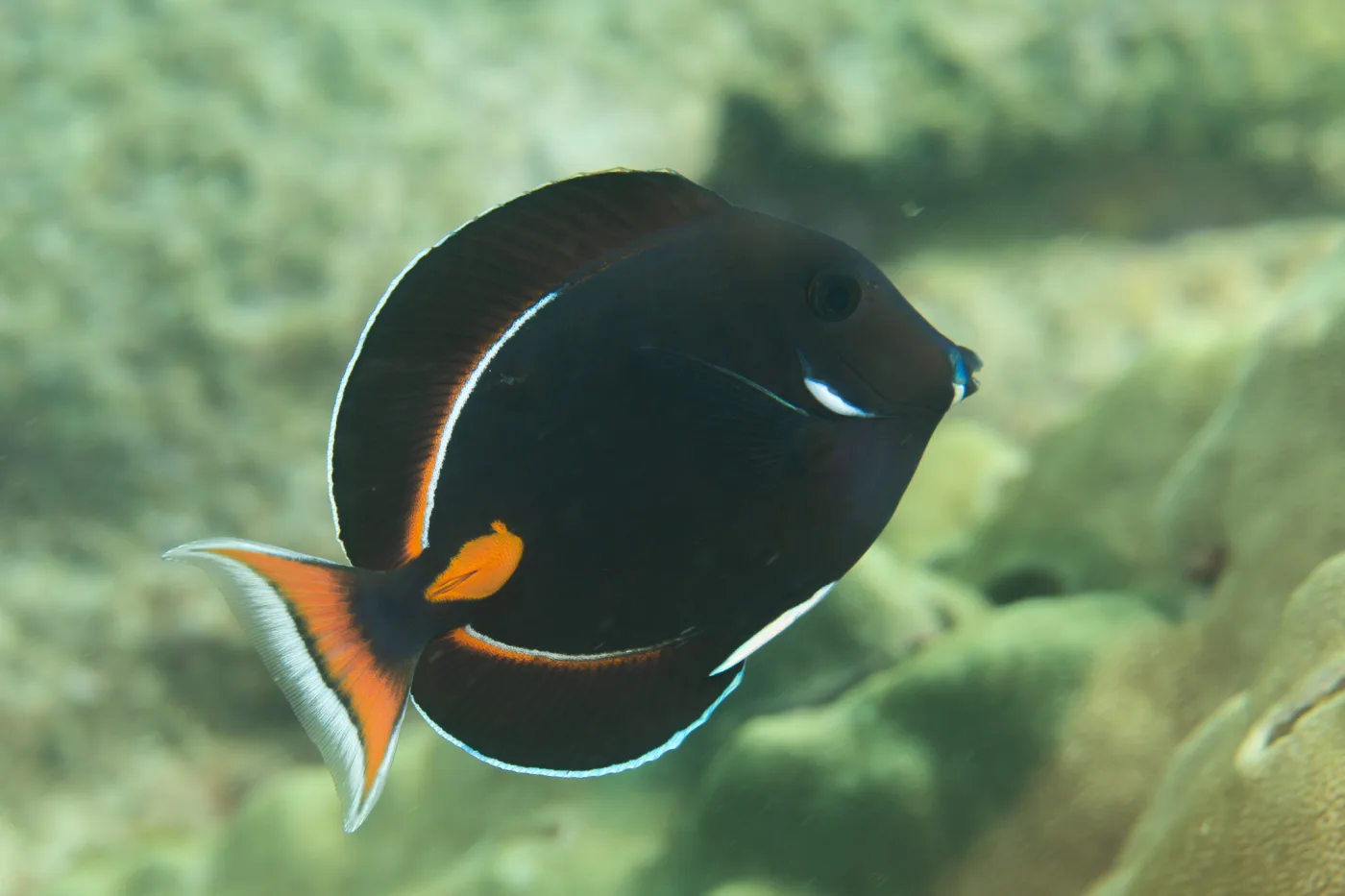
Acanthurus achilles is a surgeonfish (family Acanthuridae) of Pacific oceanic islands. The body is oval and compressed with a steep head profile, a small protrusible mouth and one folding scalpel spine on each side of the caudal peduncle. Adults are bluish-black with a white bar on the gill cover, a pale blue ring near the snout tip, a mostly orange tail with a white rear margin and a large orange teardrop-shaped blotch around the peduncle spine; juveniles lack the blotch. The dorsal fin has 9 spines and 29-33 soft rays and the anal fin 3 spines and 26-29 soft rays, and the maximum recorded length is 24 cm TL. The species ranges from the islands of Oceania to Hawaii and Pitcairn, with records from the Mariana, Wake and Marcus islands and the southern tip of Baja California. Adults live in groups on clear seaward reefs, usually in the top 4 m and rarely below 10 m, where waves break over the reef crest, and graze filamentous and small fleshy algae. Pairs are described as monogamous, and the species sometimes hybridizes with the whitecheek tang, A. nigricans.
- Appearance
- Bluish-black to deep brown body with a large orange teardrop-shaped spot around the tail spine, a mostly orange tail with a white rear edge, white and orange highlights on the dorsal and anal fins, a white bar on the gill cover and a pale blue ring near the snout. Young fish lack the teardrop: only the spine sheath is orange, and LiveAquaria describes the juvenile marking as a streak rather than a teardrop. The orange spot grows with age. Hybrids with the whitecheek tang (A. nigricans), found mostly in Hawaii and Micronesia, are mostly black, lack the whitecheek's cheek mark and keep the orange tail.
- Native range
- Tropical Pacific, about 28°N to 26°S: the oceanic islands of Oceania east to the Hawaiian and Pitcairn islands, also the Mariana, Wake and Marcus islands. In the eastern Pacific it reaches the southern tip of Baja California and other offshore islands, where Reef Builders calls it rare. No type locality was given in the original description.
- Habitat
- Clear, wave-washed seaward reefs, especially the shallow reef crest where waves break over the reef top, at 0-10 m (usually 0-4 m). Adults are usually seen in groups and spend most of the day grazing rock surfaces in strong surge.
- Size
- 9.4 in (24 cm). FishBase and Wikipedia give a maximum of 24 cm (9.4 in) total length; LiveAquaria lists 8.5 in and Quality Marine about 10 in. A 2008 Reef Builders profile gives 19.5 in, which disagrees with every other source and is not used. FishBase notes the postlarva changes to a juvenile at about 6 cm.
- Lifespan
- Not documented in the sources we checked; no published longevity study or reliable captive lifespan figure was found.
- Conservation
- Least Concern. IUCN Least Concern (assessed 2010, per FishBase). Hawaii was long the main source of aquarium Achilles tangs (Reef Builders, 2008), but aquarium collecting has been banned statewide since December 2020, and the 2026 proposal to reopen West Hawaii listed five other species, not this one (Hawaii Tribune-Herald, August 2026). Fish now sold must come from elsewhere in its range. All are wild-caught
In the aquarium vs in the wild
In your aquarium
A striking centerpiece fish for large, mature reef or fish-only tanks, kept by experienced aquarists.
On the reef
A grazing herbivore of shallow, wave-washed reef crests that crops filamentous and small fleshy algae from the rock.
History
George Shaw described the species in 1803 but gave no type locality, and no type specimen is known. The name is thought to refer to Achilles, the hero of the Trojan War, and to the sharp plates on the tail base. Albert Günther's Acanthurus aterrimus (1872) is a later synonym. For decades most aquarium Achilles tangs were collected in Hawaii (Reef Builders, 2008). Court rulings halted collecting in West Hawaii in 2017, and aquarium collecting has been banned statewide since December 2020. In August 2026 the state land board sent a proposal to reopen West Hawaii for five other species back for more study.
Evolution & relatives
The Achilles tang belongs to Acanthurus, the largest surgeonfish genus, and to the Acanthurus nigricans species complex with the whitecheek tang (A. nigricans), the powder blue tang (A. leucosternon) and the powder brown tang (A. japonicus). Reef Builders describes the wide-ranging whitecheek tang as the basal member of this group, and the Achilles tang still interbreeds with it where their ranges overlap in Hawaii and Micronesia. Surgeonfishes belong to the order Acanthuriformes, which WoRMS also uses for angelfishes, rabbitfishes and butterflyfishes.
Family tree, from kingdom down
- Kingdom Animalia Animals Animals are living things made of many cells that must eat food to live. Fish, corals, crabs, snails and sea stars are all animals.
- Phylum Chordata Chordates Chordates have a stiff rod running down their back at some point in their lives. In fish and people, this rod is replaced by a backbone.
- Subphylum Vertebrata Vertebrates Vertebrates are animals with a backbone and a skull. Fish, frogs, birds and people are all vertebrates.
- Infraphylum Gnathostomata jawed vertebrates
- Parvphylum Osteichthyes bony fishes
- Gigaclass Actinopterygii ray-finned fishes
- Superclass Actinopteri
- Class Teleostei Teleost fishes Teleosts are bony fishes with thin, bendy fin rays and jaws that can push forward. Almost all of the fish in the world are teleosts.
- Order Acanthuriformes Surgeonfishes, angelfishes and kin This order of fishes includes surgeonfishes, marine angelfishes and rabbitfishes. Many have deep, flat bodies and graze on reefs.
- Family Acanthuridae Surgeonfishes and tangs Surgeonfishes have a sharp spine, like a tiny knife, on each side of the tail. Most graze on algae on reefs.
- Genus Acanthurus Acanthurus surgeonfishes This is the biggest group of surgeonfishes, with sharp tail spines. The powder blue tang belongs here.
- Species Acanthurus achilles
See it on the Tree of Life Compare with another species
Closest relatives
- Acanthurus nigricans Whitecheek Tang (Gold Rim Tang) Same genus and species complex; hybridizes with the Achilles tang
- Acanthurus leucosternon Powder Blue Tang Same genus and species complex Read guide · Compare
- Acanthurus japonicus Powder Brown Tang Same genus and species complex
- Acanthurus triostegus Convict Tang Same genus Read guide · Compare
Older scientific names: Acanthurus aterrimus, Hepatus achilles, Teuthis achilles.
Fun facts
- It is named after Achilles, the Greek hero, possibly for the sharp blades on its tail.
- Young fish have no orange teardrop; the spot grows in as the fish gets older.
- It sometimes crosses with the whitecheek tang, and the mostly black hybrids keep the Achilles tang's orange tail.
- It feeds where waves crash over the top of the reef, usually in water less than 4 m deep.
Learn more
- FishBase: Acanthurus achilles, Achilles tang fishbase.se
- Wikipedia: Achilles tang en.wikipedia.org
- Quality Marine: The Achilles Tang qualitymarine.com
Sources
- WoRMS: Acanthurus achilles Shaw, 1803 marinespecies.org
- FishBase species summary: Acanthurus achilles fishbase.se
- Wikipedia: Achilles tang en.wikipedia.org
- LiveAquaria: Achilles Tang EXPERT ONLY liveaquaria.com
- Quality Marine: The Achilles Tang qualitymarine.com
- Reef Builders: Speciation and hybridisation of the Acanthurus nigricans complex (2015) reefbuilders.com
- Reef Builders: Achilles surgeonfish (tang) profile (2008) reefbuilders.com
- Hawaii Tribune-Herald: BLNR delays decision on aquarium fishing (2026) hawaiitribune-herald.com
Scientific names and classification follow the World Register of Marine Species (AphiaID 272957). Checked by our team. Last updated October 29, 2026.
Shop this species
Search the shop →