Corals · LPS coral
Lobophyllia Coral
Lobophyllia sp.
Also called Lobo, Lobo brain coral, Lobed brain coral, Open brain coral, Folded cup coral, Symphyllia coral, Symphyllia brain coral, Carpet brain coral
Reviewed by admin on October 29, 2026 · Meet the team
- CareModerate
- Reef safeYes
- TemperamentAggressiveNight-time digestive filaments kill nearby corals
- Favorite foods
- Light (zooxanthellae)
- Mysis / frozen meaty foods
- Coral pellets / powders
- LifespanNo published lifespan
- IUCN statusNot Evaluated
Quick answers
- How hard is it to keep?
- Care level: Moderate.
- Is it reef safe?
- Yes. Safe with fish and invertebrates, but it can kill nearby corals.
- What does it eat?
- Light (zooxanthellae)
- Mysis / frozen meaty foods
- Coral pellets / powders
- How long does it live?
- No published lifespan.
- What are good tankmates?
- Peaceful reef fish that leave fleshy LPS alone
- Reef-safe snails and small hermit crabs
- Other corals kept several inches away
- Sand-bed placement near low-light corals such as mushrooms (with space)
The 30-second version
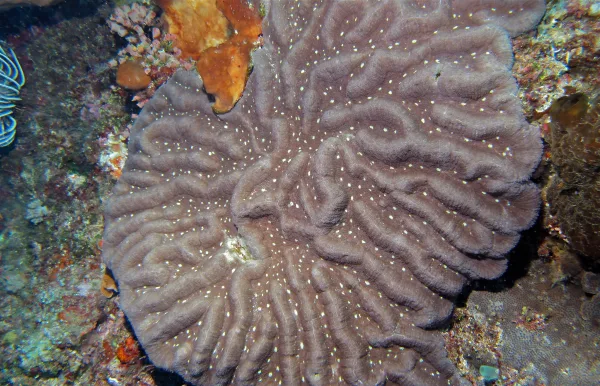
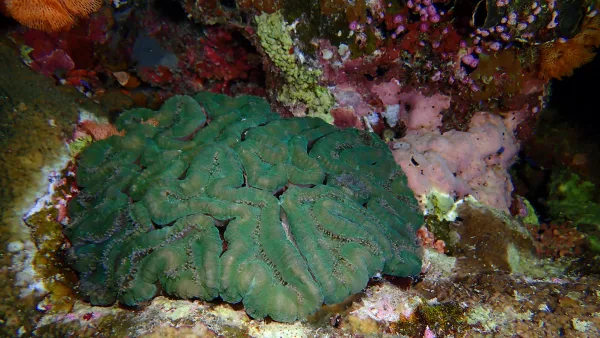
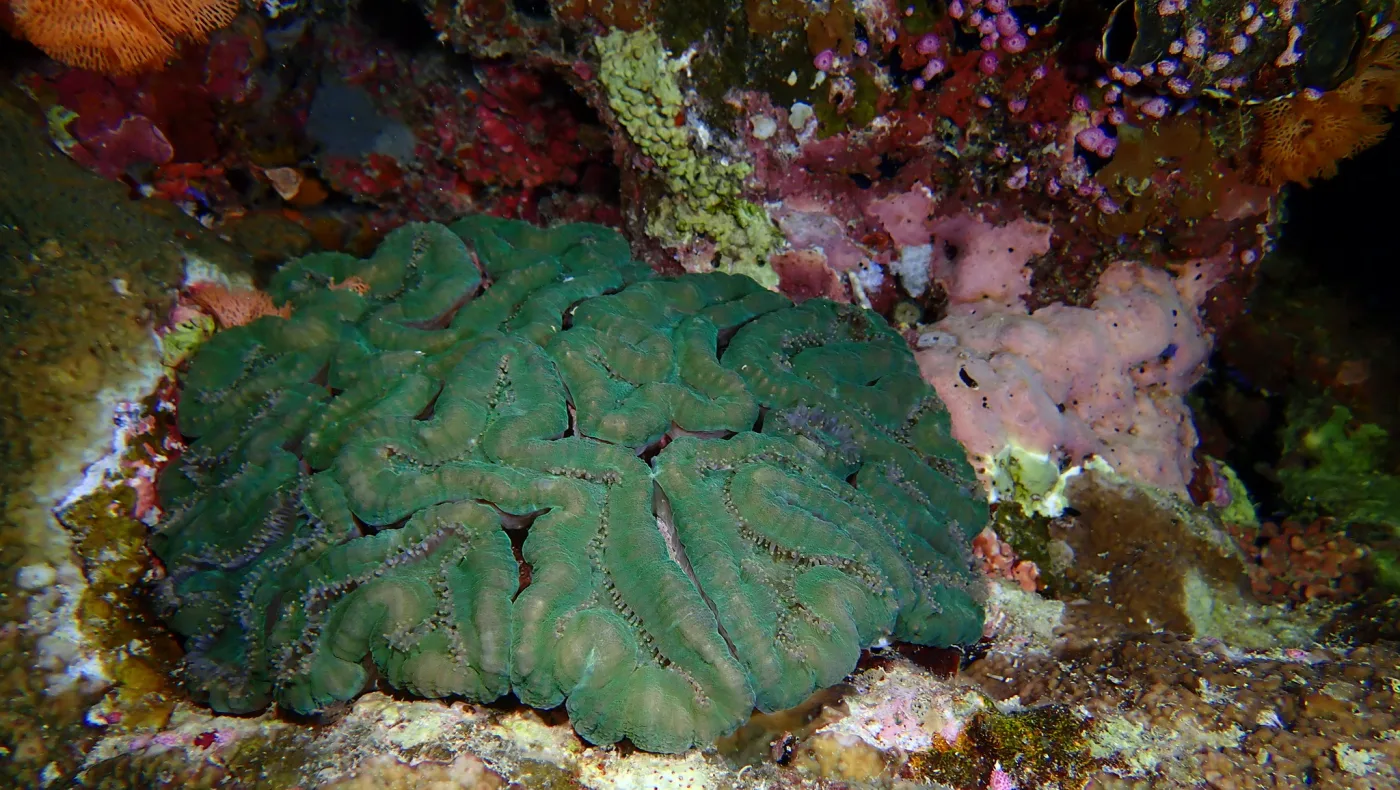
A lobo coral looks like a pile of soft, fleshy pillows or a brain with deep folds. Under the soft part is a hard skeleton with tall, sharp spikes. Lobos come in red, green, orange, brown and blue. Many have two colors in rings or stripes. Tiny algae live inside the coral and make food from light. Lobos also catch bits of food floating by. They grow very slowly. Lobos do not use long stinging arms like some corals. Instead, at night they push out thin threads from inside their bodies. The threads can melt a coral that sits too close! So lobos need space. In the wild, one colony can grow wider than a room. They live on reefs from the Red Sea to the middle of the Pacific.
Water & care
Tidal Gardens calls Lobophyllia middle of the road in difficulty and says losses are usually recently imported colonies still suffering from shipping stress; Quality Marine rates them Easy to Moderate. They want low to moderate light, low to moderate flow, a spot low in the tank, steady water, and occasional target feeding. They are sensitive to copper.
| Parameter | Keep it at | Where that sits on the usual reef range |
|---|---|---|
| Temperature | 72–78 °F | |
| Salinity (SG) | 1.023–1.025 | |
| pH | 8.1–8.4 | |
| Alkalinity | 8–12 dKH | |
| Calcium | 425 ppm | |
| Magnesium | 1,350 ppm | |
| Nitrate | 5–10 ppm |
Temperature, salinity, pH and alkalinity from Quality Marine (72-78°F, SG 1.023-1.025, pH 8.1-8.4, 8-12 dKH). Tidal Gardens gives natural seawater targets (calcium about 425 ppm, alkalinity about 8-9 dKH, magnesium about 1350 ppm), says 5-10 ppm nitrate is acceptable and 30-40 ppm can cause recession, and stresses consistency over specific values. No phosphate figure was found.
Feeding
DietPhotosynthetic
Favorite foods
- Light (photosynthesis by symbiotic algae)
- Mysis and other frozen meaty foods
- Coral pellets and powders
- Zooplankton
Symbiotic algae supply most of its food, but Tidal Gardens says lobos also benefit from direct feeding and are capable of grabbing food that floats by. Target-feed a mix of frozen foods, pellets or powders once or twice a week with the pumps turned down.
Tank & maintenance
- Aquascape
- Low in the tank or on the sand bed, where most keepers place them; if on rock, make sure it is stable and nothing can fall onto it. Leave space for its night-time filaments. No minimum tank size is published.
- Lighting
- Low to moderate: Tidal Gardens says they do not typically need more than 100 PAR. Quality Marine lists medium light. Start low and raise light slowly.
- Water flow
- Low to moderate, just enough to clear waste from the mouths. Strong flow makes the tissue retract and can cause recession where it hits hardest.
Routine upkeep
Keep alkalinity, calcium and magnesium steady, do regular partial water changes, and target-feed once or twice a week. Watch for receding tissue or a gaping mouth, check the rock above it is secure, and move neighbors that drift within reach of its filaments.
Temperament & tankmates
TemperamentAggressive
Quality Marine lists it as Aggressive. Its main weapon is mesenterial filaments (digestive threads) pushed out at night onto corals within reach, rather than long sweeper tentacles. Keep several inches of clear space around it.
Reef safeYes
Safe with fish and invertebrates, but it can kill nearby corals. Tidal Gardens says Lobophyllia are not known for sweeper tentacles but launch mesenterial filament attacks at night, so keep them a good distance from other corals. Make sure nothing on the rock above can fall onto it.
Good tankmates
- Peaceful reef fish that leave fleshy LPS alone
- Reef-safe snails and small hermit crabs
- Other corals kept several inches away
- Sand-bed placement near low-light corals such as mushrooms (with space)
Avoid
- Corals within reach of its night-time filaments
- Fish that pick at fleshy LPS
- Unstable rockwork above it
- Copper-based medications in the display
Help it thrive
- Buy colonies that have been in captivity for a while; fresh imports are the ones most often lost.
- Place it low or on the sand under modest light, around 100 PAR or less.
- Feed it small meaty foods once or twice a week.
- Give it several inches of space; its night-time filaments can kill neighbors.
- Keep nitrate low but not zero, and avoid sudden swings.
Common ailments
Tissue recession
- Signs
- Tissue pulling back to expose skeleton, often where flow hits hardest.
- Prevention
- Low to moderate flow, stable water, nitrate below about 30 ppm, and no stinging neighbors.
- Treatment
- Reduce direct flow, test and correct parameters, feed lightly, and remove anything touching it.
Shipping stress
- Signs
- A new colony stays shrunken, shows a gaping mouth or loses tissue in its first weeks.
- Prevention
- Buy well-established colonies and acclimate them slowly to light.
- Treatment
- Keep it low in calm water, hold parameters steady, and offer small foods once it starts to open.
Bleaching
- Signs
- Pale or white tissue, usually after a move to stronger light.
- Prevention
- Keep light around 100 PAR or less and raise it gradually.
- Treatment
- Lower the light or move the coral down, and keep temperature stable while it recovers.
This is general hobby guidance, not veterinary advice. Quarantine new arrivals and treat in a separate tank whenever you can.
Risks of owning one
- Its night-time mesenterial filaments can kill corals placed too close.
- Newly imported colonies are prone to loss from shipping stress.
- Slow growth means damage takes a long time to heal.
- Some species, such as L. hemprichii, are listed as Endangered; prefer established or aquacultured pieces.
Propagation & fragging
DifficultyModerate AquaculturedWidely available
Fragmentation. On branching (phaceloid) colonies the heads separate into individual polyps that can be cut apart at the stalk (Tidal Gardens). Meandroid colonies (the former Symphyllia) must be sawn through the skeleton. Growth is slow, so most aquacultured pieces come from hobbyist grow-outs. Quality Marine notes that they also reproduce sexually in the wild.
- Wear gloves and work over a container of tank water.
- On stalked colonies, cut a head off at its stalk below the living tissue; on meandroid colonies, saw through the skeleton across a valley.
- Dip the frags in an iodine coral dip.
- Glue each frag to a plug or rock.
- Place frags low in the tank in gentle flow and modest light while the cut edges heal.
Deep dive The science, history and family tree
The science
Lobophyllia de Blainville, 1830 is the type genus of the family Lobophylliidae and comprises about 20 accepted species of zooxanthellate large-polyp stony corals. Colonies are submassive to massive, flat to hemispherical, and phaceloid to flabello-meandroid: either separate corallites on stalks or meandering valleys. Calices are large (over 15 mm) with high relief, septa bear tall, widely spaced teeth, and thick, fleshy tissue covers the skeleton, often in two or more concentric colors. The genus is defined by uniserial corallites and vesicular endotheca. In the field the polyps extend mainly at night, and tentacles usually have white tips. Lobophyllia occurs on Indo-Pacific reefs from the Red Sea and East Africa to the Marshall and Pitcairn Islands, mainly on upper reef slopes and fringing reefs; L. hemprichii can form colonies over 5 m across and extensive single-species stands. In 2016 Huang et al. showed that Symphyllia, Parascolymia and Australomussa are nested within Lobophyllia and made them junior synonyms. All species are listed on CITES Appendix II, and L. hemprichii is assessed as Endangered on the IUCN Red List (2022).
- Appearance
- Thick, fleshy, often inflated tissue over either separate round to oval heads on stalks (the classic 'lobo') or continuous meandering valleys (the former Symphyllia). Colors include red, green, orange, brown, grey and blue, often two-toned in rings around the mouths or along valley walls, and many fluoresce. Former Symphyllia such as L. radians have valleys about 20-25 mm wide with a groove along the top of each wall. Look-alikes: the Scoly (L. vitiensis, formerly Parascolymia) is a single large polyp in the same genus; open brain corals (Trachyphyllia) and Homophyllia are in other genera; acans have smaller polyps packed edge to edge.
- Native range
- Indo-Pacific reefs from the Red Sea and East Africa to the Marshall Islands in the north and the Pitcairn Islands in the south. Tidal Gardens reports that most hobby Lobophyllia now come from the Great Barrier Reef, with some Indonesian stock. Quality Marine lists the Red Sea, Great Barrier Reef and Indonesia.
- Habitat
- Mainly upper reef slopes and fringing reefs; L. hemprichii is recorded at about 6-30 m. Some species are often dominant and form extensive single-species stands, and several colonies can fuse into one composite stand.
- Size
- . No genus-wide maximum is published. Corals of the World says L. hemprichii colonies may be over 5 m (16 ft) across. Calices are over 15 mm, and former Symphyllia valleys are about 20-25 mm wide. Aquarium pieces are usually single heads or small colonies and grow slowly.
- Lifespan
- No published lifespan. Colonies grow slowly and can persist for many years once settled; Tidal Gardens notes that survival improves the longer a coral has been in captivity.
- Conservation
- Not Evaluated. The genus has no assessment of its own; species are assessed individually, and the common L. hemprichii is Endangered (criteria A3ce, assessed 11 July 2022, per SeaLifeBase). All Lobophyllia are listed on CITES Appendix II. Tidal Gardens notes that slow growth makes Lobophyllia unattractive for commercial aquaculture, so most stock is wild-collected, mainly from Australia; hobbyist grow-outs are the main aquacultured source
In the aquarium vs in the wild
In your aquarium
A colorful, fleshy LPS centerpiece for the lower tank or sand bed, valued for two-tone and fluorescent colonies; slow growth keeps it relatively scarce.
On the reef
A reef-building coral of upper reef slopes and fringing reefs that can dominate patches of reef with large single-species stands.
History
Henri de Blainville named Lobophyllia in 1830; its type species, L. corymbosa, was described by Peter Forsskål in 1775 as Madrepora corymbosa. For a long time the meandering 'brain' species were kept in a separate genus, Symphyllia (Milne Edwards & Haime, 1848), and the large solitary Scoly in Parascolymia (Wells, 1964), all within the family Mussidae. DNA showed the Indo-Pacific 'mussids' were a separate lineage, placed in Lobophylliidae by Budd et al. (2012). Huang et al. (2016) then found that Symphyllia, Parascolymia and Australomussa are nested inside Lobophyllia and merged them, moving six Symphyllia species and both Parascolymia species into the genus.
Evolution & relatives
Lobophyllia belongs to the Lobophylliidae, an Indo-Pacific family in the 'robust' branch of stony corals that includes Acanthastrea, Micromussa, Homophyllia, Echinophyllia and others. Huang et al. (2016) found that species once split between Lobophyllia and Symphyllia do not form separate clades on either molecular or morphological trees, and that Symphyllia's long, meandering valleys are not a reliable character. Within the genus, L. vitiensis and L. rowleyensis (both formerly Parascolymia) form one clade, and several species, including L. hemprichii, appear paraphyletic. Corals of the World still uses Symphyllia and treats the family as under review.
Family tree, from kingdom down
- Kingdom Animalia Animals Animals are living things made of many cells that must eat food to live. Fish, corals, crabs, snails and sea stars are all animals.
- Phylum Cnidaria Cnidarians Cnidarians are soft animals with tentacles. The tentacles have tiny stinging cells. Corals, sea anemones and jellyfish all belong here.
- Subphylum Anthozoa Corals and sea anemones These cnidarians spend their whole lives as polyps: a tube with a mouth ringed by tentacles. Unlike jellyfish, they never swim around as a bell-shaped medusa.
- Class Hexacorallia Hexacorals In this group the tentacles and body parts come in sixes or multiples of six. It includes stony corals, sea anemones, mushroom corals and zoanthids.
- Order Scleractinia Stony corals Stony corals build hard skeletons out of limestone under their soft polyps. Over many years, these skeletons pile up and make coral reefs.
- Suborder Vacatina Robust corals
- Family Lobophylliidae Lobophylliid corals These stony corals have big, fleshy, colorful polyps over a hard skeleton. Acan and Lobo corals belong here.
- Genus Lobophyllia
See it on the Tree of Life Compare with another species
Closest relatives
- Lobophyllia hemprichii Lobo brain coral Same genus; common, widespread species
- Lobophyllia radians Symphyllia brain coral Same genus; formerly Symphyllia radians
- Lobophyllia vitiensis Scoly coral Same genus; formerly Parascolymia vitiensis Read guide · Compare
- Acanthastrea echinata Acan echinata Same family
Older scientific names: Symphyllia, Parascolymia, Australomussa, Palauphyllia, Symphyllia radians, Symphyllia recta, Symphyllia agaricia, Symphyllia erythraea.
Fun facts
- One Lobophyllia hemprichii colony can grow more than 5 meters across.
- Lobos fight with their stomach threads: at night they push out filaments that digest nearby corals.
- The 'Symphyllia' brain coral and the single-polyp 'Scoly' turned out to be the same genus as the lobo.
- In the Red Sea, the brain-like L. radians is usually cream, while elsewhere it can be red, grey or green.
Learn more
- Tidal Gardens: Lobophyllia coral care tidalgardens.com
- Corals of the World: Lobophyllia hemprichii coralsoftheworld.org
- Huang et al. 2016, Taxonomic classification of the reef coral family Lobophylliidae (PDF) coralreef.nus.edu.sg
- WoRMS: Lobophyllia marinespecies.org
Sources
- WoRMS: Lobophyllia de Blainville, 1830 marinespecies.org
- Wikipedia: Lobophyllia en.wikipedia.org
- Huang et al. 2016, Taxonomic classification of the reef coral family Lobophylliidae (Zool. J. Linn. Soc. 178: 436-481) coralreef.nus.edu.sg
- Corals of the World: Lobophyllia hemprichii coralsoftheworld.org
- Corals of the World: Symphyllia radians coralsoftheworld.org
- SeaLifeBase: Lobophyllia hemprichii sealifebase.se
- Tidal Gardens: Lobophyllia coral care tidalgardens.com
- Quality Marine: Red Lobophyllia Brain Coral qualitymarine.com
Scientific names and classification follow the World Register of Marine Species (AphiaID 205310). Checked by our team. Last updated October 29, 2026.
Shop this species
Search the shop →