 Sold out
Corals · LPS coral
Scoly Coral
Lobophyllia vitiensis
Also called Tongan Scoly, Tongan Scolymia, Rare Tongan Orange Scoly, Rare Tongan Green Scoly, Baby Green Scoly, Scolymia, Flat scoly, Button coral, Doughnut coral, Artichoke coral
- CareEasy
- Reef safeYes
- TemperamentSemi-aggressiveNight sweepers sting corals within reach; needs space
- Favorite foods
- Light (zooxanthellae)
- Mysis shrimp
- Brine shrimp
- Max size4 in (10.2 cm)
- Min tank30 gal
- LifespanNo fixed lifespan
- IUCN statusLeast Concern
Quick answers
- How big does the Scoly Coral get?
- Up to 4 in (10.2 cm).
- What size tank does it need?
- At least 30 gallons.
- How hard is it to keep?
- Care level: Easy.
- Is it reef safe?
- Yes. Safe with fish and invertebrates (Saltwater Aquarium Blog, Fishkeeper, Saltwater Aquarium Fish), but it needs its own space: night-time sweeper tentacles can sting corals within a few inches, and the inflated tissue spreads well beyond the skeleton.
- What does it eat?
- Light (zooxanthellae)
- Mysis shrimp
- Brine shrimp
- How long does it live?
- No fixed lifespan.
- What are good tankmates?
- Peaceful reef fish such as clownfish, gobies and cardinalfish
- Other low-light LPS placed several inches away
- Zoanthids and mushrooms that cannot reach it
- Tridacna clams (scolys are often found near them in the wild)
- Reef-safe snails and small hermit crabs
The 30-second version
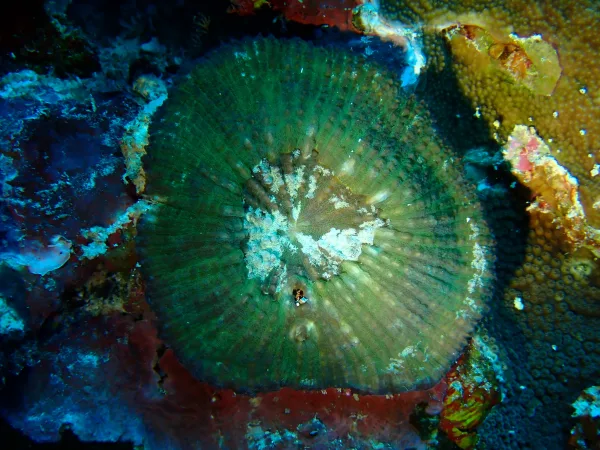
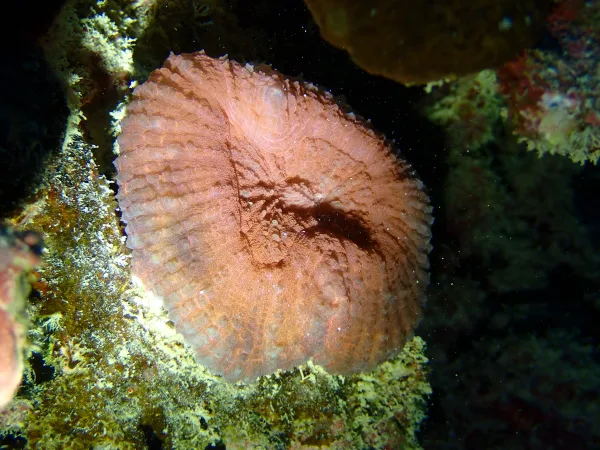
A scoly is a coral that looks like a big, soft, puffy button or doughnut. Most scolys are just one huge polyp. A polyp is an animal with a mouth in the middle and a ring of soft flesh around it. Under the flesh is a hard stone cup that the coral builds. Tiny algae live inside it. They use light to make food for the coral, a bit like solar panels. At night the scoly puffs up and puts out little arms called tentacles to catch bits of food. Some of those arms can sting other corals that sit too close, so it needs its own space. Scolys like to sit on the sand with soft light and gentle water. The ones in this shop come from the islands of Tonga, far out in the Pacific Ocean, and they can be green, orange or red.
Water & care
Scolys are widely called easy: LiveAquaria, Saltwater Aquarium Blog, Reef Chasers and Reef Builders rate them easy or beginner corals. Most of those care sheets, though, describe the Australian scoly (Homophyllia australis). Sellers of the Tongan species, Scolymia (Lobophyllia) vitiensis, are more cautious: Quality Marine rates it Moderate and That Pet Place Easy to Moderate, and Reeflex knows of no long-term captive success reports. It is rated Moderate here. Keep it on the sand bed under low to moderate light, in gentle, indirect flow, with stable alkalinity and calcium, and target-feed small meaty foods a few times a week. Wild-collected pieces can arrive stressed, so acclimate slowly and avoid copper-based medications, which Quality Marine warns it is sensitive to.
| Parameter | Keep it at | Where that sits on the usual reef range |
|---|---|---|
| Temperature | 74–78 °F | |
| Salinity (SG) | 1.023–1.026 | |
| pH | 8.1–8.4 | |
| Alkalinity | 8–12 dKH | |
| Calcium | 400–450 ppm | |
| Magnesium | 1,280–1,400 ppm |
Stability matters more than exact values. Quality Marine (for the Tongan scoly) and LiveAquaria list 72-78°F, SG 1.023-1.025, pH 8.1-8.4 and 8-12 dKH; That Pet Place gives 75-78°F and SG 1.022-1.026; Top Shelf Aquatics gives 76-80°F, SG 1.025-1.026, calcium 400-450 ppm and magnesium 1280-1350 ppm; Reeftopia gives calcium 400-450 and magnesium 1300-1400 ppm. Reeflex records wild water temperatures of about 77-84°F. No source gave species-specific nitrate or phosphate targets, so those are left blank; general LPS practice is low but measurable nutrients.
Feeding
DietPhotosynthetic
Favorite foods
- Mysis shrimp
- Brine shrimp (enriched)
- Chopped krill or shrimp
- LPS pellets and fine coral foods
- Zooplankton and micro-plankton
Much of its energy comes from its zooxanthellae, but scolys are active feeders and most sources recommend target feeding 2-3 times a week. Feed in the evening or after the lights dim, when the feeding tentacles show; place a few mysis or a small paste of food on the mouth and turn the pumps down for a few minutes. Keep portions small and remove anything it rejects so leftovers do not rot on the tissue.
Tank & maintenance
- Minimum tank
- 30 gallons
- Aquascape
- On the sand bed or on a flat, low rock with open space all round, ideally 3-8 in from other corals. Do not wedge it into rockwork where something could fall on it, and do not let it be buried by sand. Sources disagree on tank size: hobby guides for the small Australian scoly say 10 gallons is enough, while Reeflex recommends about 150 L (40 US gal) for this species and Saltwater Aquarium Fish lists 50 gallons; a larger tank gives the inflating tissue and sweepers room.
- Lighting
- Low to moderate, roughly 75-150 PAR: Reef Chasers suggests 75-125 PAR (they have kept scolys up to 200), Aquarium Source 100-150, and Tidal Gardens says about 100 PAR is adequate. Quality Marine says moderate to high. Start new pieces lower and raise light over several days; too much light can bleach or damage the tissue.
- Water flow
- Low to moderate, indirect flow: enough to carry waste away from the mouth and keep detritus off, but not so strong that it folds the flesh or stops the tissue inflating. Reduce flow while feeding.
Routine upkeep
Routine reef upkeep: regular partial water changes and steady alkalinity, calcium and magnesium. Target-feed 2-3 times a week and remove leftovers. Gently blow detritus and sand off the disc with a turkey baster, keep neighbors trimmed back out of sweeper range, and watch the edge of the disc: tissue pulling away from the skeleton is the first sign of trouble.
Temperament & tankmates
TemperamentSemi-aggressive
Not a long-sweeper bully like torch or galaxea, but it defends its space at night with stinging sweeper tentacles that grow with the coral; Reef Chasers advises at least 3 in (7.5 cm) of space and Top Shelf Aquatics 6-8 in. Ratings range from Peaceful (Saltwater Aquarium Fish, Fragbox) to Aggressive (Top Shelf Aquatics). It is itself easily stung by stronger corals, so keep it away from Galaxea, Hydnophora and other strong stingers.
Reef safeYes
Safe with fish and invertebrates (Saltwater Aquarium Blog, Fishkeeper, Saltwater Aquarium Fish), but it needs its own space: night-time sweeper tentacles can sting corals within a few inches, and the inflated tissue spreads well beyond the skeleton. Fish that nip fleshy-polyped corals can damage it.
Good tankmates
- Peaceful reef fish such as clownfish, gobies and cardinalfish
- Other low-light LPS placed several inches away
- Zoanthids and mushrooms that cannot reach it
- Tridacna clams (scolys are often found near them in the wild)
- Reef-safe snails and small hermit crabs
Avoid
- Galaxea, Hydnophora and other strong stingers within reach
- Fish that nip fleshy-polyped corals
- Strong direct flow aimed at the coral
- Very intense light without slow acclimation
- Copper-based medications in the display
Help it thrive
- Put it on the sand bed first, under dim light, and only move it once it is fully inflating each day.
- Feed small meaty foods after the lights dim, when the tentacles are out; scolys that are fed regularly hold their color and size.
- Give it more space than its skeleton suggests: the tissue can double in size by day and sweepers come out at night.
- Keep flow gentle and indirect; strong jets fold and tear the flesh.
- Never use copper-based treatments in a tank that holds a scoly.
Common ailments
Tissue recession
- Signs
- Flesh pulling back from the skeleton at the rim or around the mouth, exposed white skeleton, a disc that stops inflating.
- Prevention
- Stable alkalinity, calcium and salinity; gentle indirect flow; no stinging neighbors within reach; regular light feeding.
- Treatment
- Find and fix the cause (parameter swing, flow, a stinging neighbor, or a fish picking at it), move the coral to a sheltered low-flow spot on the sand, and keep feeding small amounts while it recovers.
Light shock and bleaching
- Signs
- Color fading to pale or white, or the disc shrinking and staying deflated, within days of arrival or a lighting change.
- Prevention
- Start low under dim light and raise intensity over several days; stay around 75-150 PAR; keep it out of intense direct light.
- Treatment
- Move it lower or reduce intensity, keep water stable, and offer light feedings while the symbiotic algae recover.
Flow and sand damage
- Signs
- Flesh folded over or torn, polyp not inflating, or sand and detritus piling on the disc.
- Prevention
- Use low to moderate indirect flow; keep it on a flat spot where sand cannot drift over it.
- Treatment
- Reduce or redirect flow, gently blow debris off the disc, and lift it onto a flat rock or frag disc if sand keeps covering it.
Sting damage from neighbors
- Signs
- Dead or receding patches on the side that faces another coral, often after the night.
- Prevention
- Keep at least 3-6 in from other corals, more from strong stingers such as Galaxea and Hydnophora.
- Treatment
- Move the scoly or the aggressor apart and keep conditions stable while the tissue regrows.
This is general hobby guidance, not veterinary advice. Quarantine new arrivals and treat in a separate tank whenever you can.
Risks of owning one
- Almost all are wild-collected and they are slow to recover from damage, so losses are expensive.
- Its night-time sweeper tentacles can sting nearby corals, and it is easily stung itself.
- The skeleton is sharp and toothed: handle it by the skeleton base, never the flesh, to avoid tearing the tissue.
- Sensitive to copper; many fish medications are unsafe in the display.
- Tongan supply is irregular, and 'scoly' is also used for the Australian Homophyllia australis, so check what you are buying.
- Colors in your tank may differ from photos taken under the seller's lighting.
Propagation & fragging
DifficultyHard AquaculturedRare or wild-caught
Not practical in the aquarium. Scolys grow as a single polyp and do not branch, so they are rarely fragged: Tidal Gardens reports that cut scolys survive far less often than most corals and take a long time to regain their round shape, and Fishkeeper calls cutting tricky with very slow regrowth. Sexual reproduction plays no part in the aquarium supply, so nearly all specimens are wild-collected.
- Buy a healthy, fully inflating specimen rather than attempting to cut one.
- If a damaged scoly must be cut, use clean tools, cut through the skeleton rather than tearing the flesh, and expect losses.
- Place any pieces on the sand under low light and gentle flow, and target-feed lightly once they reopen.
Deep dive The science, history and family tree
The science
Lobophyllia vitiensis is a zooxanthellate large-polyp stony coral in the family Lobophylliidae. It is typically monostomatous, a single large corallite with one mouth, although it can bud extra mouths, and tropical specimens are larger and sometimes colonial (Huang et al. 2016; Corals of the World). Corals of the World describes subtropical specimens as usually solitary, flat and under 60 mm across, and wild color as usually dark green or tan; aquarium specimens come in green, orange, red and multicolored forms. Reeflex gives a maximum of about 15 cm. The species was described by Brüggemann in 1877 as Scolymia vitiensis from a holotype collected in Fiji. Genetic work showed that the Indo-Pacific 'Scolymia' were not related to the Atlantic type of that genus, so the species was moved to Parascolymia, and in 2016 Huang et al. merged Parascolymia, Australomussa and Symphyllia into Lobophyllia; WoRMS now accepts Lobophyllia vitiensis. Its closest look-alike is Homophyllia australis, the Australian scoly, which is much smaller as an adult, though juveniles of the two may be indistinguishable. The species is recorded across the Indo-Pacific from the Indian Ocean to Fiji, usually uncommon, and on most reef types. Like other lobophylliids it gets much of its energy from symbiotic algae and also captures plankton with its tentacles. Like all stony corals it is listed on CITES Appendix II.
- Appearance
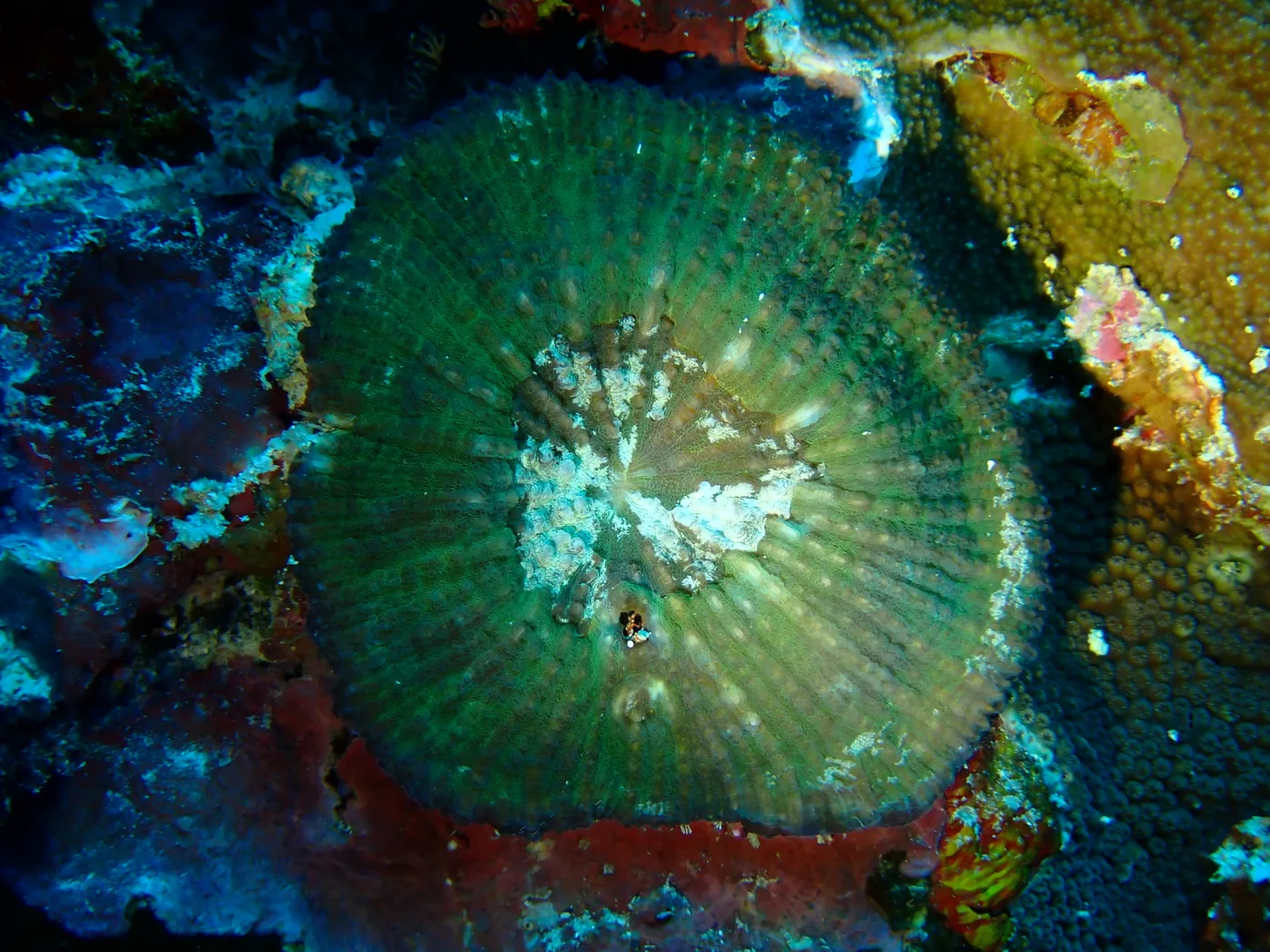
- A single round to slightly oval, fleshy disc, usually flat to gently domed, with one central mouth surrounded by a thick, often ridged or lumpy mantle that hides a toothed skeleton; some pieces carry one or two extra mouths. The 'flat scoly' shape is typical of Tongan and Fijian imports. Colors include green, orange, red, tan and two-toned mixes, sometimes with radial stripes. The tissue inflates during the day and can roughly double the coral's apparent size. Look-alikes: Homophyllia australis (Australian or 'Aussie' scoly) is much smaller as an adult, but juveniles of the two may be impossible to tell apart (Corals of the World); Lobophyllia rowleyensis (the former Australomussa) forms multi-mouthed colonies. True Scolymia species are Atlantic and not legally sold in US stores.
- Native range
- Indo-Pacific and Indian Ocean. Reeflex lists records from the Maldives, Madagascar, Mauritius and the Seychelles east through Indonesia, the Philippines, Japan and Australia to Vanuatu and Fiji; Corals of the World notes it is rare in the south-west Indian Ocean. The type locality is Fiji. In the aquarium trade it is best known from Fiji, Tonga and the Solomon Islands (Reef Builders), and Quality Marine sells it as a Central Pacific (Tongan) coral.
- Habitat
- Found in most reef environments (Corals of the World), from sheltered sites with moderate flow and light (Reef Builders) to deeper slopes; Reeflex gives a depth range of 0-50 m. Specimens usually sit loose or attached on rubble and hard bottom.
- Size
- 4 in (10.2 cm). Single heads reach about 15 cm (5.9 in) across (Reeflex); subtropical specimens are usually under 6 cm, while tropical ones grow larger and sometimes become colonial (Corals of the World). Care sheets for the smaller Australian scoly give 3-4 in (7.5-10 cm). The fleshy tissue can inflate to about twice the skeleton's size by day, so allow extra room. 'Baby' scolys are sold at 1-2 in and grow slowly.
- Lifespan
- No fixed lifespan. A single scoly can live for many years in a stable aquarium if it is fed and kept out of harm's way; growth is slow.
- Conservation
- Least Concern. Reeflex lists the species as Least Concern on the IUCN Red List; no second source was found for its current category. Like all stony corals it is on CITES Appendix II, so wild exports need permits. Almost all scolys in the trade are wild-collected, and Tongan supply is irregular: a US importer's Tonga list notes that hard corals from Tonga are currently unavailable, while some other Tongan corals are now cultured
In the aquarium vs in the wild
In your aquarium
A showpiece LPS for the sand bed: a single large, colorful disc that becomes the centerpiece of an LPS or mixed reef. It does no clean-up job.
On the reef
A slow-growing reef coral that adds calcium carbonate to the reef, hosts photosynthetic algae, captures plankton, and competes for space with its sweeper tentacles.
History
Described in 1877 by F. Brüggemann as Scolymia vitiensis, from a holotype collected in Fiji and kept at the Natural History Museum in London. For a century it and the Australian Scolymia australis were treated as the only Indo-Pacific members of Scolymia, a genus whose type species is Atlantic; Veron and Pichon (1980) even wondered whether the two were one species. DNA studies then showed a deep split between Atlantic and Indo-Pacific 'mussid' corals, so the two were moved to Parascolymia and Homophyllia (Budd et al. 2012, as summarized by Huang et al. 2016). In 2014 Arrigoni and colleagues moved the hobby's Australomussa into Parascolymia, and in 2016 Huang et al. sank Parascolymia into Lobophyllia, giving the current WoRMS name Lobophyllia vitiensis. The trade still sells it as Scolymia vitiensis: Reef Builders notes it was long known from Fiji, Tonga and the Solomon Islands as the 'flat scoly'.
Evolution & relatives
Scolys belong to the Lobophylliidae, an Indo-Pacific family that DNA studies separated from the Atlantic Mussidae (which keeps the true Scolymia) despite their similar skeletons. Lobophylliids sit on the 'robust' branch of stony corals (suborder Vacatina). Within Lobophyllia, Huang et al. (2016) found that L. vitiensis and L. rowleyensis (the former Australomussa) form a clade sharing extracalicular budding and variable corallite shapes. Its look-alike, Homophyllia australis, is in a different genus of the same family: Huang et al. note that L. vitiensis, H. australis and Micromussa pacifica are all typically single-mouthed, although the family is mostly colonial and Cynarina is its only always-solitary genus.
Family tree, from kingdom down
- Kingdom Animalia Animals Animals are living things made of many cells that must eat food to live. Fish, corals, crabs, snails and sea stars are all animals.
- Phylum Cnidaria Cnidarians Cnidarians are soft animals with tentacles. The tentacles have tiny stinging cells. Corals, sea anemones and jellyfish all belong here.
- Subphylum Anthozoa Corals and sea anemones These cnidarians spend their whole lives as polyps: a tube with a mouth ringed by tentacles. Unlike jellyfish, they never swim around as a bell-shaped medusa.
- Class Hexacorallia Hexacorals In this group the tentacles and body parts come in sixes or multiples of six. It includes stony corals, sea anemones, mushroom corals and zoanthids.
- Order Scleractinia Stony corals Stony corals build hard skeletons out of limestone under their soft polyps. Over many years, these skeletons pile up and make coral reefs.
- Suborder Vacatina Robust corals
- Family Lobophylliidae Lobophylliid corals These stony corals have big, fleshy, colorful polyps over a hard skeleton. Acan and Lobo corals belong here.
- Genus Lobophyllia carpet brain coral
- Species Lobophyllia vitiensis
See it on the Tree of Life Compare with another species
Closest relatives
- Homophyllia australis Australian (Aussie) scoly Same family; the other 'scoly' of the trade, formerly Scolymia australis
- Lobophyllia rowleyensis Australomussa Same genus; sister species, formerly Australomussa then Parascolymia rowleyensis
- Cynarina lacrymalis Button or doughnut coral Same family; formerly Scolymia lacrymalis, the family's only always-solitary genus
- Micromussa lordhowensis Acan Lord Same family (Lobophylliidae) Read guide · Compare
- Scolymia lacera Atlantic mushroom coral Look-alike in a different family (Mussidae); the Atlantic genus the name 'scoly' comes from
Older scientific names: Scolymia vitiensis, Parascolymia vitiensis, Lithophyllia vitiensis, Parascolymia fungiformis.
Fun facts
- The first specimen, described in 1877, came from Fiji, and it is still kept at the Natural History Museum in London.
- It has carried at least three genus names, Scolymia, Parascolymia and now Lobophyllia, but the trade still calls it a scoly.
- A scoly's flesh can puff up to about twice its skeleton's size during the day.
- True Scolymia live only in the Atlantic; the scolys in reef shops are Indo-Pacific corals from a different family.
Learn more
- Tidal Gardens: How to care for your Scolymia coral tidalgardens.com
- Reef Builders: This is the best Parascolymia vitiensis we've ever seen reefbuilders.com
- Corals of the World: Parascolymia vitiensis factsheet coralsoftheworld.org
- WoRMS: Lobophyllia vitiensis marinespecies.org
Sources
- WoRMS: Lobophyllia vitiensis (Brüggemann, 1877) marinespecies.org
- Huang et al. 2016, Taxonomic classification of the reef coral family Lobophylliidae (Zool. J. Linn. Soc.) coralreef.nus.edu.sg
- Corals of the World: Parascolymia vitiensis factsheet coralsoftheworld.org
- Reeflex (Meerwasser-Lexikon): Lobophyllia vitiensis reeflex.net
- Reef Builders (2017): This is the best Parascolymia vitiensis we've ever seen reefbuilders.com
- Reef Builders (2014): Kiss Australomussa goodbye, say hello to Parascolymia rowleyensis reefbuilders.com
- Quality Marine: Orange Scolymia Coral (Scolymia vitiensis), Tongan Orange qualitymarine.com
- That Pet Place: Button Coral - Scolymia vitiensis thatpetplace.com
- LiveStock USA: Tonga corals list livestockusa.org
- Tidal Gardens: How to care for your Scolymia coral tidalgardens.com
- LiveAquaria: Scolymia Coral Australia (care facts) liveaquaria.com
- Saltwater Aquarium Blog: Scoly coral care guide saltwateraquariumblog.com
- Reef Chasers: Scolymia coral care guide reefchasers.com
- Top Shelf Aquatics: UFO Scolymia Coral topshelfaquatics.com
- Saltwater Aquarium Fish: Scolymia, Colored saltwaterfish.com
- Fishkeeper: Australian Scolymia Coral fishkeeper.co.uk
- Reef Builders (2024): An introduction to Scolymia (Homophyllia australis) care reefbuilders.com
- Aquarium Source: Scoly coral care guide aquariumsource.com
- Reeftopia: Scolymia, an in-depth guide reeftopia.com.au
- Fragbox: Scolymia coral care fragbox.ca
- Wikipedia: Scolymia en.wikipedia.org
Care facts
The care facts on this guide and its product pages (care level, reef safety, temperament, size, tank, diet, flow, purpose, foods, acclimation and origin) combine 18 independent sources, checked October 25, 2026.
- Orange Scolymia Coral (Scolymia vitiensis), item 52134 (Tongan Orange) Quality Marine
- Button Coral - Scolymia vitiensis - Medium That Pet Place
- Lobophyllia vitiensis (Artichoke Coral) Meerwasser-Lexikon / Reeflex
- Scoly Coral Care Guide Saltwater Aquarium Blog
- Scoly Coral Care Guide: Fragging, Mates, Feeding Aquarium Source (Millie Sheppard)
- How to Care for Your Scolymia Coral Tidal Gardens
- Scolymia Coral Australia 2" WYSIWYG LiveAquaria
- Scolymia: Colored Saltwater Aquarium Fish (saltwaterfish.com)
- Australian Scolymia Coral Fishkeeper (Maidenhead Aquatics)
- Scolymia Coral Care Guide Reef Chasers
- UFO Scolymia Coral Top Shelf Aquatics
- An introduction to Scolymia (Homophyllia australis) care Reef Builders
- Scolymia Coral (coral wiki) Fragbox
- Scolymia: an in-depth guide Reeftopia
- Kiss Australomussa goodbye, say hello to Parascolymia rowleyensis Reef Builders
- This is the BEST Parascolymia vitiensis we've ever seen Reef Builders
- Huang et al. 2016, Taxonomic classification of the reef coral family Lobophylliidae (Zool. J. Linn. Soc. 178: 436-481) Zoological Journal of the Linnean Society
- Tonga Corals LiveStock USA (importer list)
Scientific names and classification follow the World Register of Marine Species (AphiaID 888126). Last updated October 25, 2026.
Shop this species
Search the shop →Sold out right now. We restock weekly, so check back soon.