Fish · Tang
Convict Tang
Acanthurus triostegus
Also called Convict Surgeonfish, Convict Surgeon, Fiveband Surgeonfish, Manini
Reviewed by admin on October 29, 2026 · Meet the team
- CareModerate
- Reef safeYes
- TemperamentSemi-aggressiveUsually calm; bullied by bolder Acanthurus
- Favorite foods
- Nori / seaweed sheets
- Herbivore pellets
- Spirulina flakes
- Max size10.6 in (27 cm)
- Min tank125 gal
- LifespanNot documented in the sources we checked
- IUCN statusLeast Concern
Quick answers
- How big does the Convict Tang get?
- Up to 10.6 in (27 cm).
- What size tank does it need?
- At least 125 gallons.
- How hard is it to keep?
- Care level: Moderate.
- Is it reef safe?
- Yes. Grazes algae and leaves corals and invertebrates alone; LiveAquaria, Quality Marine and Top Shelf Aquatics all list it as reef safe, and Reef Builders says it does especially well in reef tanks with live rock to graze.
- What does it eat?
- Nori / seaweed sheets
- Herbivore pellets
- Spirulina flakes
- How long does it live?
- Not documented in the sources we checked; no published longevity study or reliable captive lifespan figure was found.
- What are good tankmates?
- Peaceful community fish such as clownfish, gobies and cardinalfish
- Tangs of other genera with a different body shape (Zebrasoma, Paracanthurus, Ctenochaetus, Naso)
- Wrasses and dwarf angelfish
- Corals and invertebrates
The 30-second version
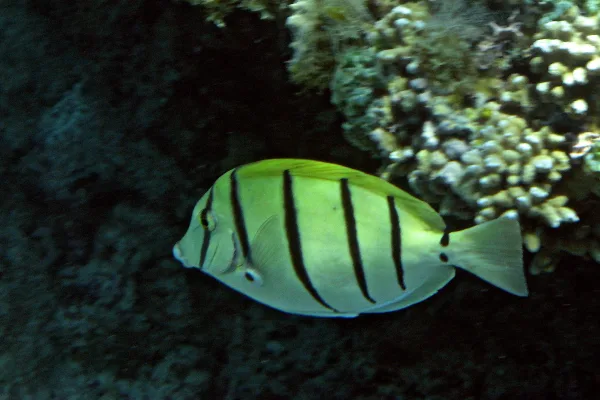
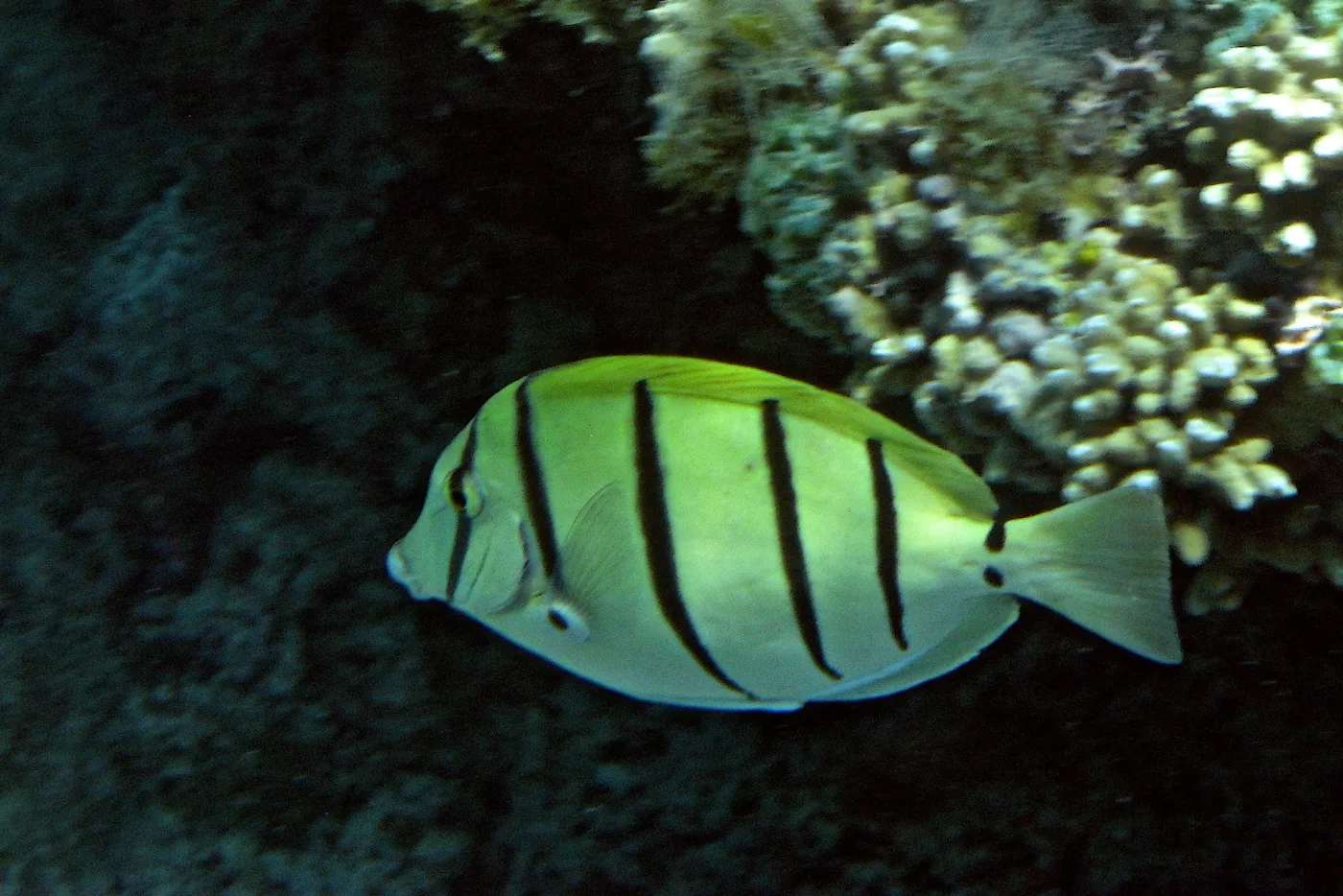
The convict tang wears stripes, like the striped suits that prisoners wore long ago. Its body is white or pale yellow, with six thin black bars. One bar runs right through its eye. It lives on warm reefs in the Indian and Pacific Oceans. Baby convict tangs live in tide pools near the shore. The grown-ups swim in big groups. A big group can push past the small fish that guard their own patches of algae. Then the whole group eats the algae. Being in a group keeps them safe too. All those stripes make it hard for a hunter to pick out just one fish. In a home tank it is calm for a tang. It needs lots of room to swim and algae to eat every day.
Water & care
One of the calmer, smaller Acanthurus tangs, but it still needs a long tank of about 125 gallons or more, steady water quality and algae every day. Choose a fish that is eating, quarantine it before it goes into the display, and add it before or with other tangs rather than after bolder Acanthurus have settled in. Live rock that grows algae gives it something to graze between meals.
| Parameter | Keep it at | Where that sits on the usual reef range |
|---|---|---|
| Temperature | 72–78 °F | |
| Salinity (SG) | 1.020–1.025 | |
| pH | 8.1–8.4 | |
| Alkalinity | 8–12 dKH |
LiveAquaria and Quality Marine agree on 72-78°F, SG 1.020-1.025, pH 8.1-8.4 and 8-12 dKH. Calcium, magnesium, nitrate and phosphate are left null because no species-specific values are published; keep normal reef targets in a reef tank.
Feeding
DietHerbivore
Favorite foods
- Dried seaweed (nori) on a clip
- Spirulina and herbivore flakes or pellets
- Frozen herbivore foods
- Natural algae on live rock
- Mysis or brine shrimp as an occasional extra
Feed small amounts about three times a day, mostly plant foods. LiveAquaria asks for marine seaweed at least three times a week, which it says helps its immune system and lowers aggression. Meaty foods are a supplement, not a staple.
Tank & maintenance
- Minimum tank
- 125 gallons
- Aquascape
- A long tank with open swimming lanes, plus live rock for grazing and places to rest at night. The system should be mature.
- Lighting
- No special need; light that grows some algae on the rock helps.
- Water flow
- Good, steady water movement and oxygenation, as for other tangs. No species-specific flow figure is published.
Routine upkeep
Regular water changes and good filtration, as for any tang. Keep some algae growing on the rock, feed several small meals a day, and watch for white spots and for bullying by other tangs.
Temperament & tankmates
TemperamentSemi-aggressive
Described as easygoing and one of the more placid surgeonfishes. It is more often the victim than the bully: other tangs, especially more aggressive Acanthurus, may harass it. It can still quarrel with similarly shaped tangs, and maturing fish can turn on other tangs. Convict tangs can live together if added at the same time to a very spacious tank, ideally as juveniles. Reef Builders suggests tankmates from other genera, such as Zebrasoma, Paracanthurus, Ctenochaetus or Naso.
Reef safeYes
Grazes algae and leaves corals and invertebrates alone; LiveAquaria, Quality Marine and Top Shelf Aquatics all list it as reef safe, and Reef Builders says it does especially well in reef tanks with live rock to graze. Quality Marine and Top Shelf note that an underfed fish may pick at small invertebrates or nip large-polyp stony corals, so keep it well fed with algae.
Good tankmates
- Peaceful community fish such as clownfish, gobies and cardinalfish
- Tangs of other genera with a different body shape (Zebrasoma, Paracanthurus, Ctenochaetus, Naso)
- Wrasses and dwarf angelfish
- Corals and invertebrates
Avoid
- Bolder Acanthurus tangs that may bully it
- Similarly shaped tangs added after it
- Several convict tangs in a tank that is not very large
- Tanks under about 125 gallons
Help it thrive
- Quarantine it first; Reef Builders recommends quarantine for all tangs.
- Give it a long tank of 125 gallons or more with open swimming space.
- Offer seaweed or other algae foods every day in small meals.
- Add it before, or at the same time as, other tangs, and skip bolder Acanthurus.
- Keep a group only in a very large tank, with all fish added together.
Common ailments
Marine ich (white spot, Cryptocaryon irritans)
- Signs
- Small white spots on the body and fins, scratching, fast breathing and loss of appetite.
- Prevention
- Quarantine new fish and keep water stable.
- Treatment
- Treat in a hospital tank with copper, chloroquine phosphate or the tank-transfer method, following the product's directions, and leave the display without fish for several weeks.
Marine velvet (Amyloodinium ocellatum)
- Signs
- A fine dusty coating on the skin, very fast breathing, hanging near the surface and quick decline.
- Prevention
- Strict quarantine and separate equipment for each tank.
- Treatment
- A temperature- and pH-matched freshwater dip for quick relief, then copper or chloroquine phosphate in a hospital tank, following the product's directions.
Stress from bullying
- Signs
- Hiding, torn fins, faded color and not eating when kept with bolder tangs.
- Prevention
- Pick tankmates from other tang genera and give it plenty of room.
- Treatment
- Move the bully or the convict tang, and feed it well while it recovers.
This is general hobby guidance, not veterinary advice. Quarantine new arrivals and treat in a separate tank whenever you can.
Risks of owning one
- Can be bullied by more aggressive tangs, especially other Acanthurus.
- Needs a large tank for its adult size.
- Can bring marine ich into a tank if it is not quarantined.
- An underfed fish may nip large-polyp stony corals.
- Like all tangs, it has a tail spine that can cut hands during netting, although this species' spine is small.
Breeding
DifficultyVery hard Captive-bredRare or wild-caught
In the wild it spawns in aggregations, and eagle rays often feed on the clouds of eggs and sperm. Larvae drift in open water and change into juveniles at about 3.2 cm. LiveAquaria notes the young stay in the plankton for months, which makes home breeding very difficult. In 2024, after a four-year project, Biota Hawaii and the Oceanic Institute of Hawaii Pacific University announced hatchery-raised convict tangs, the second Acanthurus raised after A. mata and the first proposed for commercial sale. The first fish were reserved for Biota customers, so captive-bred convicts are still scarce.
Deep dive The science, history and family tree
The science
Acanthurus triostegus is a small, oval, laterally compressed surgeonfish with a small head, a pointed snout and a thick-lipped terminal mouth. The body is pale yellowish to silvery white with six narrow black bars, the first slanting through the eye, and two black spots on the caudal peduncle. Its peduncle spine is small and, according to Reef Builders, rarely used. The dorsal fin has 9 spines and 22-26 soft rays and the anal fin 3 spines and 19-22 soft rays. Maximum length is 27 cm TL, with 17 cm typical. It is one of the most widespread surgeonfishes, occurring through the Indo-Pacific except the seas around the Arabian Peninsula, and in the eastern Pacific from the Gulf of California to Panama and the Galapagos. Adults live over hard bottoms in lagoons and on seaward reefs to about 90 m, while juveniles are abundant in tide pools. It grazes filamentous algae, often near freshwater runoff, and large feeding schools can overwhelm the territories of algae-farming damselfishes. Spawning takes place in aggregations. Hawaiian fish, which have a black bar below the pectoral fin, are sometimes treated as a separate subspecies or species, A. t. sandvicensis.
- Appearance
- White to pale yellow body with six thin black vertical bars (the first runs through the eye) and two small black spots on the tail base. Males and females look alike. Hawaiian fish have a black line below each pectoral fin, while fish from elsewhere usually have a black dot there. The zebra tang (A. polyzona), which has a smaller Indian Ocean range, looks similar but has nine bars.
- Native range
- Indo-Pacific from the East African coast and Madagascar east through the Pacific islands to Hawaii, north to southwestern Japan and south to Australia, but not the seas around the Arabian Peninsula. Eastern Pacific from the lower Gulf of California to Panama, including the Revillagigedo, Cocos, Clipperton and Galapagos islands. Type locality given as 'Indies'.
- Habitat
- Hard bottoms in lagoons, on seaward reef slopes, in bays and estuaries, from the shallows to about 90 m. Juveniles are common in tide pools. Adults are seen singly, in small groups or in large schools that graze algae together.
- Size
- 10.6 in (27 cm). FishBase gives 27 cm (10.6 in) total length as the maximum and 17 cm as a common length. Aquarium sources list smaller adults: LiveAquaria 8 in, Quality Marine almost 8 in, Top Shelf Aquatics about 10 in. FishBase notes the postlarva changes to a juvenile at 3.2 cm.
- Lifespan
- Not documented in the sources we checked; no published longevity study or reliable captive lifespan figure was found.
- Conservation
- Least Concern. IUCN Least Concern (assessed 2010, per FishBase). It is fished for food in many places and collected for the aquarium trade; FishBase lists reports of ciguatera poisoning from eating it. Hatchery-reared fish from Biota (Hawaii) were announced in 2024, but most fish in the trade are still wild-caught
In the aquarium vs in the wild
In your aquarium
A calm, boldly striped algae grazer for larger reef and fish-only tanks.
On the reef
A schooling grazer of filamentous algae on shallow hard bottoms; big schools can overrun damselfish algae gardens.
History
Carl Linnaeus described the fish in 1758 as Chaetodon triostegus, giving its home only as 'Indies'. It was later named many more times, as Acanthurus zebra, Harpurus fasciatus and A. sandvicensis among others, and WoRMS now lists more than 20 synonyms. In Hawaii it is called manini; it is fished by anglers there and has been collected for the aquarium trade. In 2024 Biota Hawaii announced the first convict tangs raised in a hatchery, fed from the start on prepared foods such as pellets, nori and frozen spirulina brine shrimp.
Evolution & relatives
The convict tang belongs to Acanthurus, the largest surgeonfish genus, in the family Acanthuridae. Its closest relative is the zebra tang (A. polyzona) of the Indian Ocean, and the two hybridize at Mauritius. The Hawaiian population differs slightly in color and is sometimes treated as its own subspecies, A. t. sandvicensis. Surgeonfishes belong to the order Acanthuriformes, which WoRMS also uses for angelfishes, rabbitfishes and butterflyfishes.
Family tree, from kingdom down
- Kingdom Animalia Animals Animals are living things made of many cells that must eat food to live. Fish, corals, crabs, snails and sea stars are all animals.
- Phylum Chordata Chordates Chordates have a stiff rod running down their back at some point in their lives. In fish and people, this rod is replaced by a backbone.
- Subphylum Vertebrata Vertebrates Vertebrates are animals with a backbone and a skull. Fish, frogs, birds and people are all vertebrates.
- Infraphylum Gnathostomata jawed vertebrates
- Parvphylum Osteichthyes bony fishes
- Gigaclass Actinopterygii ray-finned fishes
- Superclass Actinopteri
- Class Teleostei Teleost fishes Teleosts are bony fishes with thin, bendy fin rays and jaws that can push forward. Almost all of the fish in the world are teleosts.
- Order Acanthuriformes Surgeonfishes, angelfishes and kin This order of fishes includes surgeonfishes, marine angelfishes and rabbitfishes. Many have deep, flat bodies and graze on reefs.
- Family Acanthuridae Surgeonfishes and tangs Surgeonfishes have a sharp spine, like a tiny knife, on each side of the tail. Most graze on algae on reefs.
- Genus Acanthurus Acanthurus surgeonfishes This is the biggest group of surgeonfishes, with sharp tail spines. The powder blue tang belongs here.
- Species Acanthurus triostegus
See it on the Tree of Life Compare with another species
Closest relatives
- Acanthurus polyzona Zebra Tang Same genus; closest relative, hybridizes with it at Mauritius
- Acanthurus achilles Achilles Tang Same genus Read guide · Compare
- Acanthurus mata Elongate Surgeonfish Same genus; the first Acanthurus raised in captivity
- Zebrasoma flavescens Yellow Tang Same family, different genus; Reef Builders suggests Zebrasoma tangs as tankmates Read guide · Compare
Older scientific names: Chaetodon triostegus, Acanthurus sandvicensis, Acanthurus triostegus sandvicensis, Acanthurus zebra, Teuthis triostegus.
Fun facts
- Big schools of convict tangs can swamp the algae gardens that damselfish guard and eat the algae before the damsels can chase them all off.
- Its stripes may help the school: predators find it hard to single out one striped fish.
- Eagle rays often show up at spawning time to eat the clouds of eggs.
- In Hawaii it is called manini.
- In 2024 it became the first Acanthurus tang proposed for commercial captive-bred sale.
Learn more
- FishBase: Acanthurus triostegus, Convict surgeonfish fishbase.se
- Wikipedia: Convict surgeonfish en.wikipedia.org
- Reef Builders: Awesome fish spotlight, Acanthurus triostegus reefbuilders.com
Sources
- WoRMS: Acanthurus triostegus (Linnaeus, 1758) marinespecies.org
- FishBase species summary: Acanthurus triostegus fishbase.se
- Wikipedia: Convict surgeonfish en.wikipedia.org
- LiveAquaria: Convict Tang liveaquaria.com
- Quality Marine: Convict Tang qualitymarine.com
- Top Shelf Aquatics: Convict Tang care guide topshelfaquatics.com
- Reef Builders: Awesome fish spotlight, Acanthurus triostegus (2017) reefbuilders.com
- CORAL Magazine: Captive-bred species first, convict tangs (2024) coralmagazine.com
Scientific names and classification follow the World Register of Marine Species (AphiaID 219630). Checked by our team. Last updated October 29, 2026.
Shop this species
Search the shop →