 Sold out
Fish · Blenny
Tailspot Blenny
Ecsenius stigmatura
Also called Tail Spot Blenny, Tailspot Coralblenny
- CareEasy
- Reef safeYes
- TemperamentPeacefulChases blennies, gobies and look-alikes
- Favorite foods
- Algae grown on live rock
- Nori / algae pellets
- Mysis shrimp
- Max size2.5 in (6.3 cm)
- Min tank20 gal
- LifespanAbout 3-5 years according to hobby care…
- IUCN statusLeast Concern
Quick answers
- How big does the Tailspot Blenny get?
- Up to 2.5 in (6.3 cm).
- What size tank does it need?
- At least 20 gallons.
- How hard is it to keep?
- Care level: Easy.
- Is it reef safe?
- Yes. Generally reef safe and listed as reef compatible by LiveAquaria.
- What does it eat?
- Algae grown on live rock
- Nori / algae pellets
- Mysis shrimp
- How long does it live?
- About 3-5 years according to hobby care guides (Salt Water Aquarium Blog); not well documented.
- What are good tankmates?
- Clownfish
- Firefish
- Cardinalfish
- Chromis
- Sand-dwelling gobies
The 30-second version
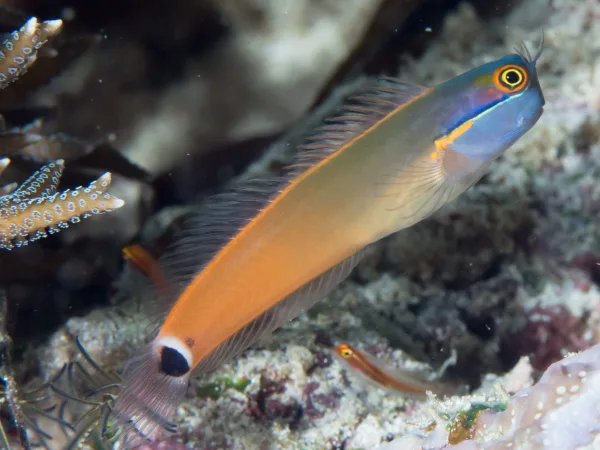
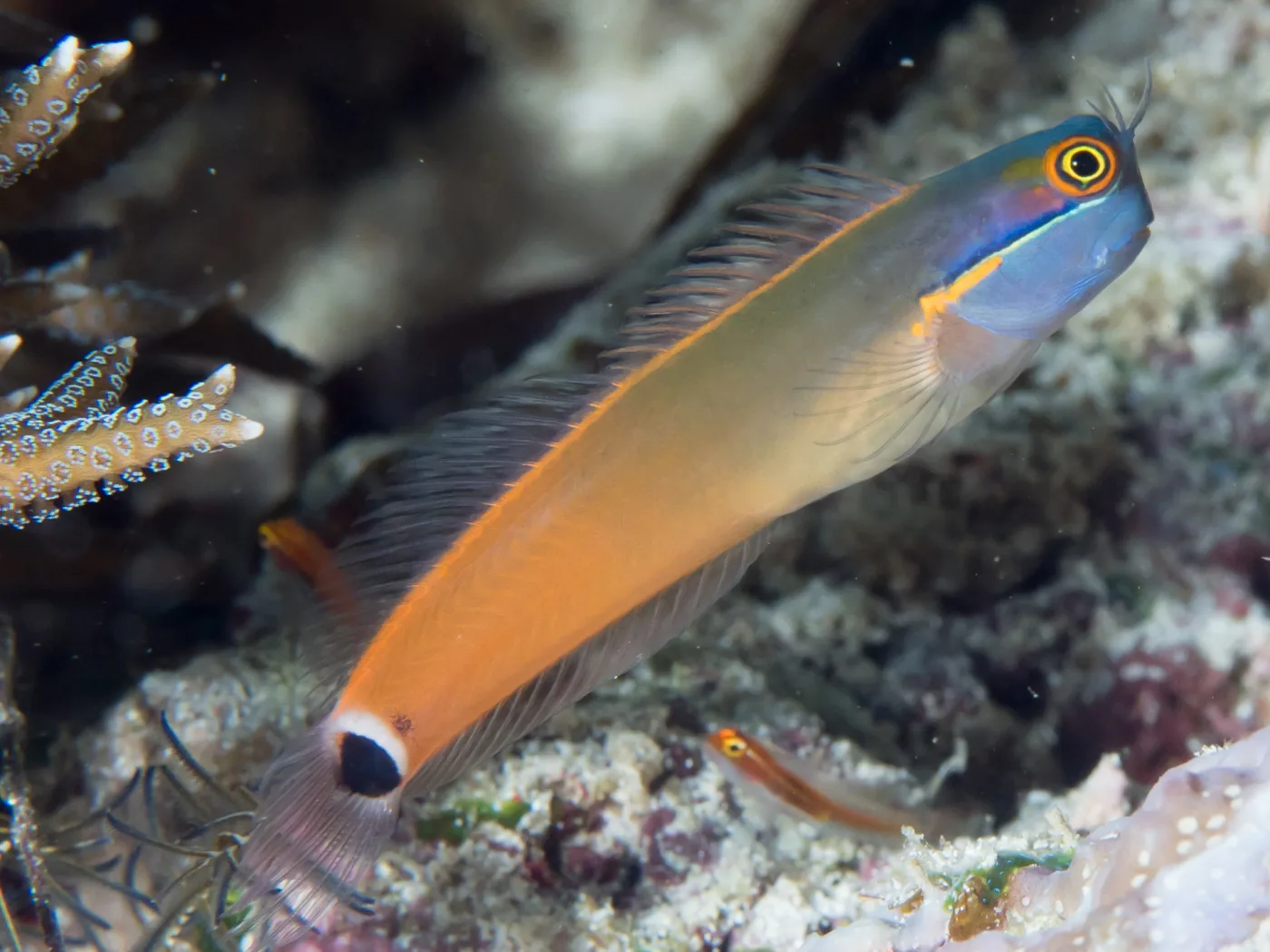
The Tailspot Blenny is a tiny fish. It only grows to about as long as your finger. Look for a small black dot right where its tail starts. It looks like the dot at the end of a sentence. Its body is gray to orange, and its head is a bit blue. It has big yellow eyes with a stripe below each one. It comes from reefs and calm bays near Indonesia and the Philippines. It loves to sit on rocks and peek out of small holes. All day long, it nibbles tiny green fuzz off the rocks. It is shy at first, but it soon gets brave and curious. It is small and gentle, so it is a great fish for small reef tanks. Just keep the lid on tight, because it can jump!
Water & care
One of the best blennies for small tanks: small, hardy and peaceful. It needs mature live rock with algae film, algae-based foods two or three times a day, peaceful tankmates and a tight lid. Large or pushy fish can keep it hiding.
| Parameter | Keep it at | Where that sits on the usual reef range |
|---|---|---|
| Temperature | 72–78 °F | |
| Salinity (SG) | 1.020–1.025 | |
| pH | 8.1–8.4 | |
| Alkalinity | 8–12 dKH |
Standard retailer care ranges (LiveAquaria, Quality Marine). Meerwasser-Lexikon records wild water around 83-85 F (28.4-29.2 C), so it tolerates warm reef temperatures. In a reef, follow your corals' targets for calcium, magnesium and nutrients; ammonia and nitrite must stay at zero.
Feeding
DietHerbivore
Favorite foods
- Film algae and microalgae grazed from rock and glass
- Nori (dried seaweed)
- Spirulina flakes and herbivore pellets
- Frozen herbivore blends
- Small amounts of mysis or brine shrimp
Two or three small meals a day, mostly algae-based, on top of natural grazing. It usually accepts flakes, pellets and frozen foods readily (Quality Marine, Meerwasser-Lexikon). If it starts picking at corals, increase the algae-based feedings.
Tank & maintenance
- Minimum tank
- 20 gallons
- Aquascape
- Mature live rock with small holes, ledges and lookouts for perching and hiding; a sand bed is fine. Add it to an established tank with algae growth.
- Lighting
- No special needs; medium reef lighting is fine.
- Water flow
- Low to moderate is ideal, though it tolerates typical reef flow.
Routine upkeep
Regular small water changes and stable salinity, which matters more in the small tanks this fish is often kept in. Keep some film algae on the rocks for grazing, check daily that it is eating, and make sure the lid has no gaps around equipment.
Temperament & tankmates
TemperamentPeaceful
Peaceful with most fish, though it can squabble with other blennies and fish of a similar shape (Quality Marine), especially its own kind in small tanks. It is shy at first and is easily intimidated by aggressive tankmates such as dottybacks.
Reef safeYes
Generally reef safe and listed as reef compatible by LiveAquaria. A few keepers report individuals picking at fleshy or small-polyp corals (fleshy LPS polyps or SPS), usually when underfed; extra algae-based feedings normally stop it, and a persistent nipper may need rehoming.
Good tankmates
- Clownfish
- Firefish
- Cardinalfish
- Chromis
- Sand-dwelling gobies
- Other peaceful nano fish
Avoid
- Another tailspot, unless a pair or a large tank
- Other Ecsenius or similar blennies in small tanks
- Larger blennies such as the Lawnmower Blenny
- Dottybacks and other aggressive small fish
- Fish big enough to swallow it
Help it thrive
- Add it to a mature tank with algae on the rocks rather than a brand-new setup.
- Provide several small holes near the front so it has lookouts and feels secure.
- Feed algae-based foods two or three times a day in small amounts.
- Keep tankmates peaceful; boisterous fish keep it in hiding.
- Fit a tight lid; blennies jump when startled, especially while settling in.
Common ailments
Marine ich (Cryptocaryon) and velvet (Amyloodinium)
- Signs
- White salt-grain spots (ich) or a fine gold-gray dust (velvet), fast breathing, scratching, hiding and refusing food.
- Prevention
- Quarantine new fish for several weeks and keep water quality stable.
- Treatment
- Treat in a separate hospital tank. Blennies are scaleless and can react badly to some medications, so dose carefully, monitor closely and seek experienced advice before using copper.
Underfeeding and stress
- Signs
- Thin, pinched belly, pale or blotchy stress coloring, constant hiding, or picking at corals.
- Prevention
- Mature tank with algae, two or three small algae-based meals a day, and peaceful tankmates.
- Treatment
- Increase feeding, remove or rehome bullies, and add more hiding places.
Jumping
- Signs
- Fish missing or found outside the tank, often soon after being added or after a fright.
- Prevention
- Use a tight-fitting lid or mesh screen and cover gaps around equipment.
- Treatment
- Prevention is the only reliable answer.
This is general hobby guidance, not veterinary advice. Quarantine new arrivals and treat in a separate tank whenever you can.
Risks of owning one
- It jumps when startled; an open nano tank can lose it overnight.
- Occasional individuals pick at fleshy corals or SPS, usually when hungry.
- It can be bullied or eaten by larger, aggressive tankmates.
- It sometimes lies still or 'plays dead' when frightened, which can cause false alarms.
- Harmless to people: it has no venom.
Breeding
DifficultyVery hard Captive-bredRare or wild-caught
Like other Ecsenius, it lays adhesive eggs on the walls or ceiling of a cave or hole, and the male guards them until they hatch; the larvae are planktonic. Meerwasser-Lexikon reports that captive breeding is possible but output is tiny, and Ecsenius larvae were notoriously hard to raise until ORA reared Ecsenius gravieri in 2014. Sexes are hard to tell apart, so forming a pair is largely luck.
- Keep a compatible pair in a mature, stable tank with caves or holes for egg laying.
- Feed generously with algae-based foods plus live and frozen meaty foods.
- Watch for a male guarding eggs on a cave wall.
- Move the larvae at hatching to a separate rearing tank, since tankmates eat them.
- Feed rotifers (with phytoplankton) first, then newly hatched brine shrimp; expect heavy losses.
Deep dive The science, history and family tree
The science
Ecsenius stigmatura is a small combtooth blenny (Blenniidae: Salariinae) that reaches about 6 cm total length. The body is elongate and scaleless, grey to brown-orange with a grey-blue head. The iris is yellow, and a yellow line runs from below the eye back to above the base of the pectoral fin. The most reliable field mark, and the source of its name, is a black spot at the base of the caudal fin. The colours below the eye are reported to turn bright pink when the fish is threatened. The species is known from the western Pacific, chiefly the Philippines and Indonesia (including the Moluccas and the Raja Ampat and western New Guinea region). It lives in coastal lagoons and on sheltered coral reefs at about 2-30 m, solitary or in small groups, perching on rock and coral and sheltering in small holes. Like other Ecsenius it grazes the algal film and associated detritus from hard surfaces (trophic level about 2.0). Reproduction is oviparous with distinct pairing: adhesive demersal eggs are attached to the substrate by a filamentous pad and guarded until hatching, and the larvae are planktonic. The species was named by Henry W. Fowler, with the description published in Chapman and Schultz's 1952 review of the genus Ecsenius. It is assessed as Least Concern and appears only occasionally in the aquarium trade.
- Appearance
- A small blenny, rarely over 2.5 in, with a coppery grey-brown to orange body, a blue-grey head, very large eyes, a small mouth and a yellow line (bordered dark) running back from below the eye. The black spot at the base of the tail is the giveaway. Sexes look alike, though males tend to be slightly larger. The tail spot separates it from the Bicolor and Midas Blennies and from most other small Ecsenius in the trade.
- Native range
- Western Pacific: the Philippines and Indonesia, including the Moluccas (Ambon) and the Raja Ampat and western New Guinea area.
- Habitat
- Coastal lagoons and sheltered coral reefs at about 2-30 m (7-98 ft), solitary or in small groups, perching on rocks and coral and hiding in small holes.
- Size
- 2.5 in (6.3 cm). FishBase gives 6 cm (2.4 in) total length as the maximum. Retailers list 2.5 in (LiveAquaria) to 3 in (Quality Marine).
- Lifespan
- About 3-5 years according to hobby care guides (Salt Water Aquarium Blog); not well documented.
- Conservation
- Least Concern. Assessed Least Concern by the IUCN. Not CITES-listed. Aquarium specimens are wild-collected in Indonesia and the Philippines; captive breeding is possible but too rare to supply the trade
In the aquarium vs in the wild
In your aquarium
A small character fish for nano and community reefs; perches in view, grazes film algae and adds activity at the rock level.
On the reef
A small grazer of the algal film on sheltered reefs and lagoons, and prey for larger reef fishes.
History
Henry Weed Fowler named the species, and the description was published in Chapman and Schultz's 1952 'Review of the fishes of the blennioid genus Ecsenius' in the Proceedings of the United States National Museum; the type specimen is held at the Smithsonian (USNM 99379). It has since become a popular small blenny for nano reefs, collected mainly in Indonesia and the Philippines.
Evolution & relatives
Ecsenius is a genus of about 53 small Indo-Pacific reef blennies, often called coralblennies, within the subfamily Salariinae of the combtooth blennies (Blenniidae, roughly 400 species in 58 genera). The genus was revised by Victor Springer in 1971 and 1988, and Springer and Allen (2001) described new species in a 'stigmatura species group' named after this fish. Combtooth blennies belong to Blenniiformes, part of Ovalentaria, a big branch of spiny-rayed fishes united by eggs that are laid on and attached to the bottom; damselfishes and clownfishes, dottybacks, basslets and cichlids are on the same branch. Gobies, despite their similar bottom-perching lifestyle, belong to a separate lineage (Gobiiformes), so a tailspot blenny sits closer to a clownfish than to a goby on the tree of life. Its familiar relatives in the trade are the Bicolor and Midas Blennies in the same genus.
Family tree, from kingdom down
- Kingdom Animalia Animals Animals are living things made of many cells that must eat food to live. Fish, corals, crabs, snails and sea stars are all animals.
- Phylum Chordata Chordates Chordates have a stiff rod running down their back at some point in their lives. In fish and people, this rod is replaced by a backbone.
- Subphylum Vertebrata Vertebrates Vertebrates are animals with a backbone and a skull. Fish, frogs, birds and people are all vertebrates.
- Infraphylum Gnathostomata jawed vertebrates
- Parvphylum Osteichthyes bony fishes
- Gigaclass Actinopterygii ray-finned fishes
- Superclass Actinopteri
- Class Teleostei Teleost fishes Teleosts are bony fishes with thin, bendy fin rays and jaws that can push forward. Almost all of the fish in the world are teleosts.
- Order Blenniiformes Blennies and kin This order includes blennies and their relatives. Most are small fish that perch on the bottom and peek out of holes.
- Family Blenniidae Combtooth blennies Combtooth blennies are small fish with rows of comb-like teeth and no scales. Many scrape algae and peek out from holes in rock.
- Subfamily Salariinae Algae-scraping blennies
- Genus Ecsenius Coralblennies Coralblennies are small blennies that perch on corals and rocks in the Indian and Pacific Oceans. They mostly graze on algae.
- Species Ecsenius stigmatura
See it on the Tree of Life Compare with another species
Closest relatives
- Ecsenius bicolor Bicolor Blenny Same genus; larger and more territorial Read guide · Compare
- Ecsenius midas Midas Blenny Same genus
- Ecsenius gravieri Red Sea Mimic Blenny Same genus; the first Ecsenius bred in captivity (ORA, 2014)
- Salarias fasciatus Lawnmower Blenny Same subfamily (Salariinae), different genus Read guide · Compare
Fun facts
- Its scientific name, stigmatura, points to its trademark: a black spot (stigma) on the tail (oura).
- The colors under its eyes can flush bright pink when it feels threatened.
- Keepers report it sometimes 'plays dead' when frightened, so wait before assuming the worst.
- Like most blennies it has little or no swim bladder, so it rests on rocks instead of hovering.
- Its huge eyes and tiny mouth give it a permanently surprised, comical face.
Learn more
- FishBase: Ecsenius stigmatura fishbase.se
- Meerwasser-Lexikon: Ecsenius stigmatura en.reeflex.net
- Salt Water Aquarium Blog: Tailspot Blenny care guide saltwateraquariumblog.com
- LiveAquaria: Tail Spot Blenny liveaquaria.com
Sources
- FishBase species summary: Ecsenius stigmatura fishbase.se
- WoRMS: Ecsenius stigmatura Fowler, 1952 marinespecies.org
- Wikipedia: Ecsenius stigmatura en.wikipedia.org
- LiveAquaria: Tail Spot Blenny liveaquaria.com
- Quality Marine: Tailspot Blenny qualitymarine.com
- Salt Water Aquarium Blog: Tailspot Blenny care guide saltwateraquariumblog.com
- Aquariadise: Tailspot Blenny care aquariadise.com
- Meerwasser-Lexikon: Ecsenius stigmatura en.reeflex.net
- Reef Builders: ORA floors captive-bred Ecsenius gravieri (2014) reefbuilders.com
- Wikipedia: Ecsenius en.wikipedia.org
- Wikipedia: Ovalentaria en.wikipedia.org
- Chapman and Schultz (1952), Proc. U.S. National Museum 102(3310): original description archive.org
Care facts
The care facts on this guide and its product pages (care level, reef safety, temperament, size, tank, diet, flow, purpose, foods, acclimation and origin) combine 10 independent sources, checked October 25, 2026.
- Tail Spot Blenny LiveAquaria
- Tailspot Blenny - Ecsenius stigmatura That Pet Place
- Tailspot blenny care guide Saltwater Aquarium Blog (Albert B Ulrich III)
- Tailspot Blenny Care Sheet: Setup, Feeding, & More Build Your Aquarium
- Tailspot Blenny Care Aquariadise
- Tailspot Blenny Top Shelf Aquatics
- Tailspot Blenny Quality Marine
- Tailspot Blenny Frags2Fishes
- Tail Spot Blenny Care Guide: Ecsenius Stigmatura Reef Safe Gensou Aquatics
- Ecsenius stigmatura - FishBase FishBase
Scientific names and classification follow the World Register of Marine Species (AphiaID 277686). Last updated October 25, 2026.
Shop this species
Search the shop →Sold out right now. We restock weekly, so check back soon.
Sold out