Fish · Blenny
Lawnmower Blenny
Salarias fasciatus
Also called Jewelled Blenny, Jeweled Rockskipper, Algae Blenny, Sailfin Algae Blenny, Rock Blenny
Reviewed by admin on October 29, 2026 · Meet the team
- CareEasy
- Reef safeYes
- TemperamentPeacefulPeaceful; fights its own kind and other blennies
- Favorite foods
- Algae / biofilm on rock
- Nori / seaweed sheets
- Algae pellets
- Max size5.5 in (14 cm)
- Min tank55 gal
- LifespanUp to about 6 years reported in…
- IUCN statusLeast Concern
Quick answers
- How big does the Lawnmower Blenny get?
- Up to 5.5 in (14 cm).
- What size tank does it need?
- At least 55 gallons.
- How hard is it to keep?
- Care level: Easy.
- Is it reef safe?
- Yes. Generally safe with corals and invertebrates.
- What does it eat?
- Algae / biofilm on rock
- Nori / seaweed sheets
- Algae pellets
- How long does it live?
- Up to about 6 years reported in aquariums (Aquariadise); not well documented.
- What are good tankmates?
- Clownfish
- Chromis
- Cardinalfish
- Wrasses
- Dwarf angelfish
The 30-second version
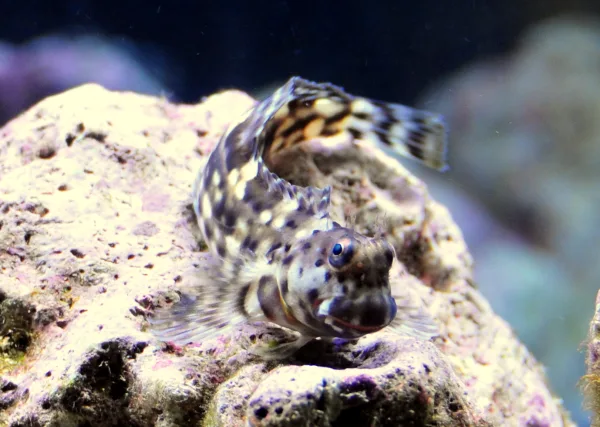
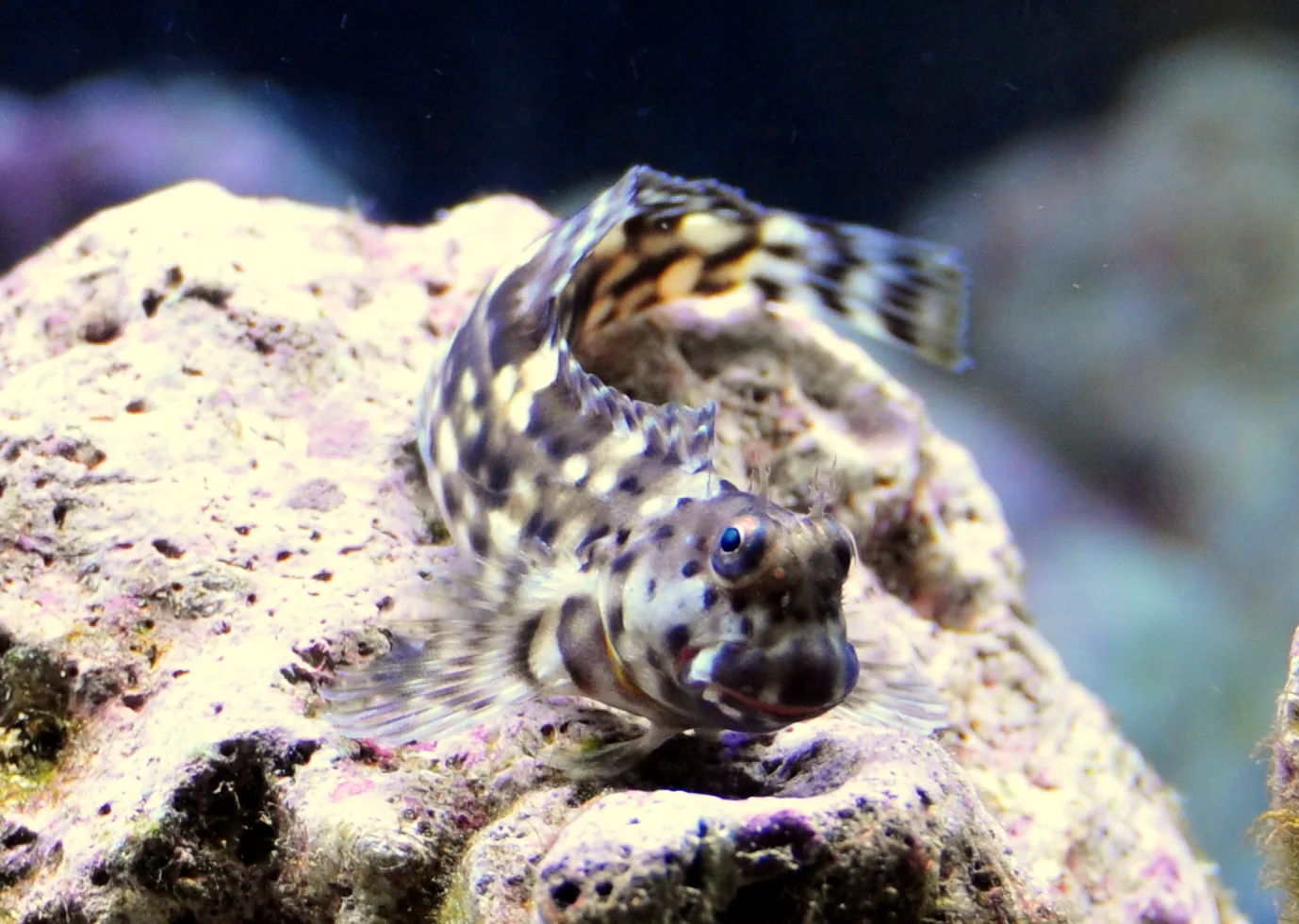
The Lawnmower Blenny got its name because it spends almost the whole day mowing the rocks. It scrapes off a fuzzy layer of tiny algae and crumbs using teeth shaped like a comb. In the wild, one of these fish can take about 3,000 bites in a single day! It has a long body that is brown and green with dark bands and lots of pale spots, plus big eyes on top of its head. It lives in shallow, sunny reef flats and lagoons, from the Red Sea all the way to the Pacific islands. It does not swim much. Instead, it hops and sits on rocks. It gets along with most fish but does not like other blennies. Its tank needs lots of algae, or it can go hungry.
Water & care
Hardy and tolerant of water quality, but it often starves slowly in tanks without enough algae and detritus film, because many individuals ignore prepared foods. Add it only to a mature tank (several months old) with visible algae, and start training it onto nori and herbivore foods right away. Retailers usually call it easy; this profile rates it Moderate because of the starvation risk and its need for space.
| Parameter | Keep it at | Where that sits on the usual reef range |
|---|---|---|
| Temperature | 72–78 °F | |
| Salinity (SG) | 1.020–1.025 | |
| pH | 8.1–8.4 | |
| Alkalinity | 8–12 dKH |
Standard retailer care ranges (LiveAquaria); Aquariadise quotes 75-84 F and SG 1.023-1.025, so warm reef temperatures are fine. Although wild fish enter estuaries, do not keep it in brackish water. In a reef, follow your corals' targets for calcium, magnesium and nutrients. Very low-nutrient tanks grow little algae for it to eat.
Feeding
DietHerbivore
Favorite foods
- Diatom and microalgae films on rock and glass
- Fine turf and hair algae
- Nori (dried seaweed) on a clip
- Frozen herbivore blends
- Spirulina-enriched brine shrimp
- Algae-based pellets
If algae is plentiful, supplement several times a week; if algae is scarce, feed small amounts of algae-based food several times a day (Scott Michael, TFH). Watch the belly and the muscles along the back: a pinched-in look means it needs more food or a tank with more algae. Acceptance of prepared foods varies; many learn to eat nori and herbivore pellets, some refuse everything but natural growth. Treat meaty foods as an occasional extra.
Tank & maintenance
- Minimum tank
- 55 gallons
- Aquascape
- Plenty of mature live rock with algae films and flat perching ledges, plus caves to retreat into. The tank should be several months old. Cover the top and the overflow, since it can leap into overflow boxes.
- Lighting
- Normal reef or fish-only lighting; enough light to keep film algae growing on the rocks helps feed it.
- Water flow
- Moderate. Very strong current can tumble it around the bottom.
Routine upkeep
Check body condition weekly. Keep an algae supply going: leave the back glass unscraped, or rotate algae-covered rocks grown in a sump or refugium. Regular partial water changes (around 20 percent every two weeks), a sealed lid and a covered overflow.
Temperament & tankmates
TemperamentPeaceful
Peaceful with most unrelated fish, but intolerant of its own kind and other Salarias: two of the same sex in a small tank may fight to the death. Smaller blennies such as Ecsenius are especially at risk. It occasionally nips seahorses, pipefish, and the bodies or fins of tangs, rabbitfish and trunkfish. Keep one per tank; pairs only in large systems.
Reef safeYes
Generally safe with corals and invertebrates. Occasional individuals nip small-polyp stony corals or clam mantles (LiveAquaria; Scott Michael in TFH), large ones rarely eat slender shrimp or nip the arm tips of serpent stars, and its grazing can knock snails off the glass. Individual taste varies: some eat filamentous hair algae, while others prefer diatoms and microalgae films, so it is not a guaranteed cure for a hair algae outbreak.
Good tankmates
- Clownfish
- Chromis
- Cardinalfish
- Wrasses
- Dwarf angelfish
- Tangs in large tanks (watch for fin nipping)
Avoid
- Another lawnmower or other Salarias blenny, unless a pair in a large tank
- Smaller blennies such as Bicolor, Midas or Tailspot Blennies
- Seahorses and pipefish
- Other algae grazers competing for food in small tanks
- Large predators: lionfish, groupers, triggerfish
Help it thrive
- Wait until the tank is several months old and has visible algae films before adding one.
- Start nori on a clip straight away so it learns prepared foods while natural algae is still available.
- Grow algae for it: an unscraped back wall or spare rocks in a lit sump give it extra grazing.
- Keep one per tank; try a pair only in a large system with plenty of algae.
- Do not mix it with small, timid blennies such as Ecsenius species.
Common ailments
Starvation (wasting)
- Signs
- Pinched-in belly, sunken muscles along the back, slow movement and constant searching for food.
- Prevention
- Add it only to a mature, algae-rich tank, train it onto nori and herbivore pellets, and keep algae growing.
- Treatment
- Increase feedings of algae-based foods several times a day, add algae-covered rocks, or move it to a larger or more algae-rich tank.
Marine ich (Cryptocaryon) and velvet (Amyloodinium)
- Signs
- White salt-grain spots (ich) or a fine gold-gray dust (velvet), fast breathing, scratching, hiding and loss of appetite.
- Prevention
- Quarantine new fish for several weeks and keep water quality stable.
- Treatment
- Treat in a separate hospital tank. Blennies are scaleless and some medications are risky for scaleless fish, so check that a treatment is suitable, dose carefully and monitor closely.
Fight wounds and torn fins
- Signs
- Ragged fins, bite marks and a fish hiding or being chased constantly, usually by or from another blenny.
- Prevention
- One per tank, no similar blennies, and enough rock to break lines of sight.
- Treatment
- Separate the fish, keep the water very clean so fins regrow, and treat any secondary infection in a hospital tank.
This is general hobby guidance, not veterinary advice. Quarantine new arrivals and treat in a separate tank whenever you can.
Risks of owning one
- Slow starvation if the algae runs out and it refuses prepared foods.
- Two of the same sex in a small tank may fight to the death.
- It bullies smaller blennies and may nip seahorses, pipefish and the fins of tangs or rabbitfish.
- It can jump out of open tanks or into overflow boxes.
- Occasional individuals nip SPS polyps or clam mantles.
Breeding
DifficultyVery hard Captive-bredRare or wild-caught
Pairs have spawned in aquariums (a 2008 CORAL magazine article covered its sex differences and captive spawning), laying adhesive eggs in shelters such as empty shells, which the male guards. Raising the planktonic larvae was not documented until The Biota Group released captive-bred juveniles in 2023. Captive-bred fish exist but are not yet commonly available, and the rearing method has not been published.
- Obtain a male and a female; adult males have longer front anal-fin rays, but the difference is slight and pairing is largely luck.
- House the pair in a large, mature tank with abundant algae and shelters such as empty clam shells or caves.
- Condition them with frequent herbivore feedings plus some meaty foods.
- Let the male guard the eggs, then move the larvae to a separate rearing tank at hatching.
- Feed live rotifers and then newly hatched brine shrimp; expect heavy losses, as commercial methods are not public.
Deep dive The science, history and family tree
The science
Salarias fasciatus is a combtooth blenny (Blenniidae: Salariinae) and the type species of the genus Salarias. It reaches about 14 cm total length. The body is elongate and scaleless, olive to brown with several dusky bars, dark streaks on the head and front of the body and numerous pale or white spots, with small bright blue spots edged in dark on the rear body; it can lighten or darken parts of its body to match the background. The dorsal fin, with 12 spines and 18-20 soft rays, has no notch, and both the dorsal and anal fins (2 spines, 19-21 soft rays) are joined to the base of the tail by a membrane. Adult males have elongated front anal-fin rays. The species occurs across the Indo-Pacific from the Red Sea and East Africa to Samoa and Micronesia, north to the Ryukyu Islands and south to the Great Barrier Reef and New Caledonia. Adults live at 0-8 m on reef flats, in shallow lagoons and on seaward reefs, and also enter estuarine areas. They are usually solitary in weedy areas on rocks and coral outcrops over mixed coral, sand and rubble, and can breathe air when necessary. Feeding is almost continuous: the fish scrapes the algal turf and its trapped detritus from hard surfaces, taking thousands of bites a day, and plant material makes up only about 15 percent of what it eats. Reproduction is oviparous with distinct pairing; adhesive demersal eggs are laid in shelters such as empty shells and guarded by the male, and the larvae are planktonic. It is assessed as Least Concern.
- Appearance
- Mottled olive, tan and brown with darker bars, dark streaks on the head and front of the body and many pale spots; the rear body carries small blue spots edged in dark. Large eyes sit high on a blunt head, and the long dorsal fin runs without a notch to the tail. Adult males have elongated front anal-fin rays. It can pale or darken patches of color to blend in. Look-alikes: the Starry Blenny (Salarias ramosus) is darker and covered in small white spots; the Black Sailfin Blenny (Atrosalarias fuscus) is uniformly dark as an adult; other Salarias, such as the Segmented Sailfin Blenny (Salarias segmentatus), are occasionally sold under similar names.
- Native range
- Indo-Pacific: Red Sea and East Africa east to Samoa and Micronesia, north to the Ryukyu Islands, south to the Great Barrier Reef and New Caledonia.
- Habitat
- Shallow reef flats, lagoons and seaward reefs at 0-8 m (0-26 ft), and estuarine areas. Usually solitary in algae-covered (weedy) areas on rocks and coral outcrops over mixed coral, sand and rubble.
- Size
- 5.5 in (14 cm). FishBase and Wikipedia give 14 cm (5.5 in) total length as the maximum. Retailers list up to about 5 in; most aquarium specimens are 3-5 in.
- Lifespan
- Up to about 6 years reported in aquariums (Aquariadise); not well documented.
- Conservation
- Least Concern. Least Concern; widespread and common. Not CITES-listed. Most aquarium specimens are wild-collected; captive-bred juveniles were first offered in 2023 by The Biota Group, which still listed them in 2026, but supply is limited. Captive-bred fish usually accept prepared foods readily
In the aquarium vs in the wild
In your aquarium
Algae grazer and character fish: it keeps film and fine turf algae down in mature tanks and becomes tame and entertaining. Individuals differ, so it is not a guaranteed hair-algae cure.
On the reef
A busy grazer on shallow reef flats that scrapes the algal turf and its trapped detritus from rock, helping keep turf short, and a prey item for larger reef fishes.
History
Marcus Elieser Bloch described the fish in 1786 as Blennius fasciatus. In 1816 Georges Cuvier founded the genus Salarias with Salarias quadripennis as its type species, but that name was later shown to be a junior synonym of Bloch's species, which made S. fasciatus the type species of the genus. In the reef hobby it has long been sold as the lawnmower or algae blenny for its grazing. A 2008 CORAL magazine article covered its sex differences and captive spawning, but captive-bred juveniles were not documented until The Biota Group offered them in 2023.
Evolution & relatives
Salarias is a genus of about 13 combtooth blennies (TFH) in the subfamily Salariinae of the Blenniidae, a family of roughly 400 mostly small, scaleless, bottom-living fishes in 58 genera. Combtooth blennies belong to Blenniiformes, part of Ovalentaria, a large branch of spiny-rayed fishes named in 2012 and united by eggs that are laid on and attached to the bottom. Damselfishes and clownfishes, dottybacks, basslets, cichlids and silversides are all on this branch. Gobies, which share the bottom-perching lifestyle, belong to a separate lineage (Gobiiformes), so on the tree of life a lawnmower blenny sits closer to a clownfish than to a goby. Blenny fossils are known from the Miocene. Within Salariinae its familiar relatives include the Starry and Segmented Sailfin Blennies (same genus), the Black Sailfin Blenny (Atrosalarias) and the coralblennies of the genus Ecsenius, such as the Bicolor Blenny.
Family tree, from kingdom down
- Kingdom Animalia Animals Animals are living things made of many cells that must eat food to live. Fish, corals, crabs, snails and sea stars are all animals.
- Phylum Chordata Chordates Chordates have a stiff rod running down their back at some point in their lives. In fish and people, this rod is replaced by a backbone.
- Subphylum Vertebrata Vertebrates Vertebrates are animals with a backbone and a skull. Fish, frogs, birds and people are all vertebrates.
- Infraphylum Gnathostomata jawed vertebrates
- Parvphylum Osteichthyes bony fishes
- Gigaclass Actinopterygii ray-finned fishes
- Superclass Actinopteri
- Class Teleostei Teleost fishes Teleosts are bony fishes with thin, bendy fin rays and jaws that can push forward. Almost all of the fish in the world are teleosts.
- Order Blenniiformes Blennies and kin This order includes blennies and their relatives. Most are small fish that perch on the bottom and peek out of holes.
- Family Blenniidae Combtooth blennies Combtooth blennies are small fish with rows of comb-like teeth and no scales. Many scrape algae and peek out from holes in rock.
- Subfamily Salariinae Algae-scraping blennies
- Genus Salarias Lawnmower blennies These blennies have many tiny teeth for scraping algae, like a lawnmower cutting grass.
- Species Salarias fasciatus
See it on the Tree of Life Compare with another species
Closest relatives
- Salarias ramosus Starry Blenny Same genus; also sold as an algae grazer
- Salarias segmentatus Segmented Sailfin Blenny Same genus
- Atrosalarias fuscus Black Sailfin Blenny Same subfamily (Salariinae), different genus; an obligate microalgae grazer
- Ecsenius bicolor Bicolor Blenny Same subfamily (Salariinae), different genus Read guide · Compare
Older scientific names: Blennius fasciatus, Salarias quadripennis.
Fun facts
- A wild jewelled blenny takes around 3,000 bites of rock a day and feeds almost nonstop.
- It can breathe air when it needs to, handy on shallow reef flats.
- Despite its algae-eater name, most of what it swallows is detritus; plant material is only about 15 percent of its diet.
- Captive-bred lawnmower blennies were not documented until 2023, more than 230 years after the species was named.
- It can pale or darken patches of its body to blend into the rocks.
Learn more
- FishBase: Salarias fasciatus fishbase.se
- TFH Magazine: Uber Algae Eaters, the Lawnmower Blennies (Scott Michael) tfhmagazine.com
- CORAL Magazine: Long Overdue: Captive-Bred Lawnmower Blennies! coralmagazine.com
- Aquariadise: Lawnmower Blenny care aquariadise.com
Sources
- FishBase species summary: Salarias fasciatus fishbase.se
- WoRMS: Salarias fasciatus (Bloch, 1786) marinespecies.org
- Wikipedia: Salarias fasciatus en.wikipedia.org
- TFH Magazine: Uber Algae Eaters, the Lawnmower Blennies tfhmagazine.com
- CORAL Magazine: Long Overdue: Captive-Bred Lawnmower Blennies! (2023) coralmagazine.com
- LiveAquaria: Sailfin/Algae Blenny liveaquaria.com
- Aquariadise: Lawnmower Blenny care aquariadise.com
- LiveAquaria: Starry Blenny liveaquaria.com
- LiveAquaria: Black Sailfin Blenny liveaquaria.com
- Wikipedia: Blenniidae en.wikipedia.org
- Wikipedia: Ovalentaria en.wikipedia.org
- The Biota Group: Lawnmower Algae Blenny (captive-bred) shop.thebiotagroup.com
Care facts
The care facts on this guide and its product pages (care level, reef safety, temperament, size, tank, diet, flow, purpose, foods, acclimation and origin) combine 14 independent sources, checked October 25, 2026.
- Salarias fasciatus, Jewelled blenny : fisheries, aquarium FishBase
- Lawnmower Blenny: Color Change, Diet, Tank Size & Lifespan Aquarium Source (Millie Sheppard)
- Lawnmower Blenny - Salarias fasciatus - Medium That Pet Place
- Lawnmower Blenny - Salarias fasciatus - Top Shelf Aquatics Top Shelf Aquatics
- Lawnmower Blenny care: diet, reef safe, description & facts Saltwater Aquarium Blog (Albert B Ulrich III)
- Lawnmower Blenny Care Guide: Great Algae Eater With One Big Catch Aquarium Store Depot
- BLENNY - LAWNMOWER Salarias fasciatus - Aquatics Unlimited Aquatics Unlimited
- Algae Blenny: Salarias fasciatus Care Guide Studio Scaped
- Lawnmower Blenny - Complete Care Guide Biomes in a Box
- Lawnmower Blenny Care Sheet Build Your Aquarium
- Lawnmower Blenny Aquariadise
- Lawnmower Blenny: Diet, Reef Compatibility, Tank Size & More light.fish
- Lawnmower Blenny Biota
- Lawnmower Blenny Care Guide Gensou
Scientific names and classification follow the World Register of Marine Species (AphiaID 219340). Checked by our team. Last updated October 29, 2026.
Shop this species
Search the shop →