 Sold out
Fish · Blenny
Bicolor Blenny
Ecsenius bicolor
Also called Flame Tail Blenny, Two-colored Blenny, Bicolour Blenny
- CareEasy
- Reef safeWith caution
- TemperamentPeacefulChases blennies and look-alikes; peaceful otherwise
- Favorite foods
- Algae grown on live rock
- Nori / algae pellets
- Mysis shrimp
- Max size4 in (10.2 cm)
- Min tank30 gal
- LifespanNot well documented
- IUCN statusLeast Concern
Quick answers
- How big does the Bicolor Blenny get?
- Up to 4 in (10.2 cm).
- What size tank does it need?
- At least 30 gallons.
- How hard is it to keep?
- Care level: Easy.
- Is it reef safe?
- With caution. It mostly grazes algae, but LiveAquaria notes it may nip clam mantles and fleshy large-polyp stony (LPS) corals when underfed, and aquarists on Meerwasser-Lexikon report individuals chewing holes in Acropora and eating Montipora digitata polyps.
- What does it eat?
- Algae grown on live rock
- Nori / algae pellets
- Mysis shrimp
- How long does it live?
- Not well documented.
- What are good tankmates?
- Clownfish
- Chromis
- Cardinalfish
- Peaceful damselfish
- Tangs (in tanks large enough for them)
The 30-second version
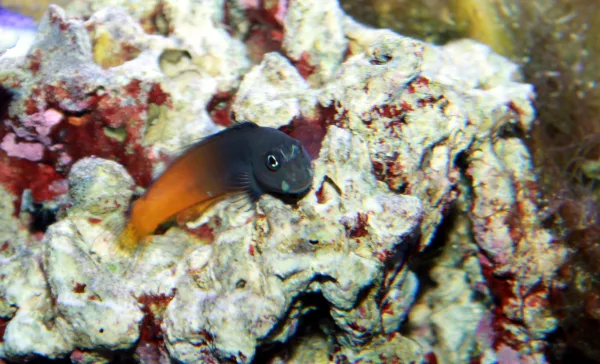
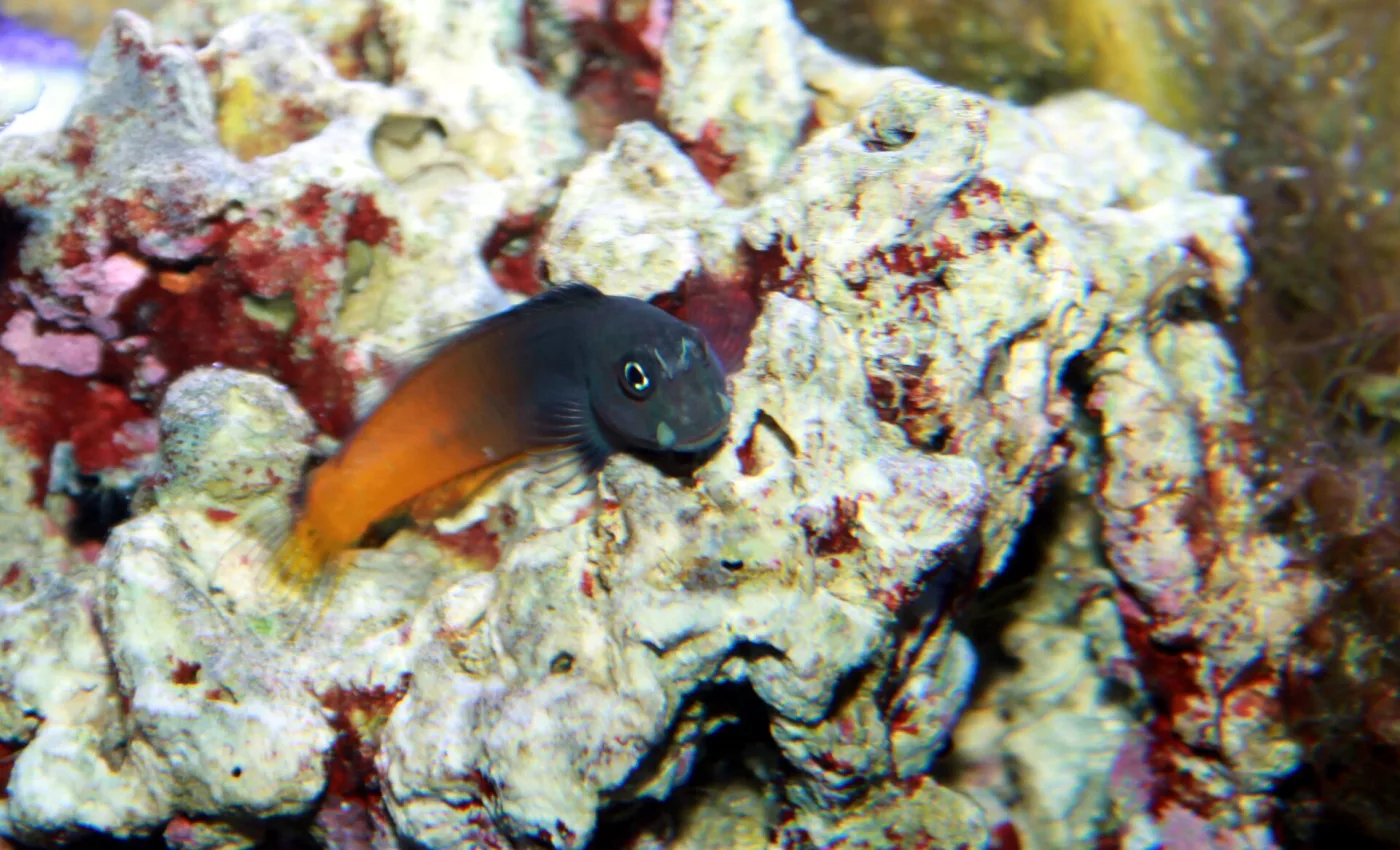
The Bicolor Blenny is a small fish that looks like it has on two shirts at once. The front half is dark brown or blue. The back half is bright orange. It lives on coral reefs in the Indian and Pacific Oceans. It does not swim around all day. It hops from rock to rock. It likes to sit in a small hole with just its head poking out, and it watches the world with its big eyes. Its teeth are lined up like a tiny comb. It uses them to scrape green fuzz off the rocks, a bit like a cow eating grass. If it gets scared, it zips away fast. It can even jump, so its tank needs a lid. It is a funny, curious fish, but it likes to have its own space.
Water & care
Hardy and adaptable once settled, as long as it has mature live rock to graze and gets algae-based foods every day. The usual problems are underfeeding (which leads to a thin, pinched belly and sometimes coral nipping), housing it with look-alike or same-niche fish, and an uncovered tank. Add it to an established aquarium rather than a new one with bare rock.
| Parameter | Keep it at | Where that sits on the usual reef range |
|---|---|---|
| Temperature | 72–78 °F | |
| Salinity (SG) | 1.020–1.025 | |
| pH | 8.1–8.4 | |
| Alkalinity | 8–12 dKH |
Ranges are the standard retailer care ranges (LiveAquaria). In a coral reef, follow your corals' targets for salinity, calcium, magnesium and nutrients; the blenny has no special needs there, so those values are left blank. Avoid stripping nutrients to near zero in a small tank: an algae-free 'ultra clean' system leaves it little to graze. Ammonia and nitrite must stay at zero.
Feeding
DietHerbivore
Favorite foods
- Film and turf algae grazed from live rock
- Nori (dried seaweed) on a clip
- Spirulina and other algae-based flakes or pellets
- Frozen herbivore blends
- Small amounts of mysis or brine shrimp
It grazes through the day, so it needs algae on the rocks plus algae-based prepared foods at least twice daily. Offer small portions of meaty frozen foods such as mysis now and then. Keep the diet mainly vegetable: some keepers suspect diets heavy in meaty foods shorten its life. A hollow, pinched belly means it is not getting enough.
Tank & maintenance
- Minimum tank
- 30 gallons
- Aquascape
- Mature, porous live rock with many holes and caves at different heights for perching, grazing and hiding. Make sure the rockwork is stable. Add it only to an established tank with visible algae growth.
- Lighting
- No special needs; normal reef or fish-only lighting is fine and helps grow the algae it grazes.
- Water flow
- Low to moderate around the rockwork where it perches; typical reef flow elsewhere is fine.
Routine upkeep
Standard reef upkeep: regular partial water changes (about 10-20 percent every one to two weeks) and stable salinity. Check daily that it is eating and that its belly looks rounded, leave some film algae on rocks or the back glass for grazing, and keep the lid and overflow covers free of gaps.
Temperament & tankmates
TemperamentPeaceful
Peaceful toward most unrelated, differently shaped fish, but territorial about its favorite holes. It may pick on other blennies, small gobies and dartfish, and does not tolerate another bicolor blenny (except a bonded pair) or similarly colored fish such as the Royal Gramma and Bicolor Dottyback. Aggression rises as tank size shrinks, so it is not a good nano fish.
Reef safeWith caution
It mostly grazes algae, but LiveAquaria notes it may nip clam mantles and fleshy large-polyp stony (LPS) corals when underfed, and aquarists on Meerwasser-Lexikon report individuals chewing holes in Acropora and eating Montipora digitata polyps. Even harmless picking can make corals stay closed. The risk is lowest in large, algae-rich reefs with regular herbivore feedings; watch it closely in SPS-dominated tanks and around tridacnid clams, and rehome an individual that keeps nipping.
Good tankmates
- Clownfish
- Chromis
- Cardinalfish
- Peaceful damselfish
- Tangs (in tanks large enough for them)
- Sand-dwelling gobies in larger tanks
Avoid
- Another bicolor blenny, unless a bonded pair
- Other Ecsenius and similar-shaped blennies in small tanks
- Royal Gramma and Bicolor (Royal) Dottyback, which share its colors
- Small dartfish and small gobies in small tanks
- Predators such as lionfish, groupers, eels, hogfish and triggerfish
Help it thrive
- Add it to a tank that has been running for several months and has film algae on the rocks.
- Give it several perching holes facing the front glass; it will pick a favorite lookout.
- Feed algae-based food at least twice a day, and clip nori in the tank when natural algae runs thin.
- Keep only one per tank unless you have a proven pair, and skip similar-looking fish.
- Use a tight-fitting lid: startled blennies dart upward and can jump out.
Common ailments
Wasting from underfeeding
- Signs
- Pinched or hollow belly, thin back muscles, lethargy, and picking at corals or clams in search of food.
- Prevention
- Only add it to a mature tank with algae growth, and feed algae-based foods at least twice daily from the start.
- Treatment
- Increase herbivore feedings, offer nori on a clip and algae-covered rocks; if it will not eat prepared foods, move it to a tank or refugium with more natural algae.
Marine ich (Cryptocaryon) and velvet (Amyloodinium)
- Signs
- White salt-grain spots (ich) or a fine gold-gray dust (velvet), rapid breathing, scratching against rocks, hiding and refusing food.
- Prevention
- Quarantine new fish for several weeks before adding them, and keep water quality stable to reduce stress.
- Treatment
- Treat in a separate hospital tank, never in the reef. Blennies are scaleless, and keepers report they can react badly to some medications, so dose carefully, monitor closely and seek experienced advice before using copper or other harsh treatments.
Jumping and stress injuries
- Signs
- Fish found on the floor or in the overflow, scrapes on the body, or a fish that hides constantly after a fright.
- Prevention
- Fit a tight lid or mesh screen, cover overflow gaps, and acclimate carefully with lights dimmed.
- Treatment
- Prevention is the only reliable answer. A fish recovered quickly may survive; return it to calm, dim conditions and watch for infection.
This is general hobby guidance, not veterinary advice. Quarantine new arrivals and treat in a separate tank whenever you can.
Risks of owning one
- Individuals can nip LPS corals, Acropora or Montipora polyps, and clam mantles, especially when hungry.
- It jumps when startled; uncovered tanks often lose blennies.
- It can bully other small bottom-dwellers and look-alike fish in small tanks.
- It slowly wastes away if the tank has little algae and it refuses prepared foods.
- Harmless to people: it has no venom.
Breeding
DifficultyVery hard Captive-bredRare or wild-caught
Bonded pairs spawn in home aquariums: the female lays adhesive, demersal eggs in a hole or crevice and the eggs are guarded until they hatch after several days. Rearing the tiny planktonic larvae is the bottleneck. Meerwasser-Lexikon reports that captive offspring are possible but far too few to supply the trade, and no commercial captive-bred E. bicolor was found. For context, ORA's Ecsenius gravieri in 2014 was the first reported Ecsenius blenny raised in captivity.
- Obtain a compatible pair; males are larger, with a longer dorsal fin and thicker lips, and turn blue on the front half when breeding.
- Provide caves, tubes or crevices where eggs can be laid and guarded.
- Condition the pair with frequent feedings of algae-based foods plus some meaty foods.
- Move the eggs or newly hatched larvae to a separate larval tank, because tankmates eat them.
- Feed rotifers first, then newly hatched brine shrimp as the larvae grow; frequent small water changes help.
- Expect heavy losses: most fry do not survive even in experienced hands.
Deep dive The science, history and family tree
The science
Ecsenius bicolor is a combtooth blenny (Blenniidae: Salariinae) of the Indo-Pacific, ranging from the Maldives east to the Phoenix Islands, north to the Ryukyu Islands, south to the southern Great Barrier Reef and throughout Micronesia. It reaches about 11 cm total length. Like other blenniids it has an elongate, scaleless body, a blunt head with large eyes, a long continuous dorsal fin (11-12 spines, 15-18 soft rays; anal fin 2 spines, 17-21 rays) and comb-like teeth used to scrape food from hard surfaces. Three colour phases are recognized: the familiar bicolor phase, dark brown to blue-black in front and yellow-orange behind, and two phases that are dark above with a broad white lateral band and a dusky belly, with or without a yellow tail. Males are generally larger than females and change colour when breeding. The species lives on clear lagoon and seaward reefs with mixed corals and algae-covered rock at about 1-25 m. It is usually solitary and shelters in abandoned tubes and small holes in the reef, darting out to graze on the algal film and associated detritus (trophic level about 2.0). Reproduction is oviparous with distinct pairing: the eggs are demersal and adhesive, attached to the substrate by a filamentous pad, and are guarded until they hatch, after which the larvae are planktonic. The species is assessed as Least Concern by the IUCN and is one of the most frequently traded Ecsenius blennies.
- Appearance
- A small, perching blenny with a blunt face and large, high-set eyes. The classic form is dark brown to deep blue on the front half and bright yellow-orange on the rear half and tail. Other colour phases are dark above with a broad white stripe along the side and a dusky belly, with or without a yellow tail, and lighter variants are seen in the trade. Males grow larger, have a longer dorsal fin and turn a vivid blue on the front half when spawning. Look-alikes: the Royal Gramma (purple and yellow, but a hovering basslet with a black eye line) and the Bicolor (Royal) Dottyback, Pictichromis paccagnellae (magenta and yellow with a sharp colour break). Neither perches on rocks the way a blenny does.
- Native range
- Indo-Pacific: Maldives east to the Phoenix Islands, north to the Ryukyu Islands, south to the southern Great Barrier Reef, and throughout Micronesia.
- Habitat
- Clear lagoon and seaward reefs with mixed corals and algae-covered rock, at about 1-25 m (3-82 ft). Usually solitary, living in an empty tube or small hole in the reef from which it watches its surroundings and darts out to graze.
- Size
- 4 in (10.2 cm). FishBase gives 11 cm (4.3 in) total length as the maximum. Retailers list about 4 in; most aquarium specimens are 2-4 in.
- Lifespan
- Not well documented. One care guide gives about 2-4 years in the wild and up to about 10 years in captivity with good care; treat these figures as rough.
- Conservation
- Least Concern. Assessed Least Concern by the IUCN; widespread and common. Not CITES-listed. Aquarium specimens are wild-collected: no commercial captive-bred supply of this species was found during research
In the aquarium vs in the wild
In your aquarium
A personable 'character' fish that perches in plain sight and grazes film algae from the rocks. It helps with light algae films but is not a cure for a serious nuisance-algae outbreak.
On the reef
A small grazer that crops algae and the detritus trapped in it from reef rock, and a prey item for larger reef predators.
History
Francis Day described the species in 1888 as Salarias bicolor in a supplement to The Fishes of India. Several later names (Salarias furcatus 1904, Salarias melanosoma 1909, Salarias burmanicus 1936 and Ecsenius hawaiiensis 1952) turned out to be the same fish. The genus Ecsenius was created by Allan McCulloch in 1923, and Victor Springer's revisions in 1971 and 1988 set out the modern species list. Thanks to its two-tone colors and comical perching, the bicolor blenny has long been one of the most commonly sold blennies in the reef hobby.
Evolution & relatives
Ecsenius is a genus of about 53 small Indo-Pacific reef blennies, often called coralblennies, within the subfamily Salariinae of the combtooth blennies (Blenniidae, roughly 400 species in 58 genera). Combtooth blennies belong to the order Blenniiformes, part of a large branch of spiny-rayed fishes called Ovalentaria, named in 2012 and united by eggs that are laid on and attached to the bottom. That branch also holds damselfishes and clownfishes, dottybacks, basslets such as the Royal Gramma, cichlids and silversides. Gobies look and act a lot like blennies, but they belong to a separate lineage (Gobiiformes), so on the tree of life a bicolor blenny actually sits closer to a clownfish than to a goby. Blenny fossils are known from the Miocene, and Ovalentaria goes back at least to the early Paleocene, just after the dinosaurs disappeared. Within Ecsenius, its familiar relatives in the trade include the Midas Blenny and the Tailspot Blenny.
Family tree, from kingdom down
- Kingdom Animalia Animals Animals are living things made of many cells that must eat food to live. Fish, corals, crabs, snails and sea stars are all animals.
- Phylum Chordata Chordates Chordates have a stiff rod running down their back at some point in their lives. In fish and people, this rod is replaced by a backbone.
- Subphylum Vertebrata Vertebrates Vertebrates are animals with a backbone and a skull. Fish, frogs, birds and people are all vertebrates.
- Infraphylum Gnathostomata jawed vertebrates
- Parvphylum Osteichthyes bony fishes
- Gigaclass Actinopterygii ray-finned fishes
- Superclass Actinopteri
- Class Teleostei Teleost fishes Teleosts are bony fishes with thin, bendy fin rays and jaws that can push forward. Almost all of the fish in the world are teleosts.
- Order Blenniiformes Blennies and kin This order includes blennies and their relatives. Most are small fish that perch on the bottom and peek out of holes.
- Family Blenniidae Combtooth blennies Combtooth blennies are small fish with rows of comb-like teeth and no scales. Many scrape algae and peek out from holes in rock.
- Subfamily Salariinae Algae-scraping blennies
- Genus Ecsenius Coralblennies Coralblennies are small blennies that perch on corals and rocks in the Indian and Pacific Oceans. They mostly graze on algae.
- Species Ecsenius bicolor
See it on the Tree of Life Compare with another species
Closest relatives
- Ecsenius midas Midas Blenny Same genus; a popular yellow-orange relative in the trade
- Ecsenius stigmatura Tailspot Blenny Same genus; a smaller nano-tank relative Read guide · Compare
- Ecsenius gravieri Red Sea Mimic Blenny Same genus; the first Ecsenius bred in captivity (ORA, 2014)
- Salarias fasciatus Lawnmower Blenny Same subfamily (Salariinae), different genus Read guide · Compare
- Atrosalarias fuscus Black Sailfin Blenny Same subfamily (Salariinae), different genus
Older scientific names: Salarias bicolor.
Fun facts
- It comes in three color phases: the classic two-tone, plus dark-backed forms with a white stripe down the side, with or without a yellow tail.
- In the wild it often lives alone inside an empty tube in the reef and uses it like a front porch.
- Males change color while breeding, and the front half can turn a vivid blue.
- Its comb-shaped teeth, which give the family the name combtooth blennies, work like a rake for scraping algae off rock.
- Four later scientific names, given between 1904 and 1952 and including Ecsenius hawaiiensis, all turned out to describe this same fish.
Learn more
- FishBase: Ecsenius bicolor fishbase.se
- Meerwasser-Lexikon: Ecsenius bicolor en.reeflex.net
- Salt Water Aquarium Blog: Bicolor Blenny care saltwateraquariumblog.com
- LiveAquaria: Bicolor Blenny liveaquaria.com
Sources
- FishBase species summary: Ecsenius bicolor fishbase.se
- WoRMS: Ecsenius bicolor (Day, 1888) marinespecies.org
- Wikipedia: Ecsenius bicolor en.wikipedia.org
- LiveAquaria: Bicolor Blenny liveaquaria.com
- Salt Water Aquarium Blog: Bicolor Blenny care saltwateraquariumblog.com
- Meerwasser-Lexikon: Ecsenius bicolor en.reeflex.net
- Reef Builders: ORA floors captive-bred Ecsenius gravieri (2014) reefbuilders.com
- Wikipedia: Ecsenius en.wikipedia.org
- Wikipedia: Blenniidae en.wikipedia.org
- Wikipedia: Ovalentaria en.wikipedia.org
Care facts
The care facts on this guide and its product pages (care level, reef safety, temperament, size, tank, diet, flow, purpose, foods, acclimation and origin) combine 12 independent sources, checked October 25, 2026.
- Ecsenius bicolor (Bicolor blenny) - FishBase FishBase
- Bicolor Blenny - Quality Marine Quality Marine
- Bicolor Blenny Care: Ecsenius bicolor Saltwater Aquarium Blog (Albert B Ulrich III, 2021-08-25)
- Bicolor Blenny - Ecsenius bicolor That Pet Place
- Bicolor Blenny Aquarium Source
- LiveAquaria bicolor blenny listing LiveAquaria
- Ecsenius bicolor: a Beginner-Friendly Blenny with Real Character Reef Builders (Jeff Kurtz, 2014-12-26)
- Fish Library: Ecsenius bicolor (Bi-color Blenny) Saltcorner
- Bicolor Blenny (Ecsenius bicolor) Species Profile AquariumDomain.com
- Bicolor Blenny - Blennies - Saltwater Fish SaltwaterFish.com
- Bicolor Blenny - Ecsenius bicolor Whitlyn Aquatics
- Bicolor Blenny care guide Gensou
Scientific names and classification follow the World Register of Marine Species (AphiaID 277652). Last updated October 25, 2026.
Shop this species
Search the shop →Sold out right now. We restock weekly, so check back soon.
Sold out