Invertebrates · Shrimp
Skunk Cleaner Shrimp
Lysmata amboinensis
Also called Scarlet Skunk Cleaner Shrimp, Pacific Cleaner Shrimp, Scarlet Cleaner Shrimp, White-banded Cleaner Shrimp, Indo-Pacific White-striped Cleaner Shrimp
- CareEasy
- Reef safeYes
- TemperamentPeacefulPeaceful; may squabble with other shrimp
- Favorite foods
- Chopped seafood / mussel
- Frozen meaty foods
- Pellets and flakes
- Max size3 in (7.6 cm)
- Min tank30 gal
- LifespanSeveral years in a stable aquarium
- IUCN statusNot Evaluated
Quick answers
- How big does the Skunk Cleaner Shrimp get?
- Up to 3 in (7.6 cm).
- What size tank does it need?
- At least 30 gallons.
- How hard is it to keep?
- Care level: Easy.
- Is it reef safe?
- Yes. Does not eat corals, clams or other invertebrates.
- What does it eat?
- Chopped seafood / mussel
- Frozen meaty foods
- Pellets and flakes
- How long does it live?
- Several years in a stable aquarium; Reef Builders notes they can live for many years, but there are no rigorous longevity data.
- What are good tankmates?
- Peaceful reef fish such as clownfish, gobies, blennies, tangs and anthias
- Another skunk cleaner as a pair
- Corals, clams and snails
- Other peaceful shrimp such as fire shrimp in larger tanks
The 30-second version
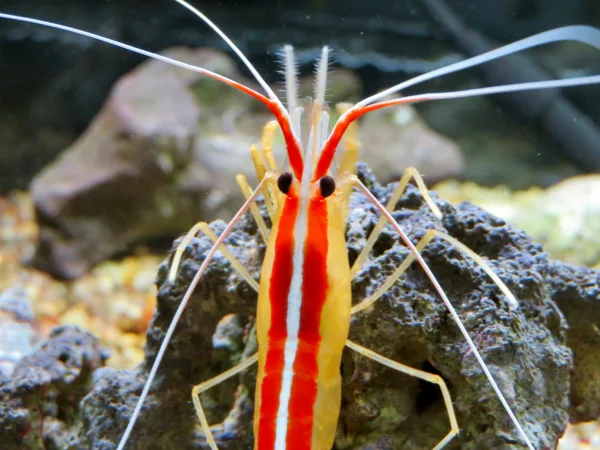
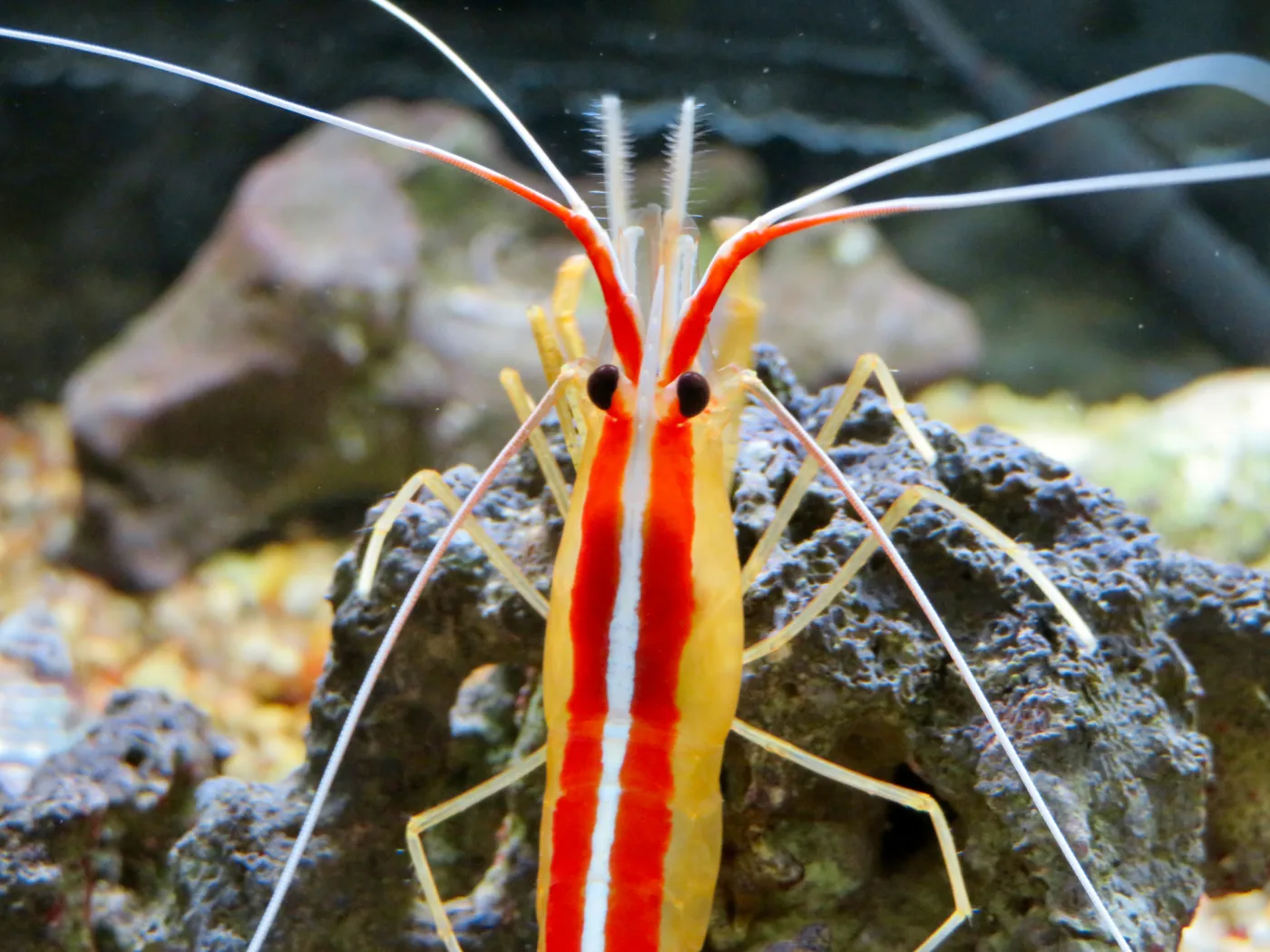
The Skunk Cleaner Shrimp is a small shrimp with a stripe down its back, just like a skunk. Its body is yellow-orange, with two red stripes and one thin white stripe on top, and it has long white feelers. In the wild it lives on coral reefs in the Indian and Pacific Oceans, often inside caves. It runs a "cleaning station." Fish swim up and hold still, and the shrimp climbs on them to pick off tiny pests and dead skin. Some fish even let it clean inside their mouths! If you hold your hand still in the tank, it may try to clean you too. Every grown-up skunk shrimp is both a mom and a dad, so any two adults can make babies. It needs gentle care: no copper medicine and no sudden changes in how salty the water is.
Water & care
Hardy once settled, but like all shrimp it does not tolerate copper or other invertebrate-toxic medications, sudden salinity or pH swings, or high nitrate. Drip-acclimate slowly (an hour or more). It needs a mature tank with caves where it can hide while molting; it molts every few weeks and the empty shell left behind is normal. LiveAquaria recommends iodine and trace-element supplements for molting, but the benefit is anecdotal; keep calcium, alkalinity and magnesium at normal reef levels and do regular water changes.
| Parameter | Keep it at | Where that sits on the usual reef range |
|---|---|---|
| Temperature | 72–78 °F | |
| Salinity (SG) | 1.023–1.025 | |
| pH | 8.1–8.4 | |
| Alkalinity | 8–12 dKH | |
| Nitrate | 0–20 ppm |
Temperature, specific gravity, pH and dKH are LiveAquaria's care ranges. Keep salinity very stable; shrimp handle slow drift far better than sudden change. Nitrate: retailers warn that shrimp do not tolerate high nitrate; under 20 ppm is the usual invertebrate guideline. Calcium, magnesium and phosphate are not species-specific, so they are left blank: keep normal reef levels. Ammonia and nitrite must be zero, and copper must be absent.
Feeding
DietOmnivore
Favorite foods
- Mysis shrimp
- Frozen brine shrimp
- Flake and pellet foods
- Parasites and dead tissue picked from fish
Scavenges leftover fish food and will take freeze-dried, frozen and flake foods (LiveAquaria). In a well-fed community tank it often finds enough, but a small piece of mysis or a pellet a few times a week keeps it from going hungry, especially in very clean or lightly stocked tanks. Do not count on fish parasites as its food.
Tank & maintenance
- Minimum tank
- 30 gallons
- Aquascape
- Mature live rock with caves and overhangs; it will claim one as a cleaning station. Provide hiding places for molting.
- Lighting
- No special needs; any reef or fish-only lighting.
- Water flow
- Low to moderate; it tolerates normal reef flow.
Routine upkeep
Standard reef upkeep: regular partial water changes, daily top-off with fresh RO/DI water (ideally an auto top-off) to keep salinity steady, and removal of uneaten food. Leave molted shells alone. Never dose copper, most antiparasitic drugs or invertebrate-toxic pest treatments in the display; treat fish in a separate quarantine tank.
Temperament & tankmates
TemperamentPeaceful
Peaceful toward fish and invertebrates. Pairs are its natural social unit; small groups can work in larger tanks with plenty of caves. A freshly molted shrimp is soft and vulnerable to crabs and larger shrimp.
Reef safeYes
Does not eat corals, clams or other invertebrates. It is an opportunistic scavenger, so it can snatch meaty food from corals and anemones at feeding time and may walk over polyps; feed it directly if this becomes a nuisance.
Good tankmates
- Peaceful reef fish such as clownfish, gobies, blennies, tangs and anthias
- Another skunk cleaner as a pair
- Corals, clams and snails
- Other peaceful shrimp such as fire shrimp in larger tanks
Avoid
- Hawkfish
- Lionfish and other scorpionfish
- Triggerfish and pufferfish
- Large wrasses
- Large predatory crabs
- Copper-treated systems
Help it thrive
- Drip-acclimate for at least an hour and match salinity closely; most losses happen in the first days after a salinity or pH shock.
- Give it a cave or overhang near the front of the tank; it will set up a cleaning station there and become a showpiece.
- Keep a pair if your tank allows: any two adults can mate, and you will often see eggs carried under the tail.
- Offer small meaty foods a few times a week instead of relying on scraps.
- Do not rely on a cleaner shrimp to cure marine ich or velvet; quarantine new fish, because the medicines that treat those diseases kill shrimp.
Common ailments
Failed or fatal molt
- Signs
- Shrimp stuck in a half-shed shell, hiding and not eating for days, or found dead next to a fresh molt.
- Prevention
- Stable salinity and normal reef alkalinity, calcium and magnesium; a varied diet; caves to hide in; no predators that harass soft, freshly molted shrimp.
- Treatment
- There is no reliable cure. Leave it undisturbed in a quiet, dim spot, check water parameters and correct any swings slowly.
Copper or medication poisoning
- Signs
- Twitching, loss of balance, lying on its side or sudden death soon after a tank was medicated or new rock, sand or decor was added.
- Prevention
- Never use copper or other invertebrate-toxic treatments in a tank with shrimp; treat fish in a separate hospital tank; test for copper if in doubt.
- Treatment
- Move the shrimp to clean, matched water at once, then run fresh carbon or a copper-removing resin and do large water changes in the affected tank.
Acclimation (osmotic) shock
- Signs
- Collapse, twitching or lying on its side within hours to days of being added, especially after a large salinity difference between bag and tank.
- Prevention
- Slow drip acclimation over an hour or more; match salinity and temperature closely before release.
- Treatment
- Usually fatal once symptoms show; keep conditions stable and the light dim, and avoid further handling.
Predation
- Signs
- Shrimp disappears, or only legs and shell pieces are found, usually after a molt or after a new fish is added.
- Prevention
- Do not keep it with hawkfish, lionfish, triggers, puffers, large wrasses or large crabs; provide caves.
- Treatment
- None; rehome the predator before trying again.
This is general hobby guidance, not veterinary advice. Quarantine new arrivals and treat in a separate tank whenever you can.
Risks of owning one
- It will be eaten by hawkfish, lionfish, triggerfish, pufferfish and large wrasses.
- Once you keep shrimp, copper and most antiparasitic medicines cannot be used in the display tank; you need a separate quarantine or hospital tank for fish.
- Very sensitive to salinity swings from evaporation or careless water changes.
- It is not a substitute for quarantine: it may pick at parasites but cannot be relied on to clear an ich or velvet outbreak.
- Practically all specimens are wild-collected, so each purchase draws on reef populations.
Breeding
DifficultyVery hard Captive-bredRare or wild-caught
Spawning is easy: any two adults can mate, and pairs carry eggs in home aquariums regularly, hatching larvae at night. Raising the larvae is the hard part. They drift in the plankton for about 58-140 days in culture, molting repeatedly, often without developing ("mark-time" molting), and losses are heavy. Research groups have reared them on Artemia nauplii, enriched Artemia and pellet diets, but aquaculture has been called problematic because of this long larval phase, and captive-bred skunk cleaners are not a regular trade item.
- Keep a healthy pair well fed on varied meaty foods; eggs appear under the tail soon after a molt.
- As the eggs near hatching they change color and tiny eyes become visible; hatching happens around dusk or at night.
- Collect the newly hatched larvae (they are attracted to a light) into a separate larval tank with gentle, non-turbulent circulation, such as a kreisel-type tank.
- Feed rotifers and newly hatched Artemia nauplii at first, moving to enriched Artemia metanauplii and fine pellet larval diets as they grow.
- Maintain very clean water with daily partial water changes and stable temperature and salinity for two to five months.
- Move settled post-larvae, which look like tiny transparent shrimp walking on surfaces, to a grow-out tank with small rubble for cover.
Deep dive The science, history and family tree
The science
Lysmata amboinensis is a caridean shrimp of the family Lysmatidae and one of the "cleaner" Lysmata: low-density, pair-living species with bright, contrasting colours and long white antennae. Adults reach roughly 5-6 cm body length. The body is yellow-orange with a broad scarlet band on each side of the dorsal midline, the two separated by a narrow white stripe running from the rostrum along the back; the antennae are white. The species ranges through the tropical Indo-West Pacific, including the Red Sea, Hawaii and French Polynesia, and is usually reported from about 5 to 40 m in caves, crevices and under reef ledges. It operates cleaning stations, advertising with a side-to-side rocking display, and removes ectoparasites, dead tissue and mucus from client fishes; moray eels often share its caves. In laboratory trials it ate the eggs and free-swimming larvae of the monogenean fluke Neobenedenia and roughly halved infection success on host fish (Militz & Hutson 2015). Like the other Lysmata studied so far it is a protandric simultaneous hermaphrodite: individuals mature first as males, then become female-phase hermaphrodites that brood embryos but keep functional male ducts and can still mate as males, so any two adults can form a breeding pair. Clutches of a few hundred eggs are carried under the abdomen and hatch as planktonic zoeae. Larval life in culture lasts about 58-140 days, much of it spent in "mark-time" molts without development, which is the main obstacle to commercial aquaculture. Its closest relative is the very similar Atlantic cleaner shrimp L. grabhami.
- Appearance
- Yellow-orange body with a wide red band on each side of a narrow white stripe that runs down the middle of the back; long, bright white antennae. Look-alikes: the Atlantic Lysmata grabhami (its sister species, rare in the trade) is almost identical; Wikipedia describes it with a white stripe along the outer edge of the tail fan. The Blood Red Fire Shrimp (L. debelius) is solid deep red with white spots and white legs. Note that the trade name "scarlet cleaner shrimp" is used for both L. amboinensis and L. debelius, so check the scientific name when ordering.
- Native range
- Tropical Indo-West Pacific, including the Red Sea, the Indonesian archipelago (it is named for Ambon/Amboina), Hawaii and French Polynesia.
- Habitat
- Coral and rocky reefs, usually about 5-40 m deep (SeaLifeBase gives a recorded range of 1-120 m). Lives in pairs in caves, crevices and under ledges, where it runs a cleaning station visited by fishes; often shares caves with moray eels.
- Size
- 3 in (7.6 cm). Body length about 5-6 cm (2-2.4 in) per Wikipedia and Reefguide.org, not counting the long antennae. Retailers sell sizes up to about 3 in, and LiveAquaria lists a 4 in maximum, so measurements vary with how they are taken.
- Lifespan
- Several years in a stable aquarium; Reef Builders notes they can live for many years, but there are no rigorous longevity data.
- Conservation
- Not Evaluated. Not evaluated by the IUCN Red List and not listed by CITES (SeaLifeBase). Nearly all specimens in the trade are wild-collected; Calado et al. (2003) warned that cleaner shrimps are collected in large numbers with likely ecosystem effects, but no population studies exist
In the aquarium vs in the wild
In your aquarium
Showpiece and "reef medic": it cleans willing fish, scavenges leftovers, and becomes very tame. A popular first invertebrate for both reef and fish-only tanks without invertebrate-eating fish.
On the reef
A dedicated cleaner: pairs run cleaning stations where fishes queue to have ectoparasites, parasite eggs, dead tissue and mucus removed. This cleaning mutualism helps keep reef fish healthy and is part of the reef's cleaning network alongside cleaner wrasses and gobies.
History
Described by the Dutch zoologist J. G. De Man in 1888, in his report on decapods collected by Dr. J. Brock in the Indonesian archipelago, originally as a variety of another species (Hippolysmata vittata var. amboinensis); the name refers to Ambon (Amboina). It later stood as Hippolysmata amboinensis until Chace (1972) merged Hippolysmata into Lysmata. Bright Lysmata shrimps have long been kept for their beauty and are among the most intensively traded decapods in the aquarium industry (Rhyne & Lin 2006). Hermaphroditism in Lysmata was reported in the 1980s (including a 1983 thesis by Bundy on peppermint shrimp), and formal studies in 1998 confirmed the protandric simultaneous hermaphrodite system. More recently, lab studies (2015 onward) have tested cleaner shrimps, including this one, as natural parasite control for farmed and aquarium fish.
Evolution & relatives
Lysmata is a genus of caridean shrimps (Caridea) in the superfamily Alpheoidea, the same superfamily as snapping shrimps and the thorid shrimps such as the Sexy Shrimp. Molecular studies (Fiedler et al. 2010; Baeza et al. 2009) found that simultaneous hermaphroditism is widespread across Lysmata and probably evolved before the genus diversified, while well-developed cleaning behavior evolved only once, in a derived "cleaner clade" that probably comprises L. amboinensis, L. debelius and L. grabhami. Most other Lysmata, including the peppermint shrimps, are group-living. Like the peppermint shrimps (the old genus Hippolysmata), the cleaners lack the developed accessory branch on the antennule that marks the 'historic' Lysmata species (Rhyne & Lin 2006). L. amboinensis and the Atlantic L. grabhami are usually treated as sister species: two near-identical cleaners, one in the Indo-Pacific and one in the Atlantic.
Family tree, from kingdom down
- Kingdom Animalia Animals Animals are living things made of many cells that must eat food to live. Fish, corals, crabs, snails and sea stars are all animals.
- Phylum Arthropoda Arthropods Arthropods have jointed legs and a hard outer shell called an exoskeleton. To grow, they must crawl out of the old shell, which is called molting.
- Subphylum Crustacea Crustaceans Crustaceans are arthropods with a hard shell and two pairs of feelers. Most live in water, like crabs, shrimps and lobsters.
- Superclass Multicrustacea
- Class Malacostraca Malacostracans This big class of crustaceans includes crabs, shrimps, lobsters and krill. Their bodies are built from about the same number of segments.
- Subclass Eumalacostraca
- Superorder Eucarida
- Order Decapoda Decapods Decapod means 'ten feet'. Crabs, shrimps, lobsters and hermit crabs all have ten legs, counting their claws.
- Suborder Pleocyemata Egg-carrying decapods
- Infraorder Caridea caridean shrimps
- Superfamily Alpheoidea Snapping, cleaner and anemone shrimps
- Family Lysmatidae Cleaner and peppermint shrimps These shrimps often have long white feelers. Some clean other fish, and others eat pest anemones in aquariums.
- Genus Lysmata Cleaner shrimps Lysmata shrimps include cleaner, fire and peppermint shrimps. Many start life as males and later become male and female at once.
- Species Lysmata amboinensis
See it on the Tree of Life Compare with another species
Closest relatives
- Lysmata grabhami Red-backed Cleaner Shrimp Sister species; its Atlantic counterpart in the cleaner clade
- Lysmata debelius Blood Red Fire Shrimp Same genus; fellow member of the pair-living cleaner clade Read guide · Compare
- Lysmata splendida (no common name) Same genus; Maldivian cleaner shrimp of the L. debelius group
- Lysmata wurdemanni Peppermint Shrimp Same genus; belongs to the group-living peppermint shrimp clade Read guide · Compare
- Lysmata vittata Indian Lined Shrimp Same genus; L. amboinensis was first described as a variety of this species
- Thor amboinensis Sexy Shrimp Same superfamily (Alpheoidea), different family (Thoridae) Read guide · Compare
Older scientific names: Hippolysmata amboinensis, Hippolysmata vittata var. amboinensis.
Fun facts
- Every adult is male and female at once: it starts life as a male, then becomes a hermaphrodite that lays eggs but can still mate as a male.
- It advertises its cleaning service to passing fish with a side-to-side rocking dance.
- In a lab study, these shrimp ate about 63% of parasite eggs in 12 hours during the day and cut the number of flukes that managed to infect fish roughly in half.
- Its larvae drift in the plankton for two to almost five months before settling, which is why almost every skunk cleaner in a shop was caught on a reef.
- Some fish let it clean inside their open mouths, and it will happily "clean" an aquarist's hand.
Learn more
- Wikipedia: Lysmata amboinensis en.wikipedia.org
- Reef Builders: Invertebrate spotlight, the skunk cleaner shrimp reefbuilders.com
- LiveAquaria: Scarlet Skunk Cleaner Shrimp care facts liveaquaria.com
- Militz & Hutson 2015, Beyond Symbiosis: Cleaner Shrimp Clean Up in Culture (PLoS ONE) pmc.ncbi.nlm.nih.gov
- WoRMS: Lysmata amboinensis marinespecies.org
Sources
- WoRMS taxon record 241289 marinespecies.org
- SeaLifeBase: Lysmata amboinensis summary sealifebase.se
- Wikipedia: Lysmata amboinensis en.wikipedia.org
- Wikipedia: Lysmata grabhami en.wikipedia.org
- LiveAquaria: Scarlet Skunk Cleaner Shrimp liveaquaria.com
- Reef Builders: skunk cleaner shrimp spotlight reefbuilders.com
- Reefguide.org: Lysmata amboinensis reefguide.org
- Militz & Hutson 2015, PLoS ONE 10(2): e0117723 pmc.ncbi.nlm.nih.gov
- Bauer 2006, Integrative and Comparative Biology 46(4): 430-438 academic.oup.com
- Fiedler et al. 2010, BMC Evolutionary Biology 10: 297 pmc.ncbi.nlm.nih.gov
- Rhyne & Lin 2006, Bulletin of Marine Science 79(1): 165-204 research.nhm.org
- Lin, Zhang & Rhyne 2002, Broodstock and larval nutrition of marine ornamental shrimp nutricionacuicola.uanl.mx
- Calado et al. 2003, Marine ornamental decapods: popular, pricey, and poorly studied (J. Crustacean Biology) academic.oup.com
Care facts
The care facts on this guide and its product pages (care level, reef safety, temperament, size, tank, diet, flow, purpose, foods, acclimation and origin) combine 14 independent sources, checked October 25, 2026.
- Scarlet Skunk Cleaner Shrimp LiveAquaria
- The Kind of Skunk You Want Quality Marine
- Skunk Cleaner Shrimp - Lysmata amboinensis - Medium/Large That Pet Place
- Scarlet Skunk Cleaner Shrimp Coral Ridge Marine
- Cleaner Shrimp Care Guide: The Reef Tank's Most Fascinating Cleanup Crew Member AquariumStoreDepot
- Scarlet Skunk Cleaner Shrimp (Lysmata amboinensis) Squeaky's Aquatics
- Cleaner Shrimp (Lysmata amboinensis) STL Marine Solutions
- Scarlet Skunk Cleaner Shrimp (Lysmata amboinensis) Vossen Aquatics
- Skunk Cleaner Shrimp Kraken Corals
- Skunk Cleaner Shrimp Saltwater Aquarium Blog
- Skunk Cleaner Shrimp saltwater fish care guide Top Shelf Aquatics
- Cleaner Shrimp Furry Critter
- Invertebrate Spotlight: The Skunk Cleaner Shrimp Reef Builders
- Lysmata amboinensis SeaLifeBase
Scientific names and classification follow the World Register of Marine Species (AphiaID 241289). Last updated October 25, 2026.
Shop this species
Search the shop →