 Hot
Invertebrates · Shrimp
Peppermint Shrimp
Lysmata wurdemanni
Also called Veined Shrimp, Caribbean Cleaner Shrimp
- CareEasy
- Reef safeYes
- TemperamentPeacefulPeaceful; may fight only if crowded
- Favorite foods
- Leftover fish food
- Aiptasia anemones
- Mysis / brine shrimp
- Max size2 in (5 cm)
- Min tank20 gal
- LifespanNot well documented
- IUCN statusNot Evaluated
Quick answers
- How big does the Peppermint Shrimp get?
- Up to 2 in (5 cm).
- What size tank does it need?
- At least 20 gallons.
- How hard is it to keep?
- Care level: Easy.
- Is it reef safe?
- Yes. Most peppermint shrimp leave corals alone, and some retailers call them fully reef safe, but Bulk Reef Supply labels them reef safe with caution because they may pick at fleshy corals and steal coral food, and hobbyists report occasional damage to zoanthids and fleshy LPS such as Acanthastrea, mostly from hungry or misidentified shrimp.
- What does it eat?
- Leftover fish food
- Aiptasia anemones
- Mysis / brine shrimp
- How long does it live?
- Not well documented; aquarium keepers generally report a few years for well-kept animals, but no published longevity data were found.
- What are good tankmates?
- Peaceful reef fish such as clownfish, gobies, blennies, cardinalfish and tangs
- Other peppermint shrimp (groups)
- Snails, hermit crabs and other clean-up crew
- Most SPS and soft corals
The 30-second version
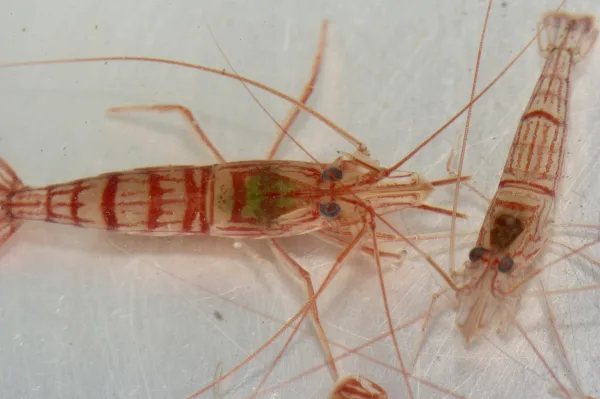
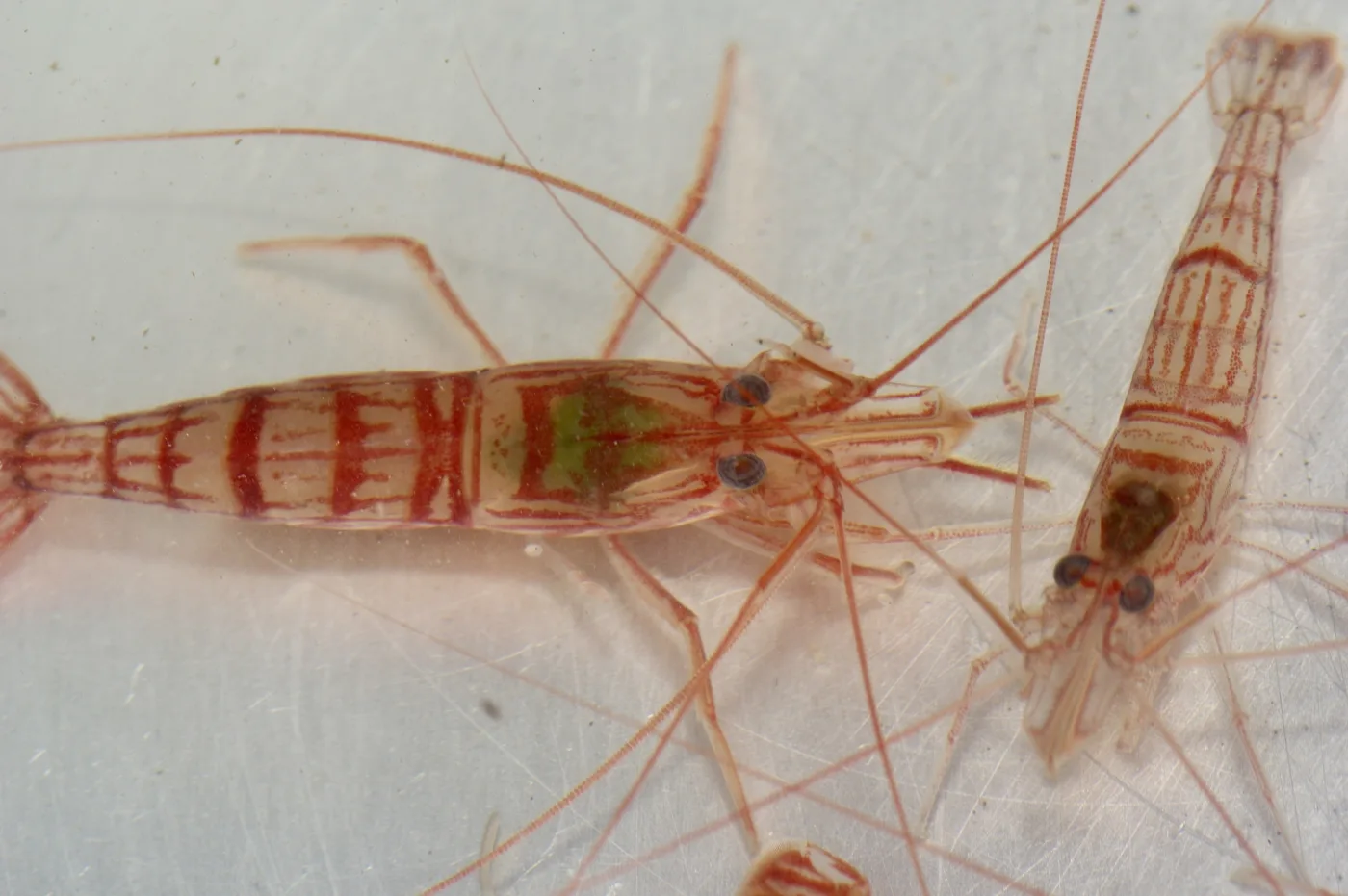
The Peppermint Shrimp looks like a piece of peppermint candy. Its body is almost clear, with thin red stripes. It comes from the warm western Atlantic Ocean, near Florida, the Gulf of Mexico and the Caribbean. In the wild, lots of them live together under rocks and around docks. Fish keepers love them because many of them eat a pest called Aiptasia. It is a small, weedy sea anemone that can spread all over a tank. But not every peppermint shrimp will eat it. Also, shrimp sold as peppermints are often a few look-alike kinds. They hide in the day and come out at night to look for food scraps. Each grown-up can be both a mom and a dad. Keep them fed, keep the water steady, and keep fish that eat shrimp away.
Water & care
Hardy and inexpensive, but like all shrimp it does not tolerate copper medications, high nitrate or sudden salinity changes; drip-acclimate. Mostly nocturnal: it hides in rockwork by day and scavenges at night. In an established tank it often finds enough to eat, but small meaty feedings a couple of times a week keep it healthy. If you bought it for Aiptasia, know that individuals vary, very large Aiptasia are often ignored, and the species you receive may not be L. wurdemanni at all.
| Parameter | Keep it at | Where that sits on the usual reef range |
|---|---|---|
| Temperature | 72–78 °F | |
| Salinity (SG) | 1.023–1.026 | |
| pH | 8.1–8.4 | |
| Alkalinity | 8–12 dKH | |
| Nitrate | 0–20 ppm |
LiveAquaria gives 72-78 F, pH 8.1-8.4, dKH 8-12 and SG 1.020-1.025; Bulk Reef Supply gives 75-78 F, SG 1.023-1.026, nitrate below 20 ppm and zero ammonia and nitrite. True L. wurdemanni is a temperate-subtropical species that tolerates cooler water, but trade animals may be tropical relatives, so keep normal reef temperatures. Calcium, magnesium and phosphate are not species-specific and are left blank; keep normal reef levels.
Feeding
DietOmnivore
Favorite foods
- Aiptasia (glass anemones), for many individuals
- Mysis shrimp
- Frozen brine shrimp
- Sinking pellets and flakes
- Leftover fish food and detritus
A scavenger of leftover food, detritus and decaying matter. Bulk Reef Supply notes they often need no extra feeding in an established tank; offer small portions of meaty food a couple of times a week. If you want them to hunt Aiptasia, do not overfeed, but never let them starve, since a hungry shrimp is more likely to try corals.
Tank & maintenance
- Minimum tank
- 20 gallons
- Aquascape
- Plenty of live rock with crevices and caves for daytime hiding and molting; open sand or rock areas for night foraging.
- Lighting
- No light needs of its own.
- Water flow
- Low to moderate.
Routine upkeep
Routine reef upkeep: stable salinity (top off daily), regular water changes and no copper or invertebrate-toxic treatments in the display. Leave molts in place. If they are working on Aiptasia, check every week or two which anemones remain and remove large ones by hand or with an Aiptasia treatment that is safe for shrimp.
Temperament & tankmates
TemperamentPeaceful
Peaceful and social; in the wild it lives in groups, and several can share a tank. It does not bother fish, though it may steal food from corals and slow feeders.
Reef safeYes
Most peppermint shrimp leave corals alone, and some retailers call them fully reef safe, but Bulk Reef Supply labels them reef safe with caution because they may pick at fleshy corals and steal coral food, and hobbyists report occasional damage to zoanthids and fleshy LPS such as Acanthastrea, mostly from hungry or misidentified shrimp. Feed them, buy from a source that identifies its species, and watch fleshy corals after adding them.
Good tankmates
- Peaceful reef fish such as clownfish, gobies, blennies, cardinalfish and tangs
- Other peppermint shrimp (groups)
- Snails, hermit crabs and other clean-up crew
- Most SPS and soft corals
Avoid
- Hawkfish
- Lionfish and other scorpionfish
- Triggerfish, pufferfish and large wrasses
- Large crabs
- Prized zoanthids or fleshy LPS if you cannot keep the shrimp well fed
- Copper-treated systems
Help it thrive
- Buy captive-bred peppermint shrimp (for example from ORA) where possible; they are healthier, sustainable and known to be peppermint species.
- Add two or three to a tank that already has small Aiptasia, and do not overfeed for the first weeks so they hunt.
- Check what you receive: a red-striped tail and a red band across the middle of the abdomen mark true L. wurdemanni; a dark tail fan marks L. boggessi; a pointed hinged snout means camel shrimp, which can eat corals.
- Drip-acclimate and match salinity closely.
- Keep them with peaceful fish only; hawkfish and wrasses will hunt them at night.
Common ailments
Bopyrid isopod parasite
- Signs
- A swollen bulge on one side of the carapace (head shield), caused by a parasitic isopod living in the gill chamber; Rhyne & Lin (2006) report L. boggessi and L. pederseni are frequently infested with Parabopyrella mortenseni.
- Prevention
- Inspect shrimp before buying and choose captive-bred stock.
- Treatment
- No practical treatment. The parasite infects only crustaceans, not fish or corals. An infested shrimp may live normally but may be unable to breed.
Failed or fatal molt
- Signs
- Stuck in a partly shed shell or found dead next to a fresh molt.
- Prevention
- Stable salinity, normal reef alkalinity, calcium and magnesium, varied meaty foods and hiding places.
- Treatment
- No reliable cure; leave it undisturbed and correct swings slowly.
Copper or medication poisoning
- Signs
- Erratic swimming, loss of balance and death after medication or new decor.
- Prevention
- No copper or invertebrate-toxic treatments in tanks with shrimp; medicate fish in a hospital tank.
- Treatment
- Move to clean matched water; carbon or copper-removing resin and big water changes in the tank.
Acclimation shock
- Signs
- Lying on its side or twitching shortly after being added.
- Prevention
- Slow drip acclimation; close salinity and temperature match.
- Treatment
- Usually fatal once it starts; keep conditions stable and the light dim.
This is general hobby guidance, not veterinary advice. Quarantine new arrivals and treat in a separate tank whenever you can.
Risks of owning one
- It may not eat Aiptasia: individuals vary, large Aiptasia are often ignored, and the shrimp sold may be a different species.
- Mislabeled camel shrimp (Rhynchocinetes durbanensis) sold as peppermints can eat coral polyps.
- Hungry individuals occasionally pick at zoanthids and fleshy LPS corals.
- Eaten by hawkfish, lionfish, triggers, puffers and large wrasses.
- Copper and many fish medicines cannot be used in a tank containing it.
Breeding
DifficultyModerate Captive-bredWidely available
Peppermint shrimp spawn readily in aquariums: any two adults can mate, and females carry green or olive eggs under the tail. Their larval period is much shorter than that of the cleaner shrimps (about 22-110 days; one study using what is now known to be L. boggessi got post-larvae in 29-32 days on Artemia nauplii), so they are among the easiest marine shrimp to raise. ORA and other farms sell captive-bred peppermint shrimp. Larvae need their own rearing tank and live foods.
- Keep a group of well-fed adults; eggs appear soon after molts.
- When eggs turn silver and show eyes, expect hatching at night; capture larvae with a light and siphon or overflow into a separate larval tank.
- Rear larvae in gentle, non-turbulent circulation with clean, stable water at reef temperatures.
- Feed rotifers and newly hatched Artemia nauplii, then enriched Artemia metanauplii; a mix of Artemia and pelleted larval diet gave faster development and better survival in research.
- Expect settlement after about one to several months; move post-larvae to a grow-out tank with rubble and small meaty foods.
Deep dive The science, history and family tree
The science
Lysmata wurdemanni is a western Atlantic caridean shrimp (Lysmatidae) and the namesake of the "peppermint shrimp" complex. Adults reach about 5 cm. The body is semi-translucent with red longitudinal, transverse and oblique bands; in L. wurdemanni sensu stricto the third abdominal segment carries a broad, more intense transverse red band, the tail fan has broad red stripes, and the eggs are bright green (Rhyne & Lin 2006). In 2006 Rhyne and Lin revised the group, designated a neotype from Key West (Gibbes' types were lost) and described four new species that had been mixed up with L. wurdemanni or L. rathbunae: L. ankeri, L. boggessi, L. pederseni and L. bahia. As revised, L. wurdemanni is a temperate-subtropical species ranging from Long Island, New York (seasonally) to southeast Florida and Texas, on rocky hard bottoms, shell bottoms, jetties, pilings and docks from less than 1 m to about 25 m. Shrimp sold as "peppermint shrimp" are frequently other members of the complex, especially L. boggessi from Florida seagrass and hard-bottom habitats, which lacks the band on the third segment and has a dark blue to blackish tail fan. Peppermint shrimps are group-living scavengers rather than dedicated cleaners. Like other Lysmata they are protandric simultaneous hermaphrodites: individuals mature as males and become female-phase hermaphrodites that brood embryos but can still mate as males. Western Atlantic peppermint shrimps have been used for many years to control the pest anemone Aiptasia in aquariums, which helps explain their popularity. Larval development in culture is short compared with the cleaner shrimps (about 22-110 days, with post-larvae in 29-32 days on Artemia in one study).
- Appearance
- Clear to creamy, semi-translucent body with thin red stripes and bands; long red-and-white banded antennae. True L. wurdemanni: a broad red band across the third abdominal segment, red-striped tail fan, bright green eggs. L. boggessi (the species most often shipped as "peppermint shrimp"): reddish-brown tint, fine stripes, no band on the third segment, dark blue-black tail fan, olive-green eggs. L. ankeri: pink eggs and a U-shaped band on the third segment. L. pederseni: nearly clear body with sharp wine-red stripes and bright red legs; lives in tube sponges. Do not confuse with the Pacific camel shrimp (Rhynchocinetes durbanensis), which has a pointed, hinged snout and white-edged red markings and is known to eat corals.
- Native range
- Western Atlantic. As revised by Rhyne & Lin (2006), L. wurdemanni ranges from Long Island, New York (seasonal) to southeast Florida, Key West and Florida Bay, and along the Gulf coast to Texas, possibly into the northern Caribbean. Related trade 'peppermints' come from Florida and the Caribbean (L. boggessi: south and west Florida; L. ankeri: Florida and the Caribbean to Brazil; L. pederseni: Florida Keys, Bermuda, Bahamas and Caribbean).
- Habitat
- Rocky hard bottoms, shell bottoms inside inlets, jetties, buoys, pilings and docks, from less than 1 m to about 25 m; usually in groups. L. boggessi lives in shallow seagrass beds and on sponge- and gorgonian-covered hard bottoms (1-15 m); L. pederseni lives inside tube sponges on coral reefs.
- Size
- 2 in (5 cm). LiveAquaria and Bulk Reef Supply both list about 2 in maximum; shops usually sell 0.75-1.5 in animals. The Rhyne & Lin neotype measured 12.4 mm carapace length.
- Lifespan
- Not well documented; aquarium keepers generally report a few years for well-kept animals, but no published longevity data were found.
- Conservation
- Not Evaluated. Not evaluated by the IUCN Red List and not listed by CITES (SeaLifeBase). Peppermint shrimps are collected commercially in Florida's marine-life fishery; Rhyne et al. (2009) flagged the rapid growth of Florida invertebrate landings for the aquarium trade. Captive-bred peppermint shrimp (ORA) are available and are the most sustainable choice
In the aquarium vs in the wild
In your aquarium
Pest control and clean-up crew: kept mainly to eat the nuisance anemone Aiptasia and to scavenge leftover food and detritus.
On the reef
A group-living scavenger on rocky shores, jetties, docks and seagrass beds, eating detritus and small animals and serving as food for many fishes. Unlike the bright cleaner shrimps, peppermint shrimps are not dedicated fish cleaners.
History
Lewis R. Gibbes described the species in 1850 as Hippolyte wurdemanni, from material from Florida and South Carolina. Gibbes' type specimens were later lost. For about 150 years nearly every western Atlantic peppermint shrimp was called L. wurdemanni (or L. rathbunae), and aquarium magazines and field guides printed photos under those names. In 2006 Andrew Rhyne and Junda Lin, working partly with shrimp from aquarium-trade collectors, chose a neotype from Key West and described four new species. Two honor Florida Keys collectors: L. boggessi is named after Ronnie Gene Boggess, a Marathon fisherman who collected it for the aquarium trade, and L. pederseni after Eric Pedersen Sr., a tropical fish collector. Another trade species, L. rafa, followed in 2007. Peppermint shrimp became an aquarium staple as natural Aiptasia control, and research in the early 2000s (Rhyne, Lin & Deal 2004) studied them as biological control; today ORA and others sell captive-bred animals.
Evolution & relatives
Peppermint shrimps belong to Lysmata, caridean shrimps in the superfamily Alpheoidea alongside snapping shrimps and thorid shrimps. Molecular work (Fiedler et al. 2010) recovered the non-cleaner peppermint shrimps, including L. wurdemanni, L. boggessi, L. pederseni and L. ankeri, as a well-supported clade, separate from the pair-living cleaner clade of L. amboinensis, L. debelius and L. grabhami. Most Lysmata, including lineages that branch before the cleaners, are group-living like the peppermints, and simultaneous hermaphroditism appears to be ancestral in the genus. Morphologically the western Atlantic peppermint complex is closest to L. californica, L. vittata and L. rathbunae (Rhyne & Lin 2006). Because the species look nearly identical when preserved, colour patterns and even egg colour turned out to be key to telling them apart.
Family tree, from kingdom down
- Kingdom Animalia Animals Animals are living things made of many cells that must eat food to live. Fish, corals, crabs, snails and sea stars are all animals.
- Phylum Arthropoda Arthropods Arthropods have jointed legs and a hard outer shell called an exoskeleton. To grow, they must crawl out of the old shell, which is called molting.
- Subphylum Crustacea Crustaceans Crustaceans are arthropods with a hard shell and two pairs of feelers. Most live in water, like crabs, shrimps and lobsters.
- Superclass Multicrustacea
- Class Malacostraca Malacostracans This big class of crustaceans includes crabs, shrimps, lobsters and krill. Their bodies are built from about the same number of segments.
- Subclass Eumalacostraca
- Superorder Eucarida
- Order Decapoda Decapods Decapod means 'ten feet'. Crabs, shrimps, lobsters and hermit crabs all have ten legs, counting their claws.
- Suborder Pleocyemata Egg-carrying decapods
- Infraorder Caridea caridean shrimps
- Superfamily Alpheoidea Snapping, cleaner and anemone shrimps
- Family Lysmatidae Cleaner and peppermint shrimps These shrimps often have long white feelers. Some clean other fish, and others eat pest anemones in aquariums.
- Genus Lysmata Cleaner shrimps Lysmata shrimps include cleaner, fire and peppermint shrimps. Many start life as males and later become male and female at once.
- Species Lysmata wurdemanni
See it on the Tree of Life Compare with another species
Closest relatives
- Lysmata boggessi Peppermint Shrimp (trade) Same genus and species complex; the species most often sold as peppermint shrimp
- Lysmata ankeri (no common name) Same species complex; Caribbean to Brazil, pink eggs
- Lysmata pederseni (no common name) Same species complex; lives in tube sponges
- Lysmata rathbunae (no common name) Same genus; deeper-water species long confused with peppermint shrimp
- Lysmata seticaudata Monaco Shrimp Same genus; Mediterranean peppermint-type shrimp, also an Aiptasia eater
- Lysmata amboinensis Skunk Cleaner Shrimp Same genus; member of the separate pair-living cleaner clade Read guide · Compare
Older scientific names: Hippolysmata wurdemanni, Hippolyte wurdemanni.
Fun facts
- What shops call "peppermint shrimp" is really a group of at least five look-alike species, and scientists only sorted them out in 2006.
- Egg color helps tell the species apart: true L. wurdemanni carries bright green eggs, L. boggessi olive-green eggs and L. ankeri pink eggs.
- One peppermint species, L. boggessi, is named after a Florida Keys fisherman who collected shrimp for the aquarium trade.
- The original 1850 specimens were lost, so in 2006 scientists had to choose a new 'name-bearing' shrimp (a neotype) from Key West.
- Every adult is both male and female, so any two can breed, and their larvae develop much faster than those of skunk cleaner or fire shrimp.
Learn more
- Rhyne & Lin 2006: A western Atlantic peppermint shrimp complex (Bulletin of Marine Science, PDF) research.nhm.org
- LiveAquaria: Peppermint Shrimp care facts liveaquaria.com
- Practical Fishkeeping: Why don't my peppermint shrimp eat Aiptasia? practicalfishkeeping.co.uk
- WoRMS: Lysmata wurdemanni marinespecies.org
Sources
- WoRMS taxon record 158365 marinespecies.org
- SeaLifeBase: Lysmata wurdemanni summary sealifebase.se
- Rhyne & Lin 2006, Bulletin of Marine Science 79(1): 165-204 research.nhm.org
- LiveAquaria: Peppermint Shrimp liveaquaria.com
- Bulk Reef Supply: ORA Peppermint Shrimp (captive bred) bulkreefsupply.com
- ORA: Monaco Peppermint Shrimp orafarm.com
- Practical Fishkeeping: Why don't my peppermint shrimp eat Aiptasia? practicalfishkeeping.co.uk
- Fiedler et al. 2010, BMC Evolutionary Biology 10: 297 pmc.ncbi.nlm.nih.gov
- Lin, Zhang & Rhyne 2002, Broodstock and larval nutrition of marine ornamental shrimp nutricionacuicola.uanl.mx
- Rhyne et al. 2009, Crawling to Collapse (PLoS ONE) journals.plos.org
Care facts
The care facts on this guide and its product pages (care level, reef safety, temperament, size, tank, diet, flow, purpose, foods, acclimation and origin) combine 12 independent sources, checked October 25, 2026.
- Peppermint Shrimp: Saltwater Aquarium Shrimp for Marine Reef Aquariums - LiveAquaria LiveAquaria
- Peppermint Shrimp - Lysmata wurdemanni/rathbunae That Pet Place
- ORA Peppermint Shrimp Bulk Reef Supply (ORA product listing)
- SHRIMP - PEPPERMINT Lysmata wurdemanni complex Aquatics Unlimited
- Peppermint Shrimp :: 57605 Quality Marine
- How To Care For Peppermint Shrimp Bulk Reef Supply (author Adam Monte)
- Peppermint Shrimp 101: Diet, Mates, Breeding & Tank Setup Aquarium Source (author Alison Yang)
- Peppermint Shrimp Care Guide: Lysmata wurdemanni Saltwater Aquarium Blog (author Albert B Ulrich III)
- Lysmata wurdemanni (Peppermint shrimp) ReefApp encyclopedia
- Common Questions about the Peppermint Shrimp Algae Barn
- Peppermint Shrimp care guide Top Shelf Aquatics
- Peppermint Shrimp - Lysmata wurdemanni Tropical Fish Plus
Scientific names and classification follow the World Register of Marine Species (AphiaID 158365). Last updated October 25, 2026.
Shop this species
Search the shop →
Hot