 Sold out
Invertebrates · Shrimp
Sexy Shrimp
Thor amboinensis
Also called Sexy Anemone Shrimp, Squat Anemone Shrimp, Sexy Dancing Shrimp
- CareEasy
- Reef safeYes
- TemperamentPeacefulPeaceful; social, best kept in groups of 3+
- Favorite foods
- Chopped seafood / mysis
- Sinking pellets
- Nori / algae foods
- Max size1 in (2.5 cm)
- Min tank20 gal
- LifespanNot well documented
- IUCN statusNot Evaluated
Quick answers
- How big does the Sexy Shrimp get?
- Up to 1 in (2.5 cm).
- What size tank does it need?
- At least 20 gallons.
- How hard is it to keep?
- Care level: Easy.
- Is it reef safe?
- Yes. Generally reef compatible (LiveAquaria, SeaScape Studio), but it eats host tissue: it grazes the outer tentacle tissue and mucus of its host anemone (usually without harming it) and grazes slime on zoanthids and Euphyllia.
- What does it eat?
- Chopped seafood / mysis
- Sinking pellets
- Nori / algae foods
- How long does it live?
- Not well documented; no published captive lifespan data were found.
- What are good tankmates?
- Other sexy shrimp (groups of 3-6)
- Small peaceful fish such as gobies, firefish and small blennies
- Anemones such as rock flower and carpet anemones
- Zoanthids, mushrooms and other soft cnidarians
The 30-second version
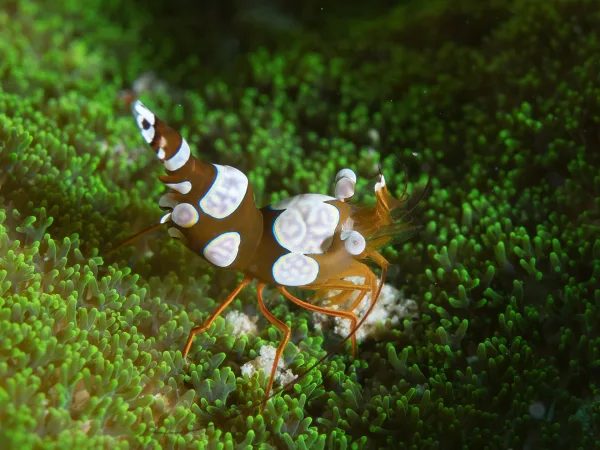
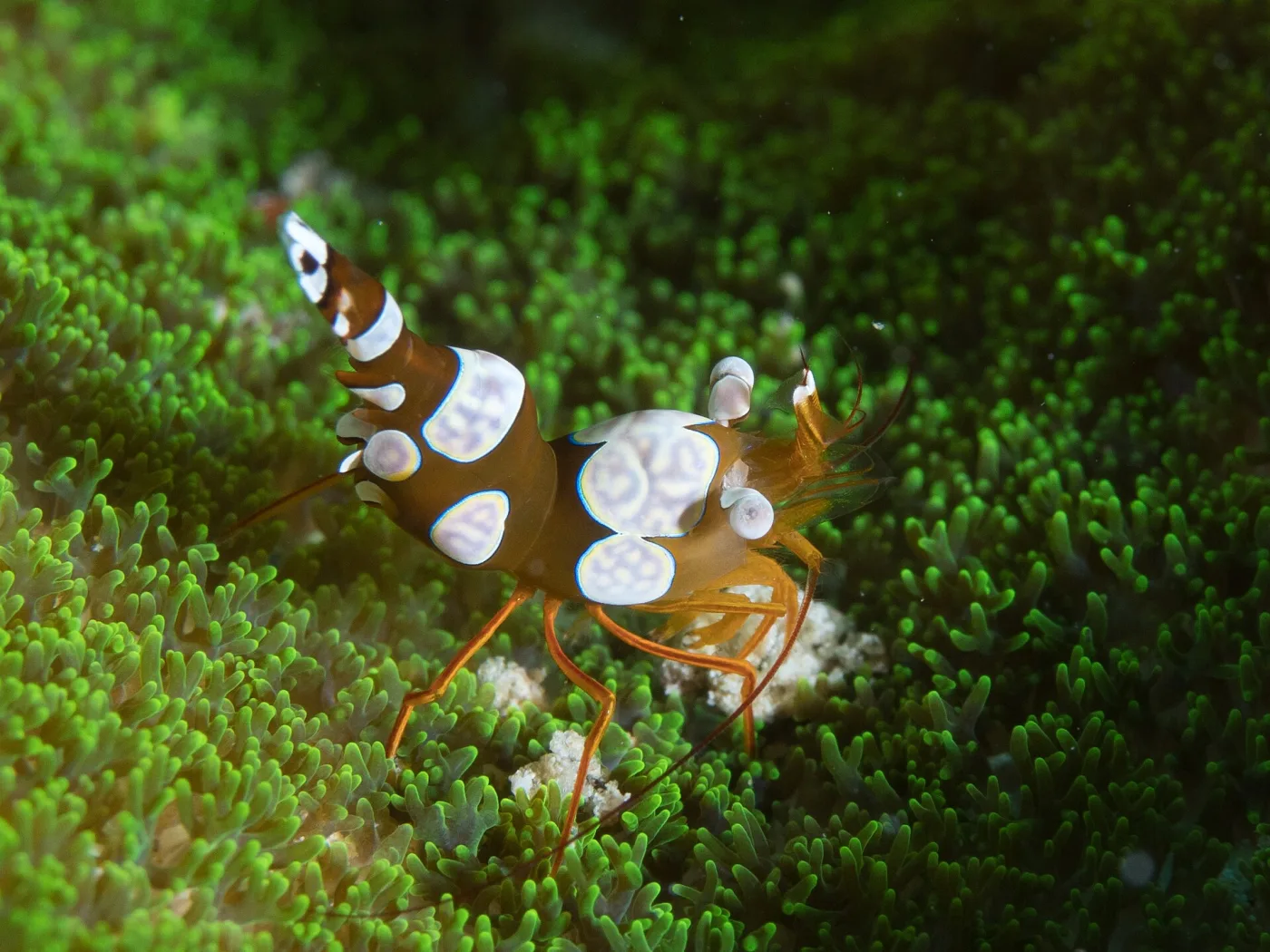
The Sexy Shrimp is a tiny shrimp, smaller than your thumbnail. It is brown or orange with bright white spots, and each spot has a thin blue line around it, like it was drawn with a marker. It got its funny name from the way it moves. It holds its tail up over its back and wiggles it from side to side, like it is dancing. In the wild it lives in warm seas. It hides in the stinging arms of sea anemones, where hungry fish cannot reach it. The anemone does not sting it. The shrimp nibbles bits of food stuck in the anemone's slime. Sexy shrimp like to live in small groups. They are great for small tanks, but fish that eat shrimp will gobble them up.
Water & care
Hardy in a stable reef tank but small and sensitive to acclimation: drip-acclimate slowly to avoid salinity or pH shock (LiveAquaria). Intolerant of copper and high nitrate. Molts roughly monthly. Does best in a group of three or more with an anemone, zoanthids or other soft cnidarians to perch on, and with no shrimp-eating fish. Food is easy: it takes small meaty foods and grazes on coral and anemone mucus.
| Parameter | Keep it at | Where that sits on the usual reef range |
|---|---|---|
| Temperature | 72–80 °F | |
| Salinity (SG) | 1.023–1.026 | |
| pH | 8.1–8.4 | |
| Alkalinity | 7–12 dKH | |
| Calcium | 380–430 ppm | |
| Nitrate | 0–20 ppm |
LiveAquaria gives 72-78 F, pH 8.1-8.4, dKH 8-12 and SG 1.023-1.025; TFH Magazine's keeper used 72-81 F, SG 1.024-1.026, pH 8.1-8.2, alkalinity 2.5 meq/L (about 7 dKH) and calcium 380-430 ppm, stressing stable alkalinity and calcium for molting. Nitrate under 20 ppm is a general invertebrate guideline (LiveAquaria: no high nitrate). Magnesium and phosphate are not species-specific; keep whatever the host corals need.
Feeding
DietCarnivore
Favorite foods
- Anemone and coral mucus with trapped particles
- Mysis shrimp, chopped small
- Frozen plankton (copepods, rotifers)
- Fine flake and pellet foods
In a reef with anemones or zoanthids it often feeds itself by grazing host mucus, but offer small meaty foods (chopped mysis, frozen plankton, fine flakes) two or three times a week so the group stays well fed and leaves polyps alone. Food must be small enough for a 2 cm shrimp.
Tank & maintenance
- Minimum tank
- 20 gallons
- Aquascape
- Rockwork with ledges and crevices, plus a host: an anemone or a patch of zoanthids, mushrooms or Euphyllia.
- Lighting
- No needs of its own; light to suit the host anemone or corals.
- Water flow
- Gentle to moderate around the host.
Routine upkeep
Small, stable reef upkeep: regular partial water changes with matched salinity, daily top-off, no copper or invertebrate-toxic treatments, and careful siphoning so the tiny shrimp are not sucked up. In a nano tank, check that overflow and pump intakes are screened.
Temperament & tankmates
TemperamentPeaceful
Completely peaceful toward fish, corals and other shrimp, and best kept in groups. It is the one at risk: many fish eat it, and some clownfish, notably larger Clark's clownfish, may chase or kill shrimp in their anemone.
Reef safeYes
Generally reef compatible (LiveAquaria, SeaScape Studio), but it eats host tissue: it grazes the outer tentacle tissue and mucus of its host anemone (usually without harming it) and grazes slime on zoanthids and Euphyllia. Care guides note that underfed shrimp can irritate LPS or zoanthid polyps with constant picking, so feed them and watch delicate polyps.
Good tankmates
- Other sexy shrimp (groups of 3-6)
- Small peaceful fish such as gobies, firefish and small blennies
- Anemones such as rock flower and carpet anemones
- Zoanthids, mushrooms and other soft cnidarians
Avoid
- Hawkfish
- Lionfish and other scorpionfish
- Dottybacks, triggerfish and pufferfish
- Wrasses large enough to eat tiny shrimp
- Larger clownfish that defend their anemone
- Copper-treated systems
Help it thrive
- Keep them in a group of three or more around a host anemone or a zoanthid patch; they are more confident and more visible together.
- Drip-acclimate slowly; their small bodies cannot handle sudden salinity or pH changes.
- Choose tankmates carefully: even small wrasses, dottybacks and hawkfish will hunt them.
- Feed small meaty foods a few times a week so they do not pester corals.
- Screen pump and overflow intakes in nano tanks; a 2 cm shrimp fits through surprisingly small gaps.
Common ailments
Acclimation (osmotic) shock
- Signs
- Lying on its side, twitching or immobile within hours of being added.
- Prevention
- Slow drip acclimation and a close salinity and temperature match; LiveAquaria stresses slow acclimation for this species.
- Treatment
- Usually fatal once it starts; keep conditions stable and dim.
Failed or fatal molt
- Signs
- Stuck in a partly shed shell or found dead beside a fresh molt (it molts about monthly).
- Prevention
- Stable alkalinity, calcium and salinity, varied food and places to hide while soft.
- Treatment
- No reliable cure; leave it alone and correct swings slowly.
Copper or medication poisoning
- Signs
- Erratic movement and sudden death after medication or new decor.
- Prevention
- No copper or invertebrate-toxic treatments in any tank with shrimp.
- Treatment
- Move to clean matched water; carbon or copper-removing resin and large water changes in the tank.
Predation and loss to host or tankmates
- Signs
- Shrimp numbers dwindle, often at night or after a molt; clownfish chasing them away from an anemone.
- Prevention
- No shrimp-eating fish; avoid large clownfish sharing the same anemone; give alternative hosts such as zoanthid patches.
- Treatment
- Remove the predator or move the shrimp to a safer tank.
This is general hobby guidance, not veterinary advice. Quarantine new arrivals and treat in a separate tank whenever you can.
Risks of owning one
- Easily eaten by hawkfish, wrasses, dottybacks, lionfish and other shrimp-eating fish; even a single predator can wipe out a group.
- Grazes host tissue and may irritate zoanthid or LPS polyps if underfed.
- Larger clownfish may kill shrimp in their anemone.
- So small it can be lost to pump intakes, overflows or siphons.
- Nearly all are wild-caught; tens of thousands are imported to the US each year with no population monitoring.
Breeding
DifficultyHard Captive-bredRare or wild-caught
Groups spawn readily in aquariums: females carry eggs under the abdomen, and a TFH Magazine writer recorded about 100 juveniles from three shrimp over nearly a year, though survival to adulthood was unclear. Complete larval development (eight zoeal stages and a decapodid) has been reared in the lab (Bartilotti et al. 2016), and live-feed trials have been run, but as of 2025 Roger Williams University researchers noted that no published studies had focused on aquaculture of this species. Captive-bred sexy shrimp are not a regular trade item.
- Keep a well-fed group with a host anemone or zoanthids; berried females carry eggs under the abdomen.
- Collect newly hatched larvae at night into a separate rearing tank with gentle circulation.
- Feed rotifers at first, then newly hatched and enriched Artemia nauplii as the larvae grow.
- Keep water very clean and stable through the eight zoeal stages.
- Offer settling larvae a piece of anemone, zoanthid rock or other host cue, since larvae are attracted to chemical and visual cues from hosts.
- Grow out juveniles with fine meaty foods and no predators.
Deep dive The science, history and family tree
The science
Thor amboinensis is a small caridean shrimp of the family Thoridae, reaching only about 13-20 mm. The body is caramel to olive-brown, marked with symmetrically placed white patches outlined in thin blue lines, and the abdomen is habitually carried raised, with the tail fan held above the carapace and swayed from side to side. It is a symbiotic generalist on sea anemones and also lives among mushroom corals and other cnidarians in shallow reef and seagrass habitats, recorded from the surface to about 60 m. Individuals feed on host tentacle tissue and on plankton and particles trapped in host mucus. Groups share a host: in the Caribbean (populations now assigned to T. dicaprio), up to 11 shrimp were found on a single sun anemone (Stichodactyla helianthus). Studies of these anemone-dwelling populations found the species to be a protandric hermaphrodite, maturing as males and later becoming females, with male-biased sex ratios (Baeza & Piantoni 2010). Females brood eggs under the abdomen; the larvae pass through eight zoeal stages and a decapodid, tied with T. floridanus for the most known in the genus (Bartilotti et al. 2016), and settling larvae are attracted to chemical and visual cues from host anemones. Long treated as a single pantropical species, T. amboinensis is now known to be a species complex: molecular data suggest at least five cryptic or pseudocryptic species, and in 2021 the western Atlantic populations were described as Thor dicaprio (Anker & Baeza 2021). The name T. amboinensis in the strict sense refers to the Indo-West Pacific species described from Ambon, Indonesia.
- Appearance
- Tiny (under an inch) with a caramel, tan or orange-brown body and bold white or pinkish patches each ringed by a thin blue line; tail held cocked up over the back and constantly swayed. The western Atlantic Thor dicaprio looks almost the same; its most diagnostic feature is red-and-white banding on the antennae (Anker & Baeza 2021).
- Native range
- Indo-West Pacific in the strict sense (described from Ambon, Indonesia). Historically reported as pantropical, including the Red Sea, Indian Ocean, Pacific, Caribbean, Gulf of Mexico and the eastern Atlantic (Madeira, Canary Islands); western Atlantic populations are now Thor dicaprio, and other regional populations may be further cryptic species.
- Habitat
- Shallow reefs, reef flats and seagrass areas from the surface to about 60 m (SeaLifeBase), living among the tentacles of sea anemones (including carpet and sun anemones) and on mushroom corals and other cnidarians, usually in small groups per host.
- Size
- 1 in (2.5 cm). Wikipedia gives about 13 mm (0.5 in); SeaScape Studio 0.75 in; TFH Magazine roughly 1 in. LiveAquaria's table says 0.5 in while its text says up to 1.5 in, an apparent inconsistency.
- Lifespan
- Not well documented; no published captive lifespan data were found. Expect a short-lived animal measured in a few years at most.
- Conservation
- Not Evaluated. Not evaluated by the IUCN Red List and not CITES-listed (SeaLifeBase). Roughly 20,000-30,000 are imported into the US each year, almost all wild-caught, with no population data (Roger Williams University, 2025)
In the aquarium vs in the wild
In your aquarium
Nano-tank showpiece valued for its dancing tail and bold spots; it also tidies host mucus and small leftovers.
On the reef
A small commensal living among sea anemone tentacles and other cnidarians, protected by its host's stinging cells and feeding on host tissue, mucus and trapped plankton; prey for small reef fishes.
History
Described by J. G. De Man in 1888 as Hippolyte amboinensis, from material collected by Dr. J. Brock in the Indonesian archipelago; the name refers to Ambon (Amboina) in the Maluku Islands. In 1916 Stanley Kemp described Thor discosomatis from Indian Museum material, now treated as a synonym. For over a century it was regarded as one species found in every tropical ocean. Its tail-waving 'dance' made it a nano-reef favorite, and it is now imported into the US by the tens of thousands each year. In 2021 Arthur Anker and J. Antonio Baeza showed that the western Atlantic animals are a separate species, Thor dicaprio, and that T. amboinensis is a complex of cryptic species.
Evolution & relatives
Thor belongs to the family Thoridae within the caridean superfamily Alpheoidea, which also contains the snapping shrimps and the cleaner and peppermint shrimps (Lysmatidae). It was long placed in the large family Hippolytidae (LiveAquaria still lists it there), but molecular work showed Hippolytidae as then defined was not a natural group; in Fiedler et al.'s 2010 16S tree, Thor grouped with Heptacarpus, and both now sit in Thoridae. Within Thor, the amboinensis complex has diversified into at least five cryptic or pseudocryptic lineages; the western Atlantic Thor dicaprio differs from the others by 8.8-19.2% in COI DNA (Anker & Baeza 2021). Living inside stinging hosts is a lifestyle that has evolved repeatedly in shrimps, and in Thor it comes with a group-living, protandric mating system.
Family tree, from kingdom down
- Kingdom Animalia Animals Animals are living things made of many cells that must eat food to live. Fish, corals, crabs, snails and sea stars are all animals.
- Phylum Arthropoda Arthropods Arthropods have jointed legs and a hard outer shell called an exoskeleton. To grow, they must crawl out of the old shell, which is called molting.
- Subphylum Crustacea Crustaceans Crustaceans are arthropods with a hard shell and two pairs of feelers. Most live in water, like crabs, shrimps and lobsters.
- Superclass Multicrustacea
- Class Malacostraca Malacostracans This big class of crustaceans includes crabs, shrimps, lobsters and krill. Their bodies are built from about the same number of segments.
- Subclass Eumalacostraca
- Superorder Eucarida
- Order Decapoda Decapods Decapod means 'ten feet'. Crabs, shrimps, lobsters and hermit crabs all have ten legs, counting their claws.
- Suborder Pleocyemata Egg-carrying decapods
- Infraorder Caridea caridean shrimps
- Superfamily Alpheoidea Snapping, cleaner and anemone shrimps
- Family Thoridae Thorid shrimps This family has small shrimps, and some of them live among sea anemones and corals.
- Genus Thor Sexy shrimps Thor shrimps are tiny shrimps that live among sea anemones. The sexy shrimp wiggles its tail in the air.
- Species Thor amboinensis
See it on the Tree of Life Compare with another species
Closest relatives
- Thor dicaprio (no common name) Same species complex; the western Atlantic populations formerly called T. amboinensis
- Thor floridanus Bryozoan Shrimp Same genus; western Atlantic, also with eight zoeal stages
- Thor manningi (no common name) Same genus; western Atlantic species
- Heptacarpus (no common name) Same family (Thoridae); grouped with Thor in molecular trees
- Lysmata amboinensis Skunk Cleaner Shrimp Same superfamily (Alpheoidea), different family (Lysmatidae) Read guide · Compare
Older scientific names: Hippolyte amboinensis, Thor discosomatis.
Fun facts
- It holds its tail straight up over its back and wiggles it as it walks, which is how it earned the name sexy shrimp.
- What was thought to be one worldwide species is really at least five look-alike species; the Caribbean one was named Thor dicaprio in 2021.
- In the populations studied so far, sexy shrimp start life as males and later turn into females.
- Its larvae go through eight stages before settling, tied with the bryozoan shrimp for the most known in its genus, and they find a home by following chemical and visual cues from anemones.
- In the Caribbean, up to 11 of these shrimp (now called Thor dicaprio there) have been found sharing a single sun anemone.
Learn more
- Wikipedia: Thor amboinensis en.wikipedia.org
- TFH Magazine: Thor amboinensis tfhmagazine.com
- LiveAquaria: Sexy Anemone Shrimp care facts liveaquaria.com
- Anker & Baeza 2021: Thor dicaprio and the T. amboinensis complex (Zootaxa) mapress.com
- WoRMS: Thor amboinensis marinespecies.org
Sources
- WoRMS taxon record 107534 marinespecies.org
- SeaLifeBase: Thor amboinensis summary sealifebase.se
- Wikipedia: Thor amboinensis en.wikipedia.org
- LiveAquaria: Sexy Anemone Shrimp liveaquaria.com
- TFH Magazine: Thor amboinensis tfhmagazine.com
- SeaScape Studio invertebrate reference: Sexy Shrimp seascapestudio.net
- Anker & Baeza 2021, Zootaxa 5039(4): 495-517 mapress.com
- Bartilotti, Salabert & dos Santos 2016, Zootaxa 4066(4): 399-420 mapress.com
- Sears et al. 2025, Fecundity, gestation length, and larval series of Thor amboinensis (Aquaculture 2025 abstract) was.org
- Fiedler et al. 2010, BMC Evolutionary Biology 10: 297 pmc.ncbi.nlm.nih.gov
Care facts
The care facts on this guide and its product pages (care level, reef safety, temperament, size, tank, diet, flow, purpose, foods, acclimation and origin) combine 12 independent sources, checked October 25, 2026.
- Sexy Shrimp - Thor amboinensis That Pet Place
- Sexy Shrimp Care Guide: Dance, Diet, Tank Size & Lifespan Aquarium Source (Millie Sheppard)
- sexy shrimp care thor amboinensis Saltwater Aquarium Blog
- thor amboinensis ReefApp encyclopedia
- Sexy Shrimp Fishkeeper
- Sexy Anemone Shrimp LiveAquaria
- Thor amboinensis Tropical Fish Hobbyist
- Sexy Anemone Shrimp Quality Marine
- Sexy Anemone Shrimp - Thor amboinensis Top Shelf Aquatics
- Thor amboinensis The Cephalopod Page
- Sexy Dancer Shrimp Quality Marine
- Thor amboinensis WoRMS
Scientific names and classification follow the World Register of Marine Species (AphiaID 107534). Last updated October 25, 2026.
Shop this species
Search the shop →Sold out right now. We restock weekly, so check back soon.
Sold out