 Sold out
Corals · Mushroom coral
Ricordea Florida
Ricordea florida
Also called Ricordea mushroom, Florida ricordea, Florida false coral, Florida corallimorph, Rics, Blue Ricordea
- CareEasy
- Reef safeYes
- TemperamentSemi-aggressiveSemi-aggressive; stings corals it touches
- Favorite foods
- Light (zooxanthellae)
- Mysis shrimp (tiny pieces)
- Zooplankton / baby brine
- Max size2.5 in (6.3 cm)
- Min tank10 gal
- LifespanIndividual polyps can live for years…
- IUCN statusNot Evaluated
Quick answers
- How big does the Ricordea Florida get?
- Up to 2.5 in (6.3 cm).
- What size tank does it need?
- At least 10 gallons.
- How hard is it to keep?
- Care level: Easy.
- Is it reef safe?
- Yes. Safe with fish and invertebrates.
- What does it eat?
- Light (zooxanthellae)
- Mysis shrimp (tiny pieces)
- Zooplankton / baby brine
- How long does it live?
- Individual polyps can live for years, and clones produced by splitting can persist indefinitely in a stable aquarium.
- What are good tankmates?
- Other Ricordea, which can be grouped touching each other
- Discosoma and Rhodactis mushrooms and zoanthids given a little space
- Peaceful reef fish such as clownfish, gobies, blennies and cardinalfish
- Cleaner shrimp, snails and hermit crabs
The 30-second version
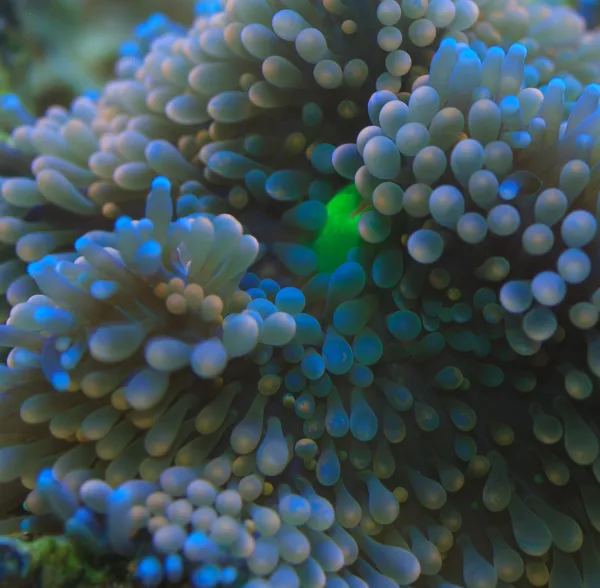
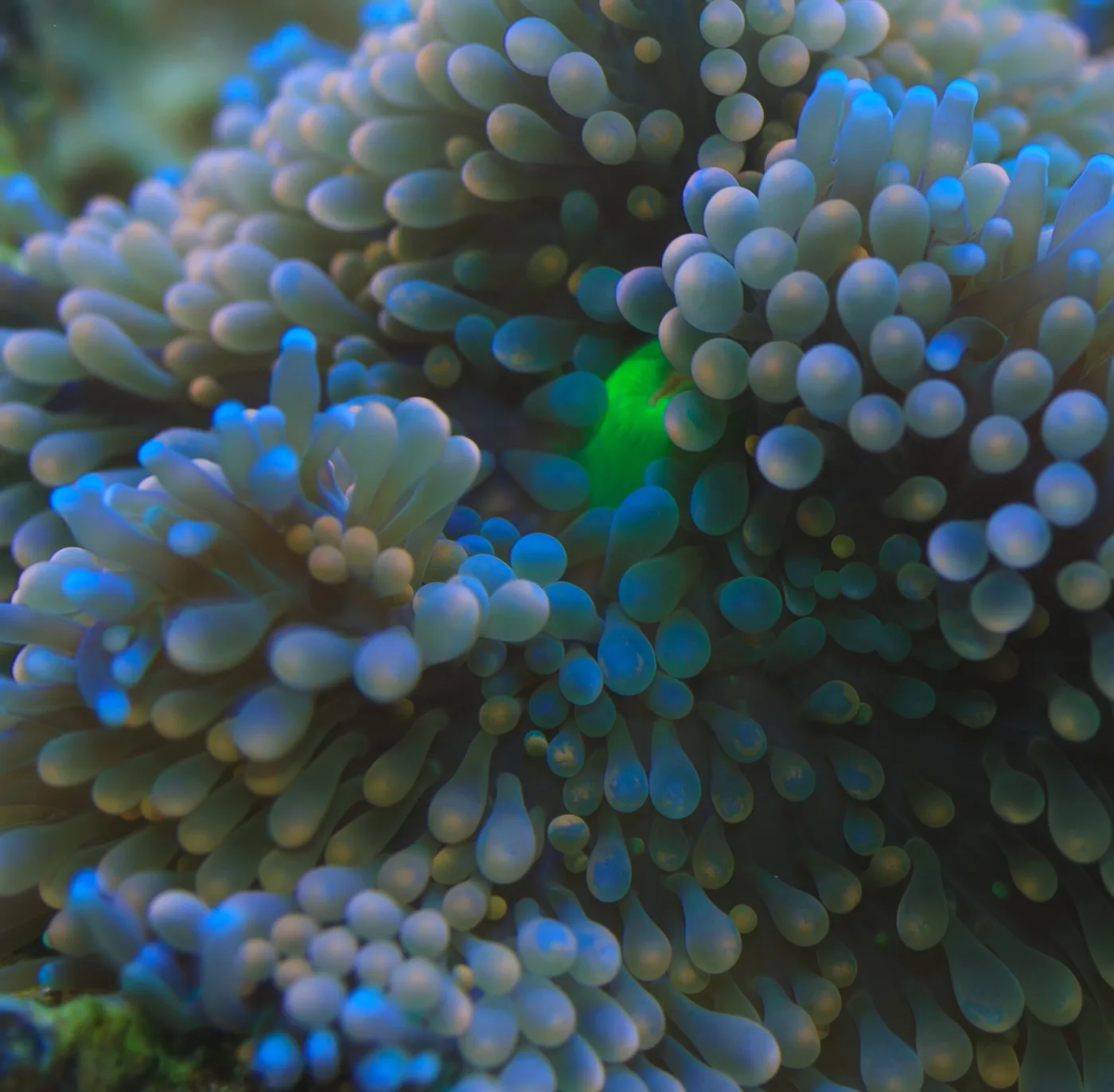
Ricordea florida is a small, round, flat animal. It looks like a mushroom covered in tiny bubbles. Those bubbles are really short, round arms called tentacles. It lives in the warm sea around Florida and in the Caribbean Sea. Ricordeas come in bright colors like green, orange, pink and blue, and they glow under blue lights. Our Blue Ricordea is one of those colors. Like other mushroom corals, it has no hard bones. Tiny plants called algae live inside it and make food from light. It also likes a small snack of shrimp now and then. Sometimes one Ricordea splits down the middle into two. Or a baby grows from a bit of its foot. Some even end up with two or three mouths!
Water & care
Fairly rugged and suitable for beginner through advanced keepers. It wants moderate light, gentle-to-moderate flow and stable parameters, and it benefits from occasional feeding. It is generally considered easier than its Indo-Pacific cousin R. yuma. The main failure points are strong flow that tears polyps loose and abrupt changes in light.
| Parameter | Keep it at | Where that sits on the usual reef range |
|---|---|---|
| Temperature | 72–78 °F | |
| Salinity (SG) | 1.023–1.025 | |
| pH | 8.1–8.4 | |
| Alkalinity | 8–12 dKH | |
| Calcium | 400–450 ppm | |
| Magnesium | 1,250–1,350 ppm | |
| Nitrate | 0–10 ppm |
Numbers are general corallimorph guidance (Top Shelf Aquatics mushroom guide; LiveAquaria mushroom listings agree on 72-78 F, pH 8.1-8.4 and 8-12 dKH); no Ricordea-specific parameter study was found. Ricordea do not need calcium or alkalinity for a skeleton. Top Shelf's general soft-coral advice is nitrate below 10 ppm and phosphate as low as possible; phosphate is left without a number. Stability matters most.
Feeding
DietPhotosynthetic
Favorite foods
- Light (photosynthesis by symbiotic algae)
- Mysis or brine shrimp pieces
- Small pellet or meaty coral foods
- Zooplankton
Gets much of its nutrition from its algae but accepts meaty foods and pellets. Target-feed each polyp a small piece of mysis or a coral pellet once or twice a week with pumps turned down; the disc folds around the food. Do not overfeed: uneaten food fouls the tank.
Tank & maintenance
- Minimum tank
- 10 gallons
- Aquascape
- On rock in the lower to middle part of the tank, or mounted on a vertical rock face if lighting is intense; group polyps on a dedicated rock to form a colorful patch. Avoid loose positions where a detached polyp could blow into a pump.
- Lighting
- Moderate. It tolerates brighter light than most mushrooms, but under very strong lighting keep it lower in the tank, out of direct glare, or on a vertical surface. Roughly the low-to-medium retail range (Bulk Reef Supply uses 75-150 PAR for low and 150-250 PAR for medium) suits it; higher light can intensify color if raised gradually.
- Water flow
- Gentle to moderate. Strong current can detach polyps, which then drift and are vulnerable to powerheads.
Routine upkeep
Feed lightly once or twice a week if you want faster growth and splitting. Keep flow gentle around the polyps, watch for detached polyps after any change to pumps, and reattach them in a rubble cup. Do regular partial water changes and keep parameters stable.
Temperament & tankmates
TemperamentSemi-aggressive
Mild for a corallimorph: it will not chase or harm fish, but contact with other corals can hurt either party, and colonies slowly spread over rock. Rated semi-aggressive on the mild end; keep it an inch or two from stony corals.
Reef safeYes
Safe with fish and invertebrates. Its sting is weak, but it can damage, or be damaged by, corals it touches, so leave a little space. Ricordea can be clustered with other Ricordea without problems.
Good tankmates
- Other Ricordea, which can be grouped touching each other
- Discosoma and Rhodactis mushrooms and zoanthids given a little space
- Peaceful reef fish such as clownfish, gobies, blennies and cardinalfish
- Cleaner shrimp, snails and hermit crabs
Avoid
- Direct contact with stony corals
- Placement in the path of a powerhead, where polyps detach
- Fish that may nip soft polyps, such as many butterflyfish and some angelfish
Help it thrive
- Feed a small piece of mysis or a coral pellet to each polyp weekly; fed Ricordea grow and split faster.
- Keep flow gentle; a polyp that is constantly blown sideways will eventually let go.
- Introduce stronger light gradually, and keep it lower or vertical under very intense lights.
- Group several color forms on one rock for a 'ric garden'; they tolerate touching each other.
- Buy aquacultured or legally collected polyps.
Common ailments
Shrinking, melting or tissue breakdown
- Signs
- The disc shrinks, loses its bubbly texture, or slowly dissolves over days. Ricordea yuma is known for a 'melting syndrome' of unknown cause, and R. florida can show similar decline under stress.
- Prevention
- Stable water quality, gradual light changes and gentle flow.
- Treatment
- Check and correct parameters slowly, do partial water changes, reduce light if it was recently raised, and remove dead tissue promptly.
Bleaching or fading
- Signs
- Colors wash out or the polyp turns pale or white.
- Prevention
- Acclimate to new lighting gradually and avoid heat spikes.
- Treatment
- Move the polyp lower or shade it, keep temperature steady, and feed lightly while it recovers.
Detaching and drifting
- Signs
- A polyp lets go of its rock and tumbles around the tank, sometimes into pumps or overflows.
- Prevention
- Gentle, indirect flow; secure placement.
- Treatment
- Place it in a cup of rubble in a calm spot until it reattaches, then move the rubble into position.
Pests
- Signs
- Flatworms or nudibranchs on or near the polyps; polyps damaged or disappearing.
- Prevention
- Inspect, dip and quarantine new polyps.
- Treatment
- Remove pests by hand and dip affected rocks.
This is general hobby guidance, not veterinary advice. Quarantine new arrivals and treat in a separate tank whenever you can.
Risks of owning one
- Wild collection is restricted or banned in parts of its range, and illegally collected Ricordea have been the subject of federal prosecutions; buy from reputable, legal sources.
- Detached polyps can be sucked into pumps and overflows.
- It has stinging cells: wear gloves when cutting or moving polyps and keep hands away from your eyes.
- Colorful wild specimens can be expensive, and stressed polyps may decline slowly over weeks before you notice.
Propagation & fragging
DifficultyModerate AquaculturedWidely available
Propagated asexually. Polyps split on their own by longitudinal fission across the mouth and produce new polyps from bits of the foot (pedal laceration); keepers also frag polyps by cutting them through the mouth. Sexual reproduction through planula larvae occurs in the wild but is not done at home.
- Wear gloves and work in a container of tank water.
- Choose a healthy polyp, ideally one with two mouths or already elongating to split.
- Slice it free from the rock at the base with a sharp scalpel, or frag the rock it sits on.
- Cut the polyp cleanly in half through the mouth (or between mouths) with a single stroke.
- Place each half in a cup or dish of rubble or frag plugs in low flow, loosely covered with mesh if needed, and leave it undisturbed for one to two weeks until it attaches.
- Feed lightly once attached; each half re-forms a full disc and mouth over the following weeks.
Deep dive The science, history and family tree
The science
Ricordea florida is a corallimorpharian in the family Ricordeidae, one of only two species in the genus; the other, R. yuma, lives in the Indo-Pacific. Polyps occur singly or in small groups and have a short cylindrical column, a flat pedal disc, and a round oral disc up to about 7.5 cm across, though most aquarium specimens are 2.5-5 cm. The oral disc bears one or more mouths and is covered with short, rounded, wart-like tentacles that become more elongated toward the margin, giving a distinctive bubbly texture. The tentacles carry nematocysts used to subdue small prey and for defense, but the sting is weaker than in most corals. Coloration is extremely variable (green, blue, orange, red, yellow, pink and brown, often several colors on one polyp) and changes with depth, temperature, season and other factors; many specimens fluoresce strongly. The species occurs in the tropical western Atlantic, including Florida, the Bahamas, the Caribbean and the Gulf of Mexico, in shallow water on reef interiors, rocky areas and pools. Zooxanthellae provide much of its energy, recycling the host's nitrogen and phosphorus wastes, and the polyps also capture zooplankton and small animals and absorb dissolved organic matter. Asexual reproduction is by longitudinal fission across the mouth and by pedal laceration, and sexual reproduction produces planula larvae that settle and grow into new polyps. Like all corallimorpharians it is anatomically close to stony corals but lacks a skeleton. NatureServe ranks it Vulnerable, and wild harvest is restricted in parts of its range.
- Appearance
- A flat, roundish disc, usually 1-2 in (2.5-5 cm) across and up to about 3 in (7.5 cm), carpeted with small rounded 'bubble' tentacles that are longer at the edge; the mouth (or several mouths) may be a contrasting color. Colors include green, blue, orange, red, yellow, pink and brown, often combined, and most forms fluoresce under actinic light; 'Blue Ricordea' is a blue color form, not a separate species. Look-alikes: Ricordea yuma from the Indo-Pacific is larger (often 3-4 in, sometimes more) and fleshier; Rhodactis mushrooms have a fuzzy layer of hair-like pseudotentacles rather than round bubbles; Discosoma are much smoother.
- Native range
- Tropical western Atlantic: Florida, the Bahamas, the Caribbean Sea and the Gulf of Mexico. WoRMS distribution records also list Bermuda, Jamaica, the Virgin Islands and the Caribbean coast of Colombia, and it is collected (now illegally for sale) in Puerto Rico.
- Habitat
- Shallow water in reef interiors, on rocky bottoms and in pools, living alone or in small groups attached to hard substrate.
- Size
- 2.5 in (6.3 cm). Wikipedia gives a maximum of about 7.5 cm (3 in); Reef Builders gives 1.5-2 in as the usual maximum (2015) and about 1 in as typical (2017). Most polyps in the trade are about 1-2 in across. Polyps divide and cluster, so a rock can carry many polyps.
- Lifespan
- Individual polyps can live for years, and clones produced by splitting can persist indefinitely in a stable aquarium.
- Conservation
- Not Evaluated. No IUCN Red List assessment was found; NatureServe ranks the species Vulnerable. It is not CITES-listed. Florida allows recreational collectors 5 single corallimorph polyps of each type per person per day, within a 20-organism daily aggregate, removed with a flexible blade no wider than 2 in and without live rock, and selling recreational catch is prohibited. Puerto Rico bans harvest of Ricordea for commercial or off-island sale; in 2020 a Puerto Rican aquarium business owner pleaded guilty to smuggling and Lacey Act charges over Ricordea worth at least $90,000. Buy aquacultured or legally collected polyps
In the aquarium vs in the wild
In your aquarium
A colorful, beginner-friendly mushroom used for 'ric gardens' and color patches on lower rockwork; brightly colored and multicolored polyps are collector pieces.
On the reef
A small photosynthetic corallimorph of shallow Caribbean and Florida reefs that also captures zooplankton and small prey, occupying space among other reef cnidarians.
History
Placide Duchassaing and Giovanni Michelotti described the species in 1860 in their 'Mémoire sur les coralliaires des Antilles', a survey of Caribbean corals. It was later moved for a time to the genus Heteranthus (as Heteranthus floridus), Watzl described the same animal again in 1922 as Corynactis bahamensis, and the genus name is sometimes misspelled Ricordia. Ricordea florida has long been popular in the aquarium hobby for its bright colors and fluorescence, much of it from Florida and Caribbean collection, which states and territories now regulate. Reef Builders called it an 'underappreciated Caribbean beauty' in 2015, and in 2020 a Puerto Rico case, in which a seller shipped at least 40 consignments of illegally harvested marine invertebrates between 2014 and 2016, including Ricordea worth at least $90,000 at retail, showed how valuable wild polyps had become.
Evolution & relatives
Ricordea belongs to the corallimorpharians, hexacorals whose soft anatomy is so similar to stony corals (Scleractinia) that morphological and molecular evidence makes the two orders closest relatives. Corallimorphs lack the basilar muscles true sea anemones use to creep, and differ in muscle and nematocyst details. The genus Ricordea has its own family, Ricordeidae, with just two species split between oceans: R. florida in the tropical western Atlantic and R. yuma in the Indo-Pacific. Its nearest relatives in the hobby are the Discosomidae (Discosoma, Rhodactis, Amplexidiscus). A 2021 phylogenomic study dates the origin of anthozoans to 648-894 million years ago, from a solitary ancestor without a skeleton.
Family tree, from kingdom down
- Kingdom Animalia Animals Animals are living things made of many cells that must eat food to live. Fish, corals, crabs, snails and sea stars are all animals.
- Phylum Cnidaria Cnidarians Cnidarians are soft animals with tentacles. The tentacles have tiny stinging cells. Corals, sea anemones and jellyfish all belong here.
- Subphylum Anthozoa Corals and sea anemones These cnidarians spend their whole lives as polyps: a tube with a mouth ringed by tentacles. Unlike jellyfish, they never swim around as a bell-shaped medusa.
- Class Hexacorallia Hexacorals In this group the tentacles and body parts come in sixes or multiples of six. It includes stony corals, sea anemones, mushroom corals and zoanthids.
- Order Corallimorpharia Mushroom corals Mushroom corals, or corallimorphs, look like flat, soft discs. They are close cousins of stony corals but never build a hard skeleton.
- Family Ricordeidae Ricordea mushrooms These mushroom corals have bumpy discs. The bumps are short tentacles that look like little bubbles.
- Genus Ricordea Ricordea mushrooms Ricordea are mushroom corals covered in tiny tentacles that look like bubbles. One kind lives in the Caribbean, and one lives in the Indian and Pacific Oceans.
- Species Ricordea florida
See it on the Tree of Life Compare with another species
Closest relatives
- Ricordea yuma Yuma ricordea Same genus; the only other Ricordea, from the Indo-Pacific
- Discosoma Disc mushrooms Same order, family Discosomidae Read guide · Compare
- Rhodactis Hairy or bounce mushrooms Same order, family Discosomidae
- Amplexidiscus fenestrafer Elephant ear mushroom Same order, family Discosomidae
- Pseudocorynactis Ball corallimorphs Same order, family Corallimorphidae
- Scleractinia Stony corals Sister order to the corallimorphs
Older scientific names: Heteranthus floridus, Corynactis bahamensis, Ricordia florida.
Fun facts
- A single Ricordea can have more than one mouth, often a sign that it is about to split into two.
- Its genus has just two species, one in the Atlantic (R. florida) and one in the Indo-Pacific (R. yuma).
- Its color can shift with depth, temperature and season, so the same polyp may not look the same year-round.
- The 'bubbles' covering the disc are tentacles armed with stinging cells, but their sting is weaker than most corals'.
- Illegally collected Ricordea from Puerto Rico, worth at least $90,000, led to federal smuggling convictions.
Learn more
- Reef Builders: Ricordea florida, an underappreciated Caribbean beauty reefbuilders.com
- Wikipedia: Ricordea florida en.wikipedia.org
- Top Shelf Aquatics: Mushroom coral care guide topshelfaquatics.com
- WoRMS: Ricordea florida marinespecies.org
Sources
- WoRMS: Ricordea florida Duchassaing & Michelotti, 1860 marinespecies.org
- Wikipedia: Ricordea florida en.wikipedia.org
- Wikipedia: Ricordea yuma en.wikipedia.org
- Wikipedia: Corallimorpharia en.wikipedia.org
- Reef Builders: Ricordea florida, an underappreciated Caribbean beauty (2015) reefbuilders.com
- Reef Builders: Ricordea yuma are still some of the showiest shrooms reefbuilders.com
- Reef Builders: Get to know these 3 types of saltwater shrooms reefbuilders.com
- Reef Builders: Panic! at the Disco(soma) reefbuilders.com
- Reef Builders: Man illegally collects Ricordea from Puerto Rico worth $90,000 reefbuilders.com
- Reef Builders: tag Ricordea (article index) reefbuilders.com
- Florida FWC: Recreational marine life regulations myfwc.com
- Top Shelf Aquatics: Mushroom coral care guide topshelfaquatics.com
- Top Shelf Aquatics: Soft coral beginner care guide topshelfaquatics.com
- LiveAquaria: Red Mushroom Coral (corallimorph parameters) liveaquaria.com
- Bulk Reef Supply: light level definitions on a zoanthid listing bulkreefsupply.com
- McFadden et al. 2021, Phylogenomics, origin and diversification of anthozoans (Systematic Biology) academic.oup.com
Care facts
The care facts on this guide and its product pages (care level, reef safety, temperament, size, tank, diet, flow, purpose, foods, acclimation and origin) combine 12 independent sources, checked October 25, 2026.
- Coral Guide - Red Ricordea (Ricordea florida) SeaScape Studio
- Ricordea florida and Ricordea yuma care article Aquarium Breeder
- Ricordea florida: an underappreciated Caribbean beauty Reef Builders
- Assorted Panama Ricordea florida mushrooms The Biota Group
- Ricordea Fishkeeper (UK)
- Ricordea florida Tropical Fish Hobbyist Magazine
- Ricordea Coral Care Sheet: Setup, Water Parameters, & More Build Your Aquarium (BYA Editorial Staff)
- Ricordea Saltwater Aquarium Blog (Albert B Ulrich III)
- Ricordea Mushroom Care Tidal Gardens
- Interesting Inverts: Ricordea Rising Quality Marine
- Green/Blue Ricordea Mushroom Quality Marine
- Ricordea florida Wikipedia
Scientific names and classification follow the World Register of Marine Species (AphiaID 290995). Last updated October 25, 2026.
Shop this species
Search the shop →Sold out right now. We restock weekly, so check back soon.
Sold out