Corals · Mushroom coral
Discosoma Mushroom Coral
Discosoma sp.
Also called Mushroom coral, Mushroom anemone, Disc anemone, Disc corallimorph, Shroom, Red Mushroom, Actinodiscus mushroom
- CareEasy
- Reef safeWith caution
- TemperamentPeacefulMild sting, but spreads and overgrows slower corals
- Favorite foods
- Light (zooxanthellae)
- Amino acids (broadcast)
- Small meaty foods
- Max size3.5 in (8.9 cm)
- Min tank10 gal
- LifespanIndividual polyps can live for many…
- IUCN statusNot Evaluated
Quick answers
- How big does the Discosoma Mushroom Coral get?
- Up to 3.5 in (8.9 cm).
- What size tank does it need?
- At least 10 gallons.
- How hard is it to keep?
- Care level: Easy.
- Is it reef safe?
- With caution. Harmless to fish and most invertebrates (unlike the much larger elephant ear, Amplexidiscus), but they can damage corals they touch and gradually spread across rockwork.
- What does it eat?
- Light (zooxanthellae)
- Amino acids (broadcast)
- Small meaty foods
- How long does it live?
- Individual polyps can live for many years, and clones spread by asexual reproduction can persist indefinitely in a stable tank.
- What are good tankmates?
- Other mushrooms (Discosoma, Rhodactis, Ricordea) in a mushroom garden
- Zoanthids and star polyps kept a few inches away
- Peaceful reef fish such as clownfish, gobies, blennies and cardinalfish
- Snails, hermit crabs and cleaner shrimp
The 30-second version
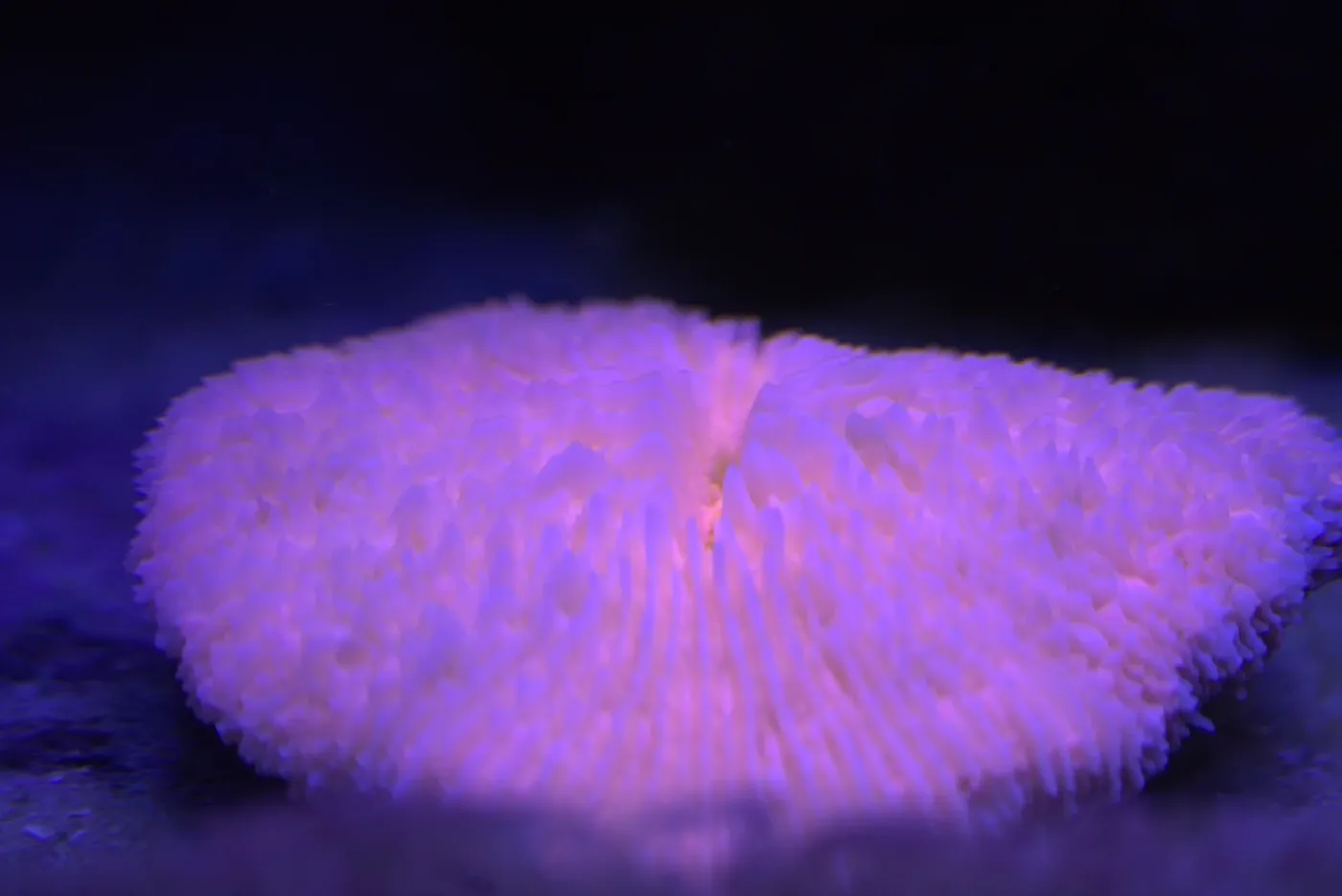
Mushroom corals look like little flat pancakes or mushroom caps stuck to the rocks. They are not true stony corals, and they are not quite sea anemones either. Each one is a soft animal with a mouth in the middle of a round disc. It has no hard bones inside. Tiny plants called algae live in its body and make food from light, so mushrooms don't need much feeding. Red mushrooms, like ours, glow under blue tank lights. Scientists even borrowed a glowing red protein from this mushroom. Now labs all over the world use it to light up living cells! Mushrooms are tough and easy to keep. They can make new mushrooms by splitting in two. They can also leave little bits of their foot behind, and each bit grows. They spread over time, so give them room.
Water & care
Hardy and forgiving, and widely recommended for beginners. Mushrooms prefer lower light and gentler flow than most corals, tolerate imperfect water better than stony corals, and need no calcium or alkalinity for growth. Most problems come from too much light, too much flow or sudden parameter swings. LiveAquaria rates its red mushroom 'Moderate', while Reef Builders and Top Shelf Aquatics call shrooms hardy beginner corals; we rate them Easy.
| Parameter | Keep it at | Where that sits on the usual reef range |
|---|---|---|
| Temperature | 72–78 °F | |
| Salinity (SG) | 1.023–1.025 | |
| pH | 8.1–8.4 | |
| Alkalinity | 8–12 dKH | |
| Calcium | 400–450 ppm | |
| Magnesium | 1,250–1,350 ppm | |
| Nitrate | 0–10 ppm |
Temperature, pH, alkalinity and salinity agree between LiveAquaria (72-78 F, pH 8.1-8.4, 8-12 dKH, SG 1.020-1.025) and Top Shelf Aquatics (72-78 F, 8.1-8.4, 8-12 dKH, 1.023-1.025, calcium 400-450, magnesium 1250-1350). Mushrooms do not use calcium or alkalinity for a skeleton; these are ordinary reef targets for mixed tanks. Top Shelf's general soft-coral advice is nitrate below 10 ppm and phosphate as low as possible; no specific phosphate number was found for mushrooms. Keep conditions stable.
Feeding
DietPhotosynthetic
Favorite foods
- Light (photosynthesis by symbiotic algae)
- Mysis or brine shrimp pieces
- Micro-plankton and zooplankton
- Phytoplankton and fine particulate foods
Mostly photosynthetic and needs no feeding in a tank with fish. Optionally target-feed each disc a few pieces of mysis, brine shrimp or a micro-plankton food once or twice a week to speed growth and color. Turn pumps down while feeding and remove anything the disc spits back out.
Tank & maintenance
- Minimum tank
- 10 gallons
- Aquascape
- Lower rockwork, shaded overhangs or the sand-bed level, on rocks they can spread across. Plan a separate 'shroom rock' or garden area away from stony corals. Loose mushrooms reattach best in a cup or dish of rubble out of strong flow.
- Lighting
- Low to moderate; place lower in the tank under strong lighting. Roughly the 'low' retail range (Bulk Reef Supply uses 75-150 PAR for low light) suits most Discosoma. LiveAquaria lists moderate light and one Reef Builders article suggests medium to high; some forms color up under brighter light, but increase intensity gradually.
- Water flow
- Low to moderate, gentle and indirect. Too much flow makes them stay shrunken or detach and wander.
Routine upkeep
Very little. Thin out or relocate mushrooms that creep toward other corals by slicing them off the rock with a razor blade. Collect any that detach and let them reattach in a rubble cup. Do regular partial water changes and keep parameters steady. Remove uneaten food from the discs.
Temperament & tankmates
TemperamentPeaceful
Peaceful toward fish, but aggressive toward neighboring corals on contact and by slow overgrowth; LiveAquaria lists them as semi-aggressive and recommends adequate space from other corals and sessile invertebrates.
Reef safeWith caution
Harmless to fish and most invertebrates (unlike the much larger elephant ear, Amplexidiscus), but they can damage corals they touch and gradually spread across rockwork. Over time a colony can crowd and shade slower corals, and corallimorphs can carpet whole reefs in the wild. Plant them where they can spread without reaching SPS or LPS.
Good tankmates
- Other mushrooms (Discosoma, Rhodactis, Ricordea) in a mushroom garden
- Zoanthids and star polyps kept a few inches away
- Peaceful reef fish such as clownfish, gobies, blennies and cardinalfish
- Snails, hermit crabs and cleaner shrimp
Avoid
- SPS and LPS corals placed within reach
- Very high-flow spots near powerheads (polyps detach and blow away)
- Fish that may nip soft polyps, such as many butterflyfish and some angelfish
- Leaving a colony to spread unchecked in a tank of stony corals
Help it thrive
- Start them low in the tank; under strong LEDs or halides they look and grow better in the shade.
- Keep flow gentle so the discs stay fully open and do not peel off.
- Feed a few mysis now and then for bigger, faster-splitting discs.
- Give them a dedicated rock so they can spread without reaching stony corals.
- Keep salinity and temperature steady; shrinking is usually the first sign of a swing.
Common ailments
Shrinking, shriveling or melting
- Signs
- Discs stay small and closed, shrivel, or turn to mush.
- Prevention
- Stable water quality and avoiding extremes of light, flow and temperature.
- Treatment
- Test and correct parameters slowly, do partial water changes, reduce light or flow if they recently increased, and remove dead tissue.
Bleaching
- Signs
- Discs lose color and turn pale or white.
- Prevention
- Moderate light and gradual acclimation to new lights or positions; avoid heat spikes.
- Treatment
- Move the polyps lower or shade them, stabilize temperature, and give them time; they often regain color as their algae recover.
Detaching and wandering
- Signs
- Polyps let go of the rock, drift around the tank, and end up in pumps or overflows.
- Prevention
- Gentle, indirect flow and appropriate light.
- Treatment
- Catch the polyp, place it in a cup or dish of rubble or frag plugs in a calm spot until it reattaches, then move the rubble where you want it.
Pests
- Signs
- Flatworms or nudibranchs on or near the discs; damaged or disappearing polyps.
- Prevention
- Inspect, dip and quarantine new mushroom rocks.
- Treatment
- Remove pests manually and dip affected rocks.
This is general hobby guidance, not veterinary advice. Quarantine new arrivals and treat in a separate tank whenever you can.
Risks of owning one
- Mushrooms spread steadily and can crowd, shade and sting slower corals; removing an established carpet from rockwork is tedious.
- Detached polyps can be sucked into pumps or overflows.
- Like other cnidarians they have stinging cells; wear gloves when cutting or handling them and keep hands away from your eyes.
- Elephant ear mushrooms (Amplexidiscus) look similar at a glance but can swallow small fish, so make sure of what you are buying.
Propagation & fragging
DifficultyEasy AquaculturedWidely available
Propagated asexually. Mushrooms reproduce on their own by pedal laceration (bits of the foot that grow into new polyps) and by division, and keepers frag them by cutting a disc into pieces that each grow a new mouth. In the wild they also reproduce sexually through planula larvae.
- Wear gloves and work in a container of tank water.
- Slice the mushroom off its rock at the base with a razor blade or scalpel, or frag the whole rock piece.
- Cut the disc cleanly in halves or wedge-shaped quarters through the mouth.
- Place the pieces in a dish or cup of rubble or frag plugs, optionally held down loosely with mesh, in low flow.
- Leave them undisturbed for one to two weeks until they attach, then move the rubble to the display.
- Each piece heals and forms a new mouth over the following weeks.
Deep dive The science, history and family tree
The science
Discosoma Rüppell & Leuckart, 1828 is a genus of zooxanthellate corallimorpharians (order Corallimorpharia, family Discosomidae), soft-bodied hexacorals often called mushroom or disc anemones. Corallimorpharians resemble stony corals (Scleractinia) in most of their anatomy but secrete no skeleton, and morphological and molecular evidence places them as the stony corals' closest relatives. Discosoma polyps are flattened discs on a very short column attached by a pedal disc. The oral disc is smooth or bears small, reduced discal tentacles arranged radially, and the genus lacks the well-developed marginal tentacles of Rhodactis or the bubble-like vesicles of Ricordea. Polyps produce large amounts of mucus and display a huge range of colors, including metallic, fluorescent, striped and spotted forms. The genus occurs in warm waters of the Indo-Pacific (including the Red Sea), the Caribbean and the tropical western Atlantic, from intertidal flats to sheltered reef habitats at diving depths, and often forms dense aggregations. Nutrition comes from symbiotic dinoflagellates plus food particles captured from the water. Reproduction is largely asexual (pedal laceration and division), with sexual reproduction through planula larvae. Corallimorpharian carpets can overgrow reef surfaces and are associated with phase shifts away from hard-coral dominance. WoRMS accepts 11 species, but genetic data suggest the genus contains fewer than six; D. nummiforme, ranging from the Indo-Pacific into the Red Sea, is the most common in the aquarium trade. The red fluorescent protein DsRed was first isolated from Discosoma and is the ancestor of widely used laboratory markers such as mCherry.
- Appearance
- Round, flat to slightly domed discs, commonly a few centimeters across, attached to rock by a short stalk, often in clusters. The surface is smooth or finely bumpy with radiating lines and a slit-like mouth in the center; edges may be slightly lobed. The trade 'Red Mushroom' is red to maroon, often with lighter radial striping or spots, and fluoresces under actinic light; other forms are blue, purple, green, striped, spotted, metallic or two-toned ('jawbreakers' and similar collector names). Look-alikes: Rhodactis ('hairy' or 'bounce' mushrooms) have a fuzzy layer of pseudotentacles; Ricordea are covered in round bubble-like tentacles; Amplexidiscus fenestrafer (elephant ear) grows much larger and can trap fish; rock flower anemones are true anemones with a ring of tentacles around the edge. LiveAquaria still sells Discosoma under the old name Actinodiscus.
- Native range
- Warm waters of the Indo-Pacific (including the Red Sea), the Caribbean and the tropical western Atlantic. Discosoma nummiforme, the most common hobby species, ranges from the Indo-Pacific into the Red Sea; D. neglecta is endemic to the Caribbean and tropical West Atlantic, and D. carlgreni ranges from Bermuda to Brazil. LiveAquaria's red mushrooms come from Australia and from mariculture.
- Habitat
- From the intertidal zone (some species live among turf algae on very shallow flats) to sheltered reef habitats at diving depths, often in shaded microhabitats such as under overhangs (D. neglecta at about 5-20 m). They frequently form dense carpets; on one remote eastern Indonesian reef, multicolored Discosoma have been reported covering more than 200 m of reef.
- Size
- 3.5 in (8.9 cm). Individual discs are commonly a few centimeters across. LiveAquaria sells red mushroom rocks with several polyps in 1-5 in (2.5-12.7 cm) size classes. No reliable genus-wide maximum disc size was found. Colonies of many polyps keep spreading.
- Lifespan
- Individual polyps can live for many years, and clones spread by asexual reproduction can persist indefinitely in a stable tank.
- Conservation
- Not Evaluated. No IUCN Red List assessment was found. Corallimorpharians are not CITES-listed. Florida limits recreational collectors to 5 single corallimorph polyps of each type per person per day, within a 20-organism daily aggregate, removed with a flexible blade no wider than 2 in and without live rock; recreational catch may not be sold. Common colors are widely aquacultured and maricultured
In the aquarium vs in the wild
In your aquarium
A classic beginner coral and 'shroom garden' centerpiece; inexpensive common colors fill out new reef tanks, and premium named strains are collector items.
On the reef
Photosynthetic disc polyps that form dense aggregations on intertidal flats and sheltered reefs; corallimorph carpets compete for space with stony corals and can dominate damaged reefs.
History
Eduard Rüppell and Friedrich Leuckart named Discosoma in 1828 from Red Sea material collected on Rüppell's North African expedition. Blainville's Actinodiscus (1830) is a later synonym, but it survives in the aquarium trade. WoRMS credits the order name Corallimorpharia to Oskar Carlgren (1943), though some sources cite Stephenson (1937). Mushrooms have been reef-tank staples for decades because they thrive under modest lighting, and red and purple Discosoma are among the corals many hobbyists remember from their first tanks. In 1999 researchers isolated a red fluorescent protein (drFP583, later called DsRed) from a Discosoma mushroom; engineered descendants such as mCherry, developed in Roger Tsien's lab, are now standard tools in biology.
Evolution & relatives
Corallimorpharians are hexacorals, and morphological and molecular evidence makes them the closest relatives of the stony corals (Scleractinia). They differ from true sea anemones (Actiniaria) in lacking the basilar muscles anemones use to creep and in details of their muscles and stinging cells. A 'naked coral' hypothesis proposed that corallimorpharians descended from stony corals that lost their skeletons; this remains debated, and recent phylogenies treat the two as sister lineages. A 2021 phylogenomic study dates the origin of anthozoans to 648-894 million years ago, from a solitary ancestor without a skeleton. Within Discosomidae, Discosoma's closest relatives are Rhodactis, Amplexidiscus, Metarhodactis and Platyzoanthus, and genetic work places Platyzoanthus mussoides inside the Discosoma clade. Ricordea sits in its own family, Ricordeidae.
Family tree, from kingdom down
- Kingdom Animalia Animals Animals are living things made of many cells that must eat food to live. Fish, corals, crabs, snails and sea stars are all animals.
- Phylum Cnidaria Cnidarians Cnidarians are soft animals with tentacles. The tentacles have tiny stinging cells. Corals, sea anemones and jellyfish all belong here.
- Subphylum Anthozoa Corals and sea anemones These cnidarians spend their whole lives as polyps: a tube with a mouth ringed by tentacles. Unlike jellyfish, they never swim around as a bell-shaped medusa.
- Class Hexacorallia Hexacorals In this group the tentacles and body parts come in sixes or multiples of six. It includes stony corals, sea anemones, mushroom corals and zoanthids.
- Order Corallimorpharia Mushroom corals Mushroom corals, or corallimorphs, look like flat, soft discs. They are close cousins of stony corals but never build a hard skeleton.
- Family Discosomidae Disc mushroom corals These mushroom corals form smooth, flat discs that stick to rocks. They come in many colors, and new discs can split off old ones.
- Genus Discosoma
See it on the Tree of Life Compare with another species
Closest relatives
- Discosoma nummiforme Mushroom coral Same genus; the most common hobby species, Indo-Pacific to Red Sea
- Discosoma neglecta Umbrella mushroom Same genus; Caribbean and tropical West Atlantic
- Rhodactis Hairy or bounce mushrooms Same family (Discosomidae)
- Amplexidiscus fenestrafer Elephant ear mushroom Same family; giant fish-catching corallimorph
- Platyzoanthus Elephant ear mushroom Same family; genetically nested within Discosoma
- Ricordea florida Ricordea mushroom Same order, different family (Ricordeidae) Read guide · Compare
- Scleractinia Stony corals Sister order to the corallimorphs
Older scientific names: Actinodiscus, Discostoma, Phialactis.
Fun facts
- A red glowing protein discovered in a Discosoma mushroom (DsRed) was engineered into mCherry and its relatives, which scientists use to make cells and proteins glow under the microscope.
- Mushroom corals are basically stony corals without the stone: their soft anatomy is very similar, but they build no skeleton.
- On one remote reef in eastern Indonesia, Discosoma mushrooms carpet more than 200 m of the reef.
- A cut-up mushroom can regrow into several complete mushrooms, each with its own mouth.
- Basic mushrooms can sell for under $40, while premium named strains such as some 'jawbreakers' have sold for thousands of dollars.
Learn more
- Reef Builders: Panic! at the Disco(soma), an overview of Discosoma corallimorphs reefbuilders.com
- Top Shelf Aquatics: Mushroom coral care guide topshelfaquatics.com
- LiveAquaria: Red Mushroom Coral liveaquaria.com
- WoRMS: Discosoma marinespecies.org
Sources
- WoRMS: Discosoma Rüppell & Leuckart, 1828 marinespecies.org
- Wikipedia: Discosoma en.wikipedia.org
- Wikipedia: Corallimorpharia en.wikipedia.org
- Wikipedia: DsRed en.wikipedia.org
- Wikipedia: mCherry en.wikipedia.org
- Reef Builders: Panic! at the Disco(soma) reefbuilders.com
- Reef Builders: Get to know these 3 types of saltwater shrooms reefbuilders.com
- Reef Builders: tag Discosoma (article index) reefbuilders.com
- Reef Builders: This eastern Indonesian reef is dominated by shrooms reefbuilders.com
- Matz et al. 1999, Fluorescent proteins from nonbioluminescent Anthozoa species (Nature Biotechnology, PubMed) pubmed.ncbi.nlm.nih.gov
- LiveAquaria: Red Mushroom Coral liveaquaria.com
- Top Shelf Aquatics: Mushroom coral care guide topshelfaquatics.com
- Top Shelf Aquatics: Soft coral beginner care guide topshelfaquatics.com
- Bulk Reef Supply: light level definitions on a zoanthid listing bulkreefsupply.com
- Florida FWC: Recreational marine life regulations myfwc.com
- McFadden et al. 2021, Phylogenomics, origin and diversification of anthozoans (Systematic Biology) academic.oup.com
Care facts
The care facts on this guide and its product pages (care level, reef safety, temperament, size, tank, diet, flow, purpose, foods, acclimation and origin) combine 14 independent sources, checked October 25, 2026.
- Discosoma mushroom coral care Tidal Gardens
- Discosoma Coral Care Frag Box
- TSA Disco Mushroom Coral Top Shelf Aquatics
- Coral Guide: Fancy Disco Mushroom (Discosoma sp.) Seascape Studio
- Discosoma Mushroom (Discosoma sp.) Care Guide Eastwood Aquarium
- Sunday Invertebrates - Discosoma Mushroom Corals ASAP Aquarium
- Discosoma Mushroom (Discosoma nummiforme) Reeflings
- Discosoma Mushroom LuisReef
- Red Mushroom (Discosoma ferrugata) The Reef Farm
- Mushroom Coral Care Guide Reefco Aquariums
- Mushroom Coral Care Overview Reef Chasers
- Discosoma mushroom: beautiful, adaptable, beginner friendly corals Reef Builders
- Mushroom Coral Care Guide: Discosoma and Rhodactis for Beginners Gensou
- St. Thomas Bubble Mushroom Quality Marine
Scientific names and classification follow the World Register of Marine Species (AphiaID 267394). Last updated October 25, 2026.
Shop this species
Search the shop →