 Sold out
Aquacultured
Corals · LPS coral
Hammer Coral
Fimbriaphyllia ancora
Also called Anchor coral, Green Hammer, Wall hammer, Branching hammer, Euphyllia hammer, Sausage coral, Ridge coral, Bubble honeycomb coral
- CareModerate
- Reef safeWith caution
- TemperamentAggressiveLong sweeper tentacles sting nearby corals
- Favorite foods
- Light (zooxanthellae)
- Mysis / fortified brine shrimp
- Micro-plankton
- Max size31.5 in (80 cm)
- Min tank30 gal
- LifespanNo fixed lifespan
- IUCN statusLeast Concern
Quick answers
- How big does the Hammer Coral get?
- Up to 31.5 in (80 cm).
- What size tank does it need?
- At least 30 gallons.
- How hard is it to keep?
- Care level: Moderate.
- Is it reef safe?
- With caution. Safe with fish and other invertebrates, but it stings other corals.
- What does it eat?
- Light (zooxanthellae)
- Mysis / fortified brine shrimp
- Micro-plankton
- How long does it live?
- No fixed lifespan: colonies keep growing by budding and splitting heads and can persist for many years in a stable aquarium.
- What are good tankmates?
- Other hammers and frogspawn (often grown close together; see the disease note)
- Clownfish (may host in it)
- Peaceful reef fish that leave LPS alone
- Reef-safe clean-up crew such as snails and small hermit crabs
The 30-second version
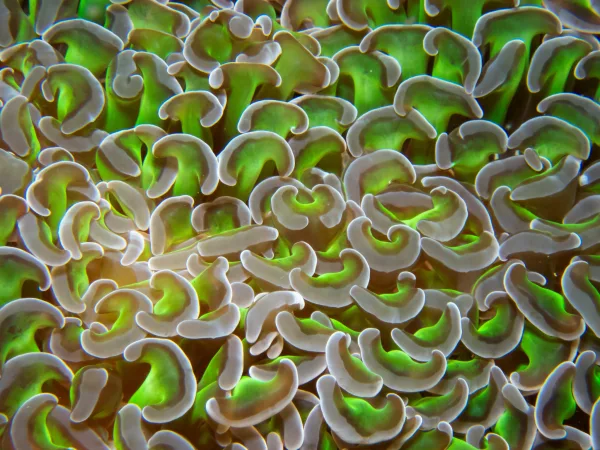
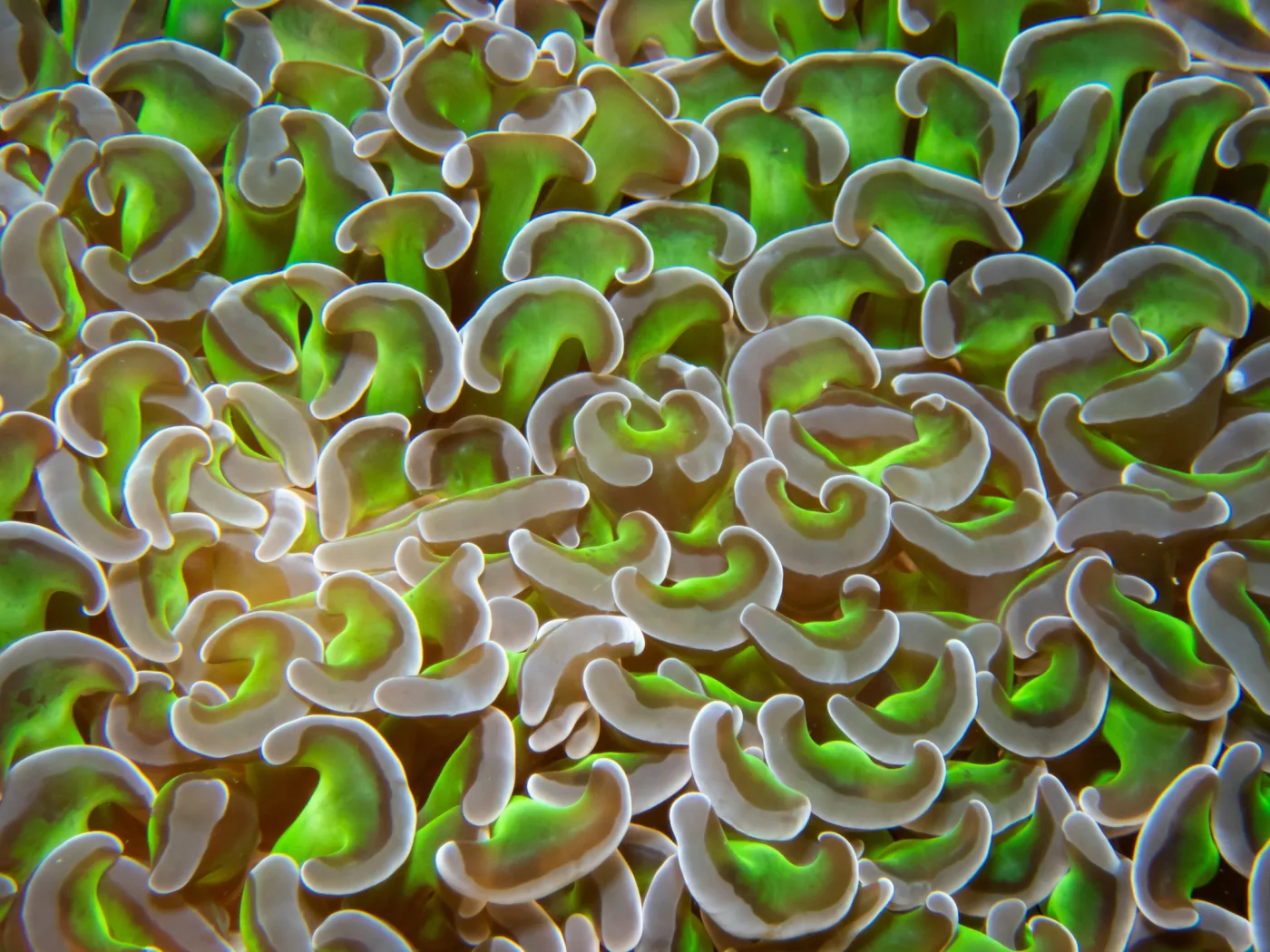
A hammer coral has lots of fat, soft tentacles. The tip of each one is shaped like a tiny hammer or a boat anchor. Under the soft parts is a hard skeleton that the coral builds itself. Some hammers grow like a curvy wall. Others grow like a little bush. Tiny living things called algae live inside the coral and make food from light. The coral also catches tiny animals floating in the water. Hammers often glow green or gold under blue lights. Their tentacles sway in the water like grass in the wind. But they can sting! At night some tentacles stretch out extra long to sting corals that grow too close. So a hammer needs lots of room. In the wild, hammers live on reefs from the Indian Ocean to the Pacific.
Water & care
Considered fairly hardy in an established, stable reef, but still sensitive to alkalinity swings, poor water quality and brown jelly disease. Branching hammers are easier to place, grow and frag than wall hammers. Be prepared to move a new hammer a few times until it opens fully; a healthy one shows a thick band of tissue at the skeleton edge and full, round tentacles.
| Parameter | Keep it at | Where that sits on the usual reef range |
|---|---|---|
| Temperature | 75–78 °F | |
| Salinity (SG) | 1.024–1.026 | |
| pH | 8.1–8.4 | |
| Alkalinity | 8–12 dKH | |
| Calcium | 400–450 ppm | |
| Magnesium | 1,300–1,450 ppm | |
| Nitrate | 5–15 ppm | |
| Phosphate | 0.03–0.1 ppm |
Stability matters most; use frequent small water changes rather than big ones that can shock the coral. Tidal Gardens notes 5-10 ppm nitrate is welcome but 30-40 ppm can cause tissue recession. LiveAquaria lists 72-78°F, pH 8.1-8.4, dKH 8-12 and SG 1.023-1.025; Reef Builders suggests about 78°F, SG 1.026, 9 dKH, 450 ppm calcium and 1300 ppm magnesium. The phosphate range is general LPS practice.
Feeding
DietPhotosynthetic
Favorite foods
- Mysis shrimp
- Brine shrimp
- Fine coral foods such as Reef Roids
- Small LPS pellets
Most energy comes from its zooxanthellae. Occasional spot feeding (about once a week) with a mysis and brine shrimp mix or a fine coral food helps growth. Hammers are not aggressive feeders, so use small particles and be patient. Do not feed a new coral for its first few days, and avoid heavy broadcast feeding, which pollutes the water more than it feeds the coral.
Tank & maintenance
- Minimum tank
- 30 gallons
- Aquascape
- Lower to middle rockwork on a secure base, with a clear radius of about 6 in (15 cm). Branching colonies sit well on rock ledges or frag racks; wall colonies on flat rock or the sand bed where they can spread. No species-specific minimum tank size is published; the real requirement is open space around it.
- Lighting
- Moderate: about 100-150 PAR is the usual target. Hammers may extend more fully under subdued light and color up more under stronger light after slow acclimation. Very long, thin tentacles suggest too little light; pale or bleached tissue suggests too much.
- Water flow
- Low to moderate, random flow that keeps the tentacles swaying and detritus off the skeleton without folding the tentacles flat. Sources differ: Reef Builders suggests lower to moderate flow, Tidal Gardens moderate to strong.
Routine upkeep
Inspect the colony weekly for receding tissue, brown slime, or bite-like spots that could mean flatworms. Keep up routine water changes (small and frequent), test and dose alkalinity, calcium and magnesium steadily, and target-feed occasionally. Trim or move neighbors as the hammer spreads, and frag branching colonies before heads crowd and shade each other.
Temperament & tankmates
TemperamentAggressive
Like other Euphyllia and Fimbriaphyllia it extends long, nematocyst-laden sweeper tentacles at night to defend its space. Hobby reports differ on whether hammers fight with other Euphyllia; many keepers grow hammers and frogspawn close together, but brown jelly disease spreads readily between these corals, so separation reduces risk.
Reef safeWith caution
Safe with fish and other invertebrates, but it stings other corals. Sweeper tentacles can reach well beyond the colony at night, so allow about 6 in (15 cm) of clear space and more as it grows. Clownfish sometimes host in hammers.
Good tankmates
- Other hammers and frogspawn (often grown close together; see the disease note)
- Clownfish (may host in it)
- Peaceful reef fish that leave LPS alone
- Reef-safe clean-up crew such as snails and small hermit crabs
Avoid
- Unrelated corals within sweeper reach (about 6 in)
- Large angelfish, butterflyfish and other fish that pick at LPS
- Unquarantined Euphyllia that may carry flatworms or brown jelly
- Strong direct flow that folds or tears the tentacles
Help it thrive
- Move a new hammer gradually until it opens fully with plump, round tentacles, then leave it there.
- Inspect new colonies on arrival, quarantine them for a couple of weeks, and dip only if needed, waiting 2-3 days after arrival before any dip.
- Use frequent small water changes rather than large ones that can shock the coral.
- Watch the tissue band at the skeleton edge; if it thins, feed a little more and check that nitrate and phosphate are not bottoming out.
- Choose a branching hammer if you want to frag and share; wall hammers grow more slowly and are harder to cut.
Common ailments
Brown jelly disease
- Signs
- Brown or black gooey material on or around the tentacles, rapid tissue loss, spreading quickly to other heads and to other Euphyllia.
- Prevention
- Stable parameters, good random flow, no tissue damage from neighbors or handling, quarantine of new corals, and some space between Euphyllia colonies.
- Treatment
- Siphon off the jelly and remove the affected head or coral from the display as soon as possible, dip the remaining colony in an antibacterial or iodine coral dip, and do a water change.
Euphyllia-eating flatworms
- Signs
- Bite-mark-like spots in the flesh, poor extension, small pale flatworms on the coral or the glass, and egg clusters on the skeleton.
- Prevention
- Quarantine and dip new Euphyllia and inspect the skeleton for eggs.
- Treatment
- Repeat coral dips about weekly for 6-8 weeks and remove egg clusters from the skeleton, since eggs survive dips. (The damaging Euphyllia flatworm described by Reef Builders was documented on torches; whether it also attacks hammers is unconfirmed.)
Tissue recession and polyp bailout
- Signs
- A missing or peeling tissue band at the skeleton edge, tissue receding into the valleys, shrunken tentacles, or whole polyps detaching.
- Prevention
- Stable alkalinity and calcium, nitrate well below 30 ppm, suitable light and flow, and no stinging neighbors.
- Treatment
- Correct the cause, increase feeding slightly if the coral looks thin, and frag healthy heads away from receding ones on branching colonies.
Bleaching and light stress
- Signs
- Pale or bleached tissue, or tentacles that stay short after a move to brighter light.
- Prevention
- Acclimate gradually and keep temperature stable.
- Treatment
- Lower the light or move the coral down, hold temperature steady, and feed lightly while it recovers.
This is general hobby guidance, not veterinary advice. Quarantine new arrivals and treat in a separate tank whenever you can.
Risks of owning one
- Its sticky tentacles can irritate skin; wear gloves and eye protection when handling or fragging.
- Sweeper tentacles can kill nearby corals.
- Brown jelly disease is very contagious among hammers and other Euphyllia and can destroy a colony quickly.
- Flatworms and other hitchhikers can arrive on wild or maricultured colonies.
- Wall hammers are slow to heal after cutting; careless fragging can kill heads.
Propagation & fragging
DifficultyModerate AquaculturedWidely available
Fragmentation. Branching hammers are easy: heads are cut off at the stalk, usually through little or no living tissue. Wall hammers must be sawn through the thinnest part of the skeleton between valleys, heal slowly and are harder. Colonies also bud new heads from the base and split heads. Sexual spawning (colonies spawn as male or female, broadcast) rarely succeeds in home aquariums.
- Use sterile tools, gloves and eye protection.
- On branching colonies, cut individual heads off at the stalk below the tissue; on wall colonies, saw through the thinnest part of the skeleton between valleys.
- Dip the frags in an iodine-based coral dip.
- Glue the bare skeleton to a plug or rock.
- Keep frags in adequate flow and moderate light, away from other corals, while the cut edges heal.
- Watch the cut areas closely for brown jelly for the first two weeks.
Deep dive The science, history and family tree
The science
Fimbriaphyllia ancora is a colonial, zooxanthellate large-polyp stony coral in the family Euphylliidae. The skeleton is usually flabello-meandroid (sometimes flabelloid or phaceloid), forming thin-walled, meandering valleys in which the columella is mostly absent. Continuous stands can cover several metres, but individual colonies are seldom more than 1 m across. Polyps are extended day and night and bear large, puffy tubular tentacles whose tips are shaped like an anchor, hammer, T or kidney bean, the key field character. Tissue ranges from blue-grey to orange, with pale cream or green tentacle margins; aquarium morphs are often vividly fluorescent green, yellow, orange or purple-tipped. The species occurs across the tropical Indo-West Pacific, from the Maldives to the Solomon Islands and from Japan to eastern Australia, with large populations in Indonesia, at 0-40 m. Typical habitats are shallow areas with moderate wave action, reef slopes from mid-reef to deeper water, and rocky outcrops. Each colony spawns as either male or female in a given season, and gametes are broadcast-spawned; in southern Taiwan spawning occurs once a year in late April or May. A multi-year study there (Shikina et al. 2024) found that about 70% of colonies changed sex every year after spawning, while the rest stayed permanently male or female. It also reproduces asexually by budding. Originally described by Veron and Pichon (1980) as Euphyllia (Fimbriaphyllia) ancora from Jewell Reef on the Great Barrier Reef, it was moved to Fimbriaphyllia after molecular work (Luzon et al. 2017) showed the hammer and frogspawn group to be a lineage separate from the torch coral. In the aquarium trade 'hammer' also covers the branching (phaceloid) F. paraancora. It is assessed as Least Concern on the IUCN Red List (2023) and listed on CITES Appendix II.
- Appearance
- Thick tubular tentacles ending in hammer-, anchor-, T- or kidney-shaped tips, extended day and night. Wall hammers (the true F. ancora) have a continuous, curving wall-like skeleton; branching hammers (usually F. paraancora) grow as separate heads on branching stalks. Common trade colors include green, neon or 'toxic' green, yellow, gold, orange and purple-tip. Look-alikes: frogspawn (F. divisa) has branched, grape-cluster tips; torch (Euphyllia glabrescens) has long tentacles with a single round tip; Euphyllia baliensis also has hammer-shaped tips but is rarely seen.
- Native range
- Tropical Indo-West Pacific: from the Maldives east to the Solomon Islands, north to Japan and south to the central east coast of Australia, with a large presence in Indonesia. The type locality is Jewell Reef on the Great Barrier Reef. Trade specimens come mainly from Australia, Indonesia, Fiji and Tonga.
- Habitat
- Reef-associated at 0-40 m: shallow areas with moderate wave action, reef slopes from mid-reef to deeper water, and rocky outcrops. Colonies can merge into continuous stands several metres across.
- Size
- 31.5 in (80 cm). Individual colonies are seldom more than about 1 m (39 in) across, though continuous cover can reach several metres. Fully open wall-type colonies can spread their tissue to well over ten times the width of the skeleton.
- Lifespan
- No fixed lifespan: colonies keep growing by budding and splitting heads and can persist for many years in a stable aquarium. Single heads can be lost to stress (polyp bailout) while the rest of the colony lives on.
- Conservation
- Least Concern. Least Concern on the IUCN Red List (assessed 27 October 2023), though reef corals as a group are under heavy pressure from bleaching (the 2024 IUCN reassessment found 44% of reef-building corals threatened). CITES Appendix II. The EU's CITES Scientific Review Group examined imports of Australian E. ancora and E. paraancora in 2020, and Queensland has had species-level harvest limits on F. ancora since 2022. Branching hammers are widely aquacultured
In the aquarium vs in the wild
In your aquarium
A reef staple and popular LPS centerpiece, valued for flowing, fluorescent tentacles and often used by clownfish as a host. Branching hammers are a mainstay of frag swaps and coral farms.
On the reef
A reef-building coral of reef slopes and rocky outcrops whose dense stands add structure to the reef; it captures plankton and competes for space with stinging sweeper tentacles.
History
Described by J.E.N. Veron and M. Pichon in 1980 as Euphyllia (Fimbriaphyllia) ancora in their Australian Institute of Marine Science monograph on the stony corals of eastern Australia, from Jewell Reef on the Great Barrier Reef; ancora is Latin for anchor, describing the tentacle tips. For decades aquarists knew it as the hammer, anchor or ridge coral in the genus Euphyllia, and it became one of the most popular corals in the hobby. In 2017 Luzon and colleagues used mitochondrial and nuclear DNA to show that Euphyllia as then defined was paraphyletic, and Fimbriaphyllia was raised to a full genus. The EU reviewed imports of Australian hammers in 2020, and Queensland introduced harvest limits for F. ancora in 2022.
Evolution & relatives
Fimbriaphyllia contains F. ancora, F. paraancora, F. divisa, F. paradivisa and F. yaeyamaensis. Luzon et al. (2017) found these form one clade defined by shorter polyps with anchor-shaped or branched tips, mainly separate sexes and broadcast spawning, while the long-tentacled, brooding torch coral sits on a separate branch. Colony shape does not define the groups: the branching F. paraancora and F. paradivisa cluster with the wall-forming ancora and divisa. The authors suggest Fimbriaphyllia may be a young group and noted signs of possible gene flow between species. Hammers sit in the Euphylliidae, on the 'complex' branch of stony corals (suborder Refertina), and DNA groups the family with Galaxea. Look-alikes such as the bubble coral and elegance coral evolved similar fleshy polyps independently on the other, 'robust', branch.
Family tree, from kingdom down
- Kingdom Animalia Animals Animals are living things made of many cells that must eat food to live. Fish, corals, crabs, snails and sea stars are all animals.
- Phylum Cnidaria Cnidarians Cnidarians are soft animals with tentacles. The tentacles have tiny stinging cells. Corals, sea anemones and jellyfish all belong here.
- Subphylum Anthozoa Corals and sea anemones These cnidarians spend their whole lives as polyps: a tube with a mouth ringed by tentacles. Unlike jellyfish, they never swim around as a bell-shaped medusa.
- Class Hexacorallia Hexacorals In this group the tentacles and body parts come in sixes or multiples of six. It includes stony corals, sea anemones, mushroom corals and zoanthids.
- Order Scleractinia Stony corals Stony corals build hard skeletons out of limestone under their soft polyps. Over many years, these skeletons pile up and make coral reefs.
- Suborder Refertina Complex corals
- Family Euphylliidae Euphylliid corals These stony corals have long, fleshy polyps that stay out during the day. They include torch, hammer and frogspawn corals.
- Genus Fimbriaphyllia Hammer and frogspawn corals These corals have fleshy tentacles shaped like hammers, anchors or bunches of eggs. Scientists split them from Euphyllia using DNA.
- Species Fimbriaphyllia ancora
See it on the Tree of Life Compare with another species
Closest relatives
- Fimbriaphyllia paraancora Branching hammer coral Same genus; the branching form usually sold as 'hammer'
- Fimbriaphyllia divisa Frogspawn coral Same genus Read guide · Compare
- Fimbriaphyllia paradivisa Branching frogspawn Same genus Read guide · Compare
- Fimbriaphyllia yaeyamaensis Same genus; branched tentacle tips
- Euphyllia glabrescens Torch coral Same family; sister genus Read guide · Compare
- Galaxea fascicularis Galaxy coral Same family per WoRMS; groups with Euphylliidae in DNA studies
Older scientific names: Euphyllia ancora, Euphyllia (Fimbriaphyllia) ancora, Fimbriaphyllia (Euphyllia) ancora, Euphyllia anacora.
Fun facts
- 'Ancora' is Latin for anchor, after the shape of the tentacle tips.
- A 2024 study in Taiwan found that about 70% of hammer colonies change sex every year, spawning as male one year and female the next (or the reverse).
- In southern Taiwan, hammer corals spawn just once a year, in late April or May.
- A fully open wall hammer can cover well over ten times the width of its skeleton.
- Until 2017 hammers, frogspawn and torches were all in one genus; DNA showed the torch belongs on a separate branch.
Learn more
- Reef Builders: Introduction to hammer coral care reefbuilders.com
- Tidal Gardens: Hammer coral care tidalgardens.com
- Wikipedia: Fimbriaphyllia ancora en.wikipedia.org
- WoRMS: Fimbriaphyllia ancora marinespecies.org
Sources
- WoRMS: Fimbriaphyllia ancora (Veron & Pichon, 1980) marinespecies.org
- SeaLifeBase: Fimbriaphyllia ancora sealifebase.se
- Wikipedia: Fimbriaphyllia ancora en.wikipedia.org
- Luzon et al. 2017, Resurrecting a subgenus to genus (PeerJ) pmc.ncbi.nlm.nih.gov
- Reef Builders (2025): Introduction to hammer coral care reefbuilders.com
- Tidal Gardens: Hammer coral care tidalgardens.com
- Reef Builders (2020): Watch out for a new, more damaging Euphyllia flatworm reefbuilders.com
- Reef Builders (2020): CITES Europe to discuss restrictions on Australian corals reefbuilders.com
- Reef Builders (2021): Revised Queensland coral exports approved until 2024 reefbuilders.com
- Reef Builders (2024): The past, present, and future of torch corals (Euphyllia disease and pests) reefbuilders.com
- IUCN (2024): Over 40% of coral species face extinction iucn.org
- Shikina et al. 2024, The stony coral Fimbriaphyllia (Euphyllia) ancora's reproductive strategy involves a sex change every year (Communications Biology) pmc.ncbi.nlm.nih.gov
- LiveAquaria: Hammer Coral, Branching (care facts) liveaquaria.com
Care facts
The care facts on this guide and its product pages (care level, reef safety, temperament, size, tank, diet, flow, purpose, foods, acclimation and origin) combine 17 independent sources, checked October 25, 2026.
- Hammer Coral (LiveAquaria) LiveAquaria
- Hammer Coral Care, Information, & Pictures Build Your Aquarium (BYA Editorial Staff)
- ECC Branching Hammer Coral 3 Pack Bulk Reef Supply
- The Hammer Coral: A Sizeable Stinger With Showpiece Potential Reef Builders (Jeff Kurtz)
- Hammer Coral: Feeding Routine + Ideal Tank Placement Guide Fish Tank Advisor
- Hammerhead Euphyllia Fishkeeper (UK databank)
- Hammer Coral Care, Placement & Feeding of Euphyllia ancora Saltwater Aquarium Blog (Albert B Ulrich III)
- Hammer Coral Care Guide: Euphyllia Ancora in Your Reef Tank Gensou (Singapore)
- Euphyllia ancora Tropical Fish Hobbyist Magazine (Bob Goemans)
- Hammer Coral Care Fragbox
- Hologram Hammer Coral Top Shelf Aquatics
- Mint Hammer Coral Top Shelf Aquatics
- Hammer Coral Care Guide: Lighting, Flow, Placement & Feeding Queen City Corals
- Hammer Coral Care Guide: Euphyllia Ancora Flow and Feeding Gensou Aquascaping
- ECC Polar Plunge Branching Hammer Bulk Reef Supply
- Hammer Coral Care Guide Reef Chasers
- Hammer Coral LiveAquaria
Scientific names and classification follow the World Register of Marine Species (AphiaID 1048073). Last updated October 25, 2026.
Shop this species
Search the shop →Sold out right now. We restock weekly, so check back soon.
Sold out
Aquacultured