 Sold out
Corals · LPS coral
Branching Frogspawn Coral
Fimbriaphyllia paradivisa
Also called Branching frogspawn, Tongan branching frogspawn, Purple tip frogspawn, Thin branched frogspawn, Frogspawn
- CareModerate
- Reef safeWith caution
- TemperamentAggressiveSweeper tentacles sting nearby corals
- Favorite foods
- Light (zooxanthellae)
- Mysis / small meaty foods
- Brine shrimp / plankton
- Max size10 in (25.4 cm)
- Min tank55 gal
- LifespanNo published lifespan
- IUCN statusLeast Concern
Quick answers
- How big does the Branching Frogspawn Coral get?
- Up to 10 in (25.4 cm).
- What size tank does it need?
- At least 55 gallons.
- How hard is it to keep?
- Care level: Moderate.
- Is it reef safe?
- With caution. Safe with fish and most invertebrates, but it stings other corals.
- What does it eat?
- Light (zooxanthellae)
- Mysis / small meaty foods
- Brine shrimp / plankton
- How long does it live?
- No published lifespan.
- What are good tankmates?
- Other branching frogspawn and hammers (often kept close together)
- Clownfish (may host in it)
- Peaceful reef fish that leave LPS alone
- Reef-safe snails and hermit crabs
The 30-second version
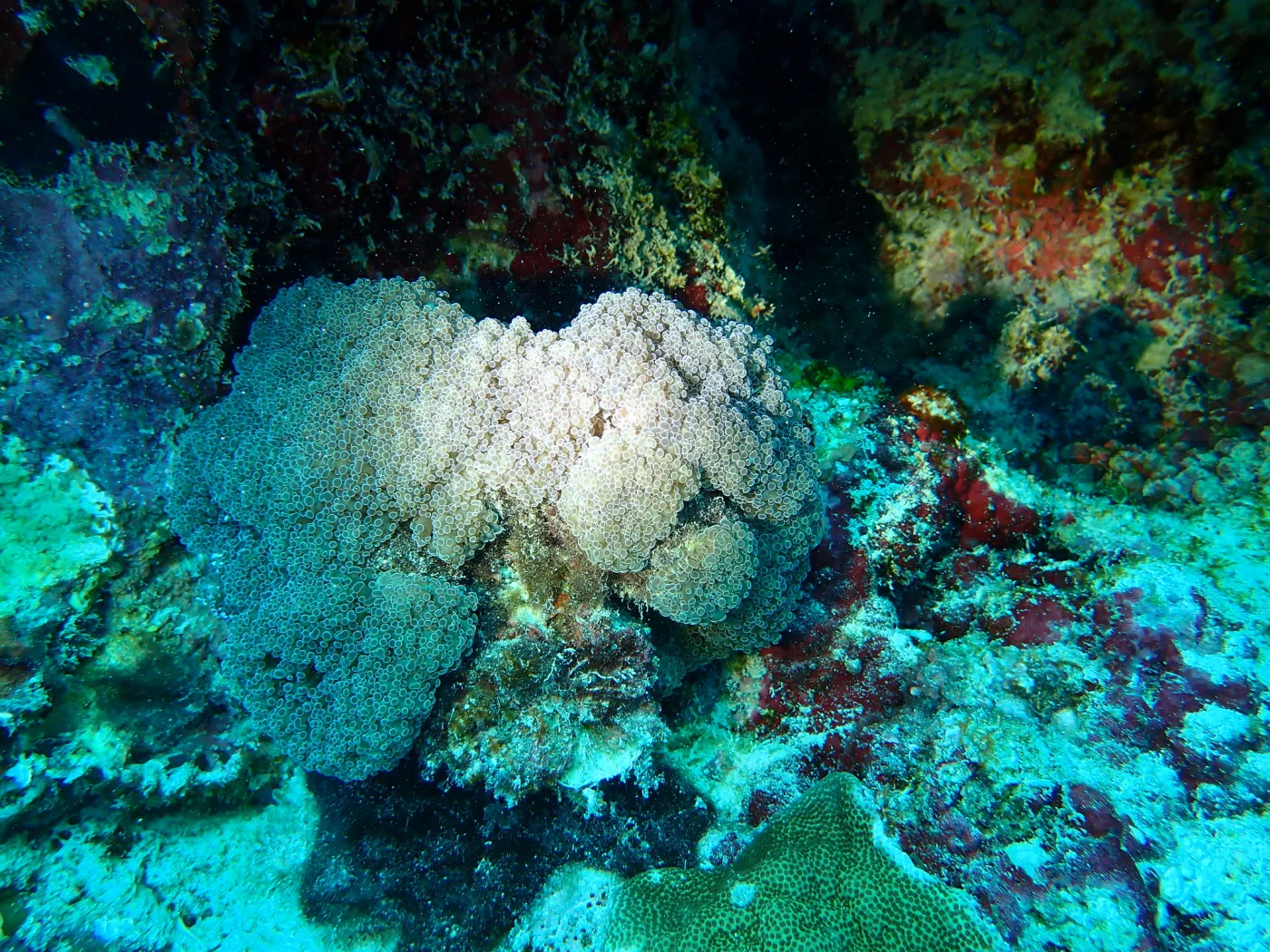
Branching frogspawn coral looks like a bunch of tiny grapes or frog eggs on top of little sticks. Each stick is a branch of hard skeleton, and each branch has its own soft head. The soft tentacles split at the ends into small round tips, often lighter than the rest. Tiny algae live inside the coral and make food from light. The coral can also catch little bits of food that float by. It grows new heads quickly, so one small piece can turn into a big bush. But be careful! At night it can push out long stinging tentacles to keep other corals away. So it needs space of its own. In the wild it lives on calm, sheltered reefs in the warm Indo-Pacific Ocean.
Water & care
Top Shelf Aquatics, Bulk Reef Supply and LiveAquaria rate frogspawn Moderate, and Meerwasser-Lexikon rates this species 'Average'. Some guides call it easy and Reef Chasers calls frogspawn advanced, mainly because of brown jelly and tissue recession. Its algae make most of its food, so steady light and chemistry matter more than heavy feeding. It grows faster and frags more easily than wall frogspawn.
| Parameter | Keep it at | Where that sits on the usual reef range |
|---|---|---|
| Temperature | 76–78 °F | |
| Salinity (SG) | 1.025–1.026 | |
| pH | 8.1–8.4 | |
| Alkalinity | 8–10 dKH | |
| Calcium | 400–450 ppm | |
| Magnesium | 1,300–1,350 ppm | |
| Nitrate | 5–15 ppm | |
| Phosphate | 0.02–0.1 ppm |
Overlap of Top Shelf Aquatics (76-80°F, SG 1.025-1.026, dKH 8-10, Mg 1280-1350, nitrate 2-10 or 5-15, phosphate 0.02-0.1) and Bulk Reef Supply (75-78°F, dKH 8-9.5, Mg 1300-1450, nitrate 10-25, phosphate 0.01-0.1). LiveAquaria's frogspawn sheet allows 72-78°F and SG 1.022-1.025. Stability matters more than exact numbers.
Feeding
DietPhotosynthetic
Favorite foods
- Mysis shrimp
- Enriched brine shrimp
- Micro-plankton and zooplankton
- Small coral pellets or finely chopped seafood
Its zooxanthellae supply most of its food. Optional spot feeding with small meaty foods once or twice a week helps growth and color; turn the pumps down briefly so the food settles on the polyps. Overfeeding raises nitrate.
Tank & maintenance
- Minimum tank
- 55 gallons
- Aquascape
- Lower to middle rockwork or a frag rack, on a stable base with room to grow and 6-8 in clear all round. Branching colonies spread outward as they add heads.
- Lighting
- Moderate: about 75-150 PAR (Top Shelf, Queen City). BRS lists 150-250 PAR, and Reef Builders suggests moving settled colonies into higher light. Start low or shaded and raise the light over 1-2 weeks.
- Water flow
- Moderate, indirect flow that keeps the tentacles swaying without folding them flat. Most sources say moderate; a few say low to moderate or moderate to strong.
Routine upkeep
Check weekly for receding tissue, brown slime or polyp bailout; keep up routine water changes and steady alkalinity, calcium and magnesium; feed lightly once or twice a week if at all; and frag or move neighbors as the colony spreads.
Temperament & tankmates
TemperamentAggressive
Most care sheets rate frogspawn Aggressive (Top Shelf and Queen City say Semi-aggressive). Night-time sweeper tentacles damage most unrelated corals in reach. It usually tolerates other frogspawn and hammers close by, but Top Shelf and Reef Chasers advise keeping it away from torch corals.
Reef safeWith caution
Safe with fish and most invertebrates, but it stings other corals. Sweeper tentacles can reach about 6 in (15 cm) at night (LiveAquaria), and Top Shelf recommends 6-8 in of spacing. Fish that nip LPS, such as angelfish and butterflyfish, should be avoided. Clownfish sometimes host in it, which can irritate the coral if it goes on for long.
Good tankmates
- Other branching frogspawn and hammers (often kept close together)
- Clownfish (may host in it)
- Peaceful reef fish that leave LPS alone
- Reef-safe snails and hermit crabs
Avoid
- Unrelated corals within about 6-8 in
- Torch corals
- Angelfish, butterflyfish and other fish that nip LPS
- Strong direct flow that collapses the polyps
Help it thrive
- Drip acclimate, then dip new frogspawn for pests before it goes in the display.
- Start it low or shaded and raise the light over 1-2 weeks.
- Leave 6-8 inches of clear space and check where the sweepers reach after lights out.
- Use indirect flow that makes the tentacles sway rather than lie flat.
- Cut off any head that starts to recede quickly so the problem cannot spread.
Common ailments
Brown jelly disease
- Signs
- A brown, jelly-like mass on one or more heads with fast tissue loss, which can spread to neighboring heads.
- Prevention
- Stable parameters, good random flow, careful handling, and quarantine of new corals.
- Treatment
- Siphon off the jelly, dip the colony in an iodine or antiseptic coral dip, and cut off affected heads above healthy skeleton.
Tissue recession and polyp bailout
- Signs
- Tissue pulling back from the base of the heads to expose skeleton, or polyps detaching from the skeleton.
- Prevention
- Steady alkalinity, suitable light and flow (too much of either is a common cause), enough nutrients, and no stinging neighbors.
- Treatment
- Increase random flow around the skeleton, siphon decaying tissue, dip the colony, and frag healthy heads away from receding ones.
Bleaching
- Signs
- Pale or bleaching tentacle tips and polyps that stay retracted at peak light, often after a lighting change.
- Prevention
- Raise light gradually and keep PAR in the moderate range.
- Treatment
- Lower the light or move the coral down, keep temperature stable, and feed lightly while it recovers.
This is general hobby guidance, not veterinary advice. Quarantine new arrivals and treat in a separate tank whenever you can.
Risks of owning one
- Sweeper tentacles reaching about 6 inches can kill neighboring corals.
- Brown jelly disease can wipe out heads quickly and spread through a colony.
- Shops label branching frogspawn inconsistently (F. paradivisa, F. yaeyamaensis or E. divisa), so the coral you receive may differ from the label.
- Wild-collected colonies come from a species listed as Threatened under the US Endangered Species Act; prefer aquacultured pieces.
Propagation & fragging
DifficultyEasy AquaculturedWidely available
Fragmentation. Each head sits on its own branch, so heads can be cut off at the stalk with bone cutters without cutting through living tissue. Meerwasser-Lexikon calls it easy to breed and says captive offspring are in the trade, and Fish Tank Advisor reports up to 30 new clusters a year. Sexual reproduction has not been recorded.
- Wear gloves and use clean bone cutters.
- Cut a head off at its stalk, cutting only skeleton.
- Dip the frag in an iodine-based coral dip.
- Glue the bare skeleton to a plug or rock.
- Place in moderate, indirect flow and moderate light, away from other corals.
- Watch the cut heads closely for brown jelly for two weeks.
Deep dive The science, history and family tree
The science
Fimbriaphyllia paradivisa is a colonial, zooxanthellate large-polyp stony coral in the family Euphylliidae. Colonies are phaceloid: separate corallites on branching stalks, with a skeleton much like that of the torch coral, Euphyllia glabrescens. The polyps carry branched tentacles that end in small rounded knobs and look almost identical to those of the wall frogspawn, F. divisa, so the growth form, not the tentacles, is what separates the two. Polyps are pale greenish-grey, rarely pink, with lighter tips, and fluoresce under blue-heavy light; in Red Sea green and yellow morphs the fluorescence is concentrated in the tentacle tips. The species is found in the Indo-Pacific, mostly in the Coral Triangle, and in American Samoa, in places sheltered from wave action such as fringing reef crests, mid-slope terraces and lagoons, usually at about 2-25 m. Corals of the World describes it as uncommon, and in the Gulf of Eilat/Aqaba it lives on mesophotic reefs at about 36-72 m. Its reproduction is unrecorded; Luzon et al. (2017) predicted that it is a gonochoric broadcast spawner like other Fimbriaphyllia. Described by Veron in 1990 as Euphyllia paradivisa, it was moved to Fimbriaphyllia after that 2017 molecular study. It is listed as Threatened under the US Endangered Species Act, assessed as Least Concern on the IUCN Red List (2024), and listed on CITES Appendix II.
- Appearance
- Separate heads on branching stalks, each crowned with tentacles that split into clusters of small rounded tips. Tissue is usually pale greenish-grey or brownish gold, with lighter, cream, green, purple or (rarely) pink tips. Look-alikes: wall frogspawn (F. divisa) has the same tentacles on a continuous, meandering wall skeleton; thick-branched frogspawn (F. yaeyamaensis) has noticeably short, thick tentacles and a squat look; hammer coral (F. ancora) and branching hammer (F. paraancora) have anchor- or T-shaped tips; torch coral (Euphyllia glabrescens) has long tentacles with single round tips.
- Native range
- Indo-Pacific, mostly the Coral Triangle (the Philippines to Timor-Leste and east to the Solomon Islands), and American Samoa, where US critical habitat is designated. NOAA describes the range as the Red Sea to the central Pacific; Red Sea records come from the Gulf of Eilat/Aqaba. Meerwasser-Lexikon also lists Indonesia, Malaysia, Singapore, Mauritius, Samoa, Tonga and Tuvalu. Trade specimens come from Indonesia, the Solomon Islands and Tonga.
- Habitat
- Reef-associated, in low-light areas protected from wave action: fringing reef crests, mid-slope terraces and lagoons, usually 2-25 m. It also lives deeper; Indonesian colonies have been collected at about 30 m, and Red Sea populations live at about 36-72 m.
- Size
- 10 in (25.4 cm). Colony size. Meerwasser-Lexikon gives up to 25 cm (9.8 in); general frogspawn guides give about 10 in (25 cm) across. Colonies add heads quickly, and night-time sweepers reach well beyond the skeleton.
- Lifespan
- No published lifespan. Colonies keep growing by adding heads; Fish Tank Advisor reports branching frogspawn producing 30 or more new clusters a year, and healthy heads can be fragged off to start new colonies.
- Conservation
- Least Concern. IUCN Red List: Least Concern (Roche et al. 2024; previously Vulnerable, which some sites still show). Listed as Threatened under the US Endangered Species Act since 10 October 2014, with critical habitat in American Samoa; NOAA cites climate change, disease, habitat damage, pollution, small population size and unsustainable fishing as threats, and the aquarium trade is named as a collection pressure. CITES Appendix II, so wild colonies need export permits. Reef Builders notes it is common in aquariums but rare on natural reefs. Aquacultured colonies are sold and are the better choice where available
In the aquarium vs in the wild
In your aquarium
A popular display coral for its fluffy, egg-cluster tentacles and fast branching growth; a frag-swap staple and an occasional clownfish host.
On the reef
An uncommon reef coral of sheltered, low-light slopes and lagoons that captures plankton, hosts photosynthetic algae and defends space with sweeper tentacles.
History
Described by J.E.N. Veron in 1990 as Euphyllia paradivisa. It became a hobby staple as 'branching frogspawn', imported from Indonesia, the Solomon Islands and Tonga, and is now also aquacultured. NOAA's listing of it as Threatened under the US Endangered Species Act took effect on 10 October 2014. It was moved to Fimbriaphyllia after Luzon and colleagues' 2017 molecular study. Rare morphs such as true pink tips and orange forms are prized; Reef Builders reported orange branching frogspawn from Indonesia in 2010.
Evolution & relatives
Branching frogspawn belongs to Fimbriaphyllia with the wall frogspawn (F. divisa), the hammers (F. ancora, F. paraancora) and F. yaeyamaensis. Luzon et al. (2017) found that these species cluster together (group V-A), separate from the torch coral, and that the group shares an ancestor with Galaxea fascicularis within Euphylliidae; branching versus wall growth does not separate the lineages. Corals of the World still uses Euphyllia paradivisa, and Veron and colleagues (2025) argue that some recent coral name changes lack enough support.
Family tree, from kingdom down
- Kingdom Animalia Animals Animals are living things made of many cells that must eat food to live. Fish, corals, crabs, snails and sea stars are all animals.
- Phylum Cnidaria Cnidarians Cnidarians are soft animals with tentacles. The tentacles have tiny stinging cells. Corals, sea anemones and jellyfish all belong here.
- Subphylum Anthozoa Corals and sea anemones These cnidarians spend their whole lives as polyps: a tube with a mouth ringed by tentacles. Unlike jellyfish, they never swim around as a bell-shaped medusa.
- Class Hexacorallia Hexacorals In this group the tentacles and body parts come in sixes or multiples of six. It includes stony corals, sea anemones, mushroom corals and zoanthids.
- Order Scleractinia Stony corals Stony corals build hard skeletons out of limestone under their soft polyps. Over many years, these skeletons pile up and make coral reefs.
- Suborder Refertina Complex corals
- Family Euphylliidae Euphylliid corals These stony corals have long, fleshy polyps that stay out during the day. They include torch, hammer and frogspawn corals.
- Genus Fimbriaphyllia Hammer and frogspawn corals These corals have fleshy tentacles shaped like hammers, anchors or bunches of eggs. Scientists split them from Euphyllia using DNA.
- Species Fimbriaphyllia paradivisa
See it on the Tree of Life Compare with another species
Closest relatives
- Fimbriaphyllia divisa Frogspawn coral (wall form) Same genus; near-identical tentacles on a wall skeleton Read guide · Compare
- Fimbriaphyllia yaeyamaensis Thick-branched frogspawn Same genus; also sold as branching frogspawn, including from Tonga
- Fimbriaphyllia ancora Hammer coral Same genus Read guide · Compare
- Fimbriaphyllia paraancora Branching hammer coral Same genus
- Euphyllia glabrescens Torch coral Same family; similar skeleton Read guide · Compare
- Galaxea fascicularis Galaxy coral Same family; shares an ancestor with the Fimbriaphyllia group
Older scientific names: Euphyllia paradivisa.
Fun facts
- Its tentacles are almost identical to wall frogspawn; you tell them apart by the skeleton underneath.
- Under blue light, green and yellow morphs glow most strongly at the tentacle tips.
- In the Red Sea it lives on deep, dim reefs down to about 72 m.
- It is common in home aquariums but rare on natural reefs, and is listed as Threatened under the US Endangered Species Act.
- A healthy colony can add 30 or more new heads in a year.
Learn more
- Top Shelf Aquatics: Gold Center Frogspawn (F. paradivisa) care guide topshelfaquatics.com
- Meerwasser-Lexikon: Fimbriaphyllia paradivisa reeflex.net
- NOAA Fisheries: Fimbriaphyllia paradivisa coral fisheries.noaa.gov
- WoRMS: Fimbriaphyllia paradivisa marinespecies.org
Sources
- WoRMS: Fimbriaphyllia paradivisa (Veron, 1990) marinespecies.org
- Wikipedia: Euphyllia paradivisa (cites IUCN Red List 2024 and NOAA) en.wikipedia.org
- NOAA Fisheries: Fimbriaphyllia paradivisa coral fisheries.noaa.gov
- Corals of the World: Euphyllia paradivisa coralsoftheworld.org
- Luzon et al. 2017, Resurrecting a subgenus to genus (PeerJ) pmc.ncbi.nlm.nih.gov
- Eyal et al. 2015, Spectral diversity of coral fluorescence in a mesophotic Red Sea reef (PLOS ONE) pmc.ncbi.nlm.nih.gov
- Meerwasser-Lexikon: Fimbriaphyllia paradivisa reeflex.net
- Top Shelf Aquatics: Gold Center Frogspawn Coral topshelfaquatics.com
- Bulk Reef Supply: ECC Neon Green Purple Tip Branching Frogspawn bulkreefsupply.com
- LiveAquaria: Frogspawn Coral (incl. thin-branched variants) liveaquaria.com
- LiveAquaria: Frogspawn Coral, Thick Branched (F. yaeyamaensis, Tonga) liveaquaria.com
- Reef Chasers: Frogspawn Coral Care Guide reefchasers.com
- Queen City Corals: Frogspawn Coral Care Guide queencitycorals.com
- Fish Tank Advisor: Frogspawn Coral Care fishtankadvisor.com
- Reef Builders (2018): True pink tipped Euphyllia paradivisa is rarer than you think reefbuilders.com
- Reef Builders (2010): Orange frogspawn in both branching species, from Indonesia reefbuilders.com
- Livestock USA: Tonga Corals price list (Frogspawn = Euphyllia paradivisa) livestockusa.org
Care facts
The care facts on this guide and its product pages (care level, reef safety, temperament, size, tank, diet, flow, purpose, foods, acclimation and origin) combine 17 independent sources, checked October 25, 2026.
- Fimbriaphyllia paradivisa (Branching Frogspawn Coral) Meerwasser-Lexikon (reeflex.net)
- Gold Center Frogspawn Coral Care Guide Top Shelf Aquatics
- ECC Neon Green Purple Tip Branching Frogspawn Bulk Reef Supply
- Frogspawn Coral LiveAquaria
- Branching Frogspawn FishProfiles.com
- Frogspawn Coral: Facts and Tips About This Beautiful Species Aquariadise (Alison Page)
- Frogspawn Coral Care: Placement, Feeding, Fragging Fish Tank Advisor (Peter Herzog)
- Frogspawn Coral 101: Care, Placement & Feeding Tips Aquarium Source (Alison Yang)
- Frogspawn Coral Care Guide Reef Chasers
- Frogspawn Coral Care Guide: Lighting, Flow, Placement & Feeding Queen City Corals
- Frogspawn Coral: Should You Add a Frag to Your Tank? Saltwater Aquarium Blog
- Frogspawn Coral Fragbox
- Frogspawn Coral Care Tidal Gardens (Than Thein)
- Frogspawn Coral Care Guide: Euphyllia Divisa in Your Reef Gensou
- True Pink Tipped Euphyllia paradivisa Is Rarer than You Think Reef Builders (Nicole Helgason)
- Euphyllia paradivisa Wikipedia (cites IUCN, NOAA)
- Fimbriaphyllia paradivisa Coral NOAA Fisheries
Scientific names and classification follow the World Register of Marine Species (AphiaID 1048080). Last updated October 25, 2026.
Shop this species
Search the shop →Sold out right now. We restock weekly, so check back soon.
Sold out