 Limited
Corals · LPS coral
Torch Coral
Euphyllia glabrescens
Also called Gold Torch, Aussie Gold Torch, Indo Gold Torch, Holy Grail Torch, Dragon Soul Torch, Trumpet coral, Pom-pom coral, Joker coral, Brain trumpet coral
- CareModerate
- Reef safeYes
- TemperamentAggressiveLong sweeper tentacles sting nearby corals
- Favorite foods
- Light (zooxanthellae)
- Mysis shrimp
- Reef Roids / micro-plankton
- Max size10.5 in (26.7 cm)
- Min tank30 gal
- LifespanNo fixed lifespan
- IUCN statusLeast Concern
Quick answers
- How big does the Torch Coral get?
- Up to 10.5 in (26.7 cm).
- What size tank does it need?
- At least 30 gallons.
- How hard is it to keep?
- Care level: Moderate.
- Is it reef safe?
- Yes. Safe with fish and other invertebrates, but one of the most aggressive common LPS toward other corals.
- What does it eat?
- Light (zooxanthellae)
- Mysis shrimp
- Reef Roids / micro-plankton
- How long does it live?
- No fixed lifespan: colonies grow by budding and splitting heads and can persist for many years in a stable aquarium.
- What are good tankmates?
- Other torch corals, with a little space between colonies
- Clownfish (may host in it)
- Peaceful reef fish that do not nip LPS
- Snails, hermit crabs and other reef-safe clean-up crew
The 30-second version
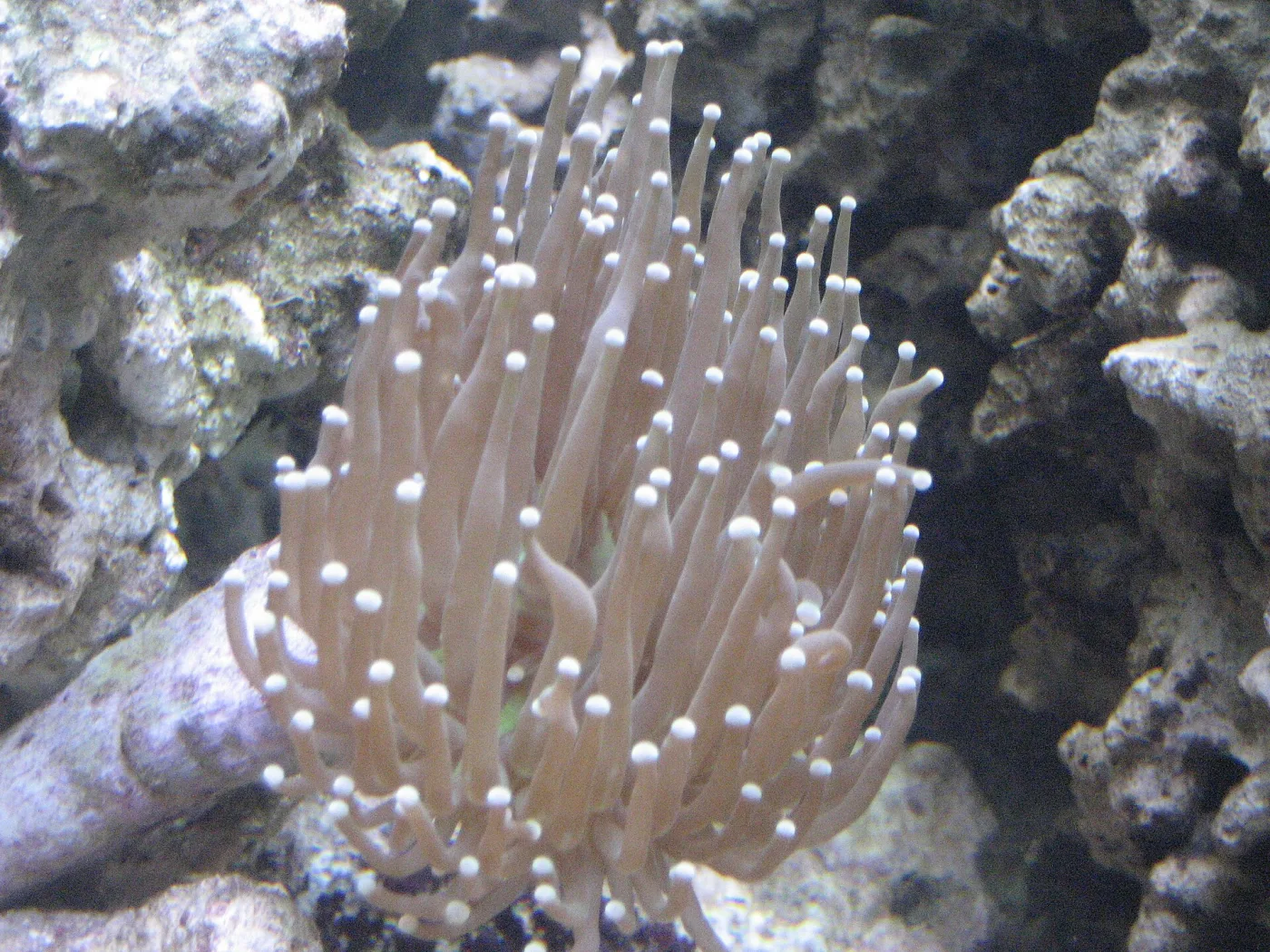
A torch coral looks like a bunch of long, wiggly noodles waving in the water. Each noodle is a tentacle with a round tip, like a little torch. Gold torches have golden tips that seem to glow under blue lights. Under all that soft stuff is a hard, branching skeleton. The coral builds it all by itself. Tiny living things called algae live inside the coral. They turn light into food. The coral also catches tiny animals that float by. But be careful: torches sting! At night they stretch out extra long tentacles called sweepers. These sting other corals nearby, so a torch needs its own space. In the wild, torches live on reefs from the Red Sea to the middle of the Pacific Ocean. Most corals let their eggs float away. A torch keeps its babies inside its body until they are ready to swim off.
Water & care
Hardy once settled in a stable, mature reef, but less forgiving of swings than soft corals or Duncans. The big issues are space (sweeper tentacles), stability (sudden alkalinity or salinity swings can trigger recession or brown jelly), and vigilance for brown jelly disease and Euphyllia-eating flatworms. Hobbyists report that Australian gold torches tend to grow more slowly and succeed less often than Indonesian strains, although the cause is unclear.
| Parameter | Keep it at | Where that sits on the usual reef range |
|---|---|---|
| Temperature | 75–78 °F | |
| Salinity (SG) | 1.024–1.026 | |
| pH | 8.1–8.4 | |
| Alkalinity | 8–12 dKH | |
| Calcium | 400–450 ppm | |
| Magnesium | 1,300–1,450 ppm | |
| Nitrate | 5–15 ppm | |
| Phosphate | 0.03–0.1 ppm |
Stability is the priority: avoid fast alkalinity or salinity swings, a common trigger for recession and brown jelly. Tidal Gardens notes that 5-10 ppm nitrate is welcome for Euphyllia but 30-40 ppm can cause tissue recession. LiveAquaria lists 72-78°F, pH 8.1-8.4, dKH 8-12 and SG 1.023-1.025; Reef Builders gives 75-78°F, SG 1.025-1.026, Ca 420-450 and Mg 1300-1500. The phosphate range is general LPS practice.
Feeding
DietPhotosynthetic
Favorite foods
- Mysis shrimp
- Enriched brine shrimp
- Fine coral foods such as Reef Roids
- Microplankton
- Small LPS pellets
Zooxanthellae supply most of its energy, but occasional spot feeding about 1-2 times a week with small meaty foods, gently pipetted near the tentacles with the pumps turned down, helps growth and color. Torches are not grabby feeders like Acans or Duncans, so use small particles and be patient. Avoid heavy broadcast feeding that fouls the water more than it feeds the coral.
Tank & maintenance
- Minimum tank
- 30 gallons
- Aquascape
- Lower to middle rockwork on a stable base, with a clear radius of about 6 in (15 cm) so tentacles and night-time sweepers do not reach neighbors, and room for the colony to widen as heads split. No species-specific minimum tank size is published; the real limit is having enough open space around it.
- Lighting
- Moderate, roughly 100-150 PAR is a common target, and torches can be acclimated slowly to somewhat lower or higher light. Blue-heavy spectrum makes gold and green morphs fluoresce. Pale tissue suggests too much light; very long, thin tentacles and browning suggest too little.
- Water flow
- Moderate, randomized or turbulent flow that makes the tentacles sway without bending them flat. Strong direct flow damages tissue and stops the coral opening; too little flow lets detritus settle and invites infection. Sources differ here: LiveAquaria rates flow as medium, Reef Builders as moderate to high but randomized.
Routine upkeep
Look over every head at least weekly for pinched or receding tissue, brown slime, or flatworms on the skeleton and glass. Keep up routine water changes and testing, dose alkalinity, calcium and magnesium steadily (small automated doses beat big manual corrections), and target-feed occasionally. Move or trim neighbors as the colony spreads, and frag heads off before the colony crowds itself.
Temperament & tankmates
TemperamentAggressive
Long sweeper tentacles loaded with nematocysts reach several inches beyond the colony at night and damage most other coral types on contact. Sources disagree about contact with other Euphyllia: some keepers find torches tolerate their own kind, while others advise keeping them away from hammers and frogspawn. Because brown jelly disease spreads readily between Euphyllia, a little space between colonies is the safer choice.
Reef safeYes
Safe with fish and other invertebrates, but one of the most aggressive common LPS toward other corals. Sweeper tentacles extend several inches at night and sting most corals they touch. Give it about 6 in (15 cm) or more of clear space and plan for growth. Clownfish sometimes adopt torches as a host, and heavy hosting can stop the coral from opening fully.
Good tankmates
- Other torch corals, with a little space between colonies
- Clownfish (may host in it)
- Peaceful reef fish that do not nip LPS
- Snails, hermit crabs and other reef-safe clean-up crew
Avoid
- Any coral within about 6 in, especially SPS, zoanthids and soft corals
- Angelfish, butterflyfish and other fish that pick at LPS
- Unquarantined Euphyllia that may carry flatworms or brown jelly
- Strong direct, one-way flow aimed at the colony
Help it thrive
- Quarantine and dip every new Euphyllia; if Euphyllia-eating flatworms are suspected, repeat dips weekly for 6-8 weeks because their eggs survive single dips.
- Keep alkalinity rock-steady; slow, automated dosing beats big manual corrections.
- Give it a 'moat' of 6 inches or more and check where the sweepers reach after lights out.
- Use random, turbulent flow so the tentacles sway gently rather than lie flat.
- If one head shows brown jelly, siphon it off and cut that head away quickly to protect the rest of the colony.
Common ailments
Brown jelly disease
- Signs
- A brown, jelly-like mass over a head with rapid tissue loss, often starting after injury or stress and spreading to neighboring heads and other Euphyllia within days.
- Prevention
- Stable parameters, adequate random flow, no tissue damage from neighbors or rough handling, quarantine of new corals, and a little space between Euphyllia colonies.
- Treatment
- Siphon off the jelly, cut away the affected head as soon as it is noticed, dip the rest of the colony in an antibacterial or iodine-based coral dip, isolate it if possible, and do a water change. Treatment is mostly damage control, so act fast.
Euphyllia-eating flatworms
- Signs
- Polyps stay short and close to the skeleton and the coral slowly declines; pale, narrow flatworms about 6-10 mm long on the coral or the glass; bite-like spots in the tissue; clusters of eggs glued to the skeleton.
- Prevention
- Quarantine and dip every new Euphyllia, and inspect the skeleton for egg clusters before adding it to the display.
- Treatment
- Adults drop off after a few minutes in a standard coral dip; repeat dips about weekly for at least 6-8 weeks to break the life cycle, and scrape or cut away skeleton carrying egg clusters, since the eggs resist dips.
Tissue recession and polyp bailout
- Signs
- Pale or pinched flesh, tissue receding down the corallite to expose white skeleton, retracted or kinked tentacles, or whole polyps detaching from the skeleton.
- Prevention
- Stable alkalinity, calcium and salinity; nitrate kept well below 30 ppm; suitable light and flow; no stinging neighbors.
- Treatment
- Correct the underlying cause, frag healthy heads away from receding ones, and keep the coral in clean, moderate flow. Bailed-out polyps very rarely survive.
Bleaching
- Signs
- Tissue turning very pale or translucent while tentacles may still extend.
- Prevention
- Acclimate to new light gradually and keep temperature stable.
- Treatment
- Reduce light intensity, hold temperature steady, and offer small feedings while the coral recovers its zooxanthellae.
This is general hobby guidance, not veterinary advice. Quarantine new arrivals and treat in a separate tank whenever you can.
Risks of owning one
- Its sticky tentacles can irritate skin; wear gloves when handling.
- Sweeper tentacles can kill neighboring corals and start tissue fights that end in infection.
- Brown jelly disease can wipe out a colony within days and spread to other Euphyllia.
- Euphyllia-eating flatworms can hitchhike on new colonies and are hard to eradicate because their eggs are so resilient.
- Named morphs (gold, Holy Grail, Dragon Soul) sell in speculative markets at high prices, so losses are costly.
Propagation & fragging
DifficultyEasy AquaculturedWidely available
Propagated by fragmentation: the branching skeleton lets individual heads be cut off below the living tissue. Colonies also multiply by budding, when a head splits into two. Sexual reproduction by brooding has been achieved in captivity (Ultra Coral Australia raised a captive-spawned Gold Torch), but the aquarium supply relies on fragging.
- Wait until a head has split and each half sits on its own skeleton branch.
- Wear gloves; let the tentacles retract so the branch below the tissue is visible.
- Cut or snap the branch well below the living tissue with bone cutters or a saw, without tearing the flesh.
- Dip the new frag in a coral dip and glue the bare skeleton, not the tissue, to a plug.
- Place it in moderate random flow and moderate light, away from other corals; expect a few days of retraction.
- Watch the cut heads closely for brown jelly during the first two weeks.
Deep dive The science, history and family tree
The science
Euphyllia glabrescens is a colonial, zooxanthellate large-polyp stony coral and the type species of the genus Euphyllia (family Euphylliidae). Colonies are phaceloid: separate tubular corallites about 2-3 cm across and 1.5-3 cm apart branch from a common base to form dome-shaped clumps, usually under 1 m in diameter. Corallite walls are thin and sharp-edged and the outer skeleton is relatively smooth, the feature behind the name glabrescens. Polyps are extended day and night and carry long tubular tentacles, several centimeters long, with rounded knob-like tips. Tissue is typically grey-blue, grey-green or brown with cream, green, yellow or gold tips, and aquarium strains are often strongly fluorescent. Sweeper tentacles armed with potent nematocysts extend several inches at night to sting competitors. The species is widespread in the Indo-Pacific, from the Red Sea (rare) and northern Indian Ocean through Southeast Asia and Australia to southern Japan, Micronesia and American Samoa, at about 1-40 m. It occupies a wide range of reef habitats, including protected lagoons, fringing reefs and reef slopes, and is usually uncommon but conspicuous. Unlike most stony corals, and unlike the hammer and frogspawn corals now placed in Fimbriaphyllia, it is a hermaphroditic brooder: fertilization is internal and well-developed planula larvae are released from the polyps. Molecular work (Luzon et al. 2017) showed it sits on a separate branch from the hammer and frogspawn group. It is assessed as Least Concern on the IUCN Red List (2023) and listed on CITES Appendix II; trade specimens come mainly from Indonesia and Australia.
- Appearance
- Long, tube-shaped tentacles with a single rounded tip, extended day and night over a branching skeleton that is mostly hidden. Gold torches have golden-yellow tissue and tips; other morphs include green, purple, pink-tipped, 'Holy Grail' and related grail types, Dragon Soul, and banded 'tiger' torches. Australian torches tend to have thicker, cylindrical tentacles, Indonesian torches thinner tentacles that taper toward the tip. Look-alikes: hammer coral (Fimbriaphyllia ancora and F. paraancora) has anchor- or T-shaped tips; frogspawn (F. divisa and F. paradivisa) has branched, grape-like tips; elegance coral (Catalaphyllia) has a broad oral disc with tentacles around it; bubble coral (Plerogyra) has smooth bubble-like vesicles. Tiger torches are sometimes exported as 'Euphyllia cristata', but true E. cristata is rarely exported.
- Native range
- Indo-Pacific: the Red Sea and Gulf of Aden (rare), the northern Indian Ocean and Persian Gulf, Southeast Asia, Australia, southern Japan and the East China Sea, Micronesia (the type locality is in the Ratak Chain of the Marshall Islands) and east to American Samoa. Aquarium supply comes mainly from Indonesia and Australia, with some from Fiji, Tonga and the Solomon Islands.
- Habitat
- Reef-associated at roughly 1-40 m. Found in a wide range of reef environments, commonly in protected lagoons and other sheltered water, on fringing reefs and on reef slopes. Colonies usually occur singly. High bleaching levels have been recorded in Palau.
- Size
- 10.5 in (26.7 cm). Wild colonies are usually under 1 m (39 in) across, and about 30 cm (1 ft) is typical. Each corallite (head) is 2-3 cm wide; tentacles are several centimeters long, and night-time sweeper tentacles reach several inches beyond the colony.
- Lifespan
- No fixed lifespan: colonies grow by budding and splitting heads and can persist for many years in a stable aquarium. Individual heads can be lost to stress (polyp bailout) while the rest of the colony survives.
- Conservation
- Least Concern. Least Concern on the IUCN Red List (assessed 27 October 2023), though it bleaches and faces the same warming that led the 2024 IUCN reassessment to find 44% of reef-building corals threatened. CITES Appendix II. Supply has seen repeated shocks: a halt on Indonesian coral exports (lifted in January 2020) pushed prices up, the EU's CITES Scientific Review Group examined Australian Euphyllia imports in 2020, and Queensland set species-level harvest limits for E. glabrescens from 2022. Aquacultured and maricultured torches are now widely available
In the aquarium vs in the wild
In your aquarium
A centerpiece LPS and one of the hobby's most collected corals, prized for flowing, often fluorescent tentacles, frequently used as a clownfish host, and traded as high-priced named morphs.
On the reef
A reef-building coral that adds branching structure in lagoons and on reef slopes, captures zooplankton, and competes aggressively for space with its sweeper tentacles.
History
First described by Adelbert von Chamisso and Karl Wilhelm Eysenhardt as Caryophyllia glabrescens, from the Ratak (Radack) Chain of the Marshall Islands; WoRMS dates the description to 1821, although some hobby articles give 1812. In 1846 James Dwight Dana erected the genus Euphyllia with this species as its type. Aquarists have kept torches since at least the early 1990s, and since the 2010s the trade has shifted toward aquacultured and maricultured colonies. Around 2019 a halt on Indonesian coral exports, combined with tight Australian supply, sent prices of Australian gold torches soaring (about £250 a head at UK retail). Indonesian exports resumed in January 2020, and named Indonesian strains such as Holy Grail and Dragon Soul became collector items. The EU reviewed Australian Euphyllia imports in 2020, and Queensland introduced harvest limits for E. glabrescens from 2022.
Evolution & relatives
Torches belong to the Euphylliidae, on the 'complex' branch of stony corals (suborder Refertina), which also holds Duncans and sun corals (Dendrophylliidae) and Acropora and Montipora (Acroporidae). DNA studies group Euphylliidae with Galaxea in what researchers call clade V. The look-alike bubble corals (Plerogyra, Physogyra) and the elegance coral (Catalaphyllia) were once classified with Euphyllia, but DNA places them on the other, 'robust' branch (Plerogyridae and Merulinidae), so their long, fleshy polyps evolved independently. Luzon et al. (2017) found the old genus Euphyllia was paraphyletic and raised the subgenus Fimbriaphyllia (hammers and frogspawn, with shorter tentacles, anchor-shaped or branched tips, mainly separate sexes and broadcast spawning) to a full genus. That left the long-tentacled, hermaphroditic, brooding torch in Euphyllia proper. Torches are therefore the closest relatives of hammers and frogspawn in the hobby, but on their own twig.
Family tree, from kingdom down
- Kingdom Animalia Animals Animals are living things made of many cells that must eat food to live. Fish, corals, crabs, snails and sea stars are all animals.
- Phylum Cnidaria Cnidarians Cnidarians are soft animals with tentacles. The tentacles have tiny stinging cells. Corals, sea anemones and jellyfish all belong here.
- Subphylum Anthozoa Corals and sea anemones These cnidarians spend their whole lives as polyps: a tube with a mouth ringed by tentacles. Unlike jellyfish, they never swim around as a bell-shaped medusa.
- Class Hexacorallia Hexacorals In this group the tentacles and body parts come in sixes or multiples of six. It includes stony corals, sea anemones, mushroom corals and zoanthids.
- Order Scleractinia Stony corals Stony corals build hard skeletons out of limestone under their soft polyps. Over many years, these skeletons pile up and make coral reefs.
- Suborder Refertina Complex corals
- Family Euphylliidae Euphylliid corals These stony corals have long, fleshy polyps that stay out during the day. They include torch, hammer and frogspawn corals.
- Genus Euphyllia Torch corals Euphyllia corals, such as torch corals, have long, flowing tentacles with round tips. They can sting corals that grow too close.
- Species Euphyllia glabrescens
See it on the Tree of Life Compare with another species
Closest relatives
- Euphyllia paraglabrescens Same genus per WoRMS; not yet sequenced, and Luzon et al. (2017) predicted from its short polyps that it may belong with Fimbriaphyllia
- Euphyllia cristata Same genus; DNA confirms its placement in Euphyllia
- Euphyllia baliensis Same genus per WoRMS (described 2012); has hammer-shaped tentacle tips, and Luzon et al. (2017) predicted it may belong with Fimbriaphyllia
- Fimbriaphyllia ancora Hammer coral Same family; sister genus split from Euphyllia in 2017 Read guide · Compare
- Fimbriaphyllia divisa Frogspawn coral Same family; sister genus split from Euphyllia in 2017 Read guide · Compare
- Galaxea fascicularis Galaxy coral Same family per WoRMS; groups with Euphylliidae in DNA studies
- Plerogyra sinuosa Bubble coral Look-alike only: on the separate robust-coral branch (Plerogyridae)
Older scientific names: Caryophyllia glabrescens, Euphyllia (Euphyllia) glabrescens, Leptosmilia glabrescens, Lobophyllia glabrescens, Euphyllia rugosa, Euphyllia turgida.
Fun facts
- The torch is the 'type species' of Euphyllia: the whole genus is defined by it.
- Unlike most stony corals, torches brood: eggs are fertilized inside the polyp and the larvae leave already well developed.
- The name glabrescens refers to its smooth-looking skeleton.
- During the 2019 shortage a single Australian gold torch head sold for around £250 in the UK.
- Torch tentacles stay out day and night and pull in only when the coral is badly disturbed.
Learn more
- Reef Builders: The past, present, and future of torch corals reefbuilders.com
- Reef Builders: Torch coral care guide reefbuilders.com
- Wikipedia: Euphyllia glabrescens en.wikipedia.org
- Luzon et al. 2017: molecular phylogeny of Euphyllia and Fimbriaphyllia (PeerJ, open access) pmc.ncbi.nlm.nih.gov
Sources
- WoRMS: Euphyllia glabrescens (Chamisso & Eysenhardt, 1821) marinespecies.org
- SeaLifeBase: Euphyllia glabrescens sealifebase.se
- Wikipedia: Euphyllia glabrescens en.wikipedia.org
- Luzon et al. 2017, Resurrecting a subgenus to genus (PeerJ) pmc.ncbi.nlm.nih.gov
- Reef Builders (2024): The past, present, and future of torch corals reefbuilders.com
- Reef Builders (2026): Torch coral care guide reefbuilders.com
- Reef Builders (2020): Watch out for a new, more damaging Euphyllia flatworm reefbuilders.com
- LiveAquaria: Torch Coral liveaquaria.com
- Tidal Gardens: Hammer coral care (Euphyllia husbandry) tidalgardens.com
- Reef Builders (2022): Why 2022 has been the year of the Indonesian torch coral reefbuilders.com
- Fishkeeping News (2019): Hot corals, the golden torch fishkeepingnews.com
- Reef Builders (2020): CITES Europe to discuss restrictions on Australian corals reefbuilders.com
- Reef Builders (2021): Revised Queensland coral exports approved until 2024 reefbuilders.com
- IUCN (2024): Over 40% of coral species face extinction iucn.org
Care facts
The care facts on this guide and its product pages (care level, reef safety, temperament, size, tank, diet, flow, purpose, foods, acclimation and origin) combine 13 independent sources, checked October 25, 2026.
- Torch Coral (Euphyllia glabrescens) LiveAquaria
- Torch Coral Care Guide: Lighting, Flow, Placement & Feeding Queen City Corals
- Torch Coral Fishkeeper
- How to Care for Torch Corals Aquariumbreeder
- Gold Torch Coral Biota
- Electric Torch Coral Top Shelf Aquatics
- ECC Golden Dragon Torch Bulk Reef Supply
- Torch Coral Care, Information, & Pictures Build Your Aquarium
- The past, present and future of torch corals (Euphyllia glabrescens) Reef Builders
- Purple Tip Green Torch Coral Quality Marine
- Torch Coral - Large Polyp Stony LPS Beginner Coral Saltwater Aquarium Blog (Albert B. Ulrich III)
- Torch Coral Care FragBox
- Torch Coral (Euphyllia glabrescens) care Gensou
Scientific names and classification follow the World Register of Marine Species (AphiaID 207617). Last updated October 25, 2026.
Shop this species
Search the shop →
Limited