 Sale
Invertebrates · Crab
Emerald Crab
Mithraculus sculptus
Also called Green Clinging Crab, Emerald Mithrax Crab, Mithrax Crab
- CareEasy
- Reef safeYes
- TemperamentSemi-aggressivePeaceful if fed; hunger drives it to eat snails, polyps
- Favorite foods
- Bubble algae
- Hair algae / film algae
- Pellets / mysis / nori
- Max size2 in (5.1 cm)
- Min tank20 gal
- LifespanAbout 2-4 years in captivity per one…
- IUCN statusNot Evaluated
Quick answers
- How big does the Emerald Crab get?
- Up to 2 in (5.1 cm).
- What size tank does it need?
- At least 20 gallons.
- How hard is it to keep?
- Care level: Easy.
- Is it reef safe?
- Yes. Most keep it with corals without trouble, but it is an opportunistic omnivore: LiveAquaria and Wikipedia both warn that an underfed emerald crab may eat coral polyps, other invertebrates or small fish, and keeper reports describe attacks on soft coral and SPS polyps, zoanthids and snails.
- What does it eat?
- Bubble algae
- Hair algae / film algae
- Pellets / mysis / nori
- How long does it live?
- About 2-4 years in captivity per one care guide (Aquariadise); no published data.
- What are good tankmates?
- Mid- and upper-water peaceful fish such as tangs, chromis, anthias and clownfish
- Most hard corals in a well-fed tank
- Large snails such as turbo and trochus
- Larger fish too big for it to catch
The 30-second version
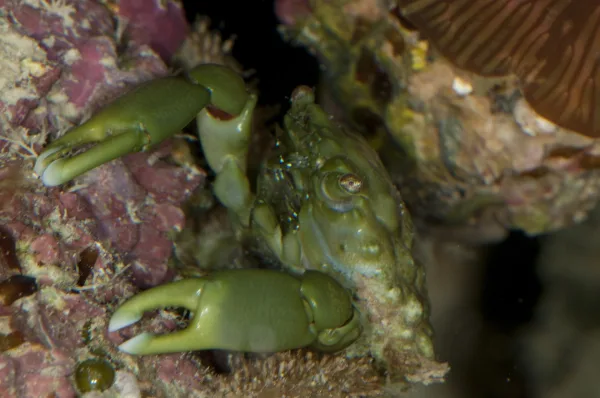
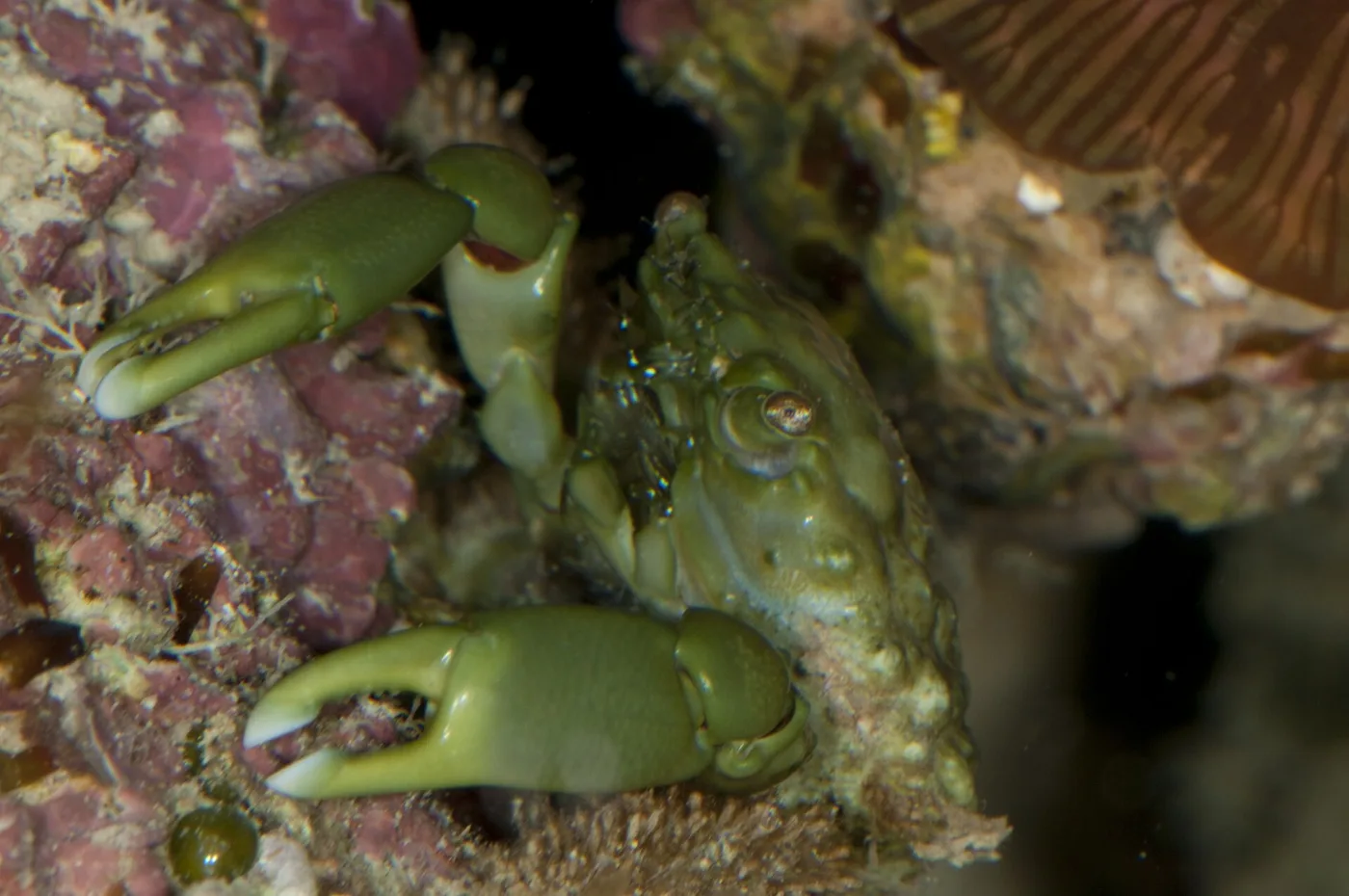
The Emerald Crab is a small crab that is shiny green, like a jewel. Its back is flat, its legs are a bit hairy, and its claws look like tiny spoons with white tips. It comes from the warm seas near Florida, the Caribbean and the Gulf of Mexico. It is a night owl. In the day it hides in cracks in the rock, and at night it comes out to look for food. Fish keepers like it because it eats bubble algae. That is a green pest that looks like little marbles stuck to the rocks. It also eats food scraps. But this crab is not picky. If it gets very hungry, it may nibble on corals, snails or even a small, sleepy fish. So keep it well fed.
Water & care
Hardy and tolerant of reef conditions and strong flow, but intolerant of copper and of fluctuating parameters (LiveAquaria). It needs a mature tank with plenty of rock caves. The key to keeping it reef-friendly is food: algae alone is rarely enough, so add meaty foods and dried seaweed. It molts as it grows; the empty shell looks like a dead crab, and the crab hides for several days while the new shell hardens.
| Parameter | Keep it at | Where that sits on the usual reef range |
|---|---|---|
| Temperature | 72–80 °F | |
| Salinity (SG) | 1.023–1.025 | |
| pH | 8.1–8.4 | |
| Alkalinity | 8–12 dKH |
LiveAquaria gives 72-78 F, pH 8.1-8.4, dKH 8-12 and SG 1.020-1.025; Aquariadise gives 74-82 F, pH 8.0-8.4, dKH 8-12 and SG 1.023-1.025. The crab tolerates a range of conditions; keep normal, stable reef parameters for your corals. Calcium, magnesium, nitrate and phosphate are not species-specific, so they are left blank. No copper.
Feeding
DietOmnivore
Favorite foods
- Bubble algae (Valonia)
- Mysis shrimp
- Dried seaweed (nori)
- Sinking pellets and algae wafers
- Leftover meaty foods
Graze on algae plus meaty leftovers. Supplement two or three times a week with mysis, chopped shrimp, dried seaweed or a quality sinking pellet. In research (Figueiredo et al. 2008), offering pellets made the crabs eat significantly less bubble algae while offering mysids did not, so favor mysis over pellets if algae control matters. Do not starve it in the hope it eats more algae: starvation makes it more likely to turn on corals and tankmates.
Tank & maintenance
- Minimum tank
- 20 gallons
- Aquascape
- Mature live rock with plenty of caves and crevices for daytime hiding; bubble algae or other algae to graze is a bonus.
- Lighting
- No needs of its own.
- Water flow
- Any; its clinging legs handle strong flow.
Routine upkeep
Routine reef upkeep. Watch its behavior for the first weeks: if it starts picking at corals or chasing small fish, feed more or remove it. Leave molts in the tank (they are eaten or break down) and do not mistake a molt for a dead crab. Catching one later is hard, since it clings tightly and hides in rock, so plan before adding it.
Temperament & tankmates
TemperamentSemi-aggressive
Rated semi-aggressive by LiveAquaria and Aquariadise. It usually ignores active fish but may grab small, sleeping or sick fish, snails, shrimp and other crabs, especially when hungry. Two emerald crabs may fight, and males are more aggressive than females.
Reef safeYes
Most keep it with corals without trouble, but it is an opportunistic omnivore: LiveAquaria and Wikipedia both warn that an underfed emerald crab may eat coral polyps, other invertebrates or small fish, and keeper reports describe attacks on soft coral and SPS polyps, zoanthids and snails. Large individuals are the most likely to cause damage. Keep it fed, keep only one or two per tank, and remove any crab that is caught picking at corals.
Good tankmates
- Mid- and upper-water peaceful fish such as tangs, chromis, anthias and clownfish
- Most hard corals in a well-fed tank
- Large snails such as turbo and trochus
- Larger fish too big for it to catch
Avoid
- Very small bottom-dwelling fish such as small gobies
- Small or freshly molted shrimp
- Other emerald crabs in small tanks
- Prized zoanthids or soft corals if you cannot feed it well
- Triggerfish, pufferfish, large wrasses and other crab-eaters
- Copper-treated systems
Help it thrive
- Feed it: a little mysis or dried seaweed two or three times a week keeps it reef-friendly. In research, mysis did not reduce its bubble-algae eating, but pellets did.
- Add only one emerald crab to a small or medium tank; two may fight, and big crabs bully small ones.
- Give it caves to hide in by day; a secure crab forages more openly.
- Do not count on the crab alone: broken bubble-algae cells can spread the alga, and high-speed video showed the crab's own feeding releases the alga's juvenile cells (Figueiredo et al. 2008), so also remove bubbles carefully without popping them and keep nutrients in check.
- Keep an eye on small, bottom-sleeping fish and snails; remove the crab if it turns predatory.
Common ailments
Failed or fatal molt
- Signs
- Crab stuck in its old shell, missing legs after a molt, or found dead inside a split shell.
- Prevention
- Stable salinity, alkalinity, calcium and magnesium; a varied diet including meaty food; caves for shelter while soft.
- Treatment
- Leave it alone in a quiet spot; lost legs and claws regrow over later molts.
Starvation and predatory behavior
- Signs
- Picking at corals, chasing fish, attacking snails, or a thin, inactive crab in a very clean tank.
- Prevention
- Supplemental feeding of mysis, seaweed and pellets; do not rely on nuisance algae alone.
- Treatment
- Increase target feeding; remove the crab if damage continues.
Copper or medication poisoning
- Signs
- Weakness, loss of grip, and death after a tank was medicated.
- Prevention
- No copper or invertebrate-toxic treatments in any tank with crabs; treat fish in a hospital tank.
- Treatment
- Move the crab to clean, matched water and remove copper from the display with carbon or resin and water changes.
Shell disease
- Signs
- Brown or black pitting and pockmarks on the shell and legs that may worsen over time.
- Prevention
- Good water quality, a varied diet and avoiding injuries.
- Treatment
- No proven treatment; a successful molt sheds the damaged shell, so keep conditions stable and the crab well fed.
This is general hobby guidance, not veterinary advice. Quarantine new arrivals and treat in a separate tank whenever you can.
Risks of owning one
- May eat corals, snails, shrimp or small fish if underfed; behavior varies between individuals.
- Hard to catch and remove once it settles into rockwork.
- Larger crabs may fight each other or bully smaller crabs.
- Not a guaranteed bubble-algae fix; it prefers pellets and mysis to algae, and pellets in particular cut how much algae it eats.
- Copper and many fish medicines cannot be used in a tank containing it.
- All are wild-collected, and heavy collection of algae grazers worries reef scientists.
Breeding
DifficultyHard Captive-bredRare or wild-caught
Males and females mate in aquariums and females carry eggs under the broad abdomen flap. The larvae have a short planktonic phase with only two zoeal stages and a megalopa: in laboratory culture at 28-29 C on newly hatched Artemia nauplii, each zoeal stage lasted about two days, survival to the megalopa was very high, and the megalopa lasted three to nine days before becoming a crab (Rhyne, Fujita & Calado 2006). Rearing is therefore technically simpler than for cleaner shrimps, but low market value has kept commercial production from developing (Calado et al. 2003), and captive-bred emerald crabs are not a regular trade item.
- Keep a male (narrow triangular abdomen) and female (broad abdomen) together and well fed with meaty foods and algae.
- When the female carries eggs, move her to a separate tank or prepare to capture larvae at hatching, usually at night.
- Rear the zoeae in a small larval tank with gentle circulation at about 28 C, feeding newly hatched Artemia nauplii daily and flushing out uneaten food.
- Provide rubble or mesh for the megalopae to settle on after the two zoeal stages, about four days after hatching.
- Grow out the tiny crabs on finely chopped meaty foods and algae, separating sizes to reduce cannibalism.
Deep dive The science, history and family tree
The science
Mithraculus sculptus is a small spider crab (Majoidea: Mithracidae) of the western Atlantic. The carapace is flat, shiny and dark green, slightly longer than wide and finely sculptured, often with whitish material on its projections; the chelae are green, spoon-shaped and white-tipped, and the paler walking legs are hairy, often encrusted and end in sharp tips that let the crab cling to rock in strong surge. Published maximum sizes range from about 4 cm overall to around 6 cm (2.5 in) across the legs in aquarium references. The species ranges from the Bahamas and southern Florida through the Gulf of Mexico and Caribbean to Brazil, from the intertidal to about 55 m, on hard bottoms of rock and rubble, in seagrass and on reefs; it is often most abundant in back-reef habitats among branches of Porites furcata. It is largely nocturnal, sheltering in caves and crevices by day and hiding under the tentacles of the sun anemone Stichodactyla helianthus when threatened. It is an omnivorous scavenger and grazer, feeding on algae, leftover animal matter and the organisms that encrust turtle-grass blades. In aquariums it is valued for eating bubble algae (Valonia ventricosa); a 2008 study (Figueiredo et al.) found that medium and large crabs ate more of it than small ones, and that offering pellets significantly reduced algae consumption while offering frozen mysids did not. Like other spider crabs it has a short larval life: laboratory-reared larvae pass through only two zoeal stages (about two days each at 28-29 C) and a megalopa, becoming a crab roughly 7-13 days after hatching (Rhyne, Fujita & Calado 2006). Mithraculus crabs are collected in large numbers from shallow water for the aquarium trade, and their low commercial value has discouraged aquaculture (Calado et al. 2003).
- Appearance
- Flat, shiny emerald to dark green carapace with fine sculpting; green, spoon-shaped claws with white tips; paler, hairy walking legs. Males have a narrow, roughly triangular abdomen flap and slightly larger claws; females have a broad, rounded flap. Look-alikes: other Mithraculus such as the red-ridged clinging crab (M. forceps) are reddish; juvenile Caribbean king crabs (Maguimithrax spinosissimus) are much spinier and grow very large.
- Native range
- Western Atlantic: the Bahamas and southern Florida through the Gulf of Mexico and the Caribbean to Brazil (SeaLifeBase gives south to Sao Paulo).
- Habitat
- Hard bottoms of rock and rubble, back reefs, seagrass beds and reefs from the intertidal to about 55 m; common among branches of finger coral (Porites furcata) and in turtle grass. Nocturnal; hides in caves and crevices by day.
- Size
- 2 in (5.1 cm). Retailers (LiveAquaria, Aquariadise) list up to 2.5 in, which includes legs; Wikipedia gives about 4 cm (1.6 in). Most sold animals are 0.5-1.5 in. Large individuals can bully or eat smaller ones.
- Lifespan
- About 2-4 years in captivity per one care guide (Aquariadise); no published data.
- Conservation
- Not Evaluated. Not evaluated by the IUCN Red List and not CITES-listed (SeaLifeBase). All trade stock is wild-collected, largely from Florida and the Caribbean. Calado et al. (2003) warned that collecting Mithraculus in large numbers from shallow water is likely to affect ecosystems, and Rhyne et al. (2009) documented that Florida's marine-life fishery landed about 9 million invertebrates in 2007, 6 million of them algae grazers for aquariums, with landings of grazers rising sharply
In the aquarium vs in the wild
In your aquarium
Clean-up crew and nuisance-algae control, especially for bubble algae (Valonia); also scavenges leftover food.
On the reef
A nocturnal grazer and scavenger on back reefs, seagrass beds and rubble, eating algae, encrusting organisms on turtle grass, and dead animal matter; prey for reef fishes. Grazers like it help keep algae in check on reefs.
History
Described by the French naturalist Jean-Baptiste de Lamarck in 1818 as Maia sculptus, in his Histoire naturelle des animaux sans vertebres. It was later placed in Mithrax, and for decades the aquarium trade sold it as Mithrax sculptus or simply 'Mithrax crab'; it is now in the genus Mithraculus and the family Mithracidae, which was raised from a subfamily of Majidae in recent spider-crab classifications. It became a staple of the 'clean-up crew' trend in reef keeping because it eats bubble algae, which few other animals touch, and its effectiveness was tested scientifically in 2008. It is one of the many grazers collected in Florida and the Caribbean for aquariums.
Evolution & relatives
Emerald crabs are true crabs (Brachyura) in the spider-crab superfamily Majoidea, a group known from fossils since the Cenomanian stage of the Late Cretaceous (about 100-94 million years ago). Within Majoidea they belong to Mithracidae, the family that also contains the much larger Caribbean king crab (Maguimithrax spinosissimus) and other Mithraculus clinging crabs such as M. forceps and M. coryphe. Majoids are characterized by an abbreviated larval development with only two zoeal stages, and the emerald crab follows this pattern (Rhyne, Fujita & Calado 2006). True crabs like the emerald crab are only distantly related to hermit crabs, which belong to a separate infraorder, Anomura.
Family tree, from kingdom down
- Kingdom Animalia Animals Animals are living things made of many cells that must eat food to live. Fish, corals, crabs, snails and sea stars are all animals.
- Phylum Arthropoda Arthropods Arthropods have jointed legs and a hard outer shell called an exoskeleton. To grow, they must crawl out of the old shell, which is called molting.
- Subphylum Crustacea Crustaceans Crustaceans are arthropods with a hard shell and two pairs of feelers. Most live in water, like crabs, shrimps and lobsters.
- Superclass Multicrustacea
- Class Malacostraca Malacostracans This big class of crustaceans includes crabs, shrimps, lobsters and krill. Their bodies are built from about the same number of segments.
- Subclass Eumalacostraca
- Superorder Eucarida
- Order Decapoda Decapods Decapod means 'ten feet'. Crabs, shrimps, lobsters and hermit crabs all have ten legs, counting their claws.
- Suborder Pleocyemata Egg-carrying decapods
- Infraorder Brachyura true crabs
- Section Eubrachyura
- Subsection Heterotremata
- Superfamily Majoidea spider crabs
- Family Mithracidae Mithracid spider crabs These spider crabs mostly live on reefs in warm seas. Many hide in rocks by day and come out at night.
- Genus Mithraculus Clinging crabs Clinging crabs are small crabs that hold tightly onto rocks. The green emerald crab belongs here.
- Species Mithraculus sculptus
See it on the Tree of Life Compare with another species
Closest relatives
- Mithraculus forceps Red-ridged Clinging Crab Same genus; reddish western Atlantic relative Read guide · Compare
- Mithraculus coryphe Nodose Clinging Crab Same genus
- Mithraculus cinctimanus Banded Clinging Crab Same genus
- Maguimithrax spinosissimus Caribbean King Crab Same family (Mithracidae); formerly Mithrax spinosissimus
- Stenorhynchus seticornis Arrow Crab Same superfamily (Majoidea), different family (Inachoididae) Read guide · Compare
Older scientific names: Mithrax sculptus, Maia sculptus, Mithrax minutus.
Fun facts
- Its claws are shaped like tiny spoons, handy for scraping algae.
- Its legs end in sharp tips that let it cling to rock so tightly that strong currents cannot dislodge it, and aquarists struggle to pull it out of rockwork.
- When danger comes, it can hide under the stinging tentacles of a sun anemone.
- In a scientific test, emerald crabs ate much less bubble algae when they were also offered pellets, but having mysis shrimp on the menu did not slow them down.
- It is a spider crab, part of the same superfamily as the arrow crab, the Caribbean king crab and the giant Japanese spider crab.
Learn more
- Wikipedia: Mithraculus sculptus en.wikipedia.org
- LiveAquaria: Emerald Crab care facts liveaquaria.com
- Aquariadise: Emerald crab care guide aquariadise.com
- WoRMS: Mithraculus sculptus marinespecies.org
Sources
- WoRMS taxon record 421990 marinespecies.org
- SeaLifeBase: Mithraculus sculptus summary sealifebase.se
- Wikipedia: Mithraculus sculptus en.wikipedia.org
- Wikipedia: Majoidea en.wikipedia.org
- LiveAquaria: Emerald Crab liveaquaria.com
- Aquariadise: Emerald crab aquariadise.com
- Calado et al. 2003, Marine ornamental decapods: popular, pricey, and poorly studied academic.oup.com
- Rhyne et al. 2009, Crawling to Collapse (PLoS ONE) journals.plos.org
- Figueiredo et al. 2008, Efficiency of using emerald crabs to control bubble alga (J. Mar. Biol. Assoc. UK 88: 95-101), abstract nsuworks.nova.edu
- Rhyne, Fujita & Calado 2006, Larval development and first crab of Mithraculus sculptus (J. Mar. Biol. Assoc. UK 86: 1133-1147, PDF) research.nhm.org
Care facts
The care facts on this guide and its product pages (care level, reef safety, temperament, size, tank, diet, flow, purpose, foods, acclimation and origin) combine 14 independent sources, checked October 25, 2026.
- Emerald Crab - LiveAquaria LiveAquaria
- CRAB - EMERALD Mithraculus sculptus Aquatics Unlimited
- Emerald Crab 101: Care, Molting & Reef Safe Advice Aquarium Source (author Alison Yang)
- Emerald Crab (Aquariadise) Aquariadise (author Charlie Morton)
- Emerald Crab - Mithraculus sculptus That Pet Place
- Emerald Crab - Topshelf Aquatics Topshelf Aquatics
- Emerald crab: a fine addition to any reef clean up crew Saltwater Aquarium Blog (Albert B Ulrich III)
- Emerald Crab - Fragbox Corals Fragbox Corals
- Emerald Crab Care Guide: The Best Crab for Bubble Algae Control in Reef Tanks AquariumStoreDepot
- Emerald Crabs: Essential Care & Reef Tank Safety Guide ReefJar
- Mithraculus sculptus Wikipedia
- Emerald Crab LiveAquaria
- Efficiency of using emerald crabs to control bubble alga (Figueiredo et al. 2008, JMBA) Nova Southeastern University / J. Mar. Biol. Assoc. UK
- Emerald Crab care Reef Tank Resource
Scientific names and classification follow the World Register of Marine Species (AphiaID 421990). Last updated October 25, 2026.
Shop this species
Search the shop →
Sale