 Sold out
Invertebrates · Crab
Spider Crab
Mithraculus forceps
Also called Red-ridged Clinging Crab, Ruby Red Crab, Red Emerald Crab, Ruby Emerald Crab, Yellow Coral Crab
- CareEasy
- Reef safeWith caution
- TemperamentPeacefulPeaceful; may pick at corals if underfed
- Favorite foods
- Hair and film algae
- Bubble algae
- Leftover fish food
- Max size1 in (2.5 cm)
- Min tank26 gal
- LifespanNo published data
- IUCN statusNot Evaluated
Quick answers
- How big does the Spider Crab get?
- Up to 1 in (2.5 cm).
- What size tank does it need?
- At least 26 gallons.
- How hard is it to keep?
- Care level: Easy.
- Is it reef safe?
- With caution. Sold as reef safe (Salty Underground) and described as a harmless algae grazer (Meerwasser-Lexikon), but keeper reports on Meerwasser-Lexikon describe underfed crabs attacking SPS, LPS and soft corals and a disc anemone, behavior that stopped once they were fed extra food.
- What does it eat?
- Hair and film algae
- Bubble algae
- Leftover fish food
- How long does it live?
- No published data.
- What are good tankmates?
- Peaceful reef fish
- Snails, hermit crabs and other clean-up crew
- Most corals in a tank where the crab is well fed
The 30-second version
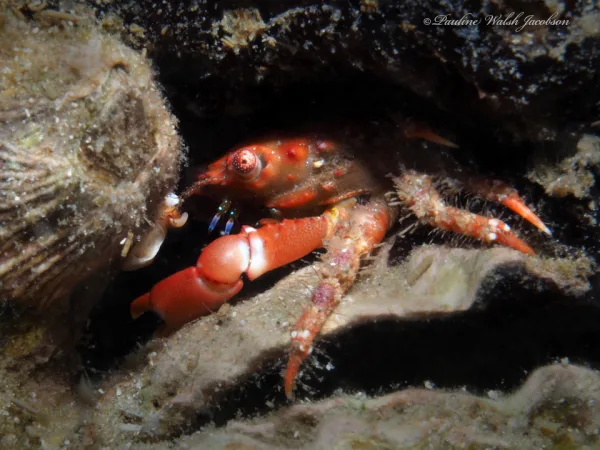
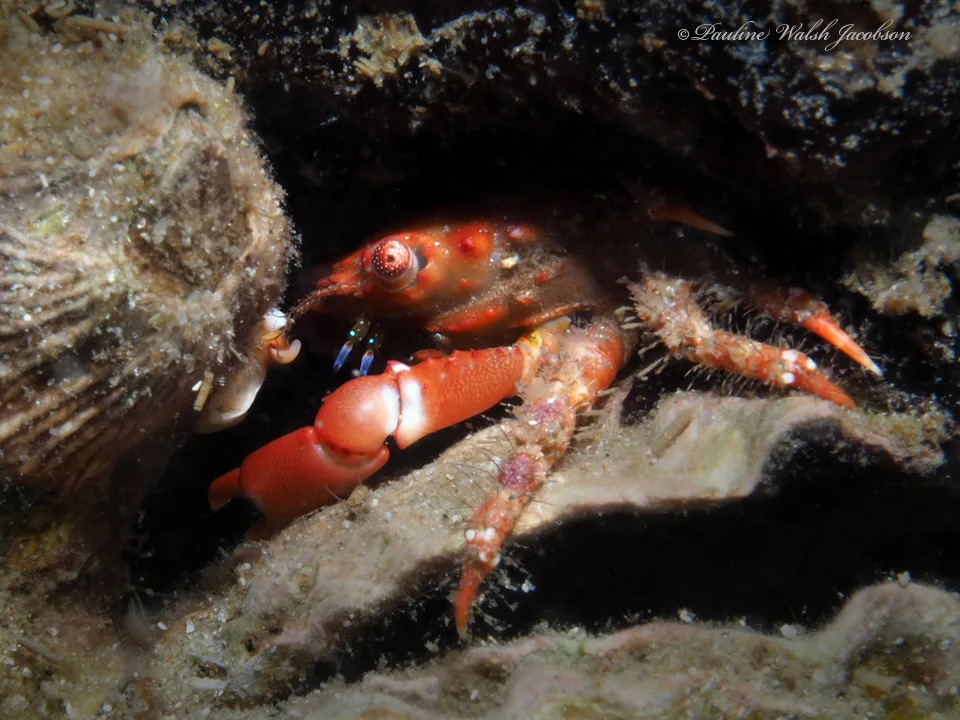
This little crab is red, and it is about as big as a grape. It is a cousin of the green emerald crab and looks just like it, only red. It lives in the warm sea from Florida and the Caribbean down to Brazil. It likes to hide in cracks in the rock and in sea grass. People put it in fish tanks because it eats algae, the green fuzz that grows on rocks. It also eats bits of fish food that fall to the bottom. It is mostly calm. But if it gets very hungry, it may pick at corals, so give it a little food now and then.
Water & care
Florida Keys collector Sea Critters and retailer Salty Underground both rate it a beginner animal. It does best in a tank with plenty of rock and hiding places, where it spends much of its time out of sight. Salty Underground keeps it at 72-82 F and pH 8.0-8.3 with no detectable ammonia. A German reference notes that reports of long-term keeping are scarce, so its care is less documented than the emerald crab's. Algae alone may not be enough food: keepers found that supplemental feeding stopped coral-picking.
| Parameter | Keep it at | Where that sits on the usual reef range |
|---|---|---|
| Temperature | 72–82 °F | |
| pH | 8–8.3 |
Salty Underground gives 72-82 F, pH 8.0-8.3 and 0 ppm ammonia. Other parameters are not species-specific; keep normal, stable reef conditions.
Feeding
DietOmnivore
Favorite foods
- Hair and film algae
- Bubble algae
- Macroalgae
- Leftover fish food
- Prepared foods
Grazes on algae growing on rock and scavenges leftover food. Retailers describe it as primarily herbivorous but happy to eat uneaten fish food; a German keeper reports it eats almost any algae except Caulerpa and wire algae, plus a good amount of prepared food. If algae runs low, offer prepared or meaty foods, since keepers report that supplemental feeding stops coral-picking.
Tank & maintenance
- Minimum tank
- 26 gallons
- Aquascape
- Plenty of live rock with crevices and hiding spots; a crab with secure hiding places forages more openly.
- Lighting
- No needs of its own.
- Water flow
- No stated preference in care sources; it lives on reefs and seagrass beds.
Routine upkeep
Routine reef upkeep. Watch the crab in its first weeks: if it begins picking at corals, feed more or remove it. It hides in rockwork, so it may be seen rarely and can be hard to catch later.
Temperament & tankmates
TemperamentPeaceful
Listed as peaceful (Salty Underground) or passive (Sea Critters) and harmless (Meerwasser-Lexikon). Its risk is opportunistic picking at corals and other sessile invertebrates when hungry, not aggression toward fish.
Reef safeWith caution
Sold as reef safe (Salty Underground) and described as a harmless algae grazer (Meerwasser-Lexikon), but keeper reports on Meerwasser-Lexikon describe underfed crabs attacking SPS, LPS and soft corals and a disc anemone, behavior that stopped once they were fed extra food. WetWebMedia's Bob Fenner considers all Mithraculus crabs, red or green, opportunistic and suspects them when green star polyps are clipped. Keep it fed and remove any crab caught damaging corals.
Good tankmates
- Peaceful reef fish
- Snails, hermit crabs and other clean-up crew
- Most corals in a tank where the crab is well fed
Avoid
- Prized soft corals, zoanthids or star polyps if you cannot feed it
- Large crab-eating fish such as triggers and puffers
- Tanks with little rockwork to hide in
Help it thrive
- Give it lots of rock and hiding spots; Sea Critters says these crabs truly thrive in tanks with plenty of rock.
- Feed it a little prepared food when algae runs short; keepers found this stops coral-picking.
- Do not count on it alone to clear an algae outbreak; keep nutrients in check too.
- Remove any individual caught damaging corals or polyps.
Common ailments
Hunger and coral-picking
- Signs
- Crab tearing at corals, polyps or anemones, especially in a very clean tank with little algae.
- Prevention
- Supplemental feeding of prepared or meaty foods; do not rely on nuisance algae alone.
- Treatment
- Increase feeding; remove the crab if damage continues.
Wrong crab received
- Signs
- A long-legged, pear-shaped crab that covers itself with seaweed or sponge and grows to several inches (a Libinia spider crab), or a different clinging crab such as Mithrax hispidus, instead of a small red clinging crab.
- Prevention
- Check new arrivals against photos of Mithraculus forceps before adding them to a reef tank.
- Treatment
- Rehome larger spider crabs to a fish-only or species tank; Libinia are scavengers and predators that grow to 6-10 cm.
This is general hobby guidance, not veterinary advice. Quarantine new arrivals and treat in a separate tank whenever you can.
Risks of owning one
- Trade name is ambiguous: other Florida spider crabs (Libinia, Mithrax hispidus) are larger and less reef-safe; check the animal you receive.
- May pick at corals and polyps if underfed.
- Hides in rockwork and is hard to catch once settled.
- All trade animals are wild-collected.
Breeding
DifficultyHard Captive-bredRare or wild-caught
Females carry eggs under the abdomen; in Brazil, egg-carrying females were found in every season (Mantelatto et al. 2003). Research groups have developed larval and juvenile culture protocols: a production model estimated that 1500 larvae reared under optimal conditions reach commercial size in 225 days, with temperature the most important factor for survival, growth and profit (Figueiredo et al. 2008). Wild-caught females appear to store sperm and can produce a second clutch whose larvae survive to settled juveniles about as well as the first (85.7% and 68.3% at 13 days after hatching; Penha-Lopes et al. 2007). Despite this, it is not sold as captive-bred.
- Keep a well-fed adult female; wild-caught females may already carry stored sperm.
- Collect larvae when the female's eggs hatch and rear them in a separate larval tank.
- Expect settled juvenile crabs within about two weeks of hatching.
- Keep temperature stable and optimal, the key factor for survival and growth in research culture.
Deep dive The science, history and family tree
The science
Sold by a Miami wholesaler simply as "spider crab", this animal is most likely Mithraculus forceps, the red-ridged clinging crab, a small spider crab (Majoidea: Mithracidae) of the western Atlantic; the identification is uncertain because the trade name is not tied to one species in any source we found. It is the red counterpart of the green emerald crab (Mithraculus sculptus), and retailers describe it as looking the same apart from its color. Field guides give a size of 0.5-1 in (1-2.5 cm); a German aquarium reference gives 3-5 cm, probably including the legs, and Florida Keys collectors sell animals of about 1-1.5 in. The Florida Fish and Wildlife Conservation Commission (FWC) identifies it by four spines along each front side of the carapace that grow larger toward the rear, and a triangular leg segment (merus) with five outer and two inner marginal spines; some animals are yellow-brown rather than red, hence the name "yellow coral crab". It ranges from Bermuda and North Carolina through the Gulf of Mexico and the Caribbean to Santa Catarina in southern Brazil, from the shallows to about 90 m, in reef and seagrass habitats, and it sometimes lives in loose association with sea anemones (SeaLifeBase). FWC notes it has been found cleaning algae off several coral species, and it is a licensed species in Florida's commercial marine-life fishery. In aquariums it is kept, like the emerald crab, to control nuisance algae (Figueiredo et al. 2008), and retailers report it eating hair algae, macroalgae and bubble algae as well as uneaten fish food. Larval and juvenile culture methods have been worked out in research labs, but trade animals are collected from the wild.
- Appearance
- Small, rounded, slightly flattened carapace in bright red (sometimes yellow-brown), with four spines along each front edge of the carapace that increase in size toward the rear; spoon-like claws and hairy walking legs like the emerald crab. Look-alikes: the emerald crab (Mithraculus sculptus) is the same shape but green; the longnose and portly spider crabs (Libinia), also sold as "spider crab" by some Florida shippers, are larger, long-legged, pear-shaped crabs that cover themselves in algae and sponge.
- Native range
- Western Atlantic: Bermuda and North Carolina through Florida, the Bahamas, the Gulf of Mexico and the Caribbean south to Santa Catarina, Brazil.
- Habitat
- Coral reefs, rubble and seagrass beds from the shallows to about 90 m; field guides list 3-15 m as typical on Florida and Caribbean reefs. Hides in crevices and is sometimes associated with sea anemones.
- Size
- 1 in (2.5 cm). Field guides (Reef Guide, WetWebMedia) give 0.5-1 in (1-2.5 cm) for the body; Meerwasser-Lexikon gives 3-5 cm, likely including legs. Florida Keys collectors sell animals of about 1-1.5 in, and some retailers ship them at about 0.5 in.
- Lifespan
- No published data.
- Conservation
- Not Evaluated. Not evaluated by the IUCN Red List and not CITES-listed (SeaLifeBase). In Florida it is a listed marine-life species (FWC marine life code 836); commercial collection needs a Saltwater Products License with Restricted Species and Marine Life endorsements. Trade stock is wild-collected; researchers working on its aquaculture cite growing collecting pressure on coral reefs (Penha-Lopes et al. 2007)
In the aquarium vs in the wild
In your aquarium
Clean-up crew: grazes nuisance algae (including bubble algae) and scavenges leftover food.
On the reef
A small reef and seagrass grazer; FWC has found it cleaning algae off several coral species, and it sometimes shelters with sea anemones.
History
Described by the French zoologist Alphonse Milne-Edwards in 1875. It was long placed in the genus Mithrax, and the name Mithrax forceps still appears in field guides and hobby sites; it is now in Mithraculus, family Mithracidae (WoRMS). It became a clean-up-crew animal alongside the emerald crab, sold as "ruby red crab", "red emerald crab" or, by some Florida wholesalers, just "spider crab". In the 2000s researchers studied it as a candidate for aquaculture to relieve collecting pressure on reefs.
Evolution & relatives
A true crab (Brachyura) in the spider-crab superfamily Majoidea, family Mithracidae, which also contains the emerald crab (Mithraculus sculptus) and the coral clinging crab (Mithrax hispidus). The Libinia spider crabs also sold as "spider crab" belong to a different majoid family, Epialtidae. Its larvae develop fast, reaching the settled crab stage within about 13 days of hatching in culture (Penha-Lopes et al. 2007).
Family tree, from kingdom down
- Kingdom Animalia Animals Animals are living things made of many cells that must eat food to live. Fish, corals, crabs, snails and sea stars are all animals.
- Phylum Arthropoda Arthropods Arthropods have jointed legs and a hard outer shell called an exoskeleton. To grow, they must crawl out of the old shell, which is called molting.
- Subphylum Crustacea Crustaceans Crustaceans are arthropods with a hard shell and two pairs of feelers. Most live in water, like crabs, shrimps and lobsters.
- Superclass Multicrustacea
- Class Malacostraca Malacostracans This big class of crustaceans includes crabs, shrimps, lobsters and krill. Their bodies are built from about the same number of segments.
- Subclass Eumalacostraca
- Superorder Eucarida
- Order Decapoda Decapods Decapod means 'ten feet'. Crabs, shrimps, lobsters and hermit crabs all have ten legs, counting their claws.
- Suborder Pleocyemata Egg-carrying decapods
- Infraorder Brachyura true crabs
- Section Eubrachyura
- Subsection Heterotremata
- Superfamily Majoidea spider crabs
- Family Mithracidae Mithracid spider crabs These spider crabs mostly live on reefs in warm seas. Many hide in rocks by day and come out at night.
- Genus Mithraculus Clinging crabs Clinging crabs are small crabs that hold tightly onto rocks. The green emerald crab belongs here.
- Species Mithraculus forceps
See it on the Tree of Life Compare with another species
Closest relatives
- Mithraculus sculptus Emerald Crab Same genus; the green look-alike Read guide · Compare
- Mithraculus cinctimanus Banded Clinging Crab Same genus
- Mithrax hispidus Coral Clinging Crab Same family (Mithracidae); FWC reports it as 'coral spider crab'
- Libinia dubia Longnose Spider Crab Same superfamily (Majoidea), family Epialtidae; also shipped from Florida as 'spider crab'
Older scientific names: Mithrax forceps.
Fun facts
- It looks exactly like an emerald crab, only red.
- It has been found cleaning algae off living corals.
- It sometimes shelters with sea anemones.
- Its larvae can become tiny crabs in under two weeks.
- A female can store sperm and produce a second batch of eggs without mating again.
Learn more
- Reef Guide: Red-ridged Clinging Crab reefguide.org
- FWC: Red-ridged clinging crab myfwc.com
- Salty Underground: Ruby Red Crab care facts saltyunderground.com
- WoRMS: Mithraculus forceps marinespecies.org
Sources
- WoRMS taxon record 421988 marinespecies.org
- SeaLifeBase: Mithraculus forceps summary sealifebase.se
- FWC: Red-ridged clinging crab (marine life code 836) myfwc.com
- FWC: Coral clinging crab (code 987, 'Crab, coral spider') myfwc.com
- Reef Guide: Red-ridged Clinging Crab reefguide.org
- WetWebMedia: Mithrax crab identification FAQ wetwebmedia.com
- Meerwasser-Lexikon: Mithraculus forceps meerwasser-lexikon.de
- Sea Critters of the Florida Keys: Ruby Red Crab seacrittersfloridakeys.com
- Salty Underground: Ruby Red Crab saltyunderground.com
- Gulf Specimen Marine Lab: Spider Crab (Libinia) gulfspecimen.org
- Figueiredo et al. 2008, Productivity and profitability of Mithraculus forceps aquaculture (Aquaculture 283: 43-49), abstract researchonline.jcu.edu.au
- Penha-Lopes et al. 2007, Can larvae produced from stored sperm in Mithraculus forceps be used in aquaculture? nsuworks.nova.edu
- Mantelatto et al. 2003, Biological aspects of Mithraculus forceps from Anchieta Island, Brazil (J. Mar. Biol. Assoc. UK 83: 789-791), abstract marineinfo.org
Care facts
The care facts on this guide and its product pages (care level, reef safety, temperament, size, tank, diet, flow, purpose, foods, acclimation and origin) combine 9 independent sources, checked October 25, 2026.
- Ruby Red Crab Sea Critters of the Florida Keys (Marathon, FL collector/retailer)
- Algae Eating Ruby Red Crab (Mithraculus forceps) Salty Underground
- Mithraculus forceps - Meerwasser-Lexikon Meerwasser-Lexikon (Germany)
- Red-Ridged Clinging Crab - Mithraculus forceps - South Florida Reefs Florent's Guide to the South Florida Reefs
- Mithrax crab identification FAQ WetWebMedia (Bob Fenner)
- Red-ridged clinging crab Florida Fish and Wildlife Conservation Commission
- Mithraculus forceps summary SeaLifeBase
- Productivity and profitability of Mithraculus forceps aquaculture (Figueiredo, Penha-Lopes, Lin & Narciso 2008, Aquaculture 283: 43-49) James Cook University ResearchOnline
- Can larvae produced from stored sperm in the ornamental crab Mithraculus forceps be used in aquaculture? (Penha-Lopes et al. 2007) NSUWorks, Nova Southeastern University
Scientific names and classification follow the World Register of Marine Species (AphiaID 421988). Last updated October 25, 2026.
Shop this species
Search the shop →Sold out right now. We restock weekly, so check back soon.
Sold out