 Sold out
Invertebrates · Crab
Arrow Crab
Stenorhynchus seticornis
Also called Yellowline Arrow Crab, Arrowhead Crab, Florida Arrow Crab, Flurry Arrow Crab
- CareEasy
- Reef safeWith caution
- TemperamentSemi-aggressiveFights other crabs; may eat small shrimp and fish
- Favorite foods
- Mysis, krill, chopped shrimp
- Small bristleworms
- Pellets and flake foods
- Max size5.5 in (14 cm)
- Min tank30 gal
- LifespanAbout 5 years in captivity per two care…
- IUCN statusNot Evaluated
Quick answers
- How big does the Arrow Crab get?
- Up to 5.5 in (14 cm).
- What size tank does it need?
- At least 30 gallons.
- How hard is it to keep?
- Care level: Easy.
- Is it reef safe?
- With caution. Retailers such as LiveAquaria, Aquatics Unlimited and That Pet Place list it as reef compatible, while ReefApp, Aquarium Source, Build Your Aquarium and others rate it 'with caution'.
- What does it eat?
- Mysis, krill, chopped shrimp
- Small bristleworms
- Pellets and flake foods
- How long does it live?
- About 5 years in captivity per two care guides (Aquarium Source, Build Your Aquarium); several retailers call it long-lived.
- What are good tankmates?
- Peaceful to semi-aggressive fish too large for it to catch, such as tangs, clownfish and chromis
- Stony corals in a well-fed tank
- Snails and larger hermit crabs it cannot overpower (results vary)
- Tanks with a bristleworm population to hunt
The 30-second version
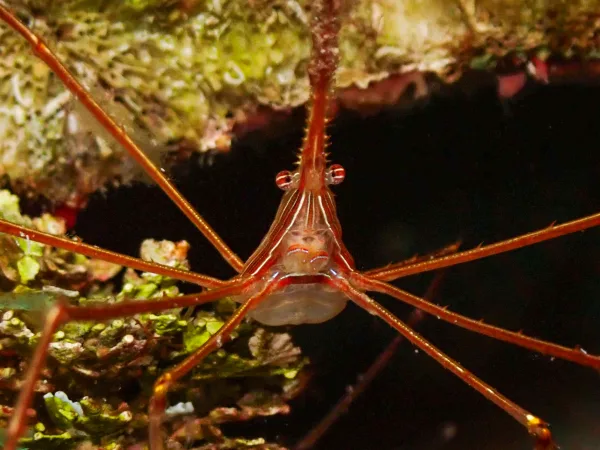
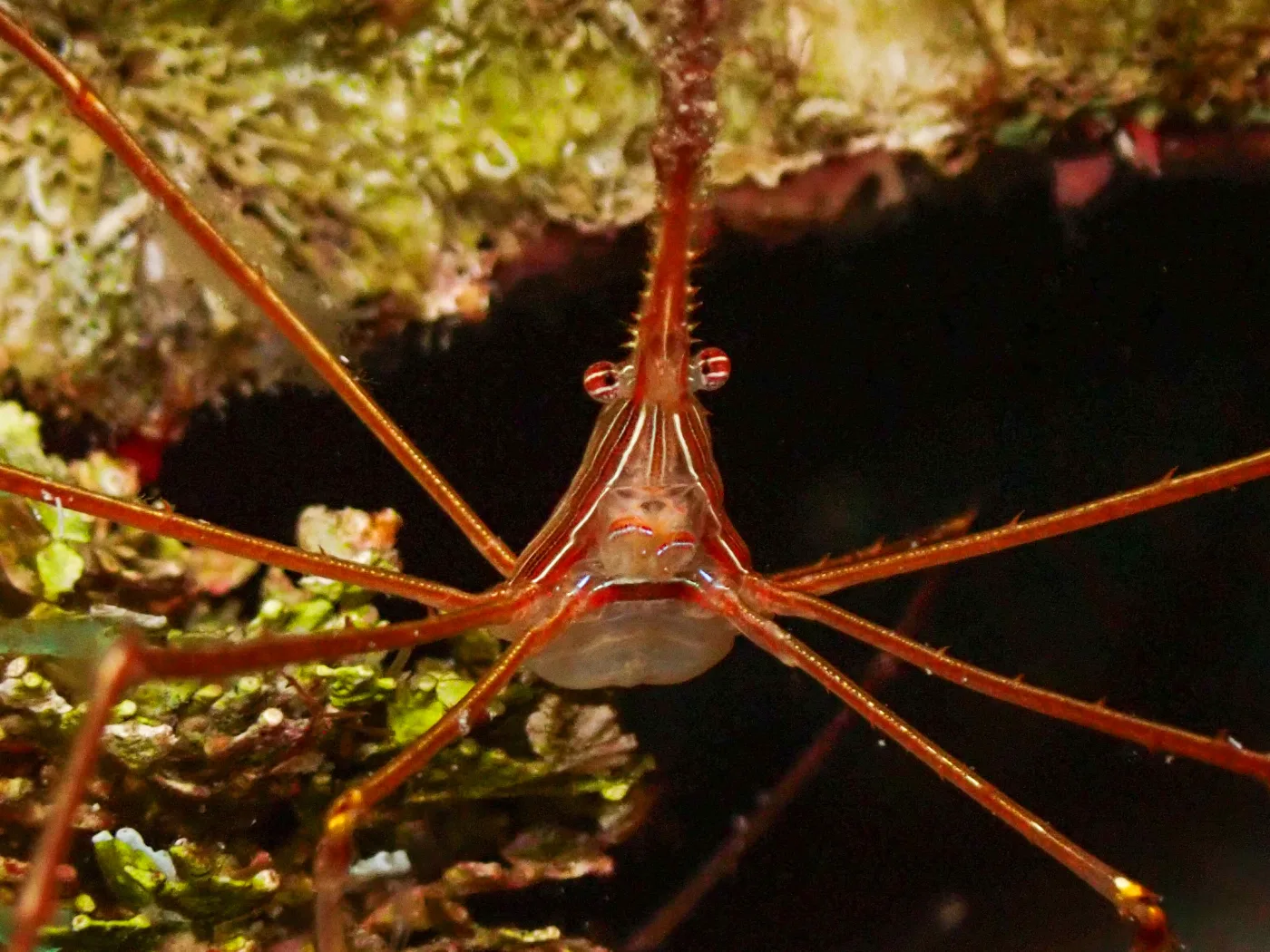
The Arrow Crab looks like a tiny spider made of sticks. Its body is a small triangle with a long, sharp point on the front, like an arrow. Its legs are very thin and very long. They are more than three times as long as its body. It has gold and brown stripes, and its claw tips can be purple. It lives on reefs near Florida and in the Caribbean Sea. It sleeps in caves in the day and walks around at night to find food. Fish keepers like it because it eats bristleworms, small worms that hide in the rocks. But it is a little hunter. It may grab small shrimp, small slow fish or feather duster worms. It also fights other arrow crabs. So keep just one, and feed it well.
Water & care
Hardy and easy to feed: most sellers rate it easy, a few moderate. Add it to an established tank with plenty of rockwork, caves and crevices, since it hides by day. Like all crabs it cannot tolerate copper medications. It molts as it grows; leave the cast shell in the tank and keep alkalinity, calcium and magnesium stable for a clean molt. Feed it a few times a week even in a tank with bristleworms, because a hungry arrow crab turns to shrimp, small fish and coral polyps.
| Parameter | Keep it at | Where that sits on the usual reef range |
|---|---|---|
| Temperature | 72–78 °F | |
| Salinity (SG) | 1.020–1.025 | |
| pH | 8.1–8.4 | |
| Alkalinity | 8–12 dKH |
LiveAquaria gives 72-78 F, dKH 8-12, pH 8.1-8.4 and SG 1.020-1.025; Aquariadise gives the same temperature, pH and dKH with SG 1.020-1.026. Calcium, magnesium, nitrate and phosphate are not species-specific, so they are left blank. No copper.
Feeding
DietCarnivore
Favorite foods
- Mysis shrimp and krill
- Chopped shrimp and other meaty foods
- Small bristleworms
- Sinking pellets
- Flake and tablet foods
A scavenger and small predator that accepts almost all meaty, flake and tablet foods (LiveAquaria). Target-feed mysis, krill or chopped seafood, or let it take leftovers and sinking pellets, about three or four times a week. Do not rely on bristleworms alone: an underfed arrow crab is the one that attacks shrimp, fish and polyps.
Tank & maintenance
- Minimum tank
- 30 gallons
- Aquascape
- Established live rock with caves, cracks and overhangs for daytime hiding; open rock surfaces for it to walk over at night.
- Lighting
- No needs of its own; it avoids bright light and is most active at night.
- Water flow
- Care sheets rarely state a preference; one retailer suggests moderate, variable flow that does not knock it off its perch.
Routine upkeep
Routine reef upkeep. Feed it a few times a week and watch it over the first weeks for attacks on shrimp, fish or polyps. Leave molts in the tank; the crab hides for a few days afterwards while its new shell hardens. It is easy to spot at night but can be hard to remove from rockwork, so plan tankmates before adding it.
Temperament & tankmates
TemperamentSemi-aggressive
Rated semi-aggressive by most sellers (LiveAquaria, Aquatics Unlimited, Aquarium Source); Saltwater Aquarium Blog calls it aggressive and one retailer peaceful. It is territorial and fights other arrow crabs and other crabs, so keep one per tank (That Pet Place allows two only in 75 gallons or more). It is a predator of small shrimp such as banded coral shrimp, other small crustaceans and small, slow fish, especially when hungry. Large fish such as triggerfish, puffers, hawkfish and wrasses may in turn eat the crab.
Reef safeWith caution
Retailers such as LiveAquaria, Aquatics Unlimited and That Pet Place list it as reef compatible, while ReefApp, Aquarium Source, Build Your Aquarium and others rate it 'with caution'. It ignores most stony corals, but underfed crabs may pick at mushrooms, polyps and soft corals (LiveAquaria, Quality Marine), and it eats feather duster worms (ADW, Saltwaterfish.com) and small shrimp. It also eats the bristleworms that many keepers consider useful detritivores (ReefApp).
Good tankmates
- Peaceful to semi-aggressive fish too large for it to catch, such as tangs, clownfish and chromis
- Stony corals in a well-fed tank
- Snails and larger hermit crabs it cannot overpower (results vary)
- Tanks with a bristleworm population to hunt
Avoid
- Other arrow crabs or other crabs in small tanks
- Small shrimp such as banded coral, cleaner or peppermint shrimp, especially when they molt
- Small, slow bottom fish such as small gobies and blennies
- Feather duster worms and prized soft corals or mushrooms
- Triggerfish, pufferfish, hawkfish and large wrasses that eat crabs
- Copper-treated systems
Help it thrive
- Keep only one arrow crab per tank; they are territorial and fight each other and other crabs.
- Feed meaty foods such as mysis or chopped shrimp a few times a week so it leaves tankmates alone.
- Add it to a mature tank with plenty of caves and overhangs.
- Skip it if you keep small shrimp, feather dusters or tiny gobies.
- Keep alkalinity stable and leave its molts in the tank.
Common ailments
Failed or fatal molt
- Signs
- Crab stuck in its old shell, missing legs after a molt, or found dead in a split shell.
- Prevention
- Stable salinity, alkalinity, calcium and magnesium; varied meaty diet; caves to hide in while soft.
- Treatment
- Leave it alone in a quiet spot; lost legs regrow over later molts.
Starvation and predatory behavior
- Signs
- Thin, inactive crab, or attacks on shrimp, small fish, feather dusters or polyps.
- Prevention
- Target-feed meaty foods three or four times a week; do not rely on bristleworms or leftovers alone.
- Treatment
- Feed more; remove the crab if attacks continue.
Copper or medication poisoning
- Signs
- Weakness, loss of grip, and death after a tank was medicated.
- Prevention
- No copper or invertebrate-toxic treatments in any tank with crabs; treat fish in a hospital tank.
- Treatment
- Move the crab to clean, matched water and remove copper from the display with carbon or resin and water changes.
Fighting injuries
- Signs
- Missing legs or a dead crab when two arrow crabs or other crabs share a tank.
- Prevention
- Keep one arrow crab per tank; two only in 75 gallons or more, with caution (That Pet Place).
- Treatment
- Separate the crabs; legs regrow over later molts.
This is general hobby guidance, not veterinary advice. Quarantine new arrivals and treat in a separate tank whenever you can.
Risks of owning one
- May eat small shrimp, small slow fish, feather dusters and other small invertebrates, especially if underfed.
- May pick at mushrooms, soft corals and polyps when hungry.
- Kills other arrow crabs and fights other crabs.
- Removes bristleworms, which many reefers see as useful detritivores.
- Copper and many fish medicines cannot be used in a tank containing it.
- Most are wild-collected from Florida and Caribbean reefs.
Breeding
DifficultyHard Captive-bredRare or wild-caught
The male places a spermatophore on the female, which uses it to fertilize her eggs; she carries them under her abdomen until they hatch as planktonic zoea larvae. Breeding in a home aquarium is described as difficult to impossible. In the laboratory, Mendes and Valenca (2008) reared larvae on chopped fish and Artemia nauplii at about 28.7 C and 35 salinity, with the first megalopae after ten days and 30% survival. Antunes et al. (2023) kept 15 egg-carrying females in recirculating 400 L systems, where each released one to four larval batches over two months; larval development took 22-25 days and larvae reached the juvenile stage only at 23 C and 35 PSU (6.6% survival). Cultured crabs from Bocas Mariculture in Panama are sold by Biota, but they are not yet a regular trade item.
- Keep a well-fed male and female in a large system with plenty of rock.
- Move egg-carrying females to a separate broodstock tank before the eggs hatch.
- Collect the larvae at hatching and rear them in a small larval vessel with gentle aeration.
- Feed newly hatched Artemia nauplii (and finely chopped fish) several times a day and keep water clean.
- Hold temperature and salinity steady; in the 2023 study only 23 C and 35 PSU produced juveniles.
- Provide settlement surfaces for megalopae and grow juveniles on fine meaty foods, separating sizes.
Deep dive The science, history and family tree
The science
Stenorhynchus seticornis is a small spider crab (Majoidea: Inachoididae) of the western Atlantic. The body is triangular and drawn out in front into a long rostrum with serrated edges; the legs are extremely thin and more than three times the body length. Coloration is whitish or light tan to golden brown with fine dark lines, and the claws are often violet-tipped. Published sizes vary with what is measured: field guides give a body or carapace of about 2.5-6 cm, legs reach about 10 cm across, and aquarium retailers commonly quote 6 in (15 cm) including legs. The species ranges from North Carolina and Bermuda through the Gulf of Mexico and the Caribbean to Brazil, Uruguay and Argentina, and is abundant around Florida, the Bahamas and the Caribbean. It lives on rock, coral, calcareous algae, shell and sand bottoms and in seagrass, usually at 3-40 m but recorded from 1 to 366 m. It is nocturnal and territorial, sheltering by day and foraging at night as a scavenger and small predator of feather duster worms, small crustaceans and other tiny reef animals. It often lives among the pseudotentacles of the anemone Lebrunia danae alongside cleaner shrimp, may decorate itself with attached material, and has been seen cleaning reef fish, moray eels and squirrelfish in Brazil. Females carry eggs under the abdomen until they hatch as planktonic zoea larvae. In aquariums it is kept mainly to eat bristleworms, but it is a predator that can take small shrimp, slow fish and sessile invertebrates. Laboratory rearing has been achieved (Mendes & Valenca 2008; Antunes et al. 2023) and one Panamanian farm supplies cultured crabs, but most trade animals are wild-collected.
- Appearance
- Small triangular body with a long, needle-like, serrated rostrum; very long, thin, spider-like legs; tan to golden brown with fine dark lines running along the body; claws often tipped violet. Look-alikes: the Panamic arrow crab (Stenorhynchus debilis) of the eastern Pacific is nearly identical and sometimes sold as 'arrow crab'; other spider and decorator crabs have broader bodies and shorter legs.
- Native range
- Western Atlantic: North Carolina and Bermuda through Florida, the Bahamas, the Gulf of Mexico and the Caribbean south to Brazil, Uruguay and Argentina (SeaLifeBase, Wikipedia). Common offshore in Florida, including the Keys and the northeast coast.
- Habitat
- Reefs, rocky and rubble bottoms, calcareous algae, shell and sand, and seagrass; most often at 3-40 m (10-130 ft) but recorded from 1 to 366 m. Nocturnal; hides in crevices or among anemone tentacles, especially Lebrunia danae, by day.
- Size
- 5.5 in (14 cm). Most retailers (LiveAquaria, Quality Marine, Aquatics Unlimited, Saltwaterfish.com) list 6 in including legs; That Pet Place gives 8 in and some guides claim up to 10 in. Field guides measure the body only: 3-6 cm (ADW), carapace up to 5 cm (Naturalis), 1-2 in (Florent's Reef Guide), with legs about 10 cm across (Wikipedia). Purchase size is usually 1-4 in.
- Lifespan
- About 5 years in captivity per two care guides (Aquarium Source, Build Your Aquarium); several retailers call it long-lived. No published data.
- Conservation
- Not Evaluated. Not evaluated by the IUCN Red List (SeaLifeBase) and not CITES-listed. In Florida it is a regulated marine-life species: commercial collectors need a Saltwater Products License with Restricted Species and Marine Life endorsements (FWC, trip-ticket code 709). Most trade animals are wild-collected in Florida and the Caribbean; Biota sells crabs cultured by Bocas Mariculture in Panama as an alternative
In the aquarium vs in the wild
In your aquarium
Display animal and bristleworm control; also scavenges leftover food.
On the reef
A nocturnal scavenger and small predator of feather duster worms, small crustaceans and other tiny reef animals; lives with anemones such as Lebrunia danae and has been seen cleaning reef fish. Prey for larger fish.
History
Described by the German naturalist Johann Friedrich Wilhelm Herbst in 1788 as Cancer seticornis. Johan Christian Fabricius described it again in 1793 as Cancer sagittarius, a name now treated as a junior synonym, and older literature also uses Leptopodia sagittaria. The genus Stenorhynchus dates from 1818 (WoRMS credits Lamarck), and in 1966 the International Commission on Zoological Nomenclature (Opinion 763) confirmed S. seticornis as its type species. Older sources place it in Majidae or Inachidae; WoRMS now classifies it in Inachoididae. It has long been a staple of the marine aquarium trade, collected in Florida under the state's marine-life rules and across the Caribbean, and has been sold mainly for bristleworm control. Laboratory larval rearing was reported in Brazil from 2008, and cultured crabs from Panama are now offered by at least one US supplier.
Evolution & relatives
Arrow crabs are true crabs (Brachyura) in the spider-crab superfamily Majoidea, a group known from the Cenomanian stage of the Late Cretaceous to the present. Majoidea now contains several families, including Inachidae, Inachoididae, Majidae, Mithracidae and Epialtidae; the arrow crab sits in Inachoididae, subfamily Stenorhynchinae. Its genus has four accepted species: S. seticornis of the western Atlantic, S. lanceolatus of the eastern Atlantic, S. debilis of the eastern Pacific and S. yangi. Its long legs and slender body are an extreme version of the spider-crab body plan shared with the emerald crab and the giant Japanese spider crab.
Family tree, from kingdom down
- Kingdom Animalia Animals Animals are living things made of many cells that must eat food to live. Fish, corals, crabs, snails and sea stars are all animals.
- Phylum Arthropoda Arthropods Arthropods have jointed legs and a hard outer shell called an exoskeleton. To grow, they must crawl out of the old shell, which is called molting.
- Subphylum Crustacea Crustaceans Crustaceans are arthropods with a hard shell and two pairs of feelers. Most live in water, like crabs, shrimps and lobsters.
- Superclass Multicrustacea
- Class Malacostraca Malacostracans This big class of crustaceans includes crabs, shrimps, lobsters and krill. Their bodies are built from about the same number of segments.
- Subclass Eumalacostraca
- Superorder Eucarida
- Order Decapoda Decapods Decapod means 'ten feet'. Crabs, shrimps, lobsters and hermit crabs all have ten legs, counting their claws.
- Suborder Pleocyemata Egg-carrying decapods
- Infraorder Brachyura true crabs
- Section Eubrachyura
- Subsection Heterotremata
- Superfamily Majoidea spider crabs
- Family Inachoididae
- Subfamily Stenorhynchinae
- Genus Stenorhynchus
- Species Stenorhynchus seticornis
See it on the Tree of Life Compare with another species
Closest relatives
- Stenorhynchus debilis Panamic Arrow Crab Same genus; eastern Pacific look-alike also sold in the trade
- Stenorhynchus lanceolatus Same genus; eastern Atlantic
- Stenorhynchus yangi Same genus
- Mithraculus sculptus Emerald Crab Same superfamily (Majoidea), different family (Mithracidae) Read guide · Compare
- Macrocheira kaempferi Japanese Spider Crab Same superfamily (Majoidea); the largest living crab
Older scientific names: Cancer seticornis, Cancer sagittarius, Leptopodia sagittaria.
Fun facts
- Its legs are more than three times as long as its body.
- In Brazil it has been seen cleaning reef fish, moray eels and squirrelfish, fish that would normally eat crabs.
- It often hides among the tentacles of the anemone Lebrunia danae, next to cleaner shrimp.
- It can decorate its body with bits of material for camouflage.
- It has been found as deep as 366 m (about 1,200 ft).
Learn more
- Wikipedia: Stenorhynchus seticornis en.wikipedia.org
- LiveAquaria: Arrow Crab care facts liveaquaria.com
- Saltwater Aquarium Blog: Arrow crab care in a reef aquarium saltwateraquariumblog.com
- WoRMS: Stenorhynchus seticornis marinespecies.org
Sources
- WoRMS taxon record 421957 marinespecies.org
- WoRMS: genus Stenorhynchus marinespecies.org
- SeaLifeBase: Stenorhynchus seticornis summary sealifebase.se
- Animal Diversity Web: Stenorhynchus seticornis animaldiversity.org
- Wikipedia: Stenorhynchus seticornis en.wikipedia.org
- Wikipedia: Majoidea en.wikipedia.org
- Naturalis Caribbean Diving: Stenorhynchus seticornis caribbean-diving.linnaeus.naturalis.nl
- Florent's Reef Guide: Yellowline Arrow Crab reefguide.org
- FWC: Yellowline arrow crab (marine life code) myfwc.com
- LiveAquaria: Arrow Crab liveaquaria.com
- Quality Marine: Arrow Crab qualitymarine.com
- That Pet Place: Arrow Crab thatpetplace.com
- Aquatics Unlimited: Arrow Crab aquaticsunlimited.com
- Biota: Arrow Crab (cultured, Bocas Mariculture) shop.thebiotagroup.com
- Saltwater Aquarium Blog: Arrow crab care saltwateraquariumblog.com
- Aquarium Source: Arrow Crab 101 aquariumsource.com
- ReefApp: Stenorhynchus seticornis reefapp.net
- Mendes & Valenca 2008, Preliminary observations on the larval cycle of arrow crab in laboratory (Bol. Inst. Pesca 34) institutodepesca.org
- Antunes et al. 2023, Broodstock management of the arrow crab and effects of temperature and salinity on larvae survival (Aquaculture International) repositorio.unesp.br
Care facts
The care facts on this guide and its product pages (care level, reef safety, temperament, size, tank, diet, flow, purpose, foods, acclimation and origin) combine 19 independent sources, checked October 25, 2026.
- Arrow Crab LiveAquaria
- Arrow Crab Quality Marine
- Arrow Crab Care in a Reef Aquarium Saltwater Aquarium Blog
- Arrow Crab Aquariadise
- Arrow Crab 101: Diet, Mates, Breeding & Behavior Aquarium Source
- Stenorhynchus seticornis ReefApp encyclopedia
- CRAB - ARROW Stenorhynchus seticornis Aquatics Unlimited
- Arrow Crab - Stenorhynchus seticornis That Pet Place
- A Guide To Arrow Crab Care Build Your Aquarium (Kaylee Keech)
- Arrowhead Crab Stenorhynchus Seticornis Sims Tropical Fish (UK)
- Arrow Crab Saltwaterfish.com
- Arrow Crab Biota (Biota NC)
- Stenorhynchus seticornis (yellowline arrow crab) Animal Diversity Web (University of Michigan)
- Yellowline Arrow Crab - Florent's Guide To The Florida, Bahamas & Caribbean Reefs Florent's Reef Guide
- Stenorhynchus seticornis - Caribbean Diving Naturalis Biodiversity Center
- Stenorhynchus seticornis Wikipedia
- Broodstock management of the arrow crab Stenorhynchus seticornis and effects of temperature and salinity on larvae survival (Antunes et al. 2023, Aquaculture International) UNESP repository / Springer
- Preliminary observations on the larval cycle of arrow crab Stenorhynchus seticornis in laboratory (Mendes & Valenca 2008) Boletim do Instituto de Pesca
- Stenorhynchus seticornis, Yellowline arrow crab SeaLifeBase
Scientific names and classification follow the World Register of Marine Species (AphiaID 421957). Last updated October 25, 2026.
Shop this species
Search the shop →Sold out right now. We restock weekly, so check back soon.
Sold out