 Only 1 left
Fish · Butterflyfish
Blackback Butterflyfish
Chaetodon melannotus
Also called Black Back Butterflyfish, Black-backed Butterflyfish, Melannotus Butterflyfish, Black-backed Coralfish, Blackback Butterfly
Reviewed by admin on October 29, 2026 · Meet the team
- CareModerate
- Reef safeNo
- TemperamentPeacefulOnly toward other butterflyfish in small tanks
- Favorite foods
- Mysis shrimp
- Meaty frozen foods
- Chopped seafood
- Max size7 in (18 cm)
- Min tank120 gal
- LifespanMaximum reported age 20 years
- IUCN statusLeast Concern
Quick answers
- How big does the Blackback Butterflyfish get?
- Up to 7 in (18 cm).
- What size tank does it need?
- At least 120 gallons.
- How hard is it to keep?
- Care level: Moderate.
- Is it reef safe?
- No. Not reef safe.
- What does it eat?
- Mysis shrimp
- Meaty frozen foods
- Chopped seafood
- How long does it live?
- Maximum reported age 20 years (FishBase, Wikipedia).
- What are good tankmates?
- Tangs
- Angelfish that are not too boisterous
- Calm community fish of similar size
The 30-second version
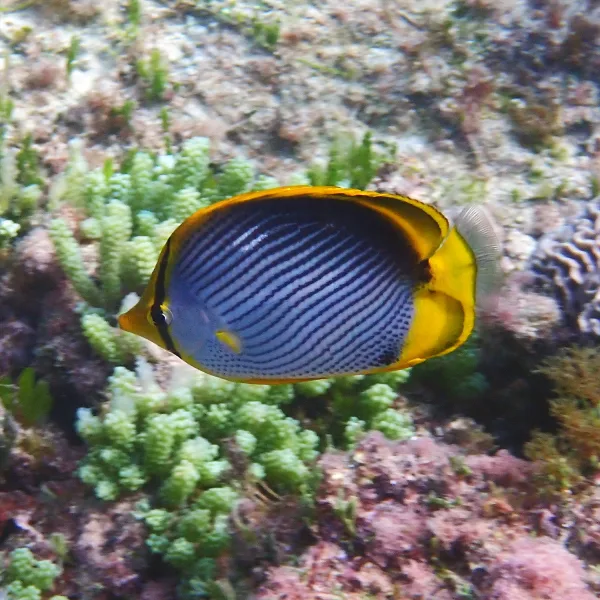
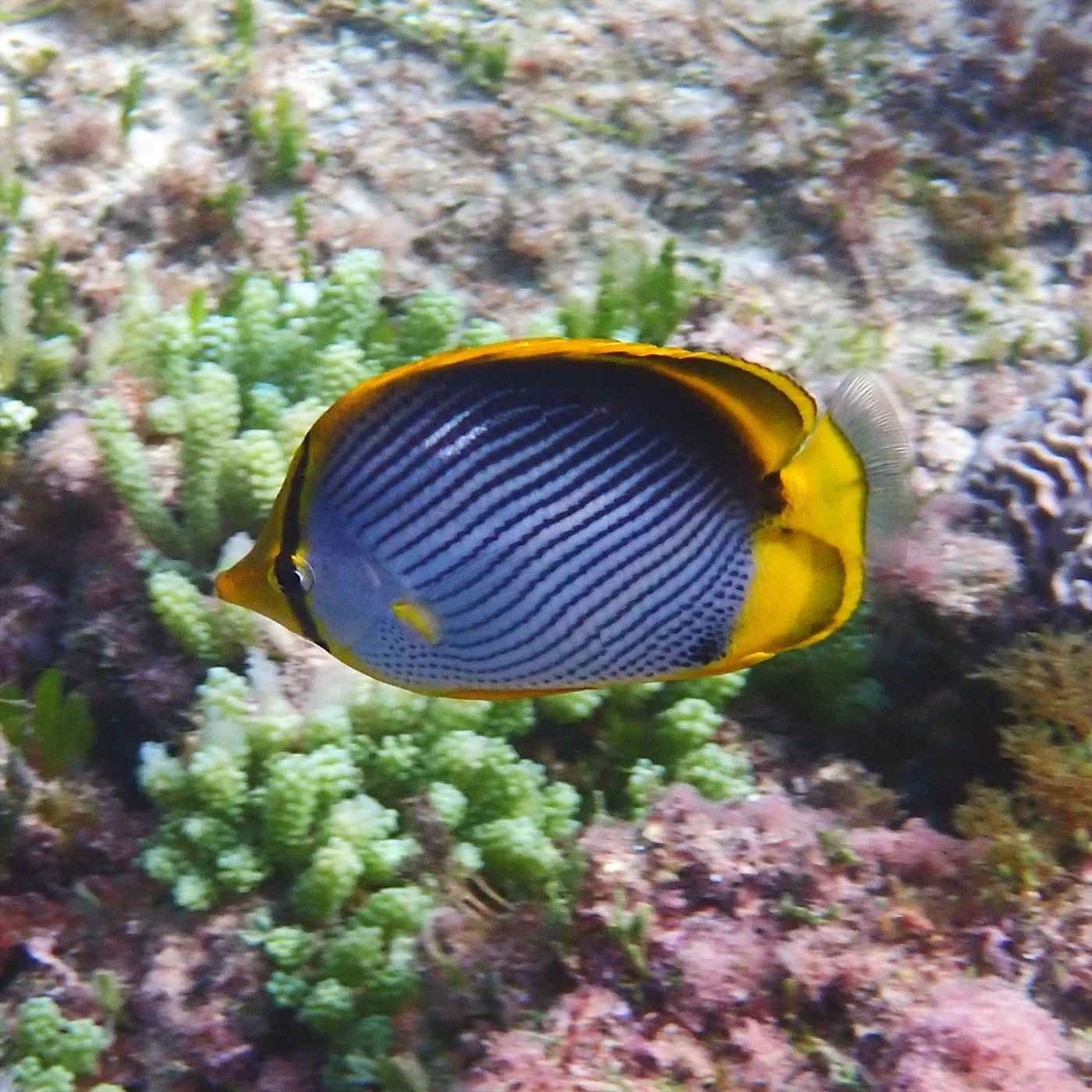
The blackback is a flat, silver-white fish with a yellow edge all around. Lots of thin dark lines slant up its sides. A black stripe hides each eye, and a black patch sits near its tail. At night, or when it gets scared, its back turns dark. Only two white spots stay light. That is how it got its name, which means black back. It lives on coral reefs from the Red Sea to the Pacific Ocean. Babies hide in bushy corals. Grown-ups eat the soft parts of live corals, both hard and soft ones. That makes this fish hard to feed in a tank. It must learn to eat shrimp and other foods. It needs a big tank with lots of rock. Never put it with corals, or it will eat them.
Water & care
Its natural food is live coral, so success depends on weaning it onto prepared foods. Choose a fish that is already eating frozen foods, give it a mature fish-only tank with plenty of rock to hide in and open swimming room, and offer small meals of varied meaty foods with some algae-based food several times a day. LiveAquaria suggests foods with added vitamins or color enhancers to keep its colors bright. It is shy at first.
| Parameter | Keep it at | Where that sits on the usual reef range |
|---|---|---|
| Temperature | 72–78 °F | |
| Salinity (SG) | 1.020–1.025 | |
| pH | 8.1–8.4 | |
| Alkalinity | 8–12 dKH |
LiveAquaria and Quality Marine agree on 72-78°F, SG 1.020-1.025, pH 8.1-8.4 and 8-12 dKH. The OATA care sheet for butterflyfish in general suggests nitrate no higher than 50 mg/L; no species-specific calcium, magnesium, nitrate or phosphate values are published.
Feeding
DietCarnivore
Favorite foods
- Mysis shrimp
- Chopped clam, shrimp and other seafood
- Frozen marine preparations
- Vitamin-enriched frozen foods
- Algae-based foods
Feed small meals of varied meaty foods several times a day (Quality Marine says multiple times daily), with some algae-based food. A new fish may only pick at food at first; a quiet tank without fast feeders gives it a better chance to start eating. Never rely on corals as food.
Tank & maintenance
- Minimum tank
- 120 gallons
- Aquascape
- Mature live rock with many hiding places and open swimming room (LiveAquaria). A cover is a sensible precaution, because startled butterflyfish can jump.
- Lighting
- No special requirement for the fish; normal fish-only lighting.
- Water flow
- Moderate flow that moves the surface (OATA advice for butterflyfish); no species-specific figure is published.
Routine upkeep
Regular partial water changes and weekly water tests, stable temperature and salinity, and several small feedings a day. Remove uneaten food so it does not foul the water, and check that the fish is keeping its weight, since a thin belly is the first sign it is not eating enough.
Temperament & tankmates
TemperamentPeaceful
Peaceful and shy with unrelated fish (LiveAquaria, Quality Marine), but it can become territorial in a tank that is too small. LiveAquaria recommends keeping it as the only butterflyfish unless it has a mate; Quality Marine says several can be added at the same time to a large aquarium.
Reef safeNo
Not reef safe. In the wild it eats the polyps of stony and soft corals, and on the Great Barrier Reef it chose soft corals such as Lobophytum far more often than expected from how common they were (Pratchett 2007). LiveAquaria notes it is a particular risk to soft corals, and Quality Marine says it may pick at corals and crustaceans. Keep it only in a fish-only tank.
Good tankmates
- Tangs
- Angelfish that are not too boisterous
- Calm community fish of similar size
Avoid
- Other butterflyfish, unless it is a mated pair
- Soft corals, stony corals and anemones
- Feather dusters, tube worms and small crustaceans
- Fast, pushy feeders that eat everything first
- Predators large enough to swallow it
Help it thrive
- Only buy one that is already eating frozen foods in the store.
- Offer small, varied meaty meals several times a day; enriched foods help keep its color.
- Keep it in a mature fish-only tank of 120 gallons or more, never with corals.
- Keep one butterflyfish per tank unless you have a mated pair.
- Quarantine it before adding it to the display.
Common ailments
Starvation (refusing prepared foods)
- Signs
- The fish picks at the rock but ignores frozen foods, and its belly becomes hollow and the back thin over days or weeks.
- Prevention
- Buy fish that are already eating in the store, and add them to a calm, mature tank without fast competitors.
- Treatment
- Offer many small meals of different foods (mysis, chopped clam or shrimp, live brine shrimp) in a quiet quarantine tank until it feeds well, then move it.
Marine ich (Cryptocaryon irritans)
- Signs
- White, salt-like spots on the body, fins or gills, scratching, rapid breathing, cloudy eyes, hiding and loss of appetite.
- Prevention
- Quarantine every new fish in a separate tank for several weeks and keep water stable.
- Treatment
- Treat in a hospital tank with copper, chloroquine phosphate, hyposalinity or the tank-transfer method, never in a tank with invertebrates. Leave the display without fish for about 11 weeks, because the cyst stage can last up to 72 days.
Marine velvet (Amyloodinium ocellatum)
- Signs
- A fine dusty sheen on the skin, very fast breathing, gasping at the surface, scratching and lethargy. It can kill within 12 to 48 hours.
- Prevention
- Strict quarantine, and disinfect nets, buckets and equipment between tanks.
- Treatment
- A temperature- and pH-matched freshwater dip for quick relief, then copper or chloroquine phosphate in a hospital tank. Leave the display fallow with no fish.
This is general hobby guidance, not veterinary advice. Quarantine new arrivals and treat in a separate tank whenever you can.
Risks of owning one
- Eats live coral polyps, especially soft corals; not for reef tanks.
- Wild fish feed on coral, and some never accept prepared foods.
- Territorial toward other butterflyfish in small tanks.
- Wild-caught only; wild numbers fall when reefs bleach.
Breeding
DifficultyNot achieved Captive-bredRare or wild-caught
Egg-laying pair spawner: pairs are more common in the breeding season, and the aggregations seen on reefs may be for mass spawning. Like other butterflyfish it releases floating eggs, and its larvae spend a long time in the plankton as armored tholichthys larvae. No captive spawning or rearing of this species has been reported; only a few Chaetodon species, such as C. sedentarius and C. miliaris, have been raised to juveniles.
- Add two young fish together to a very large, mature tank and let them pair.
- Condition them with several daily meals of varied meaty foods.
- Collect floating eggs from the overflow with an egg collector and move them to a separate larval tank.
- Feed the larvae the smallest cultured live foods, such as copepod nauplii and rotifers. Rearing this species would be a first.
Deep dive The science, history and family tree
The science
Chaetodon melannotus is a medium-sized Indo-Pacific butterflyfish (family Chaetodontidae). The body is deep and compressed, whitish and encircled by yellow, with many dark lines rising diagonally across the flanks, black along the upper back, a black eye bar, a black saddle on the caudal peduncle, and yellow fins and snout. At night or when frightened, the upper body turns black except for two white patches. The dorsal fin has 12-13 spines and 18-21 soft rays and the anal fin 3 spines and 16-21 soft rays. Maximum total length is about 18 cm. It ranges from the Red Sea and East Africa to Samoa, north to southern Japan and south to Lord Howe Island, in coral-rich reef flats, lagoons and seaward reefs at about 1-25 m, and is common in staghorn coral thickets. Juveniles settle among branching Montipora. Adults are usually solitary or paired and may aggregate, possibly to spawn. It is an obligate corallivore that feeds on stony corals but takes a large share of its bites from soft corals such as Lobophytum. Coral bleaching has caused marked declines, and the maximum reported age is 20 years.
- Appearance
- Whitish to silvery body ringed in yellow, with many dark diagonal lines on the sides, black along the upper back, a black eye bar, a black saddle across the tail base, a black spot at the front of the anal-fin base, and yellow fins and snout. At night or when stressed the back turns black except for two white patches. The spot-tail butterflyfish (C. ocellicaudus) looks very similar but has a black spot, not a saddle, at the tail base and lacks the black upper back and the anal-fin spot.
- Native range
- Indo-Pacific: Red Sea and East Africa east to Samoa and throughout Micronesia, north to southern Japan and south to Lord Howe Island. In Australia it occurs on offshore reefs of north-western Western Australia, Ashmore Reef, the Torres Strait, the northern Great Barrier Reef and Coral Sea south to about Wollongong (New South Wales), and at Cocos (Keeling), Christmas, Lord Howe and Norfolk islands. Type locality: Tranquebar (Tharangambadi), India.
- Habitat
- Coral-rich areas of reef flats, lagoons and seaward reefs at about 1-25 m (Fishes of Australia; FishBase gives 2-20 m). Common in staghorn coral thickets and less often seen on exposed reef. Juveniles live inshore and settle among branching Montipora corals on shallow reefs with rich coral growth. Adults are solitary or paired; aggregations are seen, possibly for mass spawning.
- Size
- 7 in (18 cm). Fishes of Australia and Wikipedia give 18 cm (7 in) total length; FishBase lists 25 cm. LiveAquaria and Quality Marine give 6 in, which is closer to typical aquarium size.
- Lifespan
- Maximum reported age 20 years (FishBase, Wikipedia). No captive longevity data were found.
- Conservation
- Least Concern. Assessed Least Concern by the IUCN (2009 assessment). Not evaluated by CITES. Because it depends on live coral, climate-induced coral bleaching has caused significant population declines (Pratchett et al. 2006, cited by Fishes of Australia). FishBase rates its resilience as low (population doubling time 4.5-14 years) and its vulnerability to fishing as moderate to high. Taken in commercial fisheries and for the aquarium trade; all aquarium fish are wild-collected
In the aquarium vs in the wild
In your aquarium
An attractive mid-sized display butterflyfish for fish-only tanks; it has no cleanup role.
On the reef
A corallivore that crops the polyps of stony and soft corals on reef flats and lagoons, often among staghorn coral thickets.
History
Bloch and Schneider described the species in 1801 in Systema Ichthyologiae, from Tranquebar (now Tharangambadi) in India. Later names for the same fish include Chaetodon dorsalis Rüppell, 1829, C. melanotus Cuvier, 1831 and C. reinwardtii Günther, 1860. The name melannotus refers to the black back (from melanos, black), which shows most at night or when the fish is frightened. Some authors spell it melanotus, but the original spelling stands. In the aquarium trade it is frequently collected according to Fishes of Australia, though Quality Marine calls it infrequently seen. FishBase and WoRMS describe it as easy to maintain in aquariums, while Fishes of Australia says its live-coral diet makes it difficult.
Evolution & relatives
Butterflyfishes (Chaetodontidae) belong to the order Acanthuriformes with the surgeonfishes and angelfishes; molecular studies suggest they shared a common ancestor with the angelfishes and scats about 54 million years ago. Bellwood et al. (2010) found that a Miocene move onto coral reefs set off rapid speciation within Chaetodon, and that coral feeding evolved independently at least five times between about 15.7 and 3 million years ago. The blackback belongs to the large subgenus Rabdophorus, which may deserve rank as a separate genus. Its closest relative is the spot-tail butterflyfish (C. ocellicaudus), which shares its general look; the yellow-dotted butterflyfish (C. selene) is less closely related, and the saddle (C. ephippium) and dotted (C. semeion) butterflyfishes are more distant. Ecologically it groups with C. ulietensis and C. unimaculatus as one of the soft-coral feeders of the Great Barrier Reef (Pratchett 2007). On the site's tree, butterflyfish sit near angelfish and tangs.
Family tree, from kingdom down
- Kingdom Animalia Animals Animals are living things made of many cells that must eat food to live. Fish, corals, crabs, snails and sea stars are all animals.
- Phylum Chordata Chordates Chordates have a stiff rod running down their back at some point in their lives. In fish and people, this rod is replaced by a backbone.
- Subphylum Vertebrata Vertebrates Vertebrates are animals with a backbone and a skull. Fish, frogs, birds and people are all vertebrates.
- Infraphylum Gnathostomata jawed vertebrates
- Parvphylum Osteichthyes bony fishes
- Gigaclass Actinopterygii ray-finned fishes
- Superclass Actinopteri
- Class Teleostei Teleost fishes Teleosts are bony fishes with thin, bendy fin rays and jaws that can push forward. Almost all of the fish in the world are teleosts.
- Order Acanthuriformes Surgeonfishes, angelfishes and kin This order of fishes includes surgeonfishes, marine angelfishes and rabbitfishes. Many have deep, flat bodies and graze on reefs.
- Family Chaetodontidae Butterflyfishes Butterflyfishes are flat, colorful reef fish with small, pointy mouths. Many have a dark stripe over each eye, and lots of them eat coral.
- Genus Chaetodon
- Species Chaetodon melannotus
See it on the Tree of Life Compare with another species
Closest relatives
- Chaetodon ocellicaudus Spot-tail Butterflyfish Closest relative; very similar but with a tail spot instead of a saddle
- Chaetodon selene Yellow-dotted Butterflyfish Same subgenus (Rabdophorus); less closely related
- Chaetodon ephippium Saddle Butterflyfish Same subgenus (Rabdophorus); a more distant relative
- Chaetodon semeion Dotted Butterflyfish Same subgenus (Rabdophorus); a more distant relative
Older scientific names: Chaetodon melanotus, Chaetodon dorsalis, Chaetodon reinwardtii.
Fun facts
- At night or when scared, its back turns black except for two white patches.
- Its name means 'black back'.
- Baby blackbacks settle among branching Montipora corals.
- It can live up to 20 years.
- On the Great Barrier Reef it picks soft corals such as Lobophytum much more often than you would expect from how common they are.
Learn more
- FishBase: Chaetodon melannotus, Blackback butterflyfish fishbase.se
- WoRMS: Chaetodon melannotus Bloch & Schneider, 1801 marinespecies.org
- Fishes of Australia: Blackback Butterflyfish fishesofaustralia.net.au
- Wikipedia: Blackback butterflyfish en.wikipedia.org
Sources
- FishBase species summary: Chaetodon melannotus fishbase.se
- WoRMS taxon record 218743 marinespecies.org
- Fishes of Australia: Chaetodon melannotus fishesofaustralia.net.au
- Wikipedia: Blackback butterflyfish en.wikipedia.org
- LiveAquaria: Black Back Butterflyfish liveaquaria.com
- Quality Marine: Blackback Butterflyfish qualitymarine.com
- Pratchett 2007, Dietary selection by coral-feeding butterflyfishes on the Great Barrier Reef (Raffles Bulletin of Zoology) lkcnhm.nus.edu.sg
- Bellwood et al. 2010, Evolutionary history of the butterflyfishes and the rise of coral feeding fishes (JCU) researchonline.jcu.edu.au
Scientific names and classification follow the World Register of Marine Species (AphiaID 218743). Checked by our team. Last updated October 29, 2026.
Shop this species
Search the shop →
Only 1 left