 Only 1 left
Fish · Snapper
Black and White Snapper
Macolor niger
Also called Macolor Niger, Macolor Snapper, Black-and-white Snapper, Black and White Seaperch, Black Snapper, Macolor Niger Grunt
Reviewed by admin on October 29, 2026 · Meet the team
- CareModerate
- Reef safeNo
- TemperamentSemi-aggressiveEats small fish and crustaceans
- Favorite foods
- Chopped squid and fish
- Shrimp and clam
- Live shrimp (new arrivals)
- Max size29.5 in (75 cm)
- Min tank300 gal
- LifespanNot documented
- IUCN statusLeast Concern
Quick answers
- How big does the Black and White Snapper get?
- Up to 29.5 in (75 cm).
- What size tank does it need?
- At least 300 gallons.
- How hard is it to keep?
- Care level: Moderate.
- Is it reef safe?
- No. Not reef safe: it will eat any fish or invertebrate it can fit in its mouth (Quality Marine).
- What does it eat?
- Chopped squid and fish
- Shrimp and clam
- Live shrimp (new arrivals)
- How long does it live?
- Not documented: no published longevity figure for wild or aquarium fish was found.
- What are good tankmates?
- Peaceful fish of similar size, too large to swallow
- Large tangs
- Large angelfish
- Another black and white snapper (pairs, per Quality Marine)
The 30-second version
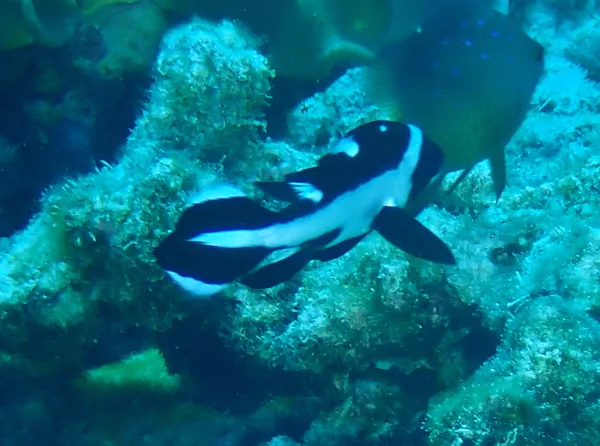
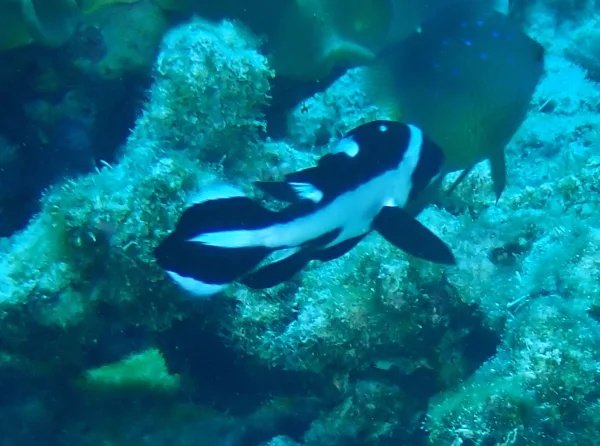
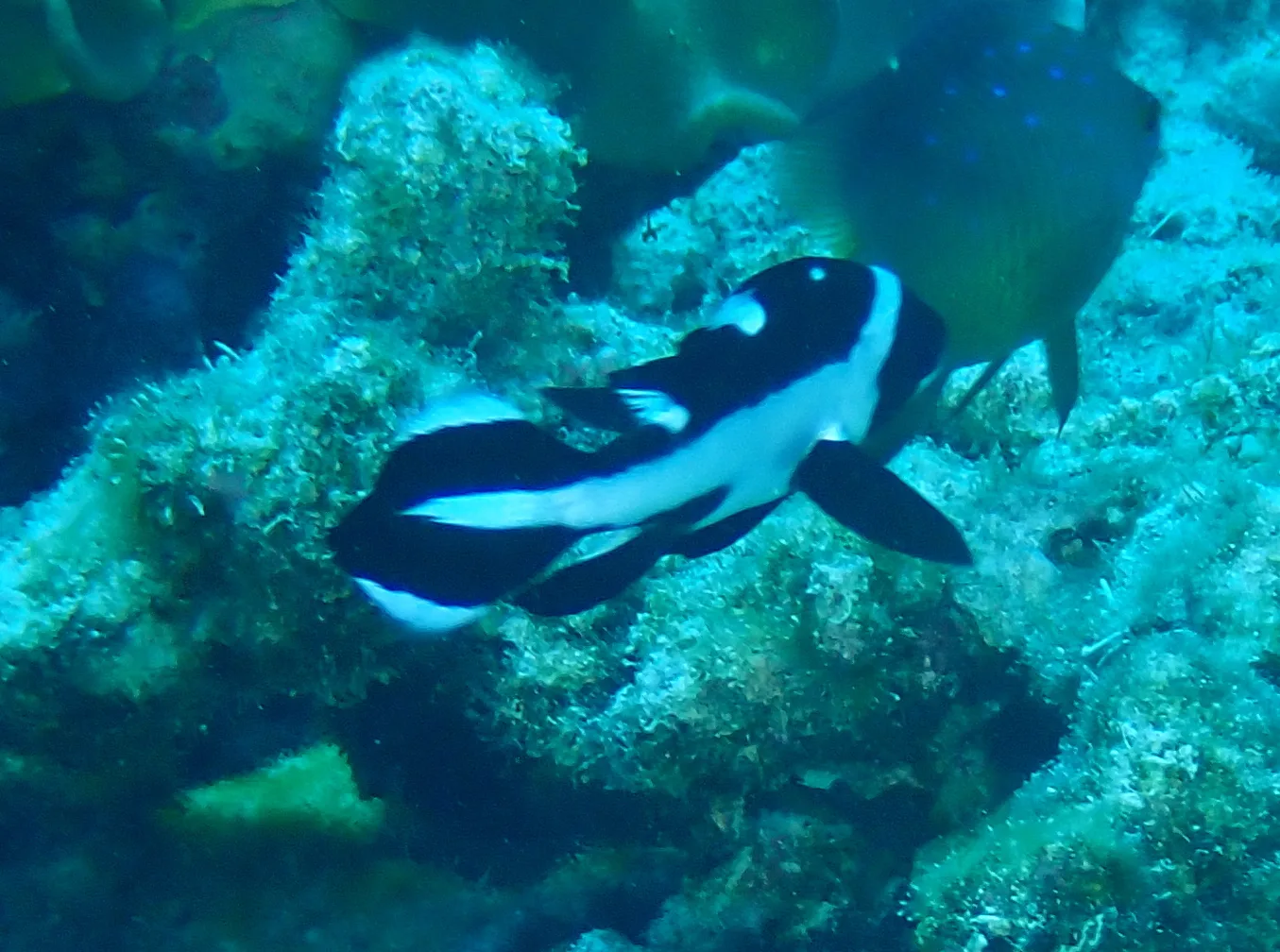
The black and white snapper changes a lot as it grows. A baby is black with big white patches. It has very long fins under its belly. As it grows up, the white patches fade away. A grown-up is gray to black, with black fins and eyes. Grown-ups can be about 30 inches long. That is longer than your arm! They swim in big groups along steep reef walls and deep channels. They hunt fish, crabs and shrimp. Babies live on their own. This fish lives in the Indian and Pacific Oceans, from the Red Sea to Samoa. People like to catch and eat it. In a tank the baby looks very fancy. But it grows into a big fish that needs a huge tank. It will eat any fish or shrimp that fits in its mouth.
Water & care
Juveniles are striking but grow into large, schooling predators, so this is a fish for very large fish-only systems of 300 gallons or more (Quality Marine, Top Shelf Aquatics). New imports may refuse prepared foods; start with live or enriched foods such as adult brine shrimp, glass or grass shrimp, black worms or ghost shrimp, then move to meaty frozen foods. Feed small meals two or three times a day while it settles. Give it plenty of rockwork with crevices and caves, wide open swimming space and a deep sand bed, and use a tight-fitting lid because it may jump.
| Parameter | Keep it at | Where that sits on the usual reef range |
|---|---|---|
| Temperature | 72–78 °F | |
| Salinity (SG) | 1.020–1.025 | |
| pH | 8.1–8.4 | |
| Alkalinity | 8–12 dKH |
Ranges from Quality Marine (72-78°F, SG 1.020-1.025, pH 8.1-8.4, 8-12 dKH). No species-specific calcium, magnesium, nitrate or phosphate values are published.
Feeding
DietCarnivore
Favorite foods
- Chopped squid
- Shrimp
- Clam
- Fish flesh
- Live ghost or grass shrimp (for new arrivals)
Feed meaty foods such as chopped squid, fish flesh, shrimp and clam twice a day (Quality Marine), or several times a day while it is new, then taper (Top Shelf Aquatics). Fresh imports that refuse prepared foods may start on enriched live adult brine shrimp, glass or grass shrimp, black worms, ghost shrimp or small baitfish.
Tank & maintenance
- Minimum tank
- 300 gallons
- Aquascape
- Abundant rockwork with crevices and caves, wide open swimming areas and a deep sand bed (Quality Marine). A tight-fitting lid is needed.
- Lighting
- No special requirement.
- Water flow
- No specific requirement is published; normal, moderate flow.
Routine upkeep
Routine water changes and strong filtration for a fast-growing predator. Keep the lid closed and gap-free. Plan the next, larger home well before the juvenile outgrows its tank.
Temperament & tankmates
TemperamentSemi-aggressive
Quality Marine advises peaceful tankmates and says it can be kept in pairs; Top Shelf Aquatics rates it aggressive because it eats small fish and crustaceans. Juveniles can be pushed around by bolder fish, so add assertive species only after it has settled, and choose non-aggressive tankmates of similar size that are too large to swallow.
Reef safeNo
Not reef safe: it will eat any fish or invertebrate it can fit in its mouth (Quality Marine). Corals themselves are not targeted (Top Shelf Aquatics), but shrimp, crabs, clean-up crew and small fish will disappear.
Good tankmates
- Peaceful fish of similar size, too large to swallow
- Large tangs
- Large angelfish
- Another black and white snapper (pairs, per Quality Marine)
Avoid
- Small fish that fit in its mouth
- Shrimp, crabs and other ornamental crustaceans
- Delicate clean-up crew
- Bold, aggressive fish added before it settles
Help it thrive
- Buy it only if you can house a fish that may reach about 30 in, in 300 gallons or more.
- Offer live or enriched foods first if it refuses prepared foods, then switch to meaty frozen foods.
- Use a tight-fitting lid; it may jump.
- Keep it with fish too large to swallow, and skip shrimp and crabs.
- Give it caves and crevices plus lots of open swimming room.
Common ailments
Marine ich (Cryptocaryon irritans)
- Signs
- White, salt-like spots on the body, fins or gills, scratching (flashing), rapid breathing, cloudy eyes, hiding and loss of appetite.
- Prevention
- Quarantine new fish in a separate tank for several weeks before adding them to the display, and keep water stable.
- Treatment
- Treat in a hospital tank. Options include copper, chloroquine phosphate, hyposalinity and the tank-transfer method; follow the product's directions. Leave the display without fish for about 11 weeks, because the cyst stage can last up to 72 days.
Marine velvet (Amyloodinium ocellatum)
- Signs
- A fine dusty sheen on the skin, very fast breathing, gasping near the surface, scratching, jerky swimming and lethargy. Heavily infected fish can die within 12 to 48 hours.
- Prevention
- Strict quarantine, and disinfect nets, buckets and equipment between tanks.
- Treatment
- Act immediately: a temperature- and pH-matched freshwater dip for quick relief, then copper or chloroquine phosphate in a hospital tank. Leave the display without fish so the parasite dies off.
Refusing food after import
- Signs
- A new fish ignores prepared foods, hides and grows thin.
- Prevention
- Buy a fish that is already eating, and give it calm tankmates and hiding places.
- Treatment
- Offer live or enriched foods such as adult brine shrimp, glass or grass shrimp, black worms or ghost shrimp, then mix in meaty frozen foods and switch over gradually (Quality Marine, Top Shelf Aquatics).
This is general hobby guidance, not veterinary advice. Quarantine new arrivals and treat in a separate tank whenever you can.
Risks of owning one
- Grows from a small juvenile to as much as 75 cm (about 30 in); most home tanks are too small.
- Eats small fish, shrimp, crabs and clean-up crew.
- May jump from an open tank.
- The striking juvenile pattern fades with age.
- Juveniles are easily confused with the midnight snapper (Macolor macularis).
Breeding
DifficultyNot achieved Captive-bredRare or wild-caught
Adults gather in aggregations to spawn in the wild. No details of eggs or larvae appear in the sources checked, and we found no report of aquarium spawning. No captive-bred fish are sold.
- No documented aquarium breeding; its adult size and schooling spawning behavior make it impractical in home tanks.
Deep dive The science, history and family tree
The science
Macolor niger is a large snapper (family Lutjanidae) of Indo-Pacific reefs. It has a relatively deep body with a convex head profile, a large mouth reaching the front of the eye, conical jaw teeth enlarged into canines at the front, a deep notch on the lower edge of the preopercle, long pectoral fins reaching the anus and a shallowly forked tail. The dorsal fin has 10 spines and 13-15 soft rays, the anal fin 3 spines and 10-11 soft rays, and the first gill arch 89-107 rakers. Juveniles are boldly black and white, with a broad white area over the rear of the head, fewer than five white spots on the back and very long pelvic fins. Adults become silvery gray to blackish with dark blotches, black fins and a dull iris, and lack yellow and blue markings on the head and body. It reaches 75 cm total length, commonly 35 cm. The species ranges from the Red Sea and East Africa to Samoa and Tonga, north to central Japan and south to Australia, on steep outer lagoon walls, channels and seaward slopes at 2-90 m. Juveniles are solitary; adults form large schools, sometimes mixed with M. macularis, and gather in aggregations to spawn. It feeds mainly on fishes and crustaceans.
- Appearance
- Juveniles are boldly patterned in black and white, with a broad white area over the back of the head and the adjacent body, fewer than five white spots along the back and very long pelvic fins. The pattern fades as the fish grows; adults are silvery gray to black with dark blotches, black fins and eyes and a dark snout and chin tip. Look-alike: juveniles of the midnight snapper (Macolor macularis) are also black and white, and the two species are often confused and school together. FishBase separates M. niger by the juvenile pattern above and by adults that lack yellow and blue markings on the head and body.
- Native range
- Indo-Pacific. Indian Ocean: Red Sea and the East African coast south to South Africa, plus the Seychelles, Madagascar, western Mascarenes, Maldives, Laccadives, Chagos, Sri Lanka, and Cocos (Keeling) and Christmas Islands. Pacific: western Malaysia, western Indonesia and the Andaman Sea east to the Marshall Islands, Samoa and Tonga, south to Australia and north to central Japan; also Niue and the Cook Islands. Type locality: Jeddah, Red Sea.
- Habitat
- Steep outer slopes of lagoon reefs, channels and seaward slopes at 2-90 m. Juveniles live alone; adults form large schools, sometimes mixed with the midnight snapper, and gather in aggregations to spawn.
- Size
- 29.5 in (75 cm). FishBase and Wikipedia give 75 cm (29.5 in) total length, with most fish under 35 cm (14 in). Quality Marine says a little over 26 in. Top Shelf Aquatics lists 6 in in its spec table but says the fish grows very large; small juveniles are what is usually sold.
- Lifespan
- Not documented: no published longevity figure for wild or aquarium fish was found.
- Conservation
- Least Concern. Assessed Least Concern by the IUCN (2015). Not evaluated by CITES. Prized as a food fish and caught commercially and recreationally with handlines, gill nets and traps, and speared by divers. Rarely seen in the aquarium trade (Quality Marine); aquarium fish are wild-collected juveniles
In the aquarium vs in the wild
In your aquarium
A striking juvenile display fish for very large fish-only or public-aquarium systems; rarely offered.
On the reef
A schooling predator of fish and crustaceans on steep outer reef walls and channels, and an important food fish.
History
Peter Forsskål described the species in 1775 as Sciaena nigra, from Jeddah in the Red Sea; the name niger refers to the blackish color of adults. Pieter Bleeker created the genus Macolor in 1860 for Diacope macolor, which he renamed Macolor typus; both names are now synonyms of Macolor niger. The genus has only one other species, the midnight snapper (M. macularis), and the two are often confused, especially as juveniles. In the aquarium trade it is rarely seen; Quality Marine sells it as the 'Macolor Niger Grunt', although it is a snapper, not a grunt, and the store lists it as 'Macolor Niger'. It is prized as a food fish across its range.
Evolution & relatives
Snappers (Lutjanidae) are a family of about 113 species in four subfamilies; Macolor and Lutjanus belong to the subfamily Lutjaninae, which also contains the fusiliers (such as Caesio), once treated as a separate family. Snappers are mostly active carnivores of crustaceans and fishes, and their fossil record goes back to the Early Eocene. Wikipedia notes that snappers can be kept in aquariums but often grow too fast to be popular. WoRMS places snappers in Eupercaria incertae sedis, the same unplaced group as the wrasses, so on the site's tree the black and white snapper sits beside the bluestripe snapper and not far from wrasses, and far from puffers and triggerfish.
Family tree, from kingdom down
- Kingdom Animalia Animals Animals are living things made of many cells that must eat food to live. Fish, corals, crabs, snails and sea stars are all animals.
- Phylum Chordata Chordates Chordates have a stiff rod running down their back at some point in their lives. In fish and people, this rod is replaced by a backbone.
- Subphylum Vertebrata Vertebrates Vertebrates are animals with a backbone and a skull. Fish, frogs, birds and people are all vertebrates.
- Infraphylum Gnathostomata jawed vertebrates
- Parvphylum Osteichthyes bony fishes
- Gigaclass Actinopterygii ray-finned fishes
- Superclass Actinopteri
- Class Teleostei Teleost fishes Teleosts are bony fishes with thin, bendy fin rays and jaws that can push forward. Almost all of the fish in the world are teleosts.
- Order Eupercaria (unplaced) Unplaced eupercarian fishes Eupercaria is a huge group of fish with spiny fins. Scientists found it by studying DNA, and it holds wrasses, grunts, butterflyfishes and many more. 'Incertae sedis' means 'place not sure': scientists have not yet agreed which order wrasses belong in.
- Family Lutjanidae Snappers Snappers are hunting fish with sharp teeth that often swim in schools near reefs. Many grow big and are caught for food.
- Genus Macolor
- Species Macolor niger
See it on the Tree of Life Compare with another species
Closest relatives
- Macolor macularis Midnight Snapper Only other species in the genus; schools with it and is often confused with it
- Lutjanus kasmira Bluestripe Snapper Same subfamily (Lutjaninae) Read guide · Compare
- Caesio Fusiliers Same subfamily; once a separate family
Older scientific names: Sciaena nigra, Diacope macolor, Macolor macolor, Macolor typus.
Fun facts
- Juveniles are boldly black and white with very long pelvic fins, but adults turn mostly gray to black.
- Its species name, niger, refers to the blackish color of the adults.
- Quality Marine sells it as the 'Macolor Niger Grunt', although it is a snapper.
- Adults school with their only close cousin, the midnight snapper, and the two are often confused.
- Its first gill arch carries 89 to 107 gill rakers.
Learn more
- FishBase: Macolor niger, Black and white snapper fishbase.se
- WoRMS: Macolor niger (Forsskål, 1775) marinespecies.org
- Wikipedia: Black and white snapper en.wikipedia.org
Sources
- FishBase species summary: Macolor niger fishbase.se
- WoRMS taxon record 218501 marinespecies.org
- Wikipedia: Black and white snapper en.wikipedia.org
- Wikipedia: Lutjanidae en.wikipedia.org
- Quality Marine: Macolor Niger Grunt qualitymarine.com
- Top Shelf Aquatics: Macolor Snapper topshelfaquatics.com
- Wikipedia: Cryptocaryon irritans en.wikipedia.org
- Wikipedia: Amyloodinium ocellatum en.wikipedia.org
Scientific names and classification follow the World Register of Marine Species (AphiaID 218501). Checked by our team. Last updated October 29, 2026.
Shop this species
Search the shop →
Only 1 left