Fish · Snapper
Bluestripe Snapper
Lutjanus kasmira
Also called Blue-Striped Snapper, Common Bluestripe Snapper, Blue-line Snapper, Blue-lined Snapper, Bluebanded Snapper, Bluestripe Sea Perch, Bluelined Seaperch, Fourline Snapper, Moonlighter
Reviewed by admin on October 29, 2026 · Meet the team
- CareModerate
- Reef safeNo
- TemperamentSemi-aggressiveEats small fish, shrimp and crabs
- Favorite foods
- Silversides and krill
- Mysis shrimp
- Carnivore pellets
- Max size15.7 in (40 cm)
- Min tank300 gal
- LifespanFishBase gives a maximum recorded age…
- IUCN statusLeast Concern
Quick answers
- How big does the Bluestripe Snapper get?
- Up to 15.7 in (40 cm).
- What size tank does it need?
- At least 300 gallons.
- How hard is it to keep?
- Care level: Moderate.
- Is it reef safe?
- No. It does not eat corals, but it is a predator of shrimp, crabs, other small invertebrates and small fish (Quality Marine; FishBase lists fishes, shrimps, crabs, stomatopods and cephalopods in its wild diet).
- What does it eat?
- Silversides and krill
- Mysis shrimp
- Carnivore pellets
- How long does it live?
- FishBase gives a maximum recorded age of 6 years for wild fish; no captive lifespan has been published.
- What are good tankmates?
- Larger fish that are not easily harassed
- Large tangs and rabbitfish
- Large angelfish
- Robust fish of similar or larger size
The 30-second version
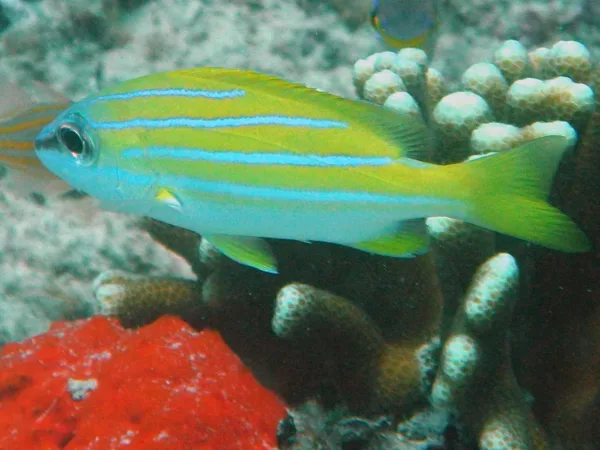
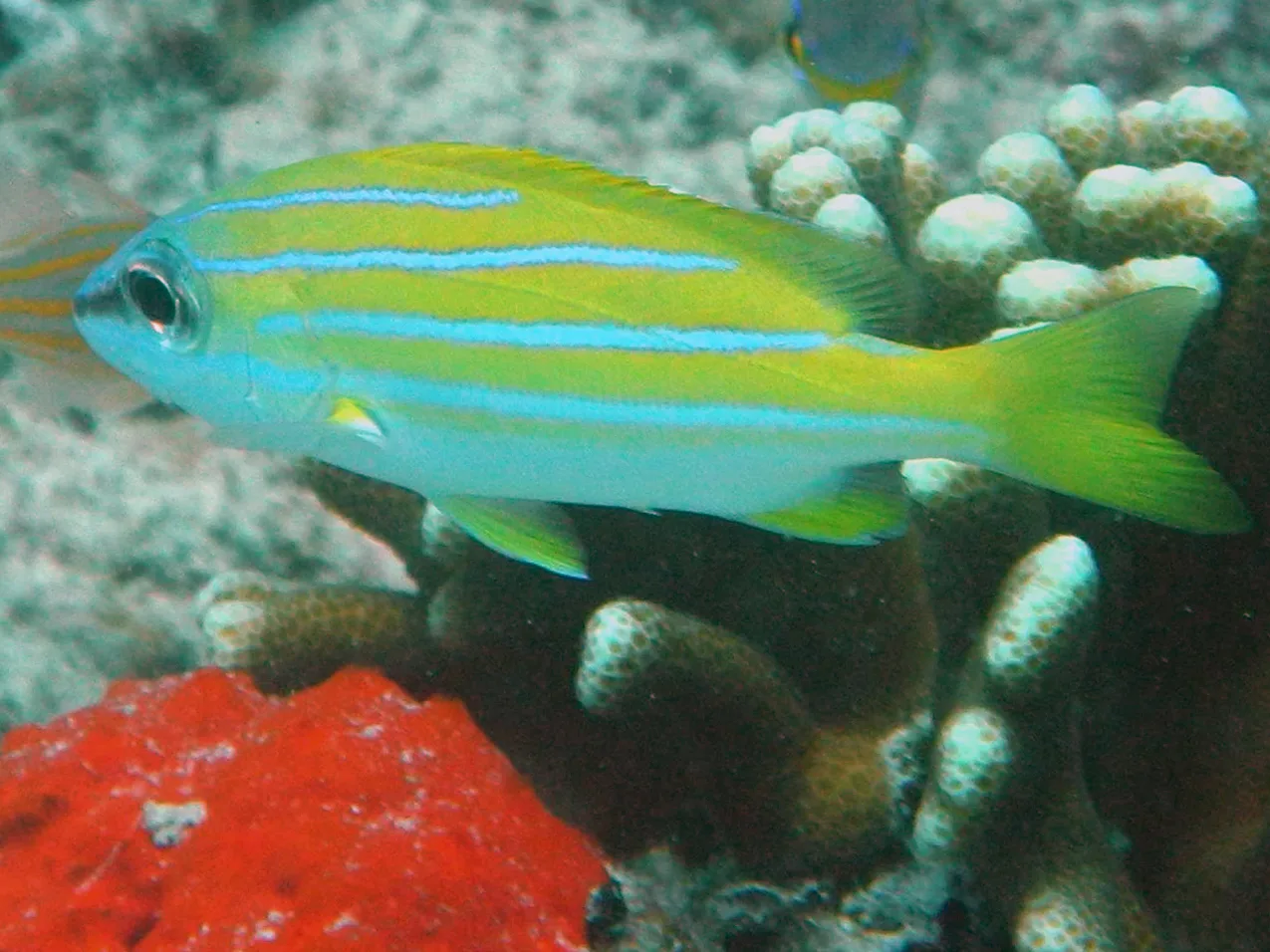
The bluestripe snapper is a bright yellow fish. It has four shiny blue stripes along each side, and its belly is white. It lives on coral reefs from the Red Sea and Africa to the middle of the Pacific Ocean. By day, big groups hang around coral heads, caves and shipwrecks. They hunt small fish, shrimp, crabs and squid. A goatfish with the same colors often swims in the same group. The goatfish may be safer hiding among the snappers. In the 1950s, people brought bluestripe snappers to Hawaii. They hoped to have more fish to catch. The snappers did so well that now there are too many. In a tank this fish can grow to about 16 inches. It is easy to feed. But it will eat any small fish or shrimp that fits in its mouth.
Water & care
Hardy, adaptable and easy to feed, accepting most meaty foods (LiveAquaria, Quality Marine). The challenge is size and activity: it grows to about 16 in and is an active swimmer that needs a very large, established fish-only tank with rockwork, caves and overhangs plus lots of open swimming room. It eats any fish or invertebrate small enough to fit in its mouth, so plan tankmates around its adult size. Quality Marine advises one per tank because it gets large; LiveAquaria suggests a group of three or more in a 300-gallon system.
| Parameter | Keep it at | Where that sits on the usual reef range |
|---|---|---|
| Temperature | 72–78 °F | |
| Salinity (SG) | 1.020–1.025 | |
| pH | 8.1–8.4 | |
| Alkalinity | 8–12 dKH |
LiveAquaria and Quality Marine agree on 72-78°F, SG 1.020-1.025, pH 8.1-8.4 and 8-12 dKH. FishBase gives a wild temperature range of 20-28°C (68-82°F). No species-specific calcium, magnesium, nitrate or phosphate values are published.
Feeding
DietCarnivore
Favorite foods
- Chopped frozen silversides
- Krill
- Mysis shrimp
- Vitamin-enriched brine shrimp
- Carnivore pellets and preparations
Easy to feed. Offer meaty foods such as chopped frozen silversides, krill, vitamin-enriched brine shrimp and mysis, plus other carnivore preparations (LiveAquaria). Feed amounts it eats quickly, and size the pieces to its mouth as it grows.
Tank & maintenance
- Minimum tank
- 300 gallons
- Aquascape
- Very large, established fish-only tank with rockwork, caves and overhangs to shelter in, and long open swimming lanes.
- Lighting
- No special requirement; Quality Marine lists medium light.
- Water flow
- No specific requirement is published; normal, moderate flow.
Routine upkeep
Routine water changes and good filtration for a large, meat-eating fish. Watch tankmates as it grows, and rehome small fish before they become prey.
Temperament & tankmates
TemperamentSemi-aggressive
LiveAquaria calls it peaceful and Quality Marine aggressive. It hunts and swallows small fish and crustaceans. House it with larger fish that are not easily harassed (Quality Marine).
Reef safeNo
It does not eat corals, but it is a predator of shrimp, crabs, other small invertebrates and small fish (Quality Marine; FishBase lists fishes, shrimps, crabs, stomatopods and cephalopods in its wild diet). LiveAquaria rates it 'with caution' for that reason. In a reef with ornamental shrimp, crabs or small fish it is effectively not reef safe; it suits fish-only or predator tanks.
Good tankmates
- Larger fish that are not easily harassed
- Large tangs and rabbitfish
- Large angelfish
- Robust fish of similar or larger size
Avoid
- Small fish that fit in its mouth
- Ornamental shrimp and crabs
- Small invertebrates and clean-up crew
- Very timid fish in a small tank
Help it thrive
- Plan for its adult size of about 16 in before buying a small one.
- Give it long, open swimming space plus rock caves and overhangs.
- Feed a varied meaty diet: silversides, krill, mysis and carnivore preparations.
- Keep it with fish too large to swallow, and skip ornamental shrimp and crabs.
- Keep one, or a group only in a very large system.
Common ailments
Marine ich (Cryptocaryon irritans)
- Signs
- White, salt-like spots on the body, fins or gills, scratching (flashing), rapid breathing, cloudy eyes, hiding and loss of appetite.
- Prevention
- Quarantine new fish in a separate tank for several weeks before adding them to the display, and keep water stable.
- Treatment
- Treat in a hospital tank. Options include copper, chloroquine phosphate, hyposalinity and the tank-transfer method; follow the product's directions. Leave the display without fish for about 11 weeks, because the cyst stage can last up to 72 days.
Marine velvet (Amyloodinium ocellatum)
- Signs
- A fine dusty sheen on the skin, very fast breathing, gasping near the surface, scratching, jerky swimming and lethargy. Heavily infected fish can die within 12 to 48 hours.
- Prevention
- Strict quarantine, and disinfect nets, buckets and equipment between tanks.
- Treatment
- Act immediately: a temperature- and pH-matched freshwater dip for quick relief, then copper or chloroquine phosphate in a hospital tank. Leave the display without fish so the parasite dies off.
This is general hobby guidance, not veterinary advice. Quarantine new arrivals and treat in a separate tank whenever you can.
Risks of owning one
- Grows to about 16 in and needs a very large tank.
- Eats small fish, shrimp, crabs and other small invertebrates.
- A schooling species in the wild; sources disagree on keeping one or a group.
- Invasive where introduced (Hawaii); never release it.
Breeding
DifficultyNot achieved Captive-bredRare or wild-caught
Wild fish mature at 20-25 cm and spawn through most of the year at low latitudes, with a peak in November and December in the Andaman Sea. The eggs are 0.78-0.85 mm and hatch at 22-25°C. We found no report of aquarium spawning or rearing, and no captive-bred fish are sold.
- No documented aquarium breeding; maturity at 20-25 cm and schooling behavior make it impractical in home tanks.
Deep dive The science, history and family tree
The science
Lutjanus kasmira is a medium-sized snapper (family Lutjanidae) with a moderately deep body and a steeply sloping head profile. The back and sides are bright yellow, fading to white below, with four bright-blue longitudinal stripes along the flanks and several faint gray stripes low on the sides; most fins are yellow. The dorsal fin has 10 spines and 14-15 soft rays, the anal fin 3 spines and 7-8 soft rays, and the lateral line 48-51 scales. It reaches 40 cm total length, although most are under 25 cm, and the recorded maximum age is 6 years. Native to the Indo-Pacific from the Red Sea and East Africa to the Marquesas and Line Islands, north to southern Japan and south to Australia, it was introduced to Hawaii in the 1950s and is now widespread there. Adults live on coral reefs in shallow lagoons and on outer reef slopes at 3-265 m, usually 30-150 m, and gather in large daytime aggregations around coral heads, caves and wrecks; juveniles live in seagrass around patch reefs. It feeds on fishes, shrimps, crabs, stomatopods, cephalopods and planktonic crustaceans, and also eats some algae. It matures at 20-25 cm and spawns through most of the year at low latitudes.
- Appearance
- Bright yellow back and sides fading to white on the belly and lower head, with four bright blue stripes along each side and a few faint gray stripes low on the belly; most fins are yellow. The head profile slopes steeply, the snout is pointed and the large mouth has sharp teeth. Look-alikes: the mimic goatfish (Mulloidichthys mimicus) has almost the same colors and schools with it, and some retailers describe five blue stripes rather than four.
- Native range
- Indo-Pacific: Red Sea and East Africa (south to East London, South Africa, and Madagascar) east through India, Southeast Asia and Australia to the Marquesas and Line Islands, north to southern Japan. Introduced to Hawaii in the 1950s, where it is now dominant around many islands. Type locality not given in the original description; the Red Sea is considered likely.
- Habitat
- Coral reefs in shallow lagoons and on outer reef slopes, from 3 m to at least 60 m and recorded to 180 m (Marquesas) and 265 m (Red Sea); FishBase gives a usual depth of 30-150 m. Adults form large aggregations around coral formations, caves and wrecks by day; larger fish become more solitary on deeper reefs. Juveniles school over sand and in seagrass beds around patch reefs. In Hawaii it also uses seagrass and sandy bottoms.
- Size
- 15.7 in (40 cm). FishBase and Wikipedia give 40 cm (15.7 in) total length, with most fish under 25 cm (about 10 in). LiveAquaria lists 10 in and Quality Marine about 16 in.
- Lifespan
- FishBase gives a maximum recorded age of 6 years for wild fish; no captive lifespan has been published.
- Conservation
- Least Concern. Assessed Least Concern by the IUCN (2015). Not evaluated by CITES. A commercial food and game fish across its range, and a principal but low-value species in Hawaii's handline fishery. Introduced to Hawaii, where WoRMS notes it outcompetes native species; Hawaii has held spearfishing contests since 2008 to remove it. Never release aquarium fish into the wild
In the aquarium vs in the wild
In your aquarium
A hardy, colorful display fish for large fish-only or predator tanks.
On the reef
A schooling mid-level predator of reefs that eats small fish, crustaceans and squid, and a commercial and game fish; in Hawaii, an introduced competitor of native fish.
History
The species was first described in 1775 as Sciaena kasmira, in the work based on Peter Forsskål's Red Sea expedition; FishBase and WoRMS credit Forsskål, while the Catalog of Fishes credits Fabricius (in Niebuhr, ex Forsskål). No type locality was given, but the Red Sea is considered likely, and kasmira is the Arabic name for this fish there. In the 1950s Hawaii's Division of Fish and Game, which judged the native fish fauna too dominated by herbivores, imported 11 species of snappers and groupers from Mexico, Kiribati, the Marquesas and Moorea; only three thrived, and the bluestripe snapper became dominant around many islands. Concerns include competition with native fish such as the yellowfin goatfish and a parasitic nematode, Spirocamallanus istiblenni, that may have arrived with it. It is also sold in the aquarium trade.
Evolution & relatives
Snappers (Lutjanidae) are a family of about 113 species in four subfamilies, found in warm seas worldwide; most are active carnivores of crustaceans and fishes near reefs. Lutjanus and Macolor belong to the subfamily Lutjaninae, which also includes the fusiliers (such as Caesio and Pterocaesio). Fusiliers were once treated as their own family, Caesionidae, but are now placed inside the snapper family. The family's fossil record reaches back to the Early Eocene. WoRMS places snappers in Eupercaria incertae sedis, the same unplaced group as the wrasses, so on the site's tree the bluestripe snapper sits near the six line wrasse and the black and white snapper and far from puffers and triggerfish.
Family tree, from kingdom down
- Kingdom Animalia Animals Animals are living things made of many cells that must eat food to live. Fish, corals, crabs, snails and sea stars are all animals.
- Phylum Chordata Chordates Chordates have a stiff rod running down their back at some point in their lives. In fish and people, this rod is replaced by a backbone.
- Subphylum Vertebrata Vertebrates Vertebrates are animals with a backbone and a skull. Fish, frogs, birds and people are all vertebrates.
- Infraphylum Gnathostomata jawed vertebrates
- Parvphylum Osteichthyes bony fishes
- Gigaclass Actinopterygii ray-finned fishes
- Superclass Actinopteri
- Class Teleostei Teleost fishes Teleosts are bony fishes with thin, bendy fin rays and jaws that can push forward. Almost all of the fish in the world are teleosts.
- Order Eupercaria (unplaced) Unplaced eupercarian fishes Eupercaria is a huge group of fish with spiny fins. Scientists found it by studying DNA, and it holds wrasses, grunts, butterflyfishes and many more. 'Incertae sedis' means 'place not sure': scientists have not yet agreed which order wrasses belong in.
- Family Lutjanidae Snappers Snappers are hunting fish with sharp teeth that often swim in schools near reefs. Many grow big and are caught for food.
- Genus Lutjanus
- Species Lutjanus kasmira
See it on the Tree of Life Compare with another species
Closest relatives
- Macolor niger Black and White Snapper Same family and subfamily (Lutjaninae) Read guide · Compare
- Lutjanus campechanus Red Snapper Same genus; Gulf of Mexico and US Atlantic coast
- Caesio Fusiliers Same subfamily; once a separate family
- Mulloidichthys mimicus Mimic Goatfish Unrelated goatfish that copies its colors and schools with it
Older scientific names: Sciaena kasmira, Mesoprion etaape, Perca lineata.
Fun facts
- Its species name, kasmira, is the Arabic name for this fish in the Red Sea.
- The mimic goatfish copies its yellow-and-blue pattern and swims in its schools.
- Brought to Hawaii in the 1950s, it became so common that Hawaii has held spearfishing contests since 2008 to remove it.
- It has been recorded as deep as 265 m in the Red Sea.
- It may have carried a parasitic worm, Spirocamallanus istiblenni, with it to Hawaii.
Learn more
- FishBase: Lutjanus kasmira, Common bluestripe snapper fishbase.se
- WoRMS: Lutjanus kasmira (Forsskål, 1775) marinespecies.org
- Wikipedia: Common bluestripe snapper en.wikipedia.org
- LiveAquaria: Bluestripe Snapper liveaquaria.com
Sources
- FishBase species summary: Lutjanus kasmira fishbase.se
- WoRMS taxon record 218482 marinespecies.org
- Wikipedia: Common bluestripe snapper en.wikipedia.org
- Wikipedia: Lutjanidae en.wikipedia.org
- LiveAquaria: Bluestripe Snapper liveaquaria.com
- Quality Marine: Common Bluestripe Snappers qualitymarine.com
- Wikipedia: Cryptocaryon irritans en.wikipedia.org
- Wikipedia: Amyloodinium ocellatum en.wikipedia.org
Scientific names and classification follow the World Register of Marine Species (AphiaID 218482). Checked by our team. Last updated October 29, 2026.
Shop this species
Search the shop →