Fish · Angelfish
Bicolor Angelfish
Centropyge bicolor
Also called Bicolor Angel, Bicolor Pygmy Angelfish, Oriole Angelfish, Oriole Dwarf Angelfish, Pacific Rock Beauty, Blue and Gold Angel, Two-colored Angel
Reviewed by admin on October 29, 2026 · Meet the team
- CareModerate
- Reef safeWith caution
- TemperamentSemi-aggressiveBullies similar angels; may nip corals and clams
- Favorite foods
- Marine algae / spirulina
- Mysis shrimp
- Angelfish prep
- Max size5.9 in (15 cm)
- Min tank70 gal
- Lifespan5-13 years in the wild depending on…
- IUCN statusLeast Concern
Quick answers
- How big does the Bicolor Angelfish get?
- Up to 5.9 in (15 cm).
- What size tank does it need?
- At least 70 gallons.
- How hard is it to keep?
- Care level: Moderate.
- Is it reef safe?
- With caution. LiveAquaria calls it 'not a good reef dweller' because it tends to nip stony and soft corals and clam mantles, and Quality Marine says it may pick at both mobile and sessile invertebrates.
- What does it eat?
- Marine algae / spirulina
- Mysis shrimp
- Angelfish prep
- How long does it live?
- 5-13 years in the wild depending on location (Wikipedia); FishBase gives a maximum reported age of 13 years.
- What are good tankmates?
- Tangs, added after the angel has settled or in a large tank
- Clownfish, wrasses and other community fish
- Other dwarf angels with a different shape, in a large tank
- Fish-only tanks with live rock
The 30-second version
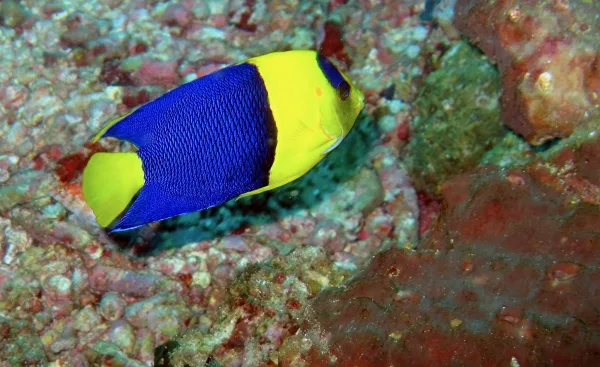
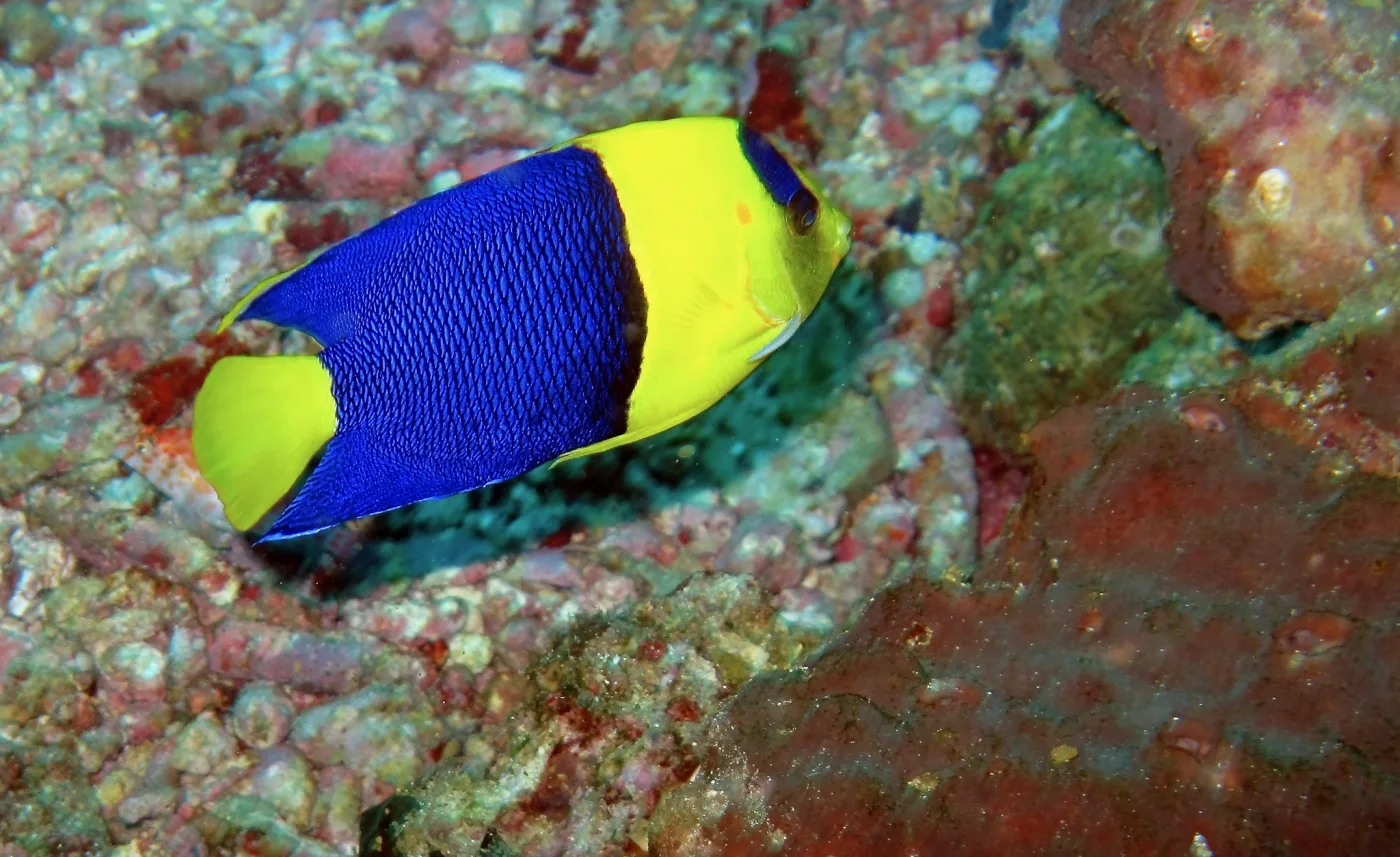
The bicolor angelfish is a small fish painted in two colors. The front of its body is bright yellow. The back is deep blue. Its tail is yellow too, and it has a blue patch over its eyes. It lives on coral reefs in the Indian and Pacific Oceans. All day it darts from one hiding spot to the next. It eats algae, small shrimp-like animals and worms. These fish live in family groups with one boy and a bunch of girls. Every bicolor angel starts life as a girl. If the boy dies, the biggest girl turns into a boy in about three weeks. In a fish tank some bicolor angels nip corals and clams. So it is a risky fish for a reef tank.
Water & care
Hardy once settled, but it can be sensitive while adjusting to a new tank. Give it at least 70 gallons with plenty of rockwork, caves and grazing surfaces, and feed algae-based and meaty foods several times a day. Wikipedia suggests adding it before boisterous fish such as tangs claim territories; other dwarf-angel advice is to add angels late, so judge by your tankmates. Keep one per tank unless you are pairing a larger and a smaller fish.
| Parameter | Keep it at | Where that sits on the usual reef range |
|---|---|---|
| Temperature | 72–78 °F | |
| Salinity (SG) | 1.020–1.025 | |
| pH | 8.1–8.4 | |
| Alkalinity | 8–12 dKH |
LiveAquaria and Quality Marine agree on 72-78°F, SG 1.020-1.025, pH 8.1-8.4 and 8-12 dKH; Wikipedia suggests 73-79°F. Calcium, magnesium, nitrate and phosphate are left null because no species-specific values are published; keep normal reef targets in a reef tank.
Feeding
DietOmnivore
Favorite foods
- Spirulina and marine algae foods
- Angelfish preparations
- Mysis or frozen shrimp
- Algae grazed from live rock
- Chopped worms and other meaty foods
Feed several small meals a day, mostly plant-based foods with some meaty foods. A mature tank with live rock for grazing between meals helps keep it healthy and may reduce nipping.
Tank & maintenance
- Minimum tank
- 70 gallons
- Aquascape
- Plenty of live rock with caves, cracks and crevices to hide in and graze, plus some open swimming room. A well-established tank is best.
- Lighting
- No special need; Quality Marine lists medium light. Light that grows some algae on the rock helps.
- Water flow
- Moderate, varied flow, as on a normal reef.
Routine upkeep
Routine water changes and stable water. Leave some algae on the rock for grazing, feed several times a day, and watch corals and clams for signs of nipping.
Temperament & tankmates
TemperamentSemi-aggressive
Moderately aggressive toward its own species and other fish, and territorial toward other angelfish with a similar body shape. Quality Marine calls it one of the more peaceful angels and says other dwarf angels can live with it in a large enough tank. If you keep more than one, add them all at once, with one larger and one or more smaller fish.
Reef safeWith caution
LiveAquaria calls it 'not a good reef dweller' because it tends to nip stony and soft corals and clam mantles, and Quality Marine says it may pick at both mobile and sessile invertebrates. Not every fish does: Practical Fishkeeping notes that some are perfect while others can quickly wreck a reef. A fish-only tank with live rock is the safest home; in a reef, be ready to rehome it.
Good tankmates
- Tangs, added after the angel has settled or in a large tank
- Clownfish, wrasses and other community fish
- Other dwarf angels with a different shape, in a large tank
- Fish-only tanks with live rock
Avoid
- Another bicolor angel, except a planned pair or harem added together
- Clams, LPS and soft corals you cannot risk
- Large predators that could swallow it
- Small tanks under about 70 gallons
Help it thrive
- Give it a mature tank with lots of live rock to graze and hide in.
- Feed small meals of algae-based and meaty foods several times a day.
- Keep only one, unless you add a planned pair at the same time.
- Skip it in a tank full of clams, LPS or soft corals you cannot risk.
- Move it with a cup or container; the gill-cover spines snag in nets.
Common ailments
Marine ich (white spot, Cryptocaryon irritans)
- Signs
- Small white spots on the body and fins, scratching, fast breathing, hiding and loss of appetite.
- Prevention
- Quarantine new fish and keep water stable.
- Treatment
- Treat in a hospital tank, never in a reef display, with chloroquine phosphate, copper or the tank-transfer method, following the product's directions. Leave the display without fish for several weeks.
Marine velvet (Amyloodinium ocellatum)
- Signs
- A fine dusty coating on the skin, very fast breathing, hanging near the surface and quick decline.
- Prevention
- Strict quarantine and separate equipment for each tank.
- Treatment
- A temperature- and pH-matched freshwater dip for quick relief, then treatment in a hospital tank, following the product's directions.
Stress and not eating after a move
- Signs
- Constant hiding, ignoring food and losing weight in the first weeks.
- Prevention
- Buy a fish that is eating, and add it to a mature tank with plenty of cover and no bullies.
- Treatment
- Offer a variety of algae and meaty foods several times a day, dim the lights, and remove aggressive tankmates.
This is general hobby guidance, not veterinary advice. Quarantine new arrivals and treat in a separate tank whenever you can.
Risks of owning one
- May nip stony and soft corals and clam mantles; some individuals can wreck a reef tank.
- Can be sensitive while adjusting to a new tank.
- Territorial toward other dwarf angels and look-alikes.
- Gill-cover spines snag in nets.
Breeding
DifficultyVery hard Captive-bredRare or wild-caught
A protogynous broadcast spawner. In harems, the male visits females at dusk and may spawn with several in one night, each female at most once. The larval stage lasts about 32 days. A 1993 Breeder's Registry report from C-Quest describes nightly spawns of about 100-250 tiny eggs that hatched after 24 hours, but no larvae survived past 9 days. Practical Fishkeeping reports that efforts are under way to rear it commercially; we found no captive-bred bicolor angels on sale.
- Pair a larger fish with a smaller one and add them together to a mature tank.
- Condition them with several feedings a day of algae and meaty foods.
- Watch at dusk for chasing and spawning up in the water column.
- Collect the floating eggs from the overflow and move them to a larval tank. This is where documented attempts end; rearing the larvae needs tiny live foods and has not been reported as a success.
Deep dive The science, history and family tree
The science
Centropyge bicolor is one of the larger pygmy angelfishes (family Pomacanthidae), with sharp spines on the cheeks like other angelfishes. The color pattern is unmistakable: the head, the front of the body, the pelvic fins and the tail are bright yellow, a dark blue bar crosses the head over the eyes, the rear of the body and the dorsal and anal fins are dark blue, and the pectoral fins are nearly clear. The dorsal fin has 15 spines and 15-17 soft rays and the anal fin 3 spines and 17-18 soft rays. Maximum length is 15 cm TL, and the maximum reported age is 13 years. It ranges from East Africa to the Samoan and Phoenix Islands, north to southern Japan and south to New Caledonia, including Micronesia. It lives on lagoon, channel and protected seaward reef slopes and drop-offs at 1-25 m, among coral and rubble, darting between shelters. It feeds on algae, small crustaceans and worms. Adults form harems of one male and several females in a male-defended territory of up to 200 m². It is a protogynous hermaphrodite: if the male disappears, the top female becomes male in 18-20 days. Spawning takes place at dusk.
- Appearance
- Bright yellow head, front body, pelvic fins and tail; dark blue rear body, dorsal fin and anal fin; a dark blue bar over the top of the head through the eyes; and nearly clear pectoral fins. Males and females look the same. Its sharp gill-cover spines snag easily in nets. The coral beauty (C. bispinosa) and flame angel (C. loriculus) share the shape but not the yellow-and-blue split.
- Native range
- Indo-Pacific: East Africa east to the Samoan and Phoenix Islands, north to southern Japan, south to New Caledonia and Australia, including the Philippines, Fiji and Micronesia.
- Habitat
- Lagoon, channel and protected seaward reef slopes and drop-offs at 1-25 m, in coral-rich and rubble areas. It stays close to shelter and darts from one hiding place to the next. Usually in pairs, small groups or harems of one male and several females.
- Size
- 5.9 in (15 cm). FishBase gives 15 cm (5.9 in) total length as the maximum; Quality Marine says up to 6 in. LiveAquaria sells sizes up to 4 in. Maximum reported age 13 years (FishBase).
- Lifespan
- 5-13 years in the wild depending on location (Wikipedia); FishBase gives a maximum reported age of 13 years. No captive lifespan study was found.
- Conservation
- Least Concern. IUCN Least Concern (assessed 2009, per FishBase). It is commonly exported for the aquarium trade and taken in subsistence fisheries. Fish in the trade are wild-caught; a 1993 Breeder's Registry report documents spawning, but no commercially raised bicolor angels were found in our sources
In the aquarium vs in the wild
In your aquarium
A colorful display fish for fish-only tanks with live rock or carefully chosen reef tanks.
On the reef
A harem-living grazer of algae, small crustaceans and worms among coral and rubble on Indo-Pacific reefs.
History
Marcus Elieser Bloch described the fish in 1787 as Chaetodon bicolor; it was later moved to Centropyge. It has long been a common aquarium export from the Indo-Pacific and goes by many trade names, including oriole angel and Pacific rock beauty. Spawning in captivity was reported by C-Quest in 1993, but the larvae have not yet been raised on a commercial scale.
Evolution & relatives
The bicolor angel belongs to Centropyge, the pygmy angelfishes, in the family Pomacanthidae, which WoRMS places in the order Acanthuriformes together with the surgeonfishes (tangs). A DNA study by Gaither et al. (2014), using an age of 38 million years for the family, found that Centropyge split from the regal angelfish genus Pygoplites about 33 million years ago, with three deep pygmy-angel lineages separating 18-28 million years ago. The same study found that Centropyge as now defined is paraphyletic, because the swallowtail angels (Genicanthus) and Apolemichthys nest inside it, and that in most pygmy-angel species complexes the species differ only in color.
Family tree, from kingdom down
- Kingdom Animalia Animals Animals are living things made of many cells that must eat food to live. Fish, corals, crabs, snails and sea stars are all animals.
- Phylum Chordata Chordates Chordates have a stiff rod running down their back at some point in their lives. In fish and people, this rod is replaced by a backbone.
- Subphylum Vertebrata Vertebrates Vertebrates are animals with a backbone and a skull. Fish, frogs, birds and people are all vertebrates.
- Infraphylum Gnathostomata jawed vertebrates
- Parvphylum Osteichthyes bony fishes
- Gigaclass Actinopterygii ray-finned fishes
- Superclass Actinopteri
- Class Teleostei Teleost fishes Teleosts are bony fishes with thin, bendy fin rays and jaws that can push forward. Almost all of the fish in the world are teleosts.
- Order Acanthuriformes Surgeonfishes, angelfishes and kin This order of fishes includes surgeonfishes, marine angelfishes and rabbitfishes. Many have deep, flat bodies and graze on reefs.
- Family Pomacanthidae Marine angelfishes Marine angelfishes are colorful reef fish with a strong spine on each cheek. Many change their colors as they grow up.
- Genus Centropyge Pygmy angelfishes Pygmy angelfishes are small, colorful angelfish that stay close to the reef. They graze on algae and tiny animals.
- Species Centropyge bicolor
See it on the Tree of Life Compare with another species
Closest relatives
- Centropyge bispinosa Coral Beauty Angelfish Same genus Read guide · Compare
- Centropyge loriculus Flame Angelfish Same genus Read guide · Compare
- Centropyge acanthops African Flameback Angelfish Same genus, subgenus Xiphipops Read guide · Compare
- Genicanthus Swallowtail angelfishes Genus that nests inside Centropyge in DNA trees
Older scientific names: Chaetodon bicolor.
Fun facts
- Every bicolor angel starts life as a female; if the harem's male disappears, the top female becomes male in 18-20 days.
- A harem male may defend a territory of up to 200 square meters.
- In aquariums it sometimes acts as a cleaner, picking at other fish, though this probably does not happen in the wild.
- Its drifting larval stage lasts about 32 days before the young fish settles on a reef.
Learn more
- FishBase: Centropyge bicolor, Bicolor angelfish fishbase.se
- Wikipedia: Bicolor angelfish en.wikipedia.org
- LiveAquaria: Bicolor Angelfish liveaquaria.com
Sources
- WoRMS: Centropyge bicolor (Bloch, 1787) marinespecies.org
- FishBase species summary: Centropyge bicolor fishbase.se
- Wikipedia: Bicolor angelfish en.wikipedia.org
- LiveAquaria: Bicolor Angelfish liveaquaria.com
- Quality Marine: Bicolor Angelfish qualitymarine.com
- Practical Fishkeeping: What's this fish? (Centropyge bicolor) practicalfishkeeping.co.uk
- Breeder's Registry spawning report CENBIC-091093-CQUEST-001 (1993) breedersregistry.org
- Europe PMC record: Gaither et al. 2014, Evolution of pygmy angelfishes (Mol. Phylogenet. Evol. 74:38-47) ebi.ac.uk
Scientific names and classification follow the World Register of Marine Species (AphiaID 211780). Checked by our team. Last updated October 29, 2026.
Shop this species
Search the shop →