Fish · Angelfish
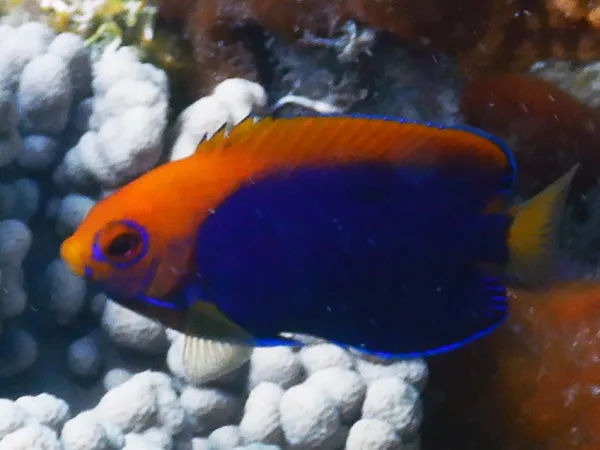
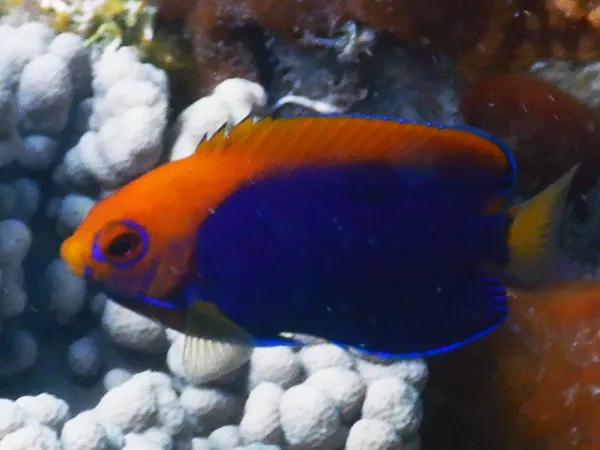
African Flameback Angelfish
Centropyge acanthops
Also called African Pygmy Angel, African Pygmy Angelfish, Orangeback Angelfish, Flameback Angelfish, Jumping Bean
Reviewed by admin on October 29, 2026 · Meet the team
- CareEasy
- Reef safeWith caution
- TemperamentSemi-aggressiveChases other small angels and look-alikes
- Favorite foods
- Marine algae / spirulina
- Mysis shrimp
- Angelfish prep
- Max size3.1 in (8 cm)
- Min tank55 gal
- LifespanNot documented in the sources we checked
- IUCN statusLeast Concern
Quick answers
- How big does the African Flameback Angelfish get?
- Up to 3.1 in (8 cm).
- What size tank does it need?
- At least 55 gallons.
- How hard is it to keep?
- Care level: Easy.
- Is it reef safe?
- With caution. LiveAquaria says that on occasion it may nip SPS and some polyp corals.
- What does it eat?
- Marine algae / spirulina
- Mysis shrimp
- Angelfish prep
- How long does it live?
- Not documented in the sources we checked; no published longevity study or reliable captive lifespan figure was found.
- What are good tankmates?
- Clownfish, gobies, blennies and cardinalfish
- Wrasses and anthias
- Tangs in a large enough tank
- Most corals and invertebrates, with some caution
The 30-second version
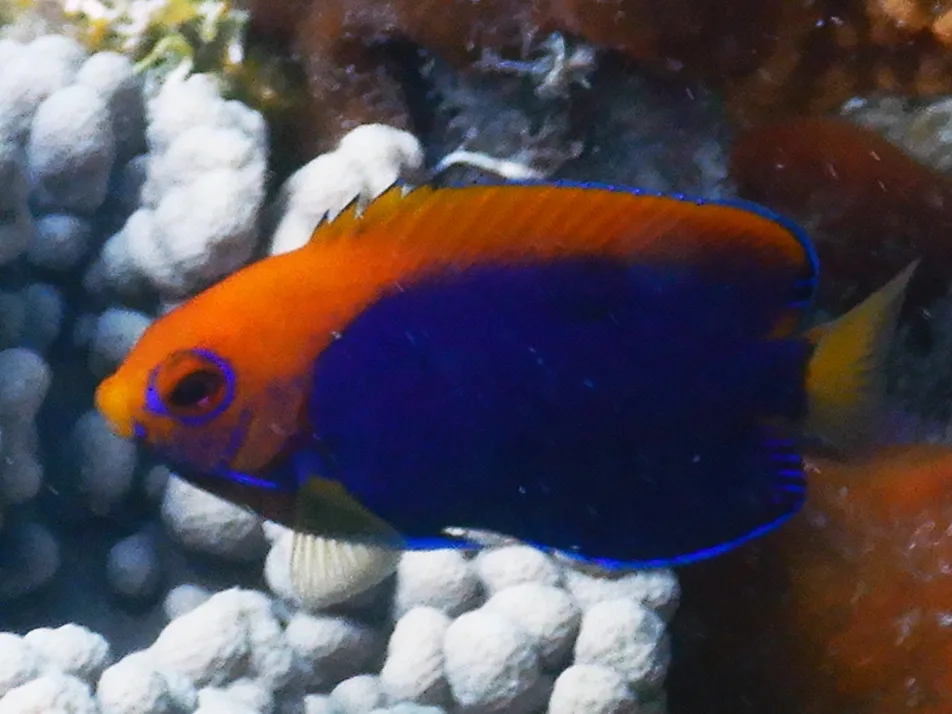
The African flameback angel is a tiny fish, about as long as your finger. Its body is deep blue to purple. A bright orange and yellow stripe runs along its back like a flame, and its tail is yellow. It lives on reefs off the east coast of Africa and on nearby islands. It hides in piles of broken coral and nibbles algae and tiny animals. These fish live in small groups. In South Africa people call it the jumping bean. Every one starts life as a girl. The boss girl can turn into a boy, and she can even change back if she stops being the boss. In a fish tank it is small and tough. It may nip some corals now and then, so keep an eye on it in a reef tank.
Water & care
A small, hardy dwarf angel that suits a medium-sized tank with plenty of live rock and rubble to hide in and graze. Give it at least 55 gallons, several small meals a day of algae-based and meaty foods, and stable water. Keep one per tank unless you have a large tank and a planned pair or group added together.
| Parameter | Keep it at | Where that sits on the usual reef range |
|---|---|---|
| Temperature | 72–78 °F | |
| Salinity (SG) | 1.020–1.025 | |
| pH | 8.1–8.4 | |
| Alkalinity | 8–12 dKH |
Ranges from LiveAquaria (72-78°F, SG 1.020-1.025, pH 8.1-8.4, 8-12 dKH). Calcium, magnesium, nitrate and phosphate are left null because no species-specific values are published; keep normal reef targets in a reef tank.
Feeding
DietOmnivore
Favorite foods
- Spirulina and marine algae foods
- Algae grazed from live rock
- Angelfish preparations
- Mysis or frozen shrimp
- Other small meaty foods
Feed small amounts several times a day, mostly algae-based foods plus some meaty foods. Live rock with algae to graze between meals helps keep it healthy and less likely to pick at corals.
Tank & maintenance
- Minimum tank
- 55 gallons
- Aquascape
- Plenty of live rock and rubble with many hiding places, plus grazing surfaces covered in film algae.
- Lighting
- No special need; light that grows some algae on the rock helps.
- Water flow
- Moderate, varied flow, as on a normal reef.
Routine upkeep
Routine water changes and stable water. Leave some algae on the rock for grazing, feed several small meals a day, and check corals for signs of nipping.
Temperament & tankmates
TemperamentSemi-aggressive
Rated semi-aggressive by LiveAquaria. Like other dwarf angels it defends its patch of rock, mainly against other small angels and similar fish. Keep one per tank, or add a group at the same time in a large tank, and be careful with close relatives such as the cherubfish and Fisher's angel.
Reef safeWith caution
LiveAquaria says that on occasion it may nip SPS and some polyp corals. Reef Builders describes the Xiphipops angels as among the most reef-safe angelfish because they are largely herbivorous. Most fish behave well, but watch zoanthids, polyp corals and clams, and keep it well fed.
Good tankmates
- Clownfish, gobies, blennies and cardinalfish
- Wrasses and anthias
- Tangs in a large enough tank
- Most corals and invertebrates, with some caution
Avoid
- Other dwarf angels, especially other Xiphipops (cherubfish, Fisher's angel)
- A second flameback unless added together in a large tank
- Large predators that could swallow it
- Prized zoanthids and polyp corals if you cannot accept occasional nipping
Help it thrive
- Give it lots of live rock and rubble with hiding places and algae to graze.
- Feed small meals of algae-based and meaty foods several times a day.
- Keep only one dwarf angel of this group per tank unless the tank is large.
- Choose captive-bred fish when you can find them.
- Move it with a cup or container; angelfish cheek spines snag in nets.
Common ailments
Marine ich (white spot, Cryptocaryon irritans)
- Signs
- Small white spots on the body and fins, scratching, fast breathing, hiding and loss of appetite.
- Prevention
- Quarantine new fish and keep water stable.
- Treatment
- Treat in a hospital tank, never in a reef display, with chloroquine phosphate, copper or the tank-transfer method, following the product's directions. Leave the display without fish for several weeks.
Marine velvet (Amyloodinium ocellatum)
- Signs
- A fine dusty coating on the skin, very fast breathing, hanging near the surface and quick decline.
- Prevention
- Strict quarantine and separate equipment for each tank.
- Treatment
- A temperature- and pH-matched freshwater dip for quick relief, then treatment in a hospital tank, following the product's directions.
This is general hobby guidance, not veterinary advice. Quarantine new arrivals and treat in a separate tank whenever you can.
Risks of owning one
- May occasionally nip SPS and some polyp corals.
- Fights other small angels, especially look-alikes.
- Small enough to be eaten by large predators.
- Wild-caught fish may be stressed after shipping.
Breeding
DifficultyHard Captive-bredWidely available
Pelagic spawner. At dusk the male nudges the female's belly to prompt her to release eggs, which he fertilizes; the eggs drift with the current. Frank Baensch's Reef Culture Technologies announced the first captive-bred fish in 2012, Sustainable Aquatics raised a batch on the mainland in 2018 by culturing its own phytoplankton and zooplankton, and ORA began offering captive-bred fish in 2020. Raising the larvae needs cultured live foods and is beyond most hobbyists.
- Start with a pair or a small group, ideally captive-bred juveniles added together, so the dominant fish becomes the male.
- Condition them with several feedings a day of algae and meaty foods.
- Watch at dusk for the male nudging the female and the pair rising to spawn.
- Collect the floating eggs from the overflow and move them to a larval tank.
- Feed the larvae cultured live zooplankton, raised on cultured phytoplankton, until they settle; expect few survivors.
Deep dive The science, history and family tree
The science
Centropyge acanthops is one of the smallest pygmy angelfishes (family Pomacanthidae), reaching about 8 cm TL. The head, upper flanks, dorsal fin and tail are golden yellow to orange, and the lower two-thirds of the body and the anal fin are deep blue to black with many close-set purple spots; the eye is ringed with blue. The name acanthops ('spine eye') refers to a backward-pointing spine below the eye. It is native to the western Indian Ocean, from Somalia to East London in South Africa and around Madagascar, the Seychelles, Comoros, Mascarenes and Chagos, with records from the Gulf of Aden, Oman, the Maldives and the Cocos (Keeling) Islands. It lives near coral, usually hiding in coral rubble in areas with dense algae, at about 1-70 m (FishBase gives 6-40 m), often in groups of up to about 10 fish. It eats algae and small invertebrates. The species is a protogynous hermaphrodite in which the dominant female becomes male and can change back if she loses dominance. Spawning happens at dusk: the male nudges or bites the female's abdomen to prompt egg release, and the eggs drift with the current without parental care. It is placed in the subgenus Xiphipops.
- Appearance
- Deep blue to purple-black body with a broad orange-to-yellow band running from the head along the back to the top of the dorsal fin, a yellow, somewhat see-through tail and a blue ring around the eye. LiveAquaria notes that the yellow, see-through tail tells it apart from its look-alike, the Brazilian flameback or fireball angel (C. aurantonotus) of the Atlantic.
- Native range
- Western Indian Ocean: East Africa from Somalia to East London (Eastern Cape, South Africa), Madagascar, the Seychelles, Comoros, Chagos and Mascarene islands; also recorded from the Gulf of Aden, Socotra and the Arabian Sea off Yemen and Oman, the Maldives and the Cocos (Keeling) Islands. Type locality: Durban, South Africa.
- Habitat
- Reefs with coral rubble and dense algae, where it hides among the rubble, from about 1-70 m (FishBase: 6-40 m). Usually in small groups of up to about 10 fish.
- Size
- 3.1 in (8 cm). FishBase and Wikipedia give 8 cm (3.1 in) total length as the maximum; LiveAquaria lists 3 in. Reef Builders notes the Xiphipops angels are among the smallest Centropyge.
- Lifespan
- Not documented in the sources we checked; no published longevity study or reliable captive lifespan figure was found.
- Conservation
- Least Concern. IUCN Least Concern (assessed 2009, per FishBase). FishBase notes it is a popular aquarium fish in Natal (South Africa) and occasionally exported from Kenya. Captive-bred fish have been produced by Reef Culture Technologies (2012), Sustainable Aquatics (2018) and ORA (2020), but many fish in the trade are still wild-caught
In the aquarium vs in the wild
In your aquarium
A small, colorful dwarf angel for medium-sized reef and fish-only tanks that also grazes film algae.
On the reef
A small grazer of algae and tiny invertebrates living in groups in coral rubble on western Indian Ocean reefs.
History
J. R. Norman described the species in 1922 as Holacanthus acanthops, from Durban, South Africa. It was later placed in Centropyge, and some classifications put it in the subgenus Xiphipops, which is why the name Xiphipops acanthops is also seen. In South Africa it is known as the jumping bean. It has long been popular with aquarists, and it became a captive-breeding success: Reef Culture Technologies in 2012, Sustainable Aquatics in 2018 and ORA in 2020.
Evolution & relatives
The African flameback belongs to Xiphipops, a small group of pygmy angels that Reef Builders lists as C. fisheri, C. resplendens, C. argi, C. aurantonotus, C. flavicauda and C. acanthops. A DNA study by Gaither et al. (2014) found that Xiphipops forms its own lineage and should be raised to a full genus, and that Centropyge as now defined is paraphyletic, because the swallowtail angels (Genicanthus) and Apolemichthys nest inside it. Using an age of 38 million years for the angelfish family, the authors dated the split between Centropyge and the regal angelfish genus Pygoplites to about 33 million years ago. The flameback's closest look-alike, the Brazilian flameback of the Atlantic, is in the same group.
Family tree, from kingdom down
- Kingdom Animalia Animals Animals are living things made of many cells that must eat food to live. Fish, corals, crabs, snails and sea stars are all animals.
- Phylum Chordata Chordates Chordates have a stiff rod running down their back at some point in their lives. In fish and people, this rod is replaced by a backbone.
- Subphylum Vertebrata Vertebrates Vertebrates are animals with a backbone and a skull. Fish, frogs, birds and people are all vertebrates.
- Infraphylum Gnathostomata jawed vertebrates
- Parvphylum Osteichthyes bony fishes
- Gigaclass Actinopterygii ray-finned fishes
- Superclass Actinopteri
- Class Teleostei Teleost fishes Teleosts are bony fishes with thin, bendy fin rays and jaws that can push forward. Almost all of the fish in the world are teleosts.
- Order Acanthuriformes Surgeonfishes, angelfishes and kin This order of fishes includes surgeonfishes, marine angelfishes and rabbitfishes. Many have deep, flat bodies and graze on reefs.
- Family Pomacanthidae Marine angelfishes Marine angelfishes are colorful reef fish with a strong spine on each cheek. Many change their colors as they grow up.
- Genus Centropyge Pygmy angelfishes Pygmy angelfishes are small, colorful angelfish that stay close to the reef. They graze on algae and tiny animals.
- Species Centropyge acanthops
See it on the Tree of Life Compare with another species
Closest relatives
- Centropyge aurantonotus Brazilian Flameback (Fireball Angelfish) Same subgenus (Xiphipops); Atlantic look-alike
- Centropyge argi Cherubfish Same subgenus (Xiphipops)
- Centropyge fisheri Fisher's Angelfish Same subgenus (Xiphipops)
- Centropyge loriculus Flame Angelfish Same genus, different lineage Read guide · Compare
Older scientific names: Holacanthus acanthops, Xiphipops acanthops.
Fun facts
- In South Africa it is nicknamed the jumping bean.
- The dominant female turns into a male, and can switch back if she loses her rank.
- Its name acanthops means 'spine eye', for the backward-pointing spine under its eye.
- At spawning time the male nudges the female's belly to get her to release eggs.
- It is one of the smallest angelfish, at about 8 cm long.
Learn more
- FishBase: Centropyge acanthops, Orangeback angelfish fishbase.se
- Wikipedia: Centropyge acanthops en.wikipedia.org
- Reef Builders: African flameback angelfish captive bred by Reef Culture Technologies (2012) reefbuilders.com
Sources
- WoRMS: Centropyge acanthops (Norman, 1922) marinespecies.org
- FishBase species summary: Centropyge acanthops fishbase.se
- Wikipedia: Centropyge acanthops en.wikipedia.org
- LiveAquaria: Flameback Angelfish liveaquaria.com
- Reef Builders: African flameback angelfish captive bred by Reef Culture Technologies (2012) reefbuilders.com
- Reef Builders: African flameback angelfish successfully bred by Sustainable Aquatics (2018) reefbuilders.com
- Reef Builders: articles tagged Centropyge acanthops (incl. ORA, 2020) reefbuilders.com
- Europe PMC record: Gaither et al. 2014, Evolution of pygmy angelfishes (Mol. Phylogenet. Evol. 74:38-47) ebi.ac.uk
Scientific names and classification follow the World Register of Marine Species (AphiaID 211775). Checked by our team. Last updated October 29, 2026.
Shop this species
Search the shop →