Fish · Angelfish
Flame Angelfish
Centropyge loriculus
Also called Flame Angel, Flaming Angelfish, Japanese Pygmy Angelfish
- CareModerate
- Reef safeWith caution
- TemperamentSemi-aggressiveBullies other dwarf angels and look-alikes; may nip corals
- Favorite foods
- Marine algae / spirulina
- Mysis shrimp
- Angelfish prep (sponge-based)
- Max size5 in (12.7 cm)
- Min tank75 gal
- LifespanAbout 5-7 years in aquariums, sometimes…
- IUCN statusLeast Concern
Quick answers
- How big does the Flame Angelfish get?
- Up to 5 in (12.7 cm).
- What size tank does it need?
- At least 75 gallons.
- How hard is it to keep?
- Care level: Moderate.
- Is it reef safe?
- With caution. Many flame angels live with corals without causing trouble, but any individual may start nipping large-polyp stony corals, zoanthids, soft coral polyps, other sessile invertebrates and tridacnid clam mantles.
- What does it eat?
- Marine algae / spirulina
- Mysis shrimp
- Angelfish prep (sponge-based)
- How long does it live?
- About 5-7 years in aquariums, sometimes longer (hobby sources; no formal longevity study found).
- What are good tankmates?
- Tangs with contrasting colors (a yellow tang is a better match than a yellow lemonpeel angel)
- Clownfish
- Anthias
- Larger, robust wrasses
- Large angelfish (Biota notes it is compatible with them)
The 30-second version
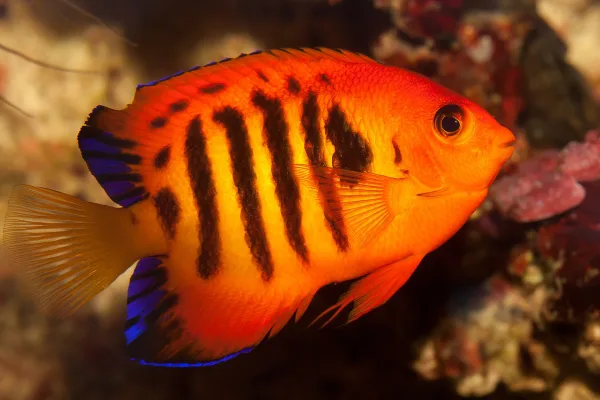
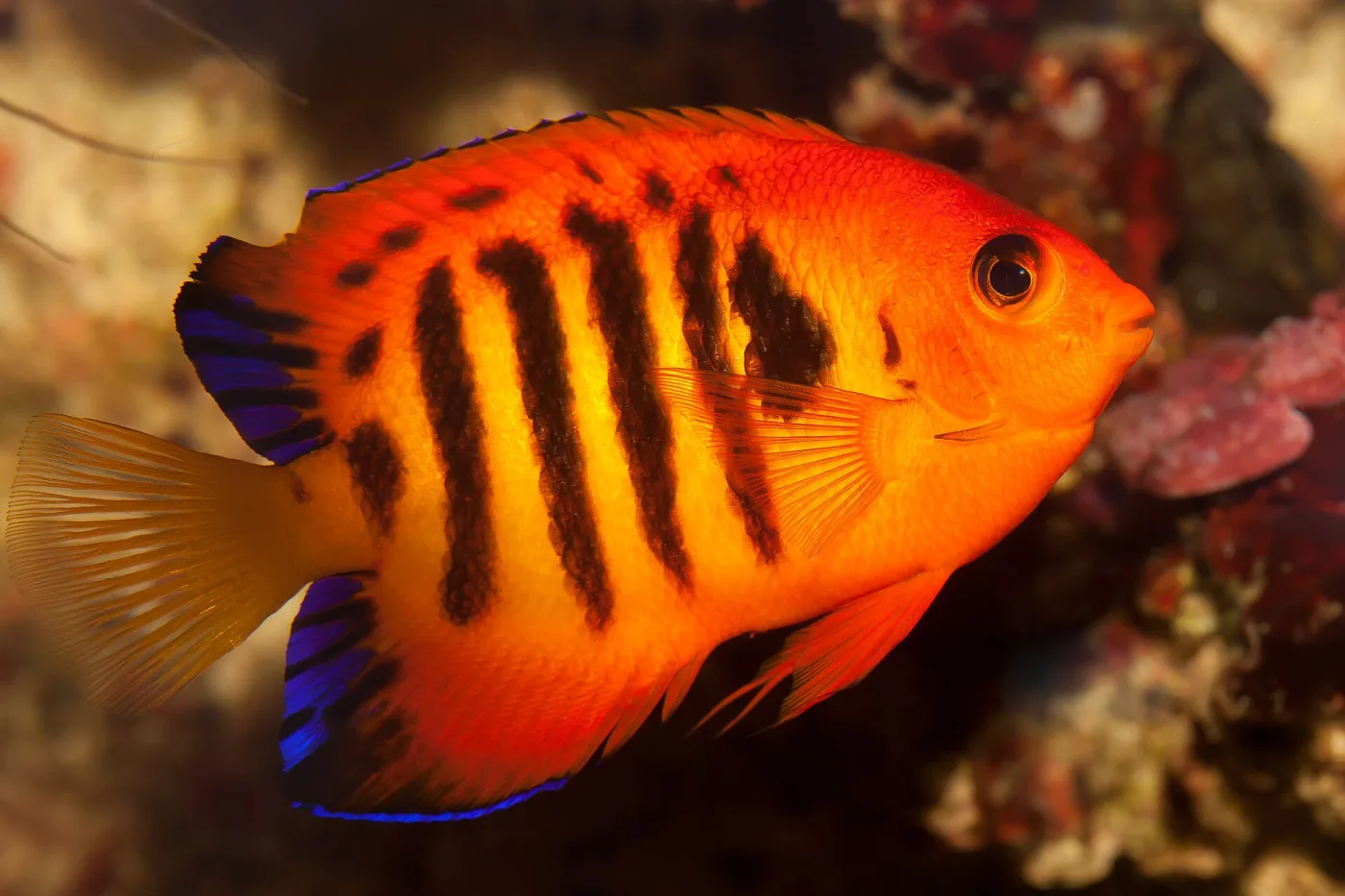
The flame angel is a small fish that looks like it is on fire. Its body is bright red and orange. It has thin black stripes on its sides and blue and black lines on the back of its fins. It lives on coral reefs in the Pacific Ocean. It zips in and out of holes in the rocks to stay safe. All day it nibbles tiny plants called algae off the rocks, like a cow eating grass. Flame angels live in small groups with one boy and a few girls. Here is a surprise: every flame angel starts life as a girl, and the boss girl can turn into a boy. In a fish tank it needs lots of rocks to hide in and a few small meals each day. A hungry flame angel may nibble corals or clams, so keep it well fed.
Water & care
Hardy once it is settled on an algae-based diet, but it needs a mature, well-established tank with lots of live rock to graze and hide in, stable water quality and several small feedings a day. New fish are often shy for the first week. Dwarf angels, and flame angels in particular, are sensitive to copper: LiveAquaria advises never exposing them to levels near or above 0.15 ppm, so plan quarantine and disease treatment carefully. Buy a fish that is already eating in the store, and add it as one of the last fish in a community.
| Parameter | Keep it at | Where that sits on the usual reef range |
|---|---|---|
| Temperature | 72–78 °F | |
| Salinity (SG) | 1.020–1.025 | |
| pH | 8.1–8.4 | |
| Alkalinity | 8–12 dKH |
Ranges from LiveAquaria and Biota (both 72-78°F, SG 1.020-1.025, pH 8.1-8.4; LiveAquaria gives 8-12 dKH). TFH suggests 75-82°F, SG 1.025, pH 8.3. In a reef tank, simply keep the normal reef targets for the corals; the fish has no special calcium, magnesium or phosphate needs. Keep nitrate low with regular water changes; no species-specific nitrate limit is published. Avoid copper in the display; if copper is used in a hospital tank, follow the product's directions, stay at the low end of its range and test daily.
Feeding
DietOmnivore
Favorite foods
- Film and filamentous algae grazed from live rock
- Frozen angelfish formulas (with sponge)
- Mysis shrimp
- Spirulina and algae-based flakes and pellets
- Dried seaweed (nori)
- Chopped clam and frozen plankton
Feed small amounts several times a day (juveniles up to four times), mostly algae-based foods plus some meaty foods such as mysis, frozen plankton and chopped clam. A mature tank with algae to graze between meals is a big part of keeping it healthy. Underfed flame angels are the ones most likely to pick at corals and clams.
Tank & maintenance
- Minimum tank
- 75 gallons
- Aquascape
- Mature live-rock aquascape with plenty of caves, overhangs and crevices to retreat into, and lots of rock surface with film algae to graze. Leave some open swimming lanes in front of the rockwork.
- Lighting
- No special requirement; normal reef or fish-only lighting. Light that grows some algae on the rock is helpful for grazing.
- Water flow
- Moderate to fairly strong, varied flow. It spends most of its time near the rockwork in the middle and lower parts of the tank.
Routine upkeep
Regular partial water changes (for example 15% every two weeks or 30% monthly) to keep nitrate low and water stable. Keep algae growing on some rock surfaces rather than scrubbing everything spotless, because the fish grazes it all day. Feed several times a day, or use an auto-feeder for one of the meals. Watch corals and clams for signs of nipping, and quarantine every new fish before it joins the tank.
Temperament & tankmates
TemperamentSemi-aggressive
Territorial toward its own species, other dwarf angels and fish of similar size, shape, color or niche. Males fight each other, sometimes to the death. Reef Builders describes a flame angel that bullied a larger bannerfish until it had to be removed. Keep one per tank unless the tank is very large: a pair or a one-male harem can work in big systems, and Biota notes captive-bred fish from the same batch can be kept as pairs if added together. Add it after the more peaceful fish have settled.
Reef safeWith caution
Many flame angels live with corals without causing trouble, but any individual may start nipping large-polyp stony corals, zoanthids, soft coral polyps, other sessile invertebrates and tridacnid clam mantles. Constant picking can keep fleshy corals from opening. Underfed fish are the most likely to nip, so frequent feeding and plenty of grazing surface reduce the risk. Tanks heavy in LPS, zoanthids and clams are the riskiest; be prepared to rehome the fish if it starts.
Good tankmates
- Tangs with contrasting colors (a yellow tang is a better match than a yellow lemonpeel angel)
- Clownfish
- Anthias
- Larger, robust wrasses
- Large angelfish (Biota notes it is compatible with them)
- Assertive, visually different community fish
Avoid
- Other dwarf angelfish, unless the tank is 5 ft or longer and the species look very different
- A second flame angel (two males will fight)
- Small, timid fish added after it
- Predators large enough to swallow it, such as groupers, lionfish and large eels
- Tridacnid clams, zoanthids and prized fleshy LPS if you cannot accept occasional nipping
Help it thrive
- Add it to a mature tank with lots of algae-covered live rock rather than a new, sterile system.
- Feed small meals several times a day, mostly algae-based foods with some meaty foods; well-fed angels nip less.
- Make it one of the last fish added, and avoid other dwarf angels or similar-looking fish.
- Choose captive-bred fish when you can; they are already used to aquarium foods.
- Quarantine and treat for flukes before it goes into the display, and avoid copper or use it only at low, tested levels.
- Move it with a cup or container instead of a net, because the gill-cover spines snag.
Common ailments
Marine ich (Cryptocaryon irritans)
- Signs
- White, salt-like spots on the body, fins or gills, scratching against rocks (flashing), rapid breathing, cloudy eyes, hiding and loss of appetite.
- Prevention
- Quarantine every new fish in a separate tank for several weeks before adding it to the display, keep water stable and feed well to reduce stress.
- Treatment
- Treat in a hospital tank, never in the reef display. Copper works, but flame angels are unusually copper-sensitive, so many keepers use chloroquine phosphate or the tank-transfer method; if copper is used, follow the product's directions, stay at the low end of its range and test daily. Leave the display without fish for about 11 weeks, because the parasite's cyst stage can last up to 72 days.
Marine velvet (Amyloodinium ocellatum)
- Signs
- A fine dusty or gold-gray sheen on the skin, very fast breathing, gasping near the surface, scratching and lethargy. Heavily infected fish can die within 12 to 48 hours.
- Prevention
- Strict quarantine of all new fish, and do not share nets, buckets or water between tanks without disinfecting them.
- Treatment
- Act immediately. A freshwater dip matched for temperature and pH gives short-term relief, followed by treatment in a hospital tank with chloroquine phosphate or carefully monitored copper. Leave the display fallow with no fish.
Gill and skin flukes (monogeneans)
- Signs
- Rapid breathing, scratching, cloudy eyes, clamped fins, hiding and poor appetite despite clean water.
- Prevention
- Reef Builders recommends treating all dwarf angels for flukes before they go into a reef tank.
- Treatment
- Praziquantel in quarantine, repeated as the product directs so that flukes hatching from eggs are also killed.
This is general hobby guidance, not veterinary advice. Quarantine new arrivals and treat in a separate tank whenever you can.
Risks of owning one
- May nip LPS corals, zoanthids, soft corals and clam mantles at any point, even after months of good behavior.
- Territorial: can bully other dwarf angels and similar fish, and two males can fight to the death.
- Very sensitive to copper, which makes treating disease harder.
- Wild-caught fish are expensive and may arrive stressed; some never adapt if added to a new, algae-free tank.
- Gill-cover spines snag in nets and can injure the fish during capture.
Breeding
DifficultyHard Captive-bredWidely available
Protogynous broadcast spawner. Pairs or harems spawn near dusk, rising into the water to release floating eggs. Spawning in aquariums is fairly common, but rearing the tiny larvae is very difficult. The Oceanic Institute in Hawaii first raised flame angels in 2002; captive-bred fish were first sold on a commercial scale in 2011 and are now produced by Biota in Hawaii and have been raised by ORA in Florida.
- Form a pair: buy one large and one small fish, or two to four juveniles (ideally captive-bred from the same batch) so the dominant fish becomes the male, and add them together to a large, mature tank.
- Condition the fish with several varied feedings a day of algae-based and meaty foods.
- Keep a steady light schedule with a dusk period; spawning usually happens as the light fades, up in the water column, so leave open space above the rockwork.
- Collect the floating eggs with an egg collector on the overflow and move them to a separate, dimly lit larval tank; eggs hatch in about a day.
- Feed the larvae only the smallest live foods, such as cultured copepod nauplii, and wean the young fish to prepared foods after they settle. Expect few survivors; this stage defeats most hobbyists.
Deep dive The science, history and family tree
The science
Centropyge loriculus is a pygmy angelfish (family Pomacanthidae) of the tropical Pacific. The body is deep and laterally compressed, bright orange-red to deep red depending on locality, with an elongate black blotch behind the pectoral-fin base and usually four or five narrow black bars on the flanks. The rear portions of the dorsal and anal fins carry alternating purplish-blue and black streaks, which are more pronounced in males. As in all angelfishes, a strong rear-facing spine sits at the corner of each gill cover. Populations differ in color: Marquesan fish lack the black bars, and aquarium importers distinguish redder, thick-barred Marshall Islands fish from thinner-barred Christmas Island fish and deep red Tahitian fish. The largest recorded wild specimens reach about 15 cm total length, although aquarium fish rarely exceed 10 cm. The species is most common around the Marshall, Line and Cook Islands, reaches the northern Great Barrier Reef and Coral Sea, and is uncommon in Hawaii. It occupies clear lagoons and seaward reef slopes from below the surge zone to about 60 m, keeping close to shelter in coral and rubble. Adults form harems of three to seven fish dominated by a single male. Like other pomacanthids it is a protogynous hermaphrodite, so a dominant female can change sex if the male disappears. The diet is mainly filamentous algae, supplemented by small crustaceans and other benthic invertebrates. Spawning is pelagic, with eggs and sperm released near dusk. Molecular studies show that the genus Centropyge, as currently defined, is paraphyletic.
- Appearance
- Bright orange-red to blood-red body with an elongate black blotch behind the pectoral fin and usually four or five thin black vertical bars; the rear of the dorsal and anal fins is striped purplish-blue and black. Color varies with origin: Marshall Islands fish are redder with thicker bars, Christmas Island fish are red-orange with thinner bars, Cebu fish have less defined bars with a yellow tint between them, Tahitian fish are blood red with little or no yellow, and Marquesan fish can lack the bars entirely (sometimes showing only a spot behind the gill cover). Males are generally larger and have more blue on the outer edges of the dorsal and anal fins, but the sexes are hard to tell apart. Like all angelfish it has a sharp spine on each gill cover, which easily snags in nets.
- Native range
- Tropical central and western Pacific, roughly 28°N to 25°S: most common around the Marshall, Line (including Christmas Island/Kiritimati) and Cook Islands, also French Polynesia (type locality: Society Islands), the northern Great Barrier Reef and Coral Sea reefs; uncommon in the Hawaiian Islands.
- Habitat
- Clear lagoons and seaward reef slopes from the lower surge zone down to about 60 m (Fishes of Australia gives 15-60 m). Secretive and always close to shelter among coral heads, rubble and crevices. Lives in harems of 3 to 7 fish led by one male.
- Size
- 5 in (12.7 cm). 15 cm (6 in) total length is the maximum recorded (FishBase, Fishes of Australia, TFH). Aquarium specimens usually top out around 4 in (10 cm). Males are generally larger than females.
- Lifespan
- About 5-7 years in aquariums, sometimes longer (hobby sources; no formal longevity study found).
- Conservation
- Least Concern. Assessed Least Concern by the IUCN (2009). Not listed by CITES. Most trade fish are wild-collected in the central Pacific (Marshall Islands and Christmas Island, less often Cebu and Tahiti). Captive-bred fish are produced in Hawaii (Biota, with the Oceanic Institute) and have been raised by ORA in Florida; they cost more but are a good choice when available
In the aquarium vs in the wild
In your aquarium
A colorful centerpiece for medium-sized fish-only or reef tanks and one of the most popular dwarf angelfish; it also grazes film algae from the rockwork.
On the reef
A grazer on Pacific reef slopes that crops filamentous algae and picks small crustaceans and other invertebrates from coral rubble, living in small harems.
History
Albert Günther described the species in 1874 as Holacanthus loriculus in 'Andrew Garrett's Fische der Südsee', with a type locality in the Society Islands (French Polynesia). It was later moved to the pygmy angel genus Centropyge (Kaup, 1860), and Centropyge flammeus Woods & Schultz, 1953 is a later synonym. The aquarium trade and some references (including TFH) spell the name Centropyge loricula, but WoRMS and FishBase keep Günther's original spelling, loriculus. The flame angel has long been one of the most sought-after dwarf angels in the hobby. The Oceanic Institute in Hawaii raised the first captive-bred flame angels in 2002. Captive-bred fish reached the market on a commercial scale in 2011 (shown at the Backer show in Chicago and supplied through Aquanautics). The late Syd Kraul later produced small batches in Hawaii, ORA showed its first captive-bred flame angel in 2020, and Biota now raises them in Hawaii with the Oceanic Institute.
Evolution & relatives
Flame angels belong to the marine angelfishes (Pomacanthidae). DNA studies (Bellwood et al. 2004) show angelfishes are a distinct lineage whose closest relatives are the butterflyfishes and scats, and WoRMS now places all of these, together with the surgeonfishes (tangs), in the order Acanthuriformes. On the site's tree, then, angelfish sit on a branch near tangs and butterflyfish, and far from wrasses, gobies and clownfish. Gaither et al. (2014) used an estimated age of 38 million years for the family. They found that Centropyge split from its closest living genus outside the group, the regal angelfish genus Pygoplites, about 33 million years ago, that three deep lineages of pygmy angels separated 18-28 million years ago, and that several young species complexes formed only 3-12 million years ago. The same study showed that Centropyge as currently defined is paraphyletic, because the larger swallowtail angels (Genicanthus) and Apolemichthys sit inside it. In most complexes the species differ only in color, not in genes or body shape. Bellwood and colleagues found that most of the family's ecological and species diversity arose in this pygmy angel clade, beginning around the Oligocene-Miocene boundary.
Family tree, from kingdom down
- Kingdom Animalia Animals Animals are living things made of many cells that must eat food to live. Fish, corals, crabs, snails and sea stars are all animals.
- Phylum Chordata Chordates Chordates have a stiff rod running down their back at some point in their lives. In fish and people, this rod is replaced by a backbone.
- Subphylum Vertebrata Vertebrates Vertebrates are animals with a backbone and a skull. Fish, frogs, birds and people are all vertebrates.
- Infraphylum Gnathostomata jawed vertebrates
- Parvphylum Osteichthyes bony fishes
- Gigaclass Actinopterygii ray-finned fishes
- Superclass Actinopteri
- Class Teleostei Teleost fishes Teleosts are bony fishes with thin, bendy fin rays and jaws that can push forward. Almost all of the fish in the world are teleosts.
- Order Acanthuriformes Surgeonfishes, angelfishes and kin This order of fishes includes surgeonfishes, marine angelfishes and rabbitfishes. Many have deep, flat bodies and graze on reefs.
- Family Pomacanthidae Marine angelfishes Marine angelfishes are colorful reef fish with a strong spine on each cheek. Many change their colors as they grow up.
- Genus Centropyge Pygmy angelfishes Pygmy angelfishes are small, colorful angelfish that stay close to the reef. They graze on algae and tiny animals.
- Species Centropyge loriculus
See it on the Tree of Life Compare with another species
Closest relatives
- Centropyge bispinosa Coral Beauty Angelfish Same genus; another popular dwarf angel Read guide · Compare
- Centropyge potteri Potter's Angelfish Same genus; Hawaiian dwarf angel that shares part of the flame angel's central Pacific range
- Centropyge ferrugata Rusty Angelfish Same genus
- Centropyge flavissima Lemonpeel Angelfish Same genus; a member of a color-defined species complex
- Centropyge acanthops African Flameback Angelfish Same genus, subgenus Xiphypops, which Gaither et al. (2014) suggest should become a separate genus Read guide · Compare
- Pygoplites diacanthus Regal Angelfish Closest living genus outside the pygmy-angel clade; split about 33 million years ago
- Genicanthus Swallowtail angelfishes Genus that nests inside Centropyge in DNA trees
Older scientific names: Centropyge loricula, Holacanthus loriculus, Centropyge flammeus.
Fun facts
- Every flame angel starts life as a female; the dominant fish in a group can change into a male.
- Flame angels from the Marquesas Islands can lack the black bars that other populations have.
- Angelfish get their family name, Pomacanthidae, from Greek words for 'cover' and 'thorn', after the sharp spine on each gill cover.
- The species name loriculus may come from the Latin loricula, a little breastplate, possibly a reference to the black bars; Australian experts say the origin is unclear.
- In the WoRMS classification, angelfish share an order (Acanthuriformes) with tangs and butterflyfish, so they are closer relatives of tangs than of wrasses or clownfish.
Learn more
- FishBase: Centropyge loriculus, Flame angel fishbase.se
- WoRMS: Centropyge loriculus (Günther, 1874) marinespecies.org
- Fishes of Australia: Flame Angelfish fishesofaustralia.net.au
- Reef Builders: Flame Angelfish overview reefbuilders.com
- Reef Builders: FAQs on dwarf angelfish reefbuilders.com
Sources
- FishBase species summary: Centropyge loriculus fishbase.se
- WoRMS taxon record 402161 marinespecies.org
- Fishes of Australia: Centropyge loriculus fishesofaustralia.net.au
- Wikipedia: Flame angelfish en.wikipedia.org
- Wikipedia: Centropyge en.wikipedia.org
- Wikipedia: Pomacanthidae en.wikipedia.org
- LiveAquaria: Flame Angelfish liveaquaria.com
- TFH Magazine: Centropyge loricula tfhmagazine.com
- Reef Builders: Flame Angelfish overview (2013) reefbuilders.com
- Reef Builders: FAQs on dwarf angelfish (2023) reefbuilders.com
- Reef Builders: Captive-bred flame angelfish at Backer (2011) reefbuilders.com
- CORAL Magazine: ORA captive-bred flame angelfish (2020) coralmagazine.com
- Biota: captive-bred Flame Angelfish shop.thebiotagroup.com
- Aquariadise: Flame Angelfish care aquariadise.com
- Gaither et al. 2014, Evolution of pygmy angelfishes (PubMed) pubmed.ncbi.nlm.nih.gov
- Bellwood et al. 2004, Evolution and biogeography of marine angelfishes researchonline.jcu.edu.au
- Wikipedia: Cryptocaryon irritans en.wikipedia.org
- Wikipedia: Amyloodinium ocellatum en.wikipedia.org
Care facts
The care facts on this guide and its product pages (care level, reef safety, temperament, size, tank, diet, flow, purpose, foods, acclimation and origin) combine 14 independent sources, checked October 25, 2026.
- Flame Angelfish - LiveAquaria LiveAquaria
- Flame Angelfish (Centropyge loriculus) overview Reef Builders
- Flame Angelfish - Aquariadise Aquariadise
- Flame Angelfish Care Guide Saltwater Aquarium Blog (Albert B Ulrich III)
- Centropyge loriculus, Flame angel - FishBase FishBase
- Flame Angelfish - Quality Marine Quality Marine
- Flame Angelfish - Biota Biota
- Centropyge loriculus - FishProfiles.com FishProfiles.com
- 252 Centropyge loriculus - Reeflex Reeflex
- Flame Angelfish Tidal Arc
- Flame Angelfish Aquatic Community
- Flame Angelfish Care Guide Furry Critter Network
- Flame Angelfish Fishkeeper
- Flame Angelfish complete care guide Biomes in a Box
Scientific names and classification follow the World Register of Marine Species (AphiaID 402161). Last updated October 25, 2026.
Shop this species
Search the shop →