Fish · Goby
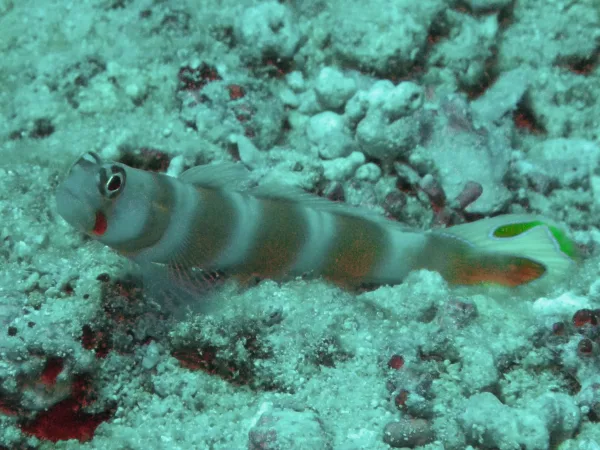
Aurora Goby
Amblyeleotris aurora
Also called Pinkbar Goby, Pink-bar Shrimp Goby, Sunburst Goby, Sunburst / Aurora Goby, Beautiful Prawn Goby
Reviewed by admin on October 29, 2026 · Meet the team
- CareModerate
- Reef safeYes
- TemperamentPeacefulPeaceful; may fight other shrimp gobies
- Favorite foods
- Mysis shrimp
- Frozen bloodworms
- Enriched brine shrimp
- Max size4.3 in (11 cm)
- Min tank10 gal
- LifespanNot documented
- IUCN statusLeast Concern
Quick answers
- How big does the Aurora Goby get?
- Up to 4.3 in (11 cm).
- What size tank does it need?
- At least 10 gallons.
- How hard is it to keep?
- Care level: Moderate.
- Is it reef safe?
- Yes. Leaves corals, clams and other invertebrates alone (Reef Exclusive).
- What does it eat?
- Mysis shrimp
- Frozen bloodworms
- Enriched brine shrimp
- How long does it live?
- Not documented; no published lifespan for aquarium or wild fish was found.
- What are good tankmates?
- Alpheus pistol shrimp, especially Randall's pistol shrimp (A. randalli)
- Fairy wrasses
- Smaller Halichoeres and Macropharyngodon wrasses
- Cardinalfish
- Blennies
The 30-second version
The aurora goby is a fish with a best friend. Its friend is a pistol shrimp. The shrimp digs a burrow in the sand, and they both live in it. The shrimp can hardly see, so the goby keeps watch at the door. The shrimp keeps one feeler on the goby all the time. If danger comes, the goby darts into the hole, and the shrimp rushes in right after it. The goby is white with wide pink and orange bars. Its tail is yellow with red spots, like the sun coming up. That is why it is named after Aurora, the goddess of the dawn. It lives on sandy reefs in the Indian Ocean. In a tank it is shy and peaceful. It needs deep sand, a shrimp buddy and a lid, because it can jump.
Water & care
Hardy once settled, but shy and particular about its setup. It needs a sand bed at least 2 in deep of mixed-grain sand (about 2-4 mm grains) that a shrimp can tunnel in, rockwork resting on the tank bottom, and ideally an Alpheus shrimp partner. New fish often hide when people come near: feed at least twice a day, with the tank lights on and the room dark if needed, and use a baster to squirt food toward the burrow. Add the goby and shrimp before other fish so they learn to feed without competition, and keep the tank covered.
| Parameter | Keep it at | Where that sits on the usual reef range |
|---|---|---|
| Temperature | 72–78 °F | |
| Salinity (SG) | 1.020–1.025 | |
| pH | 8.1–8.4 | |
| Alkalinity | 8–12 dKH | |
| Nitrate | 0–10 ppm |
Ranges from Quality Marine's product page. Its care article suggests SG 1.025-1.026 for the shrimp's sake, mid-70s °F, pH steady within a tenth or two of 8.2, nitrate under 10 ppm, and stable calcium and alkalinity to help the shrimp molt. No species-specific calcium or magnesium values are published.
Feeding
DietCarnivore
Favorite foods
- Mysis shrimp
- Frozen bloodworms
- Enriched brine shrimp
- Chopped mussel and prawn
- Sinking pellets mixed with frozen food
Feed meaty foods at least twice a day (Quality Marine; Reef Exclusive suggests several feedings a day, especially for new fish). It also forages in the sand around its burrow. Make sure food reaches the bottom near the burrow before faster fish eat it all; pellets are accepted once mixed with meaty foods.
Tank & maintenance
- Minimum tank
- 10 gallons
- Aquascape
- A sand bed at least 2 in deep of mixed-grain sand (about 2-4 mm grains; fine, uniform sand caves in when the shrimp digs), very stable rockwork resting on the glass bottom, and open sand for digging. Loose coral rubble helps. A tight-fitting lid is essential.
- Lighting
- No special requirement.
- Water flow
- Moderate. Quality Marine suggests strong filtration, turning the tank volume over about 10 times an hour, without blasting the sand bed.
Routine upkeep
Regular partial water changes. A deeper sand bed needs regular vacuuming or turning, but work away from the burrow. Check that rockwork stays stable, since the shrimp keeps digging.
Temperament & tankmates
TemperamentPeaceful
Peaceful with other fish, but it can be territorial toward other Amblyeleotris gobies unless kept as a pair, and Reef Exclusive says it may fight its own kind unless they are a mated pair. Larger predators and boisterous fish frighten it, especially at feeding time.
Reef safeYes
Leaves corals, clams and other invertebrates alone (Reef Exclusive). The only reef risk comes from its partner shrimp, which can undermine rocks that sit on the sand, so build rockwork on the tank bottom.
Good tankmates
- Alpheus pistol shrimp, especially Randall's pistol shrimp (A. randalli)
- Fairy wrasses
- Smaller Halichoeres and Macropharyngodon wrasses
- Cardinalfish
- Blennies
- Ocellaris and percula clownfish
Avoid
- Large predators
- Boisterous fish that frighten it or take all the food
- Other Amblyeleotris gobies, unless a mated pair
Help it thrive
- Buy it with an Alpheus shrimp, such as Randall's pistol shrimp, and add them together.
- Use 2 in or more of mixed-grain sand, and set rocks on the glass, not on the sand.
- Add the goby and shrimp before other fish.
- Feed at least twice a day, and target-feed near the burrow if it is shy.
- Keep a tight lid on the tank; startled gobies jump.
Common ailments
Starvation from shyness
- Signs
- A thin, pinched belly, constant hiding and a fish that never comes out at feeding time.
- Prevention
- Add it before other fish, keep tankmates calm, and feed at least twice a day.
- Treatment
- Feed with the tank lights on and the room dark, and squirt mysis or bloodworms gently toward the burrow with a baster. Remove pushy tankmates if needed.
Jumping out of the tank
- Signs
- A missing fish, usually after something startled it.
- Prevention
- Use a tight-fitting lid or mesh cover with no gaps, and avoid sudden scares such as lights switched on in a dark room.
- Treatment
- There is no treatment once it is out of the water for long; prevention is the only reliable answer.
Stress without a burrow
- Signs
- Constant hiding in the rockwork, darting and refusing food in a tank with fine or shallow sand or no shrimp partner.
- Prevention
- Provide at least 2 in of mixed-grain sand and an Alpheus shrimp partner.
- Treatment
- Add a suitable shrimp and deepen the sand bed with coarser grains, and keep the area around the burrow quiet.
This is general hobby guidance, not veterinary advice. Quarantine new arrivals and treat in a separate tank whenever you can.
Risks of owning one
- Jumps when startled; a tight lid is essential.
- Shy; it can go hungry next to fast, pushy feeders.
- Its partner shrimp can undermine rockwork set on sand.
- Can fight other Amblyeleotris gobies unless kept as a pair.
Breeding
DifficultyNot achieved Captive-bredRare or wild-caught
Little is published. Gobies that share burrows with Alpheus randalli probably lay their eggs as a mass inside the burrow (Wikipedia, Alpheus randalli). No captive spawning or rearing of A. aurora was found in the sources checked.
- Buy a pair if possible; Quality Marine recommends buying these gobies paired.
- Give the pair a shrimp partner, a deep sand bed and a calm tank.
- Feed varied meaty foods at least twice a day.
- Watch for eggs in the burrow; no rearing method is known for this species.
Deep dive The science, history and family tree
The science
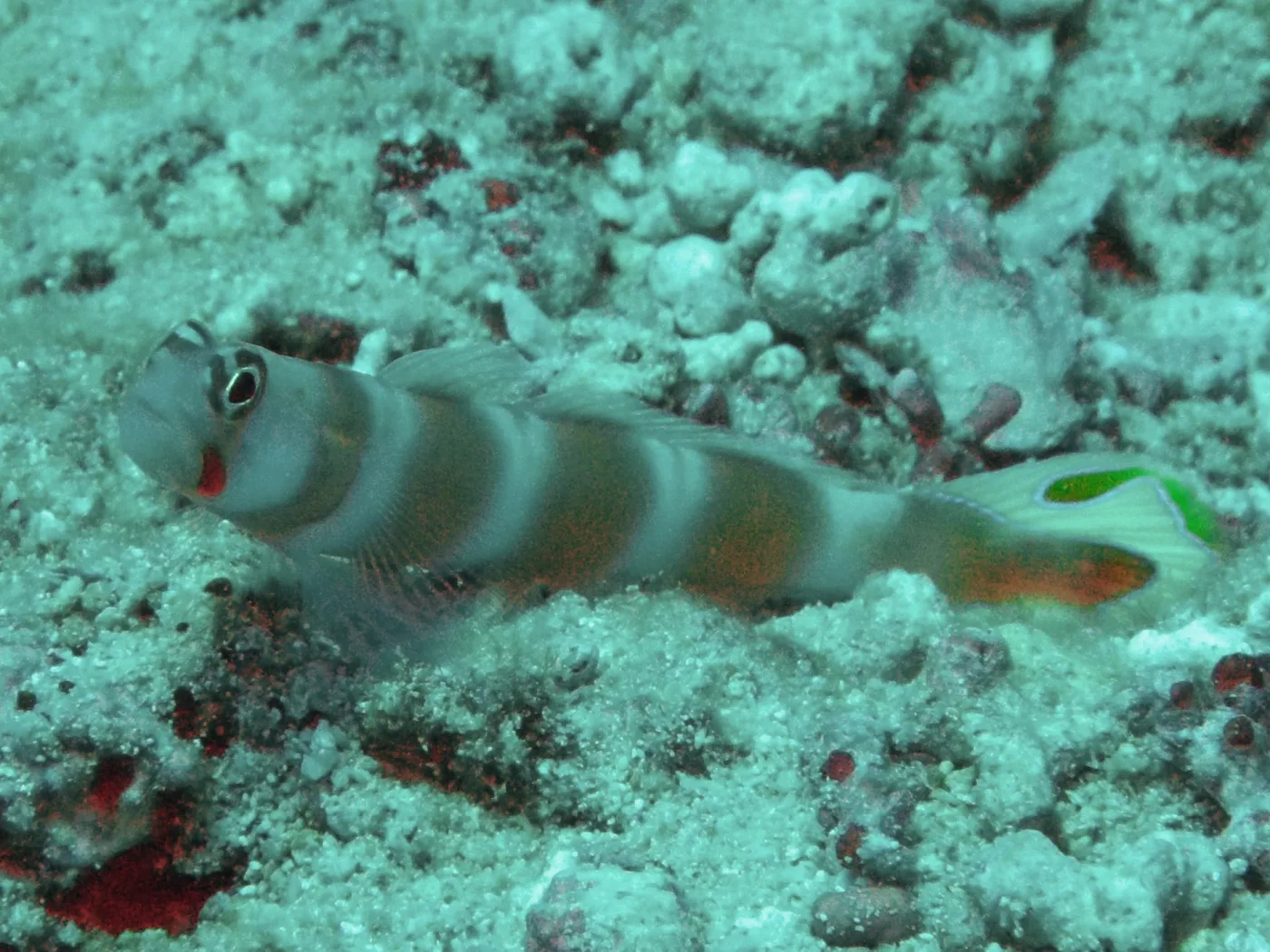
Amblyeleotris aurora is a shrimp goby (family Gobiidae) of the western Indian Ocean that reaches about 11 cm total length. The body is elongate and nearly round in cross-section, whitish with five wide brown to orange-red or pink bands, an oblique brown band at the rear corner of the mouth, and a yellow caudal fin with ocellated red spots or streaks. The first dorsal fin has 7 spines, the second 13 soft rays, and the anal fin 1 spine and 14 soft rays; the pelvic fins are separate except for a very low membrane at the base. It occurs from the Maldives south to northern Natal, South Africa, at 5-40 m but usually 5-10 m, on sand and rubble flats of clear coastal and outer reefs. Each goby shares a burrow in coarse sand with the alpheid snapping shrimp Alpheus randalli: the shrimp digs and maintains the burrow, while the goby, with far better eyesight, watches for predators and the shrimp keeps antennal contact with it. The IUCN lists it as Least Concern.
- Appearance
- White to pale body with five broad pink, orange-red or brown bars, an oblique brown bar from the corner of the mouth, and a bright yellow tail with red spots or flecks, the 'sunburst' or rising-sun pattern behind its names. Some fish look pastel orange, others soft pink. Other banded Amblyeleotris, such as the gorgeous prawn goby (A. wheeleri), are sold alongside it; the yellow, red-spotted tail is the best clue to A. aurora.
- Native range
- Western Indian Ocean: the Maldives south to northern Natal, South Africa; also reported from the Andaman Sea. It was described in a 1977 study of prawn-associated gobies from the Seychelles. Retailers offer fish from Africa and the Maldives.
- Habitat
- Sand and rubble flats on clear coastal and outer reefs, at 5-40 m (usually 5-10 m; FishBase's biology notes give 20-35 m). It lives in a burrow dug by the snapping shrimp Alpheus randalli in coarse sand. By day the goby rests near the entrance; at night both partners retreat inside and the entrances are sealed.
- Size
- 4.3 in (11 cm). FishBase and Wikipedia give 11 cm (4.3 in) total length as the maximum. Quality Marine and Reef Exclusive say almost 4 in.
- Lifespan
- Not documented; no published lifespan for aquarium or wild fish was found.
- Conservation
- Least Concern. Assessed Least Concern by the IUCN (2018 assessment cited by FishBase). Not evaluated by CITES. FishBase places it in the very high price category of the aquarium trade, and Quality Marine says it is only occasionally seen in the trade
In the aquarium vs in the wild
In your aquarium
A peaceful display fish, best known for sharing a burrow with a pistol shrimp.
On the reef
A burrow-dwelling shrimp goby that acts as the lookout for its snapping shrimp partner on sand and rubble flats.
History
N. V. C. Polunin and R. Lubbock described the species in 1977 as Cryptocentrus aurora, in their study of prawn-associated gobies from the Seychelles in the Journal of Zoology. It now sits in Amblyeleotris, a genus named by Pieter Bleeker in 1874; the name joins the Greek amblys ('darkness') with Eleotris, the name of a Nile fish. The species name honors Aurora, the Roman goddess of the dawn, because the tail pattern recalls a rising sun. In the trade it is sold as the aurora, pinkbar or sunburst goby and is only occasionally available.
Evolution & relatives
Amblyeleotris is the largest genus of shrimp gobies, with 39 species in WoRMS (Wikipedia lists 38) across the Indo-Pacific, from under 3 cm to nearly 20 cm in standard length. In every species the shrimp digs and keeps up the burrow, while the goby, with much sharper eyes, keeps watch. Fossil goby ear stones (otoliths) found with snapping shrimp remains from the late early Miocene suggest that the partnership is at least that old. WoRMS places the genus in the subfamily Gobiinae of the family Gobiidae, with the watchman gobies (Cryptocentrus), although some classifications no longer split the goby family into subfamilies. Gobies belong to the order Gobiiformes, a different branch from the blennies, so on the site's tree an aurora goby is closer to a yellow watchman goby than to a lawnmower blenny.
Family tree, from kingdom down
- Kingdom Animalia Animals Animals are living things made of many cells that must eat food to live. Fish, corals, crabs, snails and sea stars are all animals.
- Phylum Chordata Chordates Chordates have a stiff rod running down their back at some point in their lives. In fish and people, this rod is replaced by a backbone.
- Subphylum Vertebrata Vertebrates Vertebrates are animals with a backbone and a skull. Fish, frogs, birds and people are all vertebrates.
- Infraphylum Gnathostomata jawed vertebrates
- Parvphylum Osteichthyes bony fishes
- Gigaclass Actinopterygii ray-finned fishes
- Superclass Actinopteri
- Class Teleostei Teleost fishes Teleosts are bony fishes with thin, bendy fin rays and jaws that can push forward. Almost all of the fish in the world are teleosts.
- Order Gobiiformes Gobies and kin This order includes gobies and sleepers. Most are small fish that live on the bottom, and many share burrows or perch on rocks.
- Suborder Gobioidei gobies and sleepers
- Family Gobiidae Gobies Gobies are one of the biggest families of fish. Most are small and live on the bottom, and many share burrows with shrimp.
- Subfamily Gobiinae True gobies
- Genus Amblyeleotris Shrimp gobies
- Species Amblyeleotris aurora
See it on the Tree of Life Compare with another species
Closest relatives
- Amblyeleotris randalli Randall's Prawn Goby Same genus
- Amblyeleotris wheeleri Gorgeous Prawn Goby Same genus; also described by Polunin and Lubbock in 1977
- Amblyeleotris guttata Spotted Prawn Goby Same genus
- Cryptocentrus cinctus Yellow Watchman Goby Same subfamily (Gobiinae), different genus Read guide · Compare
Older scientific names: Cryptocentrus aurora.
Fun facts
- It is named after Aurora, the Roman goddess of the dawn, because its tail looks like a rising sun.
- Its partner shrimp can hardly see, so it keeps an antenna on the goby to feel when danger comes.
- At night the goby and the shrimp seal the burrow entrances and stay inside together.
- Fossils hint that gobies and snapping shrimp have shared burrows since the Miocene.
- Its shrimp partner, Alpheus randalli, is only about 3 cm long.
Learn more
- FishBase: Amblyeleotris aurora, Pinkbar goby fishbase.se
- Quality Marine: The Pink Partner qualitymarine.com
- Wikipedia: Pinkbar goby en.wikipedia.org
- Wikipedia: Amblyeleotris en.wikipedia.org
Sources
- FishBase species summary: Amblyeleotris aurora fishbase.se
- WoRMS: Amblyeleotris aurora (Polunin & Lubbock, 1977) marinespecies.org
- Wikipedia: Pinkbar goby en.wikipedia.org
- Wikipedia: Amblyeleotris en.wikipedia.org
- Wikipedia: Alpheus randalli en.wikipedia.org
- Quality Marine: Pinkbar Goby qualitymarine.com
- Quality Marine: The Pink Partner qualitymarine.com
- Reef Exclusive: Aurora Goby reefexclusive.com
Scientific names and classification follow the World Register of Marine Species (AphiaID 209272). Checked by our team. Last updated October 29, 2026.
Shop this species
Search the shop →