 Sold out
Fish · Goby
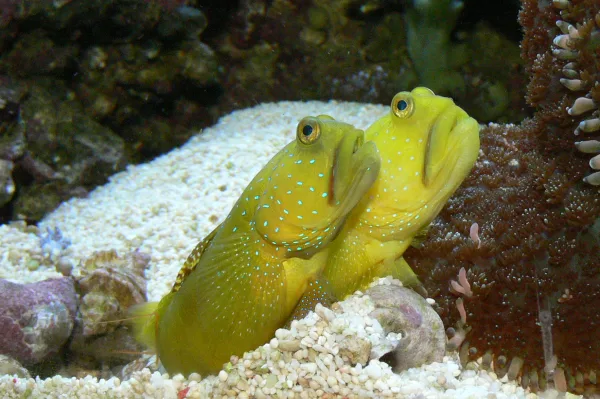
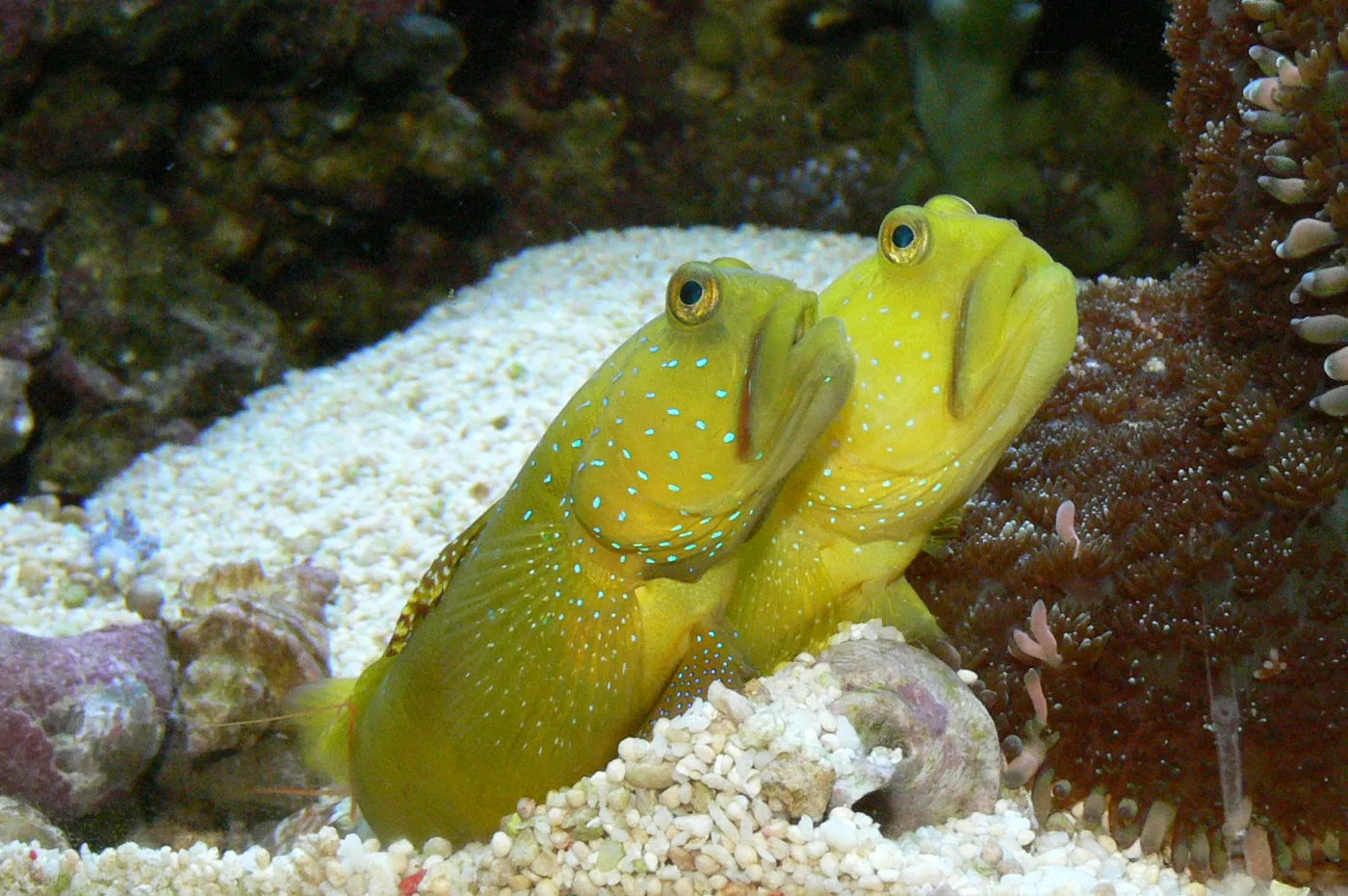
Yellow Watchman Goby
Cryptocentrus cinctus
Also called Yellow Prawn-goby, Yellow Shrimp Goby, Yellow Shrimpgoby, Watchman Goby, Banded Shrimpgoby
- CareEasy
- Reef safeYes
- TemperamentPeacefulPeaceful; fights its own kind unless a pair
- Favorite foods
- Mysis shrimp
- Brine shrimp (frozen / live)
- Small sinking pellets
- Max size4 in (10 cm)
- Min tank30 gal
- LifespanNo scientific data
- IUCN statusLeast Concern
Quick answers
- How big does the Yellow Watchman Goby get?
- Up to 4 in (10 cm).
- What size tank does it need?
- At least 30 gallons.
- How hard is it to keep?
- Care level: Easy.
- Is it reef safe?
- Yes. Leaves corals, clams and most invertebrates alone.
- What does it eat?
- Mysis shrimp
- Brine shrimp (frozen / live)
- Small sinking pellets
- How long does it live?
- No scientific data.
- What are good tankmates?
- Pistol shrimp (Alpheus bellulus, Alpheus randalli)
- Clownfish
- Firefish and dartfish
- Cardinalfish
- Small peaceful wrasses
The 30-second version
The yellow watchman goby is a chunky little yellow fish with tiny blue dots. Its big eyes sit on top of its head. It has a famous best friend: a pistol shrimp. The shrimp is a great digger, but it does not see well. So it digs a hole in the sand for both of them. The goby is the lookout. It sits at the door of the hole while the shrimp works. The shrimp keeps a feeler on the goby. If danger comes, the goby flicks its fins, and they both dive inside. Each of its eyes can look a different way, which helps it watch for trouble. In a fish tank it is calm and leaves corals alone. But it can jump, so the tank needs a lid.
Water & care
A hardy, beginner-friendly fish that accepts frozen and pellet foods. Give it a sand bed to burrow in, a cave or rock ledge as a home, a tight lid, and two or three small meaty meals a day. New fish often hide for several days and may need food placed near their cave until they settle. It does not need a pistol shrimp, but pairing one (such as the tiger pistol shrimp, Alpheus bellulus, or Randall's pistol shrimp, A. randalli) brings out its most interesting behaviour. Captive-bred fish adapt fastest.
| Parameter | Keep it at | Where that sits on the usual reef range |
|---|---|---|
| Temperature | 72–80 °F | |
| Salinity (SG) | 1.020–1.026 | |
| pH | 8.1–8.4 | |
| Alkalinity | 8–12 dKH | |
| Nitrate | 0–20 ppm |
Retailer care sheets give 72-78 °F (light.fish) to 75-80 °F (Bulk Reef Supply/ORA), specific gravity 1.020-1.026 and nitrate under 20 ppm; FishBase gives a wild temperature of 22-28 °C. No special calcium, magnesium or phosphate needs; set those for your corals.
Feeding
DietCarnivore
Favorite foods
- Frozen mysis shrimp
- Frozen brine shrimp (vitamin-enriched)
- Frozen Calanus copepods
- Small sinking pellets
- Chopped seafood
- Enriched flake food
Feed small amounts two or three times a day, letting food sink near its burrow; it rarely swims far for food. Newly added fish may need target-feeding with a pipette until they are eating confidently. Growing juveniles do best with more frequent meals. Avoid overfeeding large chunks.
Tank & maintenance
- Minimum tank
- 30 gallons
- Aquascape
- A sand bed (fine sand or a sand and crushed-coral mix) at least a couple of inches deep for burrowing, with rockwork resting on the bottom glass so digging cannot topple it. Provide a cave or ledge near the sand as a home burrow site, and a tight-fitting lid with no gaps.
- Lighting
- Any reef lighting; it spends its time at the sand bed and is not light-sensitive.
- Water flow
- Low to moderate at the sand bed; it perches where the current is gentle.
Routine upkeep
Normal reef upkeep: partial water changes of 10-25% every two to four weeks, stable salinity and temperature, and a check that the lid has no gaps. Do not stir or vacuum its burrow area; after any rockwork changes make sure digging has not undermined the rocks.
Temperament & tankmates
TemperamentPeaceful
Peaceful toward most fish, but it guards its burrow and the sand around it. Keep only one per tank unless you have a mated pair, and be careful mixing it with other sand-dwelling gobies in small tanks, where they may fight over burrows. Aggression toward its own kind tends to increase as it matures.
Reef safeYes
Leaves corals, clams and most invertebrates alone. Its burrowing, and especially a partner pistol shrimp's digging, can undermine rocks and bury or tip over corals placed on the sand, so set rockwork on the bottom glass and glue frags to rock rather than the sand bed.
Good tankmates
- Pistol shrimp (Alpheus bellulus, Alpheus randalli)
- Clownfish
- Firefish and dartfish
- Cardinalfish
- Small peaceful wrasses
- Cleaner shrimp, hermit crabs, snails and urchins
- Soft, LPS and SPS corals
Avoid
- Another watchman goby, unless a mated pair or a very large tank
- Other burrowing or sand-perching gobies in small tanks
- Large predators (eels, groupers, lionfish, puffers)
- Aggressive dottybacks and damselfish
Help it thrive
- Give it a sand bed and a cave or ledge to call home, with rocks resting on the glass.
- Pair it with a pistol shrimp, ideally adding the shrimp first so it can start digging.
- Target-feed near its burrow for the first few days; new watchman gobies often hide.
- Choose captive-bred fish when available; they arrive eating frozen and pellet foods.
- Keep a lid on the tank; watchman gobies are known jumpers.
Common ailments
Marine ich (Cryptocaryon irritans)
- Signs
- White salt-grain spots, scratching on sand or rock, fast breathing.
- Prevention
- Quarantine new fish for several weeks; keep stress low.
- Treatment
- Treat in a separate hospital tank; never medicate the reef. Some keepers find gobies more sensitive to copper than other fish, so follow the product's directions exactly and test copper daily, or use tank-transfer, and leave the display fishless for about 10-12 weeks.
Marine velvet (Amyloodinium ocellatum)
- Signs
- Dusty gold or grey film on the skin, very fast breathing, hiding, sudden deaths.
- Prevention
- Quarantine every new fish; velvet spreads quickly through the water.
- Treatment
- Move all fish to a hospital tank and treat promptly (usually a copper medication used as the product's directions say, with daily tests); leave the display fishless for at least 10-12 weeks.
Bacterial infections after fights or handling
- Signs
- Red or white patches, frayed fins, open sores, cloudy eyes.
- Prevention
- Avoid housing two watchman gobies or burrow rivals together; net gently and keep water clean.
- Treatment
- Improve water quality and move the fish to a hospital tank; use an antibiotic treatment there if the infection spreads.
This is general hobby guidance, not veterinary advice. Quarantine new arrivals and treat in a separate tank whenever you can.
Risks of owning one
- Jumping: watchman gobies are known jumpers, so a tight lid with no gaps is needed.
- Burrowing (especially with a pistol shrimp) can undermine rockwork and bury or topple corals on the sand.
- Two watchman gobies that are not a pair usually fight over burrows.
- Shy at first: it may hide for days after introduction and needs to be watched to make sure it eats.
Breeding
DifficultyHard Captive-bredWidely available
Pairs (in one report the female was larger and the more aggressive defender) spawn in a cave or under a ledge, hanging a thread-like mass of yellow eggs, more than 5,000 in one report, from the ceiling. The eggs are guarded in the nest (the report implies by the male) and hatch after 4-5 days at about 80 °F into transparent larvae under 2 mm long. Hobby breeders raised larvae on enriched rotifers, adding Artemia nauplii and copepods around day 15; metamorphosis came at about 20-30 days, but survival through that stage was low or zero. Commercial hatcheries now produce it, and captive-bred fish are sold.
- Get a pair: buy a known pair, or add two small juveniles at the same time and watch for them sharing a cave.
- Provide a cave, half flowerpot or rock ledge; one pair first spawned about 30 days after being introduced.
- Condition with varied meaty foods two or three times a day.
- Leave the eggs with the guarding parent; if the nest falls, a gently tumbling, aerated hatching container can stand in for him.
- Expect hatching after 4-5 days at about 80-81 °F, around dark or first light.
- Feed rotifers (Brachionus rotundiformis) from first feeding, then enriched Artemia nauplii and copepods from about day 15.
- Watch for a die-off around day 10 and losses during metamorphosis at about 20-30 days; dense, varied live food and clean water are critical.
Deep dive The science, history and family tree
The science
Cryptocentrus cinctus is a shrimp-associated goby (Gobiidae: Gobiinae) that reaches about 10 cm standard length. The body is moderately elongate with a blunt, scaleless head and high-set eyes; there are 7 dorsal spines and 10 soft dorsal rays, 1 anal spine and 9 soft anal rays, and 92-95 scales along the side. Two colour phases occur, one bright yellow and one whitish to grey. Both show four or five dusky bars (faint on yellow fish), fine pale blue to white spots on the head, upper body and fins, and a dark brown streak above the upper jaw. The species is found in the eastern Indian Ocean and western Pacific, from north-western Australia and Singapore to the Yaeyama Islands of southern Japan, Palau and Chuuk (Truk) in Micronesia, and the southern Great Barrier Reef. It lives at 1-25 m, mostly 10-25 m, on sandy bottoms of shallow lagoons, sheltered coastal bays and clear coastal sand slopes. Like other members of its genus it shares a burrow with alpheid snapping shrimps: the shrimp digs and maintains the burrow, and the goby, which has much better eyesight, stands guard at the entrance and warns the shrimp of danger, after which both retreat inside. It is a carnivore that takes small invertebrates around the burrow, but its wild diet has not been studied in detail. In aquarium spawnings, pairs have hung masses of up to several thousand eggs from the roof of a cave or shell, and the guarded eggs hatched after about four to five days. The species is harmless to people and assessed as Least Concern by the IUCN.
- Appearance
- Stocky, cylindrical goby with a big blunt head, eyes set high, and a body that is usually bright yellow covered in fine electric-blue spots, with faint dusky bars and a dark streak above the upper jaw. A grey to whitish phase with clearer brown bars is the same species, and individuals can change between phases as they mature. Look-alikes: other Cryptocentrus shrimp gobies (for example the ninebar prawn-goby, C. cryptocentrus, and the saddled prawn-goby, C. leucostictus); 'false yellow (spotted) watchman' is a trade name for similar Cryptocentrus gobies whose identity is often unclear, so check the scientific name; the yellow clown goby (Gobiodon okinawae) is much smaller and perches in branching corals rather than on sand.
- Native range
- Eastern Indian Ocean and western Pacific: north-western Australia (Monte Bello Islands to Ashmore Reef), Singapore and Indonesia north to the Yaeyama Islands (southern Japan), east to Palau and Chuuk (Truk) in Micronesia, and south to the southern Great Barrier Reef (One Tree Island). Catalog of Fishes also lists the Andaman Sea; FishBase gives only the western Pacific part of this range. The type locality is a reef in Singapore Harbour.
- Habitat
- Sandy areas of shallow lagoons, protected coastal bays and clear coastal sand slopes at 1-25 m (mostly 10-25 m). Lives in a burrow dug and maintained by an alpheid (pistol or snapping) shrimp, sitting at the entrance as a lookout. Water temperature in its range is about 22-28 °C (72-82 °F).
- Size
- 4 in (10 cm). FishBase gives 10 cm standard length (body without tail), about 4 in; total length is slightly more. Most aquarium fish are 3-4 in.
- Lifespan
- No scientific data. Hobby sources report up to about 10 years in aquariums with good care.
- Conservation
- Least Concern. IUCN Least Concern (assessed 2020). Not listed by CITES or CMS. Widely collected for the aquarium trade, but captive-bred fish are now sold (for example by ORA and Biota), which reduces pressure on wild stocks
In the aquarium vs in the wild
In your aquarium
A personality fish for the sand bed and the classic way to show the goby and pistol shrimp partnership in a home reef. It turns over a little sand near its burrow but is not a dedicated sand-sifter.
On the reef
A sentinel partner in the goby-shrimp mutualism: it watches for predators while the shrimp maintains the shared burrow, and it preys on small invertebrates around the burrow.
History
Albert W. Herre described the species in 1936 as Smilogobius cinctus in 'Eleven new fishes from the Malay Peninsula' in the Bulletin of the Raffles Museum, based on a single holotype (CAS-SU 29103) collected on a reef in Singapore Harbour. It was later moved to Cryptocentrus, a genus Achille Valenciennes created in 1837. The name cinctus is Latin for girdled, probably a reference to its body bars. In the aquarium hobby it became one of the most widely available shrimp gobies, valued for its colour, hardiness and the chance to keep it with a pistol shrimp. Hobbyists logged aquarium spawnings with the Breeder's Registry in 1995 and 2005, getting larvae to metamorphosis, and captive-bred fish are now offered by commercial hatcheries such as ORA and Biota.
Evolution & relatives
Cryptocentrus belongs to the subfamily Gobiinae of Gobiidae, one of the largest families of marine fishes. About 120 goby species live in close partnerships with other animals, and the shrimp gobies, including Cryptocentrus, Amblyeleotris and Stonogobiops, share burrows with Alpheus snapping shrimps. Firefish and dartfishes are in the same family but on a different branch (Ptereleotrinae), so on a tree the watchman goby sits close to firefish but not on the same twig. Mandarin dragonets, despite being called 'mandarin gobies', are not gobies at all. The goby order Gobiiformes, which also includes cardinalfishes and nurseryfishes, is an early branch of the percomorph fishes estimated to have split off in the Cretaceous. The oldest goby skeletons are from the Early Eocene, and the goby family and its mudskipper relatives (Oxudercidae) diversified around the Eocene-Oligocene transition, when much of today's goby diversity appeared.
Family tree, from kingdom down
- Kingdom Animalia Animals Animals are living things made of many cells that must eat food to live. Fish, corals, crabs, snails and sea stars are all animals.
- Phylum Chordata Chordates Chordates have a stiff rod running down their back at some point in their lives. In fish and people, this rod is replaced by a backbone.
- Subphylum Vertebrata Vertebrates Vertebrates are animals with a backbone and a skull. Fish, frogs, birds and people are all vertebrates.
- Infraphylum Gnathostomata jawed vertebrates
- Parvphylum Osteichthyes bony fishes
- Gigaclass Actinopterygii ray-finned fishes
- Superclass Actinopteri
- Class Teleostei Teleost fishes Teleosts are bony fishes with thin, bendy fin rays and jaws that can push forward. Almost all of the fish in the world are teleosts.
- Order Gobiiformes Gobies and kin This order includes gobies and sleepers. Most are small fish that live on the bottom, and many share burrows or perch on rocks.
- Suborder Gobioidei gobies and sleepers
- Family Gobiidae Gobies Gobies are one of the biggest families of fish. Most are small and live on the bottom, and many share burrows with shrimp.
- Subfamily Gobiinae True gobies
- Genus Cryptocentrus Watchman gobies Watchman gobies share a burrow with a pistol shrimp. The goby keeps watch while the nearly blind shrimp digs.
- Species Cryptocentrus cinctus
See it on the Tree of Life Compare with another species
Closest relatives
- Cryptocentrus cryptocentrus Ninebar Prawn-goby Same genus; the type species of Cryptocentrus
- Cryptocentrus leucostictus Saddled Prawn-goby Same genus
- Cryptocentrus caeruleopunctatus Harlequin Prawn-goby Same genus
- Amblyeleotris randalli Randall's Shrimp Goby Same subfamily; another shrimp-goby genus
- Stonogobiops nematodes Hi-fin Red-banded Goby Same subfamily; another shrimp-goby genus
- Nemateleotris magnifica Firefish Goby Same family (Gobiidae), different subfamily (Ptereleotrinae) Read guide · Compare
Older scientific names: Smilogobius cinctus.
Fun facts
- Each eye moves on its own, so it can watch two directions at once.
- In related shrimp gobies, scientists filmed the goby warning its shrimp with quick fin flicks that the shrimp feels through its long antennae.
- Yellow and grey watchman gobies are the same species, just different colour phases.
- One aquarium pair hung more than 5,000 eggs from the roof of a flowerpot cave.
- The scientist who named it, Albert Herre, also named the mandarin dragonet nine years earlier.
Learn more
- FishBase: Cryptocentrus cinctus fishbase.se
- WoRMS taxon record marinespecies.org
- Wikipedia: Cryptocentrus cinctus en.wikipedia.org
- Bulk Reef Supply: How to care for watchman gobies bulkreefsupply.com
- Breeder's Registry spawning report CRYCIN-121205 breedersregistry.org
Sources
- FishBase: Cryptocentrus cinctus summary fishbase.se
- WoRMS: Cryptocentrus cinctus (Herre, 1936) marinespecies.org
- Wikipedia: Cryptocentrus cinctus en.wikipedia.org
- Wikipedia: Cryptocentrus en.wikipedia.org
- Wikipedia: Goby (classification, symbioses, fossils) en.wikipedia.org
- Wikipedia: Gobiiformes en.wikipedia.org
- Bulk Reef Supply: How to care for watchman gobies bulkreefsupply.com
- Bulk Reef Supply: ORA captive-bred watchman goby bulkreefsupply.com
- light.fish: Yellow watchman goby care light.fish
- Breeder's Registry spawning report CRYCIN-121205 breedersregistry.org
- Breeder's Registry spawning report CRYCIN-071595 breedersregistry.org
- Reef Builders: Cryptocentrus albidorsus (2013) reefbuilders.com
- Fishes of Australia: Yellow Shrimpgoby, Cryptocentrus cinctus fishesofaustralia.net.au
- Aquarium Depot: Biota captive-bred yellow watchman goby listing aquariumdepot.ca
Care facts
The care facts on this guide and its product pages (care level, reef safety, temperament, size, tank, diet, flow, purpose, foods, acclimation and origin) combine 12 independent sources, checked October 25, 2026.
- Cryptocentrus cinctus summary FishBase
- How To Care For Watchman Gobies Bulk Reef Supply
- Yellow Watchman Goby - Cryptocentrus cinctus - Small That Pet Place
- Yellow Watchman Goby Reef Exclusive
- Yellow Watchman Goby Care Guide Top Shelf Aquatics
- Yellow Watchman Goby (Cryptocentrus cinctus) - Care Guide Eastwood Aquarium (Australia)
- Cryptocentrus cinctus Freakin Corals
- GOBY - WATCHMAN YELLOW Cryptocentrus cinctus Aquatics Unlimited
- Yellow Watchman Goby - Cryptocentrus cinctus Whitlyn Aquatics
- ORA Watchman Goby Bulk Reef Supply (ORA)
- Yellow Watchman Goby: Care, Size, Diet, Breeding & More Light.fish
- Watchman True Yellow Quality Marine
Scientific names and classification follow the World Register of Marine Species (AphiaID 278326). Last updated October 25, 2026.
Shop this species
Search the shop →Sold out right now. We restock weekly, so check back soon.
Sold out