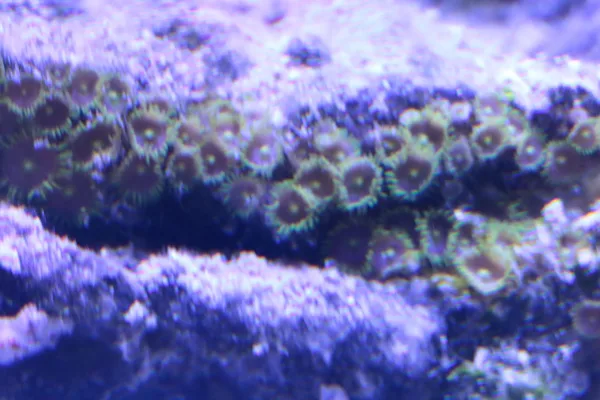
Corals · Zoanthid
Zoanthids
Zoanthus sp.
Also called Zoas, Button polyps, Colonial polyps, Sea mats, Zoanthus polyps, Rasta zoas, Utter Chaos zoas
- CareEasy
- Reef safeYes
- TemperamentPeacefulBarely stings; spreads over nearby corals
- Favorite foods
- Light (zooxanthellae)
- Phytoplankton / amino liquids
- Reef Roids / baby brine shrimp
- Min tank10 gal
- LifespanThe colony is clonal and can persist…
- IUCN statusNot Evaluated
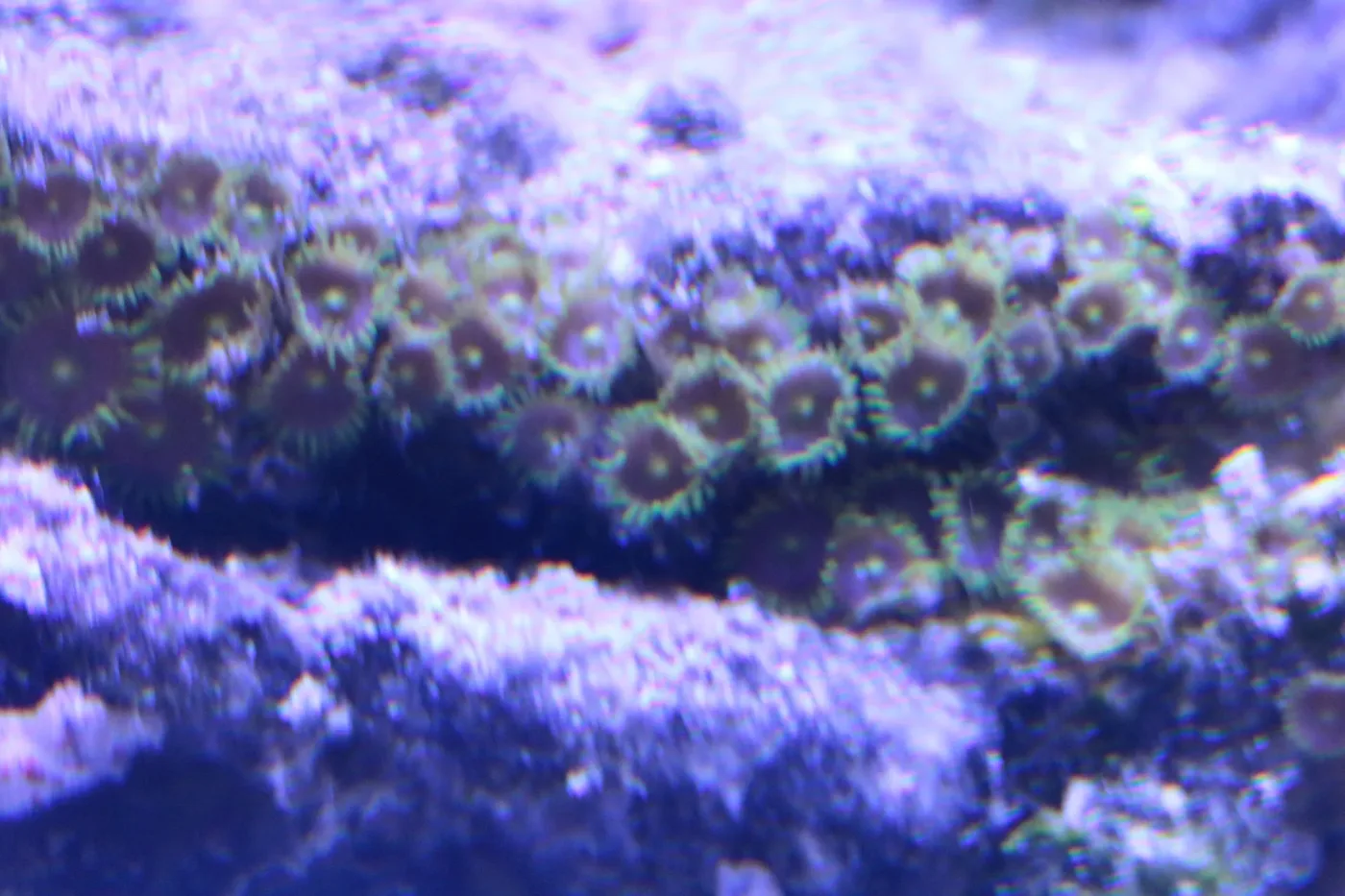
Quick answers
- What size tank does it need?
- At least 10 gallons.
- How hard is it to keep?
- Care level: Easy.
- Is it reef safe?
- Yes. Safe with fish and invertebrates and with most corals, but fast-growing colonies spread over rock and can overgrow slower corals and slower zoa morphs.
- What does it eat?
- Light (zooxanthellae)
- Phytoplankton / amino liquids
- Reef Roids / baby brine shrimp
- How long does it live?
- The colony is clonal and can persist indefinitely; individual polyps are replaced by budding.
- What are good tankmates?
- Other zoa morphs with similar growth rates
- Mushrooms, star polyps and other soft corals kept at a distance
- Peaceful reef fish such as clownfish, gobies, blennies and cardinalfish
- Snails, cleaner shrimp and other reef-safe cleanup crew
The 30-second version
Zoanthids, or 'zoas', are tiny animals that look like flowers. Each one is a polyp. It is a short tube with a mouth in the middle and a ring of small arms around it. Lots of polyps grow side by side. A thin mat joins them at the bottom, like a garden of bright buttons. Tiny plants called algae live inside them. The algae turn light into food, so zoas mostly live on light. Zoas come in almost every color. Reefers give them fun names like 'Rasta' and 'Utter Chaos'. They are easy to grow, and new polyps bud off the old ones. But zoas have a secret. Some of them, and most of all their big cousins the palys, can carry a very strong poison. Always wear gloves and goggles. Never rub your eyes after you work in the tank.
Water & care
Hardy, forgiving and fast-growing once settled, which makes zoas one of the best first corals. They want low to moderate light, moderate flow and stable parameters, and they are not fussy about calcium or alkalinity because they build no skeleton. The main challenges are keeping pests out of a collection and handling them safely because of palytoxin. Very low nutrients can leave colonies pale and slow.
| Parameter | Keep it at | Where that sits on the usual reef range |
|---|---|---|
| Temperature | 75–80 °F | |
| Salinity (SG) | 1.023–1.026 | |
| pH | 8.1–8.4 | |
| Alkalinity | 8–11 dKH | |
| Calcium | 380–450 ppm | |
| Magnesium | 1,250–1,450 ppm | |
| Nitrate | 2–20 ppm | |
| Phosphate | 0.01–0.1 ppm |
Stability matters more than the exact numbers. Sources: Top Shelf 75-82 F, SG 1.023-1.026, 8-10 dKH, 380-430 ppm calcium, 1250-1350 ppm magnesium; Bulk Reef Supply 75-78 F (77-82 F in its general notes), 8-9.5 dKH, 1300-1450 ppm magnesium, nitrate 10-25 ppm, phosphate 0.01-0.1 ppm. Zoas grow faster with some nitrate and phosphate and can pale or stall at zero nutrients; very high nutrients feed nuisance algae instead.
Feeding
DietPhotosynthetic
Favorite foods
- Light (photosynthesis by symbiotic algae)
- Phytoplankton and marine snow
- Rotifers and baby brine shrimp
- Finely chopped mysis or powdered coral foods
Feeding is optional. Most energy comes from their zooxanthellae, plus fine particles and dissolved nutrients from the water. If you feed, target-feed small amounts of fine foods once or twice a week with a pipette while flow is reduced, or broadcast phytoplankton. Overfeeding mostly feeds algae and cyanobacteria.
Tank & maintenance
- Minimum tank
- 10 gallons
- Aquascape
- Glue frags or colonies on rockwork or on separate island rocks so fast spreaders can be pruned; start them low to mid-level and move them up if they stretch. Arrange a 'zoa garden' with gaps between morphs.
- Lighting
- Low to moderate, roughly 75-250 PAR (Bulk Reef Supply's low range is 75-150 PAR and medium 150-250 PAR). Higher light can intensify colors but must be introduced gradually to avoid bleaching. Spectrum strongly changes how a morph looks.
- Water flow
- Moderate and steady, enough to keep detritus off the polyps. Flow that is too strong makes them stay closed; too weak lets sediment settle on them.
Routine upkeep
Watch colonies daily for closed polyps, missing heads or pests, and inspect the base of the stalks with a flashlight after lights out every so often. Prune fast spreaders before they reach neighbors. Do a 10-20% water change weekly or every other week and test nitrate and phosphate. Always wear gloves (and eye protection when fragging or cutting), never scrub, boil or pressure-wash rock with zoanthids on it, and never start a siphon by mouth.
Temperament & tankmates
TemperamentPeaceful
They do not attack anything mobile, but they compete for space by spreading and can sting and overgrow neighbors they touch. Retailers rate them anywhere from peaceful to semi-aggressive; leave about 2-3 in between colonies and other corals, and do not put a fast, large-polyp morph next to a slow, expensive one.
Reef safeYes
Safe with fish and invertebrates and with most corals, but fast-growing colonies spread over rock and can overgrow slower corals and slower zoa morphs. LiveAquaria notes short sweeper tentacles, so give colonies some space. Several fish groups eat them (see compatibility).
Good tankmates
- Other zoa morphs with similar growth rates
- Mushrooms, star polyps and other soft corals kept at a distance
- Peaceful reef fish such as clownfish, gobies, blennies and cardinalfish
- Snails, cleaner shrimp and other reef-safe cleanup crew
Avoid
- Butterflyfish and many angelfish, which may nip zoanthids
- Fast-growing palys or large-polyp zoas placed next to slow morphs
- Strong-stinging LPS within reach
- Unquarantined zoa frags from other tanks, which bring pests
Help it thrive
- Quarantine and dip every new frag, and check the underside and stalk bases for eggs, snails, spiders and nudibranchs before it goes into the display.
- Keep low but detectable nitrate and phosphate; stripped-out water makes zoas small and pale.
- Start new morphs lower in the tank and raise them gradually if they stretch.
- Give each morph its own space or rock so fast growers do not swallow slow ones.
- Keep salinity, temperature and alkalinity steady; most closing and melting follows a swing.
- Judge a morph's color under lighting similar to your own; vendor photos are taken under heavy blue.
Common ailments
Zoanthid-eating nudibranchs
- Signs
- Polyps disappear or stay closed; small slugs colored to match the colony hide at the base of the stalks; spiral egg masses appear on or near the colony.
- Prevention
- Quarantine and dip all new zoanthids and keep tools separate between systems.
- Treatment
- Dip the colony, blast it with a baster, remove slugs and egg masses by hand, and repeat the dip about a week later to catch hatchlings.
Sundial snails (Architectonicidae)
- Signs
- Flat, button-sized coiled snails (about 0.5-1.25 cm) sheltering between stalks, active at night; colonies shrink quickly; messy egg strands near the base of the stalks.
- Prevention
- Inspect new colonies, especially wild or maricultured rocks, at night and under magnification.
- Treatment
- Pick snails off by hand, use a dip to make adults drop off, and search for and remove egg strands; wrasses and bumblebee snails may help.
Sea spiders (pycnogonids)
- Signs
- Tiny long-legged spider-like animals at the base of polyps, easiest to see after dark; polyps close and dwindle.
- Prevention
- Quarantine and dip new frags.
- Treatment
- Isolate the colony, dip and baste repeatedly on a set schedule, and remove visible spiders and egg clusters by hand.
Zoa pox and other infections
- Signs
- Raised white or pale pustules on the stalks and mat, or fuzzy, slimy patches; affected polyps close and die off. The cause of 'zoa pox' is not well understood.
- Prevention
- Stable water, quarantine, and daily observation.
- Treatment
- Hobbyists report success with freshwater dips and iodine baths; isolate affected pieces so problems do not spread. Treatment evidence is anecdotal.
Closing, stretching or melting
- Signs
- Polyps stay shut for days, stretch on long stalks, or turn to mush.
- Prevention
- Stable parameters, appropriate light (not too strong or too weak), and no polyp-nipping tankmates.
- Treatment
- Check salinity, temperature, alkalinity and nutrients; adjust light gradually; look for pests or fish nipping at night; move the colony to gentler flow if it is being blasted.
This is general hobby guidance, not veterinary advice. Quarantine new arrivals and treat in a separate tank whenever you can.
Risks of owning one
- Palytoxin: some zoanthids, and especially some Palythoa ('palys'), contain palytoxin, one of the most potent non-protein natural toxins known. Splashes to the eye, or rubbing an eye after handling zoanthids, have caused serious toxic keratoconjunctivitis in aquarists, documented in several published case reports.
- Inhaled palytoxin: in Alaska (2012-2014), at least ten people became ill after aerosols formed while handling, scrubbing or hot-water cleaning zoanthid rock; some were hospitalized. Never boil, scrub, pressure-wash or microwave zoanthid-covered rock, and work in a ventilated area.
- Protect yourself: wear gloves and eye protection, cover cuts, never siphon by mouth, and wash your hands after gloves come off. Decontaminate rock and tools by soaking them for 30 minutes in roughly 1 part household bleach to 10 parts water.
- Highly toxic Palythoa often arrive as hitchhikers on live rock or mixed in with zoa colonies, so the zoas you bought may not be the only zoanthids you own.
- Pests (nudibranchs, sundial snails, sea spiders) can wipe out a collection quickly once established.
- Fast-spreading morphs can overgrow slower, more valuable corals.
Propagation & fragging
DifficultyEasy AquaculturedWidely available
Propagated asexually by fragging: a single polyp, or a piece of mat with a few polyps, grows into a new colony by budding. In the wild they also spawn sexually (most are hermaphrodites with external fertilization), producing free-swimming larvae, but this is not done in home aquariums.
- Put on gloves and eye protection before you start; do not touch your face.
- Lift the colony out and work over a tub of tank water in a ventilated spot.
- Use a sharp scalpel or bone cutters to slice off one or more polyps at the base, or cut a section of rubble or rock with the colony attached.
- Dry the base of the frag plug, then glue the polyp or rock piece down with reef-safe cyanoacrylate gel.
- Place frags low in the tank with moderate flow; they usually open within a few days and start budding within weeks.
- Rinse tools and gloves in tank water, then decontaminate them; wash your hands.
Deep dive The science, history and family tree
The science
Zoanthus Lamarck, 1801 is the type genus of the family Zoanthidae and of the order Zoantharia (suborder Brachycnemina), hexacorals that build no calcium carbonate skeleton. Colonies consist of polyps joined at the base by stolons or a thin sheet of tissue (coenenchyme); unlike most other zoantharians, such as Palythoa, Zoanthidae do not embed sand and debris in their body walls. Each polyp has a smooth column, an oral disk with a central mouth and marginal tentacles; polyp diameter, tentacle count and mesentery count are the traditional characters for telling species apart. Zoanthus species are zooxanthellate and live mainly in tropical and subtropical shallow water, from the intertidal zone and reef flats to shallow reef slopes. The Caribbean type species, Z. sociatus, forms extensive mats, obtains nearly half of its energy from its symbionts, and also feeds on detritus and small particles, catching prey with nematocysts on its mesenterial filaments. Reproduction is mainly asexual, by budding and fission, so colonies are usually clones; Brachycnemina are hermaphroditic, with seasonal sexual spawning that in Z. sociatus is timed to extreme low tides. Species identification is notoriously difficult: oral-disk color varies enormously within a species, and Reimer et al. (2004) found four nominal Japanese species to be genetically indistinguishable. WoRMS currently accepts about 22 species, with dozens more names of uncertain status. Most Zoanthus tested in the aquarium trade were non-toxic or only weakly toxic, but highly toxic palytoxin-bearing Palythoa can be confused with them or arrive mixed in (Deeds et al. 2011).
- Appearance
- Small polyps, typically under 1/2 in (about 4-12 mm) across, crowded together on a thin mat. Each polyp shows an oral disk (often a contrasting 'face' and mouth color), an outer ring of short tentacles (the 'skirt'), and sometimes a different-colored rim. Colors cover almost the whole spectrum and many show strong fluorescence. Named morphs are clonal color lines, not species: Rasta zoas are a classic, older morph usually described as a rainbow mix of green, orange, yellow and blue; Utter Chaos is a mid-priced collector morph described variously as a purple-to-orange or red-yellow-teal polyp, often with a distinctive white speckle pattern. Vendor descriptions disagree, and every morph shifts color with light spectrum and intensity (polyps stretch and look paler in low light, stay small and bright in strong light). Look-alikes: Palythoa and the former Protopalythoa ('palys') have larger, thicker polyps with sand embedded in their tissue and are far more likely to contain dangerous palytoxin; Parazoanthus (yellow polyps) belongs to the other zoanthid suborder.
- Native range
- Tropical and subtropical seas worldwide, including the Indo-Pacific, the Red Sea, East Africa and the western Atlantic and Caribbean (for example Z. sociatus and Z. pulchellus in the Caribbean, Z. sansibaricus across the Indo-Pacific). Most named aquarium morphs are now aquacultured.
- Habitat
- Intertidal and shallow subtidal hard bottoms, reef flats and rocky shores, often in bright light with strong intermittent currents; Z. sociatus also tolerates periodic exposure at low tide and lowered salinity. In southern Japan Zoanthus colonies range from temperate inshore waters to subtropical coral reefs, and over 20 color variants were found at a single intertidal site.
- Size
- . Colonial, with no fixed maximum colony size. Individual polyps are roughly 4-12 mm (0.2-0.5 in) across, and some morphs reach about nickel size. Colonies spread across rock by budding, faster with more nutrients.
- Lifespan
- The colony is clonal and can persist indefinitely; individual polyps are replaced by budding. Named morph lines have been propagated in captivity for decades.
- Conservation
- Not Evaluated. No IUCN Red List assessment was found for the genus or for common hobby species. Zoanthids are not CITES-listed. Collection is regulated locally: Florida limits recreational collectors to 5 single polyps of each zoanthid or corallimorph type per person per day, within a 20-organism daily aggregate, taken with a flexible blade no wider than 2 in, and Puerto Rico bans harvest of zoanthids for commercial or off-island sale. Named hobby morphs are almost always aquacultured, which is the responsible choice
In the aquarium vs in the wild
In your aquarium
Colorful, beginner-friendly coral grown as 'zoa gardens' and collected as named morphs; a mainstay of frag swaps and the coral trade. Prices range from a few dollars for common morphs to hundreds per polyp for new collector lines.
On the reef
Space-holding colonial polyps on intertidal and shallow reef flats and rocky shores; they can dominate rock surfaces, feed on detritus and plankton, and add photosynthetic production through their symbiotic algae.
History
Jean-Baptiste Lamarck named the genus Zoanthus in 1801; its type species is the Caribbean Z. sociatus, first described by John Ellis in 1768 as Actinia sociata. For a long time zoanthids were confused with other groups, at times being placed with octocorals, mollusks, sponges or echinoderms. In the aquarium hobby they became popular for their color and hardiness, and named morphs began when US growers tagged distinctive specimens; names follow descendant frags, with no formal registry. Rasta is one of the classic older morphs, and a Singapore retailer reports that Utter Chaos sold there for about $400 per polyp in 2017 before propagation brought prices down. Hobby awareness of palytoxin grew after a 2011 PLoS ONE study found highly toxic Palythoa for sale in aquarium shops and a 2015 CDC report on inhalation poisonings in Alaska.
Evolution & relatives
Zoanthids are hexacorals, the same class as stony corals, sea anemones and mushroom corals, but they form their own order, Zoantharia, which never builds a skeleton. The order has two suborders: Brachycnemina (including Zoanthus, Isaurus and Palythoa), which are hermaphroditic and mostly zooxanthellate shallow-water animals, and Macrocnemina (such as Parazoanthus and Epizoanthus), whose sexes are separate. Zoanthids as a whole range from tropical reefs to the deep sea. A 2021 phylogenomic study dates the origin of anthozoans to 648-894 million years ago, from a solitary, skeleton-free ancestor, with colonial growth evolving by the Ediacaran. Within the Zoanthidae, Zoanthus's closest relatives are Isaurus and Acrozoanthus; Palythoa is in a separate family (Sphenopidae) within the same suborder. Because oral-disk color varies so much, DNA studies are reducing the number of real Zoanthus species.
Family tree, from kingdom down
- Kingdom Animalia Animals Animals are living things made of many cells that must eat food to live. Fish, corals, crabs, snails and sea stars are all animals.
- Phylum Cnidaria Cnidarians Cnidarians are soft animals with tentacles. The tentacles have tiny stinging cells. Corals, sea anemones and jellyfish all belong here.
- Subphylum Anthozoa Corals and sea anemones These cnidarians spend their whole lives as polyps: a tube with a mouth ringed by tentacles. Unlike jellyfish, they never swim around as a bell-shaped medusa.
- Class Hexacorallia Hexacorals In this group the tentacles and body parts come in sixes or multiples of six. It includes stony corals, sea anemones, mushroom corals and zoanthids.
- Order Zoantharia Zoanthids Zoanthids are small polyps that live in mats or colonies and have no hard skeleton. They look a bit like tiny sea anemones joined together.
- Suborder Brachycnemina
- Family Zoanthidae Button polyps This family of zoanthids has smooth polyps joined at the base, like a carpet of colorful buttons. Unlike some cousins, they do not stick sand into their skin.
- Genus Zoanthus
See it on the Tree of Life Compare with another species
Closest relatives
- Zoanthus sociatus Green sea mat Same genus; the type species, from the Caribbean to southeastern Brazil
- Zoanthus sansibaricus Zoanthid Same genus; widespread Indo-Pacific species with many color morphs
- Zoanthus pulchellus Zoanthid Same genus; Caribbean species
- Zoanthus gigantus Giant zoanthid Same genus; large-polyp species described from Japan in 2006
- Isaurus Zoanthid Same family (Zoanthidae)
- Acrozoanthus Zoanthid Same family (Zoanthidae)
- Palythoa Palys Same suborder, different family (Sphenopidae); larger polyps, sand in the tissue, often much more toxic
Fun facts
- Researchers counted more than 20 different color forms of Zoanthus at a single intertidal site at Sakurajima in southern Japan, and DNA showed four supposed 'species' were really one.
- Zoanthids make proteins similar to the green fluorescent protein used in labs, which is part of why they glow under blue light.
- In Panama, the Caribbean sea mat Zoanthus sociatus times its spawning to extremely low tides.
- A single polyp of a hot new morph can sell for hundreds of dollars, while common colors cost a few dollars.
- Zoanthids were once mistaken for sponges, mollusks and even echinoderms.
Learn more
- Top Shelf Aquatics: Zoanthid care guide topshelfaquatics.com
- CDC MMWR: Suspected palytoxin inhalation exposures associated with zoanthid corals, Alaska 2012-2014 pmc.ncbi.nlm.nih.gov
- Deeds et al. 2011: Palytoxin found in Palythoa zoanthids sold in the home aquarium trade (PLoS ONE) journals.plos.org
- WoRMS: Zoanthus marinespecies.org
Sources
- WoRMS: Zoanthus Lamarck, 1801 marinespecies.org
- Wikipedia: Zoanthus en.wikipedia.org
- Wikipedia: Zoantharia en.wikipedia.org
- Wikipedia: Zoanthus sociatus en.wikipedia.org
- Reimer et al. 2004, Reconsidering Zoanthus spp. diversity (Zoological Science 21: 517-525) bioone.org
- Deeds et al. 2011, PLoS ONE 6(4): e18235 journals.plos.org
- Hamade et al. 2015, MMWR 64(31): 852-855 pmc.ncbi.nlm.nih.gov
- MacMillan et al. 2022, Aquarium palytoxin induced keratoconjunctivitis (AJO Case Reports) pmc.ncbi.nlm.nih.gov
- LiveAquaria: Zoanthus Colony Polyp Coral liveaquaria.com
- Bulk Reef Supply: ECC Rasta Bob's Zoanthid bulkreefsupply.com
- Top Shelf Aquatics: Zoanthid care guide topshelfaquatics.com
- Top Shelf Aquatics: Rasta Zoanthids topshelfaquatics.com
- Top Shelf Aquatics: Utter Chaos Zoanthids topshelfaquatics.com
- Top Shelf Aquatics: Top 10 zoanthids topshelfaquatics.com
- Top Shelf Aquatics: Zoa-eating sundial snails topshelfaquatics.com
- Gensou: Zoanthid and paly collector morphs guide gensou.sg
- Fragbox: Utter Chaos Zoa fragbox.ca
- Florida FWC: Recreational marine life regulations myfwc.com
- Reef Builders: Man illegally collects Ricordea from Puerto Rico reefbuilders.com
- McFadden et al. 2021, Phylogenomics, origin and diversification of anthozoans (Systematic Biology) academic.oup.com
Care facts
The care facts on this guide and its product pages (care level, reef safety, temperament, size, tank, diet, flow, purpose, foods, acclimation and origin) combine 16 independent sources, checked October 25, 2026.
- Zoanthids Coral Frag (also /products/zoanthus-coral-4-wysiwyg, same fields) LiveAquaria
- ECC Rainbow Hornet Zoanthid (plus BRS Zoanthid and Palythoa care guide) Bulk Reef Supply
- Coral Care Series: Zoanthids and Palythoas Top Shelf Aquatics
- Zoanthid and Palythoa Care Guide: Colourful Soft Corals for Every Reef Gensou (Singapore)
- The Ultimate Zoanthid Coral Care Guide Fragbox
- Zoanthids - The Soft Coral Superstar (A Care Guide) Aquarium Store Depot
- Zoanthid Corals (Zoas) Reef Aquarium
- Zoanthus spp.: Care, Water Parameters and Placement in Reef Aquariums Acquario di Bologna
- Zoanthid Corals: Care Tips And Best Practices Sunny Side Corals
- Asst. Zoanthids Care Guide ReefBay
- Palytoxin Dangerous Reef Builders
- Zoanthus Coral (LiveAquaria) LiveAquaria
- Zoanthid and Palythoa Coral Care Tips Bulk Reef Supply
- Zoanthid coral care guide for beginners Gensou
- Fire and Ice Polyp Frag - Zoanthus sp. (ACI) That Pet Place
- A Guide to Fragging, Part 1: Zoanthids Tropical Fish Hobbyist
Scientific names and classification follow the World Register of Marine Species (AphiaID 206284). Last updated October 25, 2026.
Shop this species
Search the shop →