 Sold out
Invertebrates · Urchin
Tuxedo Urchin
Mespilia globulus
Also called Blue Tuxedo Urchin, Globular Sea Urchin, Sphere Urchin, Blue Tuxedo Pincushion Urchin
- CareEasy
- Reef safeYes
- TemperamentPeacefulPeaceful; may graze coralline algae
- Favorite foods
- Film and turf algae
- Nori / dried seaweed
- Algae wafers or spirulina
- Max size3 in (7.6 cm)
- Min tank20 gal
- LifespanOften about 1-3 years in aquariums…
- IUCN statusNot Evaluated
Quick answers
- How big does the Tuxedo Urchin get?
- Up to 3 in (7.6 cm).
- What size tank does it need?
- At least 20 gallons.
- How hard is it to keep?
- Care level: Easy.
- Is it reef safe?
- Yes. Does not eat corals, and in a controlled study its grazing raised juvenile Acropora survival with no abrasion damage.
- What does it eat?
- Film and turf algae
- Nori / dried seaweed
- Algae wafers or spirulina
- How long does it live?
- Often about 1-3 years in aquariums according to a hobby care guide, with many losses in the first weeks from shipping and acclimation stress.
- What are good tankmates?
- Reef corals (glued down)
- Peaceful reef fish such as clownfish, gobies and wrasses
- Cleaner, peppermint and fire shrimp
- Snails, hermit crabs and other clean-up crew
The 30-second version
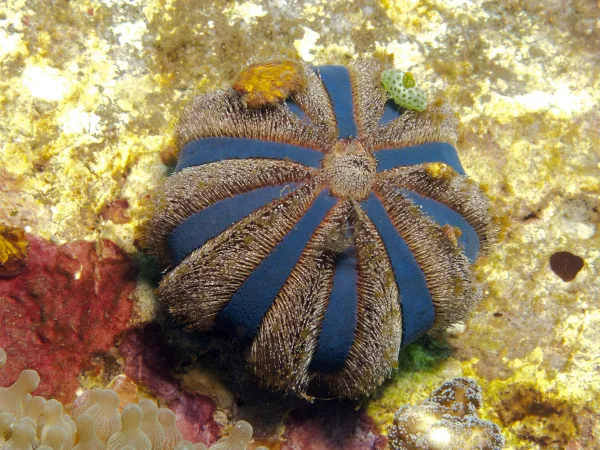
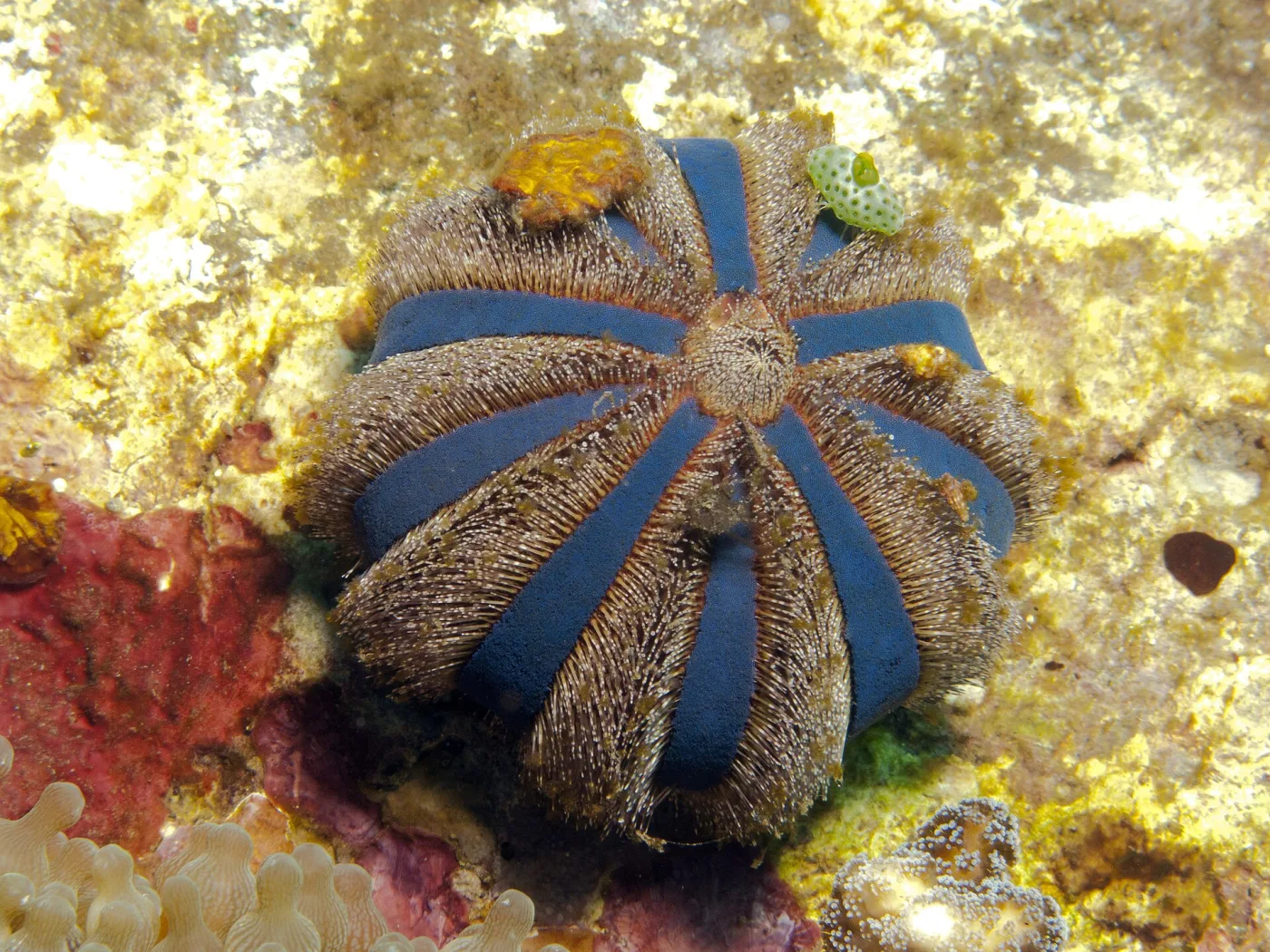
The tuxedo urchin is a small, round sea urchin. It is about the size of a golf ball. It has rows of short, dark spines. In between are smooth stripes of shiny blue or green skin. It looks a bit like a fancy suit, and that is how it got its name. It lives on shallow reefs, broken coral and sea grass in the warm Indian and Pacific Oceans. At night it creeps along on hundreds of tiny tube feet. It scrapes algae off rocks with five little teeth. During the day it often hides. It likes to hold bits of shell, rock or seaweed on its back, like a hat. Scientists think this helps it hide or stay safe. It is gentle and does not eat corals. It makes a fun algae cleaner for a reef tank.
Water & care
Not demanding once settled, but delicate during shipping and the first weeks: it is very intolerant of salinity swings and rough acclimation, which commonly lead to spine loss and death. Drip-acclimate slowly, match salinity, and add it only to a mature tank with plenty of algae-covered rock. Supplement with nori or algae wafers if the rock looks bare. Keep nitrate low and copper out of the system.
| Parameter | Keep it at | Where that sits on the usual reef range |
|---|---|---|
| Temperature | 72–78 °F | |
| Salinity (SG) | 1.023–1.026 | |
| pH | 8.1–8.4 | |
| Alkalinity | 8–12 dKH | |
| Nitrate | 0–10 ppm |
Care guides give 72-78 F, SG 1.021-1.026, pH 8.1-8.4 and 8-12 dKH; aim for a stable reef-normal salinity and never change it quickly. A care guide links spine loss to nitrate above about 10 ppm. Research facilities held adults at about 81 F (27.2 C). Calcium, magnesium and phosphate are not species-specific, so they are left blank: keep normal reef levels. No copper.
Feeding
DietHerbivore
Favorite foods
- Film and filamentous algae on rock and glass
- Coralline algae
- Dried seaweed (nori)
- Algae wafers and spirulina-based foods
Grazes mainly at night. In a mature tank it finds most of its food on the rock; if the rock looks bare, offer a piece of nori or an algae wafer near it once or twice a week, or more often in a lean tank, and remove leftovers the next morning. If fish steal the food, feed after lights-out. It eats a lot for its size and produces a fair amount of waste.
Tank & maintenance
- Minimum tank
- 20 gallons
- Aquascape
- Mature live rock with plenty of algae-covered surfaces and crevices to shelter in by day. Glue frags and keep rockwork stable. A few loose shells, rubble pieces or algae scraps give it something to carry.
- Lighting
- Any; enough light to grow film algae helps feed it. It prefers shaded hiding places during the day.
- Water flow
- Moderate.
Routine upkeep
Check that it is moving and that its spines stand upright; drooping or falling spines are an early warning. Add nori when the rock runs short of algae, re-glue any frags it carries off, and keep salinity steady with daily top-off.
Temperament & tankmates
TemperamentPeaceful
Ignores fish and invertebrates. Several can be kept together if the tank has enough algae to feed them all.
Reef safeYes
Does not eat corals, and in a controlled study its grazing raised juvenile Acropora survival with no abrasion damage. Caveats: it grazes coralline algae along with other algae, and it may pick up and carry small unglued frags, zoanthid polyps, plugs or snails as 'decorations'. Glue frags down.
Good tankmates
- Reef corals (glued down)
- Peaceful reef fish such as clownfish, gobies and wrasses
- Cleaner, peppermint and fire shrimp
- Snails, hermit crabs and other clean-up crew
Avoid
- Triggerfish, parrotfish and other fish that eat urchins
- New tanks or tanks with little algae (it will starve)
- Copper and other invertebrate-unsafe medications
- Acrylic aquariums, if fine grazing scratches matter to you
Help it thrive
- Only add it to a well-established tank with algae growing on the rock.
- Drip-acclimate slowly and keep salinity rock-steady.
- Leave a few loose shells or rubble pieces it can carry; an urchin that carries nothing may be stressed.
- Keep nitrate low, ideally under about 10 ppm.
- Spot-feed nori after lights-out if fish are stealing its food.
Common ailments
Spine loss
- Signs
- Spines droop, lie flat or fall out in patches, exposing the test; the urchin stops moving and loses grip. Often fatal once it spreads.
- Prevention
- Slow drip acclimation, stable salinity and temperature, low nitrate and enough food.
- Treatment
- Test and correct water quality, especially salinity, and keep conditions stable; there is no reliable medication. Remove it promptly if it dies.
Starvation
- Signs
- No fresh grazing trails on the rock, the urchin wanders constantly or becomes inactive, and spines may start to drop.
- Prevention
- Keep it only in a mature tank with algae-covered rock, and do not stock more grazers than the algae can support.
- Treatment
- Offer nori or algae wafers next to it, after lights-out if fish compete.
Parasites
- Signs
- Tiny snails or bumps attached among the spines, or bald patches that slowly spread.
- Prevention
- Inspect closely before buying and quarantine new urchins.
- Treatment
- Remove visible parasites carefully by hand with tweezers; no chemical treatment is known to be safe for urchins.
Copper and medication poisoning
- Signs
- Rapid spine loss and death after a medication was dosed or new equipment was added.
- Prevention
- Never dose copper or invertebrate-unsafe medications in the tank; treat fish in a hospital tank.
- Treatment
- Move it to clean water and remove the medication with activated carbon, resin and water changes.
This is general hobby guidance, not veterinary advice. Quarantine new arrivals and treat in a separate tank whenever you can.
Risks of owning one
- Grazes coralline algae as well as nuisance algae.
- Carries off unglued frags, small polyps, plugs and even snails.
- Starves in new or very clean tanks.
- Sensitive to shipping and acclimation; many losses happen in the first weeks.
- Can scratch acrylic aquariums while grazing.
- Its spines are short and not venomous, but avoid handling it with bare hands.
Breeding
DifficultyHard Captive-bredRare or wild-caught
Sexes are separate but look identical. Spawning is external. In research, a quick temperature rise (adults moved into water at about 31.5 C) or an injection of potassium chloride triggers release of eggs and sperm. The larvae (echinoplutei) feed on cultured microalgae such as Isochrysis or Chaetoceros and begin metamorphosis and settlement about 21-30 days after fertilisation; juveniles graze diatom and cyanobacteria films. This has been done in laboratories and public aquariums but is rarely attempted by hobbyists, and captive-bred animals are not regularly sold.
- Keep several healthy adults together in a stable, mature system.
- In research, spawning is induced by moving adults into warmer water (about 31.5 C) or by injecting potassium chloride solution into the body cavity; after the heat shock, sperm appeared within about 8-12 minutes and eggs about 20 minutes later.
- Fertilise the eggs with a few drops of diluted sperm, then rinse them in clean seawater.
- Rear the larvae in gently stirred clean seawater at about 24-27 C, feeding cultured microalgae from the four-armed larval stage and changing water every couple of days.
- From about day 21 offer surfaces coated in algal film for settlement; juveniles in one study averaged about 1.5 mm across 49 days after settling.
Deep dive The science, history and family tree
The science
Mespilia globulus (Linnaeus, 1758) is a small regular sea urchin of the family Temnopleuridae and the only species in its genus. The test is nearly spherical and usually about 5 cm in diameter, with reports up to about 7 cm. Short spines up to about 2 cm long, usually brown, reddish or dark, are arranged in ten vertical bands that alternate with ten bare, velvety zones coloured iridescent blue to green; this banding gives the trade names 'tuxedo' and 'blue tuxedo' urchin. Like other regular urchins it moves on tube feet and spines and feeds with a five-toothed jaw apparatus (Aristotle's lantern), and it habitually covers its upper surface with shell fragments, pebbles and algae held in place by its tube feet.
The species occurs in the tropical eastern Indian Ocean and west-central Pacific, including the Bay of Bengal and Andaman Islands, Indonesia, the Philippines, China, southern Japan, northern Australia, New Caledonia and other South Pacific islands. It lives on shallow reefs, coral rubble and seagrass beds from the shore to about 60 m, foraging mostly at night on algal films, coralline algae and organic material on hard surfaces and sheltering in crevices by day. It can be parasitised by small snails. Sexes are separate and fertilisation is external. In southern Japan adults are collected ripe in summer (about July to September); the feeding echinopluteus larvae begin metamorphosis about three to four weeks after fertilisation in culture. A 2019 study showed that its grazing greatly increases the survival of juvenile Acropora corals by keeping competing algae down.
- Appearance
- A round, golf-ball-sized urchin, usually 1.5-2 in across, with ten rows of short brown, reddish or black spines separated by ten bare stripes of shimmering blue, blue-green or green skin. Often carries shells, rubble or bits of algae on top. Colour forms sold include blue, green, red and black. Look-alikes: Microcyphus rousseaui (Rousseau's sea urchin) of the Red Sea and western Indian Ocean also has bare zones; most other urchins in the trade, such as Tripneustes (collector urchins) and Lytechinus, have spines covering the whole test.
- Native range
- Tropical eastern Indian Ocean and west-central Pacific: Bay of Bengal and the Andaman and Nicobar Islands, Indonesia (East Indies), the Philippines, China, southern Japan, northern Australia, New Caledonia and South Pacific islands. Type locality given as the Indian Ocean.
- Habitat
- Shallow reef flats and slopes, coral rubble and seagrass beds from the shore to about 60 m (WoRMS). Grazes at night and hides in crevices under rock or coral by day. In parts of its range it is most abundant close to shore during the breeding season and moves slightly offshore the rest of the year.
- Size
- 3 in (7.6 cm). Test usually about 5 cm (2 in) across (Wikipedia); Reef App and Wet Web Media give a maximum of about 7 cm (2.8-3 in). Spines are short, up to about 2 cm.
- Lifespan
- Often about 1-3 years in aquariums according to a hobby care guide, with many losses in the first weeks from shipping and acclimation stress. Wild lifespan not documented.
- Conservation
- Not Evaluated. No IUCN Red List assessment found. The aquarium trade relies almost entirely on wild-collected animals; captive breeding has been done in research and public-aquarium settings (for example Craggs et al. 2019) but is not a regular commercial source
In the aquarium vs in the wild
In your aquarium
Algae-control grazer and colourful oddity for reef tanks; one of the most popular urchins for reefs because it stays small and is gentle on corals.
On the reef
A nocturnal grazer of algal films and organic material on reefs, rubble and seagrass; by cropping algae it can help young corals survive, and it hosts parasitic snails and other small associates such as crabs.
History
Linnaeus named it Echinus globulus in 1758, and Desor created the genus Mespilia for it in 1846; globulus is Latin for a small ball. Many later names, such as Mespilia whitmaei Bell, 1881 and Salmacopsis pulchellimus Yoshiwara, 1898, are now treated as synonyms. Its development has been studied by Japanese and European embryologists since at least the 1920s-1930s, and it remains a model for how urchin larvae build their adult bodies. In the reef hobby it is sold as the tuxedo or blue tuxedo urchin, and in 2019 Craggs and colleagues showed that captive-bred Mespilia grazing alongside juvenile Acropora raised the corals' 180-day survival from about 5% to about 40% at the highest urchin density.
Evolution & relatives
Sea urchins (Echinoidea) are echinoderms, the spiny-skinned group that also includes sea stars, brittle stars and sea cucumbers, and they have a fossil record going back to the Ordovician, more than 450 million years ago. Mespilia belongs to the Camarodonta, the order that contains most familiar 'regular' urchins, including Tripneustes, Lytechinus and Echinometra, and within it to the mainly Indo-Pacific family Temnopleuridae. Its closest relatives are other temnopleurids such as Microcyphus, Salmacis and Temnopleurus. Embryology adds a clue to this grouping: Mespilia builds its adult body inside the larva from a 'cell mass' pinched off the larval skin, a route otherwise seen in Temnopleurus and Genocidaris (both temnopleuroids) but different from the amniotic-cavity route of many other urchins; whether it marks the whole lineage is still unclear.
Family tree, from kingdom down
- Kingdom Animalia Animals Animals are living things made of many cells that must eat food to live. Fish, corals, crabs, snails and sea stars are all animals.
- Phylum Echinodermata Echinoderms Echinoderms are sea animals whose bodies are usually built in five matching parts. They move on hundreds of tiny tube feet, and many have spiny skin.
- Subphylum Echinozoa Sea urchins and sea cucumbers These echinoderms have no arms. Their bodies are shaped like a ball or a sausage, as in sea urchins and sea cucumbers.
- Class Echinoidea Sea urchins Sea urchins have a round shell covered in spines. They chew food with five teeth set in a jaw called Aristotle's lantern.
- Subclass Euechinoidea
- Infraclass Carinacea
- Subterclass Echinacea
- Order Camarodonta Common sea urchins This order holds many of the round, spiny sea urchins people see most often, from rocky shores to reefs.
- Infraorder Temnopleuridea
- Family Temnopleuridae Temnopleurid urchins These sea urchins are usually small and have little pits or grooves on their shells. The tuxedo urchin belongs here.
- Genus Mespilia Tuxedo urchins These small sea urchins have bands of short spines with bare, colorful stripes between them. They often carry bits of shell or algae on their backs.
- Species Mespilia globulus
See it on the Tree of Life Compare with another species
Closest relatives
- Microcyphus rousseaui Rousseau's sea urchin Same family (Temnopleuridae); Red Sea and western Indian Ocean
- Salmacis sphaeroides a Salmacis urchin Same family (Temnopleuridae); Indo-West Pacific
- Temnopleurus toreumaticus a Temnopleurus urchin Same family (Temnopleuridae); Indo-West Pacific
- Tripneustes gratilla Collector urchin Same order (Camarodonta), different family (Toxopneustidae); a larger reef algae grazer
- Lytechinus variegatus Variegated urchin Same order (Camarodonta), different family (Toxopneustidae); Caribbean Read guide · Compare
Older scientific names: Echinus globulus, Mespilia whitmaei, Mespilia globula, Cidaris granulata.
Fun facts
- It is the only species in its genus: there is just one Mespilia.
- The blue stripes are bare skin between the rows of spines, like the satin stripes on a tuxedo.
- It 'wears' bits of shell, rubble and algae, and in aquariums it is sometimes seen carrying a snail or even a coral frag.
- In a 2019 experiment, grazing tuxedo urchins raised baby Acropora survival from about 5% to about 40%.
- Its species name, globulus, is Latin for 'little ball'.
Learn more
- Wikipedia: Mespilia globulus en.wikipedia.org
- Wet Web Media: Sea Urchins part 5 (Temnopleuridae) wetwebmedia.com
- Craggs et al. 2019: co-culturing Mespilia globulus with Acropora millepora (Scientific Reports) pmc.ncbi.nlm.nih.gov
- Reef App: Mespilia globulus (Tuxedo Urchin) reefapp.net
Sources
- WoRMS: Mespilia globulus taxon details, distribution and depth marinespecies.org
- Wikipedia: Mespilia globulus en.wikipedia.org
- Craggs, Guest, Bulling & Sweet 2019, Ex situ co-culturing of Mespilia globulus and Acropora millepora (Scientific Reports) pmc.ncbi.nlm.nih.gov
- Kitazawa et al. 2012, Morphogenesis of adult traits during the early development of Mespilia globulus (Zoological Studies) zoolstud.sinica.edu.tw
- Aquarium Breeder: Tuxedo Urchin care guide aquariumbreeder.com
- Reef App: Mespilia globulus (Tuxedo Urchin) reefapp.net
- Wet Web Media: Some Spines Now! Sea Urchins, part 5 wetwebmedia.com
- Wikipedia: Temnopleuridae en.wikipedia.org
Care facts
The care facts on this guide and its product pages (care level, reef safety, temperament, size, tank, diet, flow, purpose, foods, acclimation and origin) combine 12 independent sources, checked October 25, 2026.
- Tuxedo Urchin - Mespilia globulus LiveAquaria
- ORA Tuxedo Urchin (Assorted Color) Bulk Reef Supply
- Tuxedo Urchin - Mespilia globulus - Small/Medium That Pet Place
- Tuxedo Urchin The Biota Group
- Tuxedo Sea Urchin Care Guide: Mespilia Globulus Algae Grazer Gensou (Singapore retailer)
- 726 Mespilia globulus Meerwasser-Lexikon (ReefLex)
- mespilia globulus ReefApp
- Tuxedo Urchin (Mespilia sp.) Algae Barn
- Tuxedo Urchin (Mespilia globulus) Reeftopia
- Tuxedo Urchin Top Shelf Aquatics
- Tuxedo urchin care guide Gensou (Singapore retailer)
- Mespilia Wikipedia
Scientific names and classification follow the World Register of Marine Species (AphiaID 214476). Last updated October 25, 2026.
Shop this species
Search the shop →Sold out right now. We restock weekly, so check back soon.
Sold out