 Sold out
Invertebrates · Urchin
Pincushion Urchin
Lytechinus variegatus
Also called Pin Cushion Urchin, Variegated Urchin, Variegated Sea Urchin, Green Sea Urchin, Variegated Pincushion Sea Urchin
- CareEasy
- Reef safeYes
- TemperamentPeacefulPeaceful; bulldozes loose frags, eats coralline
- Favorite foods
- Hair and film algae
- Nori / dried seaweed
- Algae wafers
- Max size3.5 in (8.9 cm)
- Min tank30 gal
- LifespanNot documented in the care sheets or…
- IUCN statusNot Evaluated
Quick answers
- How big does the Pincushion Urchin get?
- Up to 3.5 in (8.9 cm).
- What size tank does it need?
- At least 30 gallons.
- How hard is it to keep?
- Care level: Easy.
- Is it reef safe?
- Yes. It does not eat healthy corals and most sellers list it as reef safe, but That Pet Place and SaltwaterAquarium.com say 'with caution': it is a strong, clumsy grazer that knocks over or carries off unglued frags, can damage delicate corals by crawling over them, grazes coralline algae along with nuisance algae and will eat ornamental macroalgae.
- What does it eat?
- Hair and film algae
- Nori / dried seaweed
- Algae wafers
- How long does it live?
- Not documented in the care sheets or papers checked; no reliable captive lifespan figure was found.
- What are good tankmates?
- Reef corals that are glued down
- Peaceful reef fish
- Snails, hermit crabs, copepods and other clean-up crew
- Most other invertebrates
The 30-second version
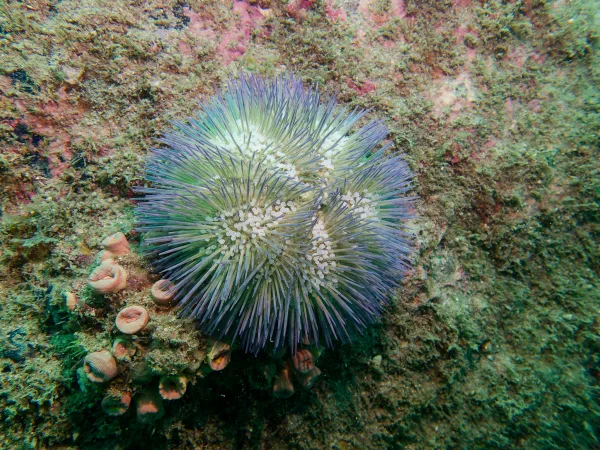
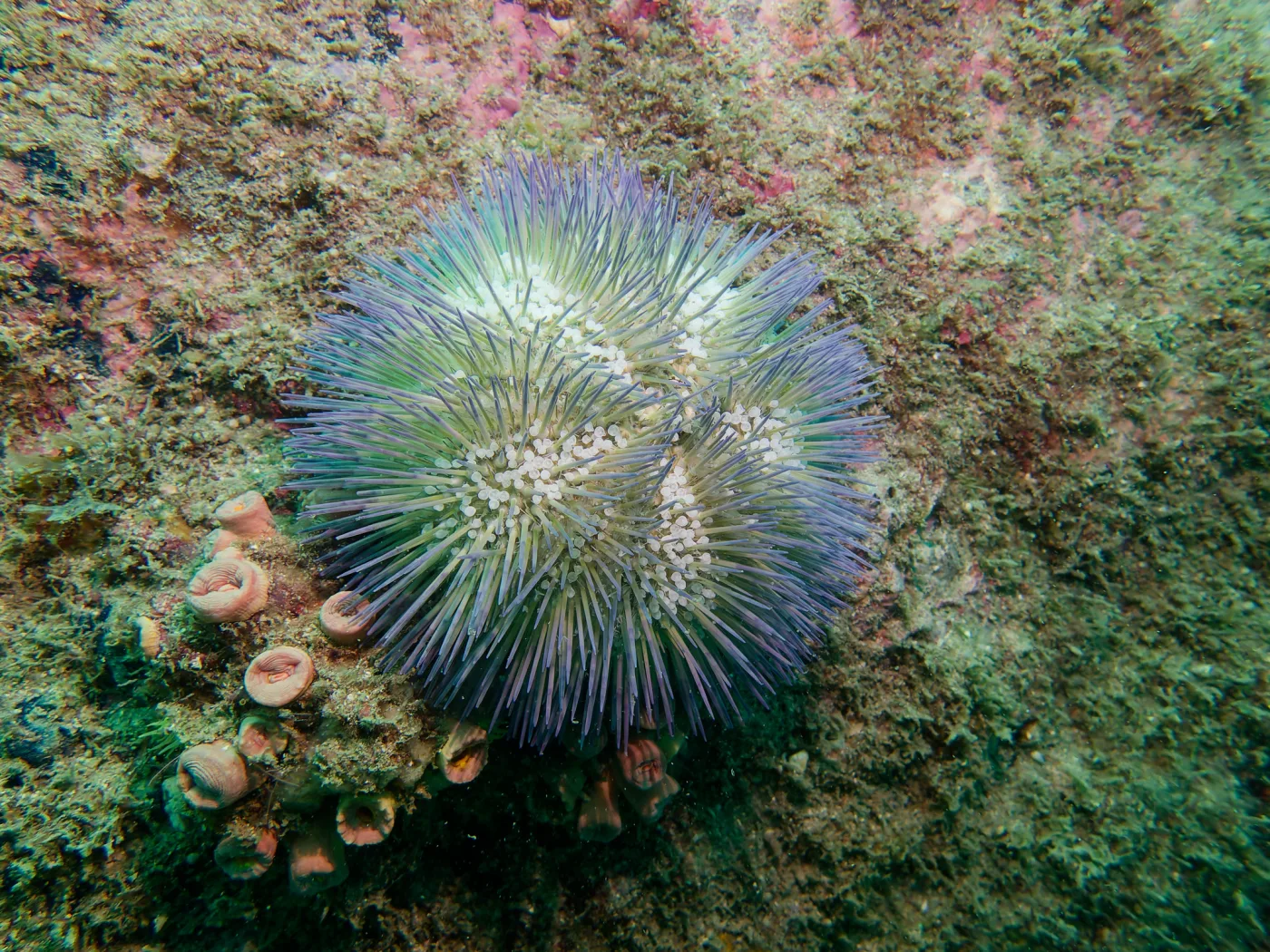
The pincushion urchin is a round sea urchin covered in short spines. It looks like a pincushion full of pins. It can be green, white, purple, red or brown. It lives in warm, shallow water near Florida, in the Gulf of Mexico and around the Caribbean islands. Many live in fields of sea grass. It walks on hundreds of tiny tube feet. It scrapes up algae and old bits of sea grass with five little teeth. It likes to hold shells, stones and bits of weed on its back, like a hat. In a fish tank it is a great algae eater. It is gentle, but it is a bit clumsy. It can knock over small corals that are not glued down.
Water & care
Hardy once settled and not fussy about food or parameters, but it needs a mature tank with algae to graze and stable water. Most care sheets rate it easy; ORA calls it moderate. It is sensitive to salinity changes during acclimation, does not tolerate high nitrate or copper, and drops its spines when water quality is poor or it is starving. Keep rockwork stable, glue frags down and add nori or algae wafers when the rock is grazed bare.
| Parameter | Keep it at | Where that sits on the usual reef range |
|---|---|---|
| Temperature | 72–78 °F | |
| Salinity (SG) | 1.023–1.025 | |
| pH | 8.1–8.4 | |
| Alkalinity | 8–12 dKH | |
| Nitrate | 0–20 ppm |
LiveAquaria, Algae Barn and SaltwaterAquarium.com give 72-78 F, SG 1.023-1.025 and pH 8.1-8.4 (LiveAquaria and Algae Barn add 8-12 dKH); ORA gives 75-78 F, SG 1.023-1.026 and nitrate below 20 ppm; That Pet Place gives 75-82 F. Change salinity only slowly. Calcium, magnesium and phosphate are not species-specific, so they are left blank: keep normal reef levels. No copper.
Feeding
DietHerbivore
Favorite foods
- Hair, film and turf algae on rock and glass
- Dried seaweed (nori)
- Algae wafers
- Macroalgae such as Ulva
- Leftover fish food and detritus
Grazes mainly at night and usually finds enough food in a mature tank with some nuisance algae and leftover fish food. When the rock is grazed clean, offer nori on a clip or under a rock, algae wafers or a piece of Ulva from the refugium a few times a week, and remove leftovers. Spine loss can be a sign of starvation. Do not starve it on purpose: a hungry urchin is more likely to pick at corals or other invertebrates.
Tank & maintenance
- Minimum tank
- 30 gallons
- Aquascape
- Mature, stable live rock with crevices to hide in by day and plenty of grazing surface; it may also bury itself in thick sand. Glue all frags and secure rockwork, since it wedges into gaps and bulldozes loose items. Glass tanks are better than acrylic.
- Lighting
- No needs of its own; light that grows some film and turf algae helps feed it.
- Water flow
- No care sheet states a preference. In the wild it lives in shallow seagrass beds and on sand, mud and rock.
Routine upkeep
Watch that it moves and grazes and that its spines stand upright; drooping or falling spines are an early warning of starvation or poor water. Add nori or algae wafers when the rock is clean, re-glue any frags it knocks loose, and keep salinity steady with daily top-off. Move it by letting it crawl onto a thin plastic sheet rather than pulling it off the rock.
Temperament & tankmates
TemperamentPeaceful
Ignores fish and mobile invertebrates. Generally solitary but tolerates others of its own kind if there is enough algae for all. In a 1974 research aquarium, urchins trapped and ate juvenile fish, so very small or weak fish resting on the bottom are not completely safe.
Reef safeYes
It does not eat healthy corals and most sellers list it as reef safe, but That Pet Place and SaltwaterAquarium.com say 'with caution': it is a strong, clumsy grazer that knocks over or carries off unglued frags, can damage delicate corals by crawling over them, grazes coralline algae along with nuisance algae and will eat ornamental macroalgae. LiveAquaria notes it may also prey on some sessile invertebrates, and a starving urchin may nibble corals.
Good tankmates
- Reef corals that are glued down
- Peaceful reef fish
- Snails, hermit crabs, copepods and other clean-up crew
- Most other invertebrates
Avoid
- Triggerfish, pufferfish and other urchin eaters
- Planted refugiums and prized macroalgae
- New tanks with little algae (it will starve)
- Acrylic tanks, which its teeth can scratch
- Copper and invertebrate-unsafe medications
Help it thrive
- Add it only to a mature tank that already has algae growing.
- Drip-acclimate slowly, at least 60-90 minutes, and keep salinity steady afterwards.
- Glue frags down and keep rockwork stable before adding it.
- Plan on about one urchin per 30 gallons, with snails and copepods to finish the small spaces.
- Feed nori or algae wafers when the rock is grazed bare rather than letting it starve.
Common ailments
Spine loss
- Signs
- Spines droop, lie flat or fall out in patches; the urchin stops moving or loses its grip.
- Prevention
- Slow drip acclimation, stable salinity, low nitrate, no copper and enough food.
- Treatment
- Test and correct water quality and salinity, offer food, and keep conditions stable; there is no reliable medication.
Starvation
- Signs
- Rock looks grazed bare, the urchin wanders constantly or becomes inactive, and spines start to drop.
- Prevention
- Keep it only in a mature tank and do not stock more grazers than the algae can support.
- Treatment
- Offer nori, algae wafers or macroalgae next to it, after lights-out if fish steal the food.
Shipping stress and spawning
- Signs
- Clouds of eggs or sperm in the bag or soon after arrival, followed by weakness.
- Prevention
- Gentle handling and slow acclimation; ORA notes urchins may spawn in transit as a stress response.
- Treatment
- Acclimate slowly and watch water quality after a spawning event.
Copper and medication poisoning
- Signs
- Rapid spine loss and death after copper or another medication was dosed.
- Prevention
- Never dose copper or invertebrate-unsafe medications in its tank; treat fish in a hospital tank.
- Treatment
- Move it to clean, matched water and remove the medication with activated carbon and water changes.
This is general hobby guidance, not veterinary advice. Quarantine new arrivals and treat in a separate tank whenever you can.
Risks of owning one
- Knocks over or carries off unglued frags and loose rock.
- Grazes coralline algae and ornamental macroalgae as well as nuisance algae.
- Can scratch acrylic aquariums while grazing.
- Starves in new or very clean tanks.
- Sensitive to salinity swings during acclimation and to copper.
- Spines are short but can puncture skin; handle with care.
Breeding
DifficultyHard Captive-bredWidely available
Sexes are separate and look identical, and fertilisation is external; the larvae are planktonic plutei that pass through several stages before settling as tiny urchins. LiveAquaria calls it extremely difficult to breed in a home aquarium. The species has long been bred in research and aquaculture labs, and ORA now produces captive-bred animals commercially, but hobby breeding is rarely attempted.
- Keep several healthy adults together in a stable, mature system; males and females cannot be told apart.
- Spawning releases eggs and sperm into the water, sometimes as a stress response during shipping.
- Rearing the planktonic larvae is hatchery or research work, as done by ORA and research labs, rather than home aquarium practice.
- Research labs grow juveniles on prepared feeds; captive-bred stock from ORA is the practical source for hobbyists.
Deep dive The science, history and family tree
The science
Lytechinus variegatus (Lamarck, 1816) is a regular sea urchin of the family Toxopneustidae from the tropical western Atlantic. The test is globular and densely covered in mostly short spines with a few longer primary spines, and reaches about 11 cm (4.3 in) in diameter (SeaLifeBase, Wikipedia). Colour is very variable: the test may be green, purple or dull red with white blotches, and spines may differ in colour from base to tip; green tests with green or white spines are most common in the Caribbean, and aquarium stock is sold in white, tan, green, pink, purple, red, brown and blue forms. Wikipedia lists four subspecies, one of them extinct. It is told apart from the similar jewel urchin, L. williamsi, by its white rather than purple pedicellariae and its larger size.
It is a common littoral and sublittoral urchin from Bermuda and North Carolina through the West Indies to Brazil (Gilmore & Gore 1974), from the shore to about 50 m (SeaLifeBase), living in seagrass meadows, on sandy, muddy and rocky bottoms and on reefs, sometimes at up to 15 per square metre. In Florida turtle-grass beds it is a generalist grazer whose diet follows what is available and palatable; it eats mostly macroalgae and drift plants and avoids chemically defended seaweeds (Beddingfield & McClintock 1999; Cobb & Lawrence 2005), and in St. Joseph Bay dead seagrass showed up on its mouth 4-30 times more often than living seagrass (Parson et al. 2021). It covers itself with algae, seagrass and shell fragments held by its tube feet, which may shade it from strong sunlight. Sexes are separate, fertilisation is external and the larvae are planktonic plutei. The species is widely used in research and aquaculture studies, and ORA developed commercially aquacultured animals for the aquarium trade.
- Appearance
- A round, densely spined urchin, usually sold at 1-2 in across and growing to about 4 in. Spines are short and fairly uniform, giving the 'pincushion' look; colour varies from white, tan and green to pink, purple, red and blue, often with white blotches on the test. It often carries bits of shell, rubble or algae on top. Look-alikes: the jewel urchin (Lytechinus williamsi) is smaller (3-5 cm), has purple pedicellariae, ridged green or white spines and a red or dark brown line along the plate seams.
- Native range
- Tropical and subtropical western Atlantic: Bermuda and North Carolina south through Florida, the Gulf of Mexico, the Bahamas and the Caribbean to Brazil. WoRMS records include Belize, Colombia, Costa Rica, Cuba, the Dominican Republic, Haiti, Honduras, Jamaica, Mexico, Panama, Puerto Rico and Venezuela.
- Habitat
- Shallow, clear water from the shore to about 50 m: turtle-grass (Thalassia) and other seagrass beds, lagoonal mangrove cays, sand and mud bottoms, rock and reef. In St. Joseph Bay, Florida, it was densest (up to about 5 per square metre) at the offshore edge of seagrass beds and moved more than 20 times faster when placed on open sand (Parson et al. 2021). Animals have also been collected from 80 ft (about 24 m) offshore of Fort Pierce, Florida (Gilmore & Gore 1974).
- Size
- 3.5 in (8.9 cm). Test diameter up to about 11 cm (4.3 in) per SeaLifeBase and Wikipedia; ORA gives about 4 in, That Pet Place 3 in excluding spines. LiveAquaria and Algae Barn list 8 in, which is well above any measured size. Usually sold at 0.5-2 in.
- Lifespan
- Not documented in the care sheets or papers checked; no reliable captive lifespan figure was found.
- Conservation
- Not Evaluated. Not evaluated by the IUCN Red List (SeaLifeBase). It is common across its range. Aquarium stock comes both from wild collection in Florida and the Caribbean and from aquaculture (ORA), and captive-bred animals are promoted as a sustainable alternative
In the aquarium vs in the wild
In your aquarium
Clean-up crew grazer for hair, film and turf algae; one of the most popular urchins for reef tanks and among the first urchins to be commercially captive-bred.
On the reef
A common grazer and scavenger of seagrass beds and hard bottoms, eating macroalgae, drift plants and dead seagrass; at very high densities it can strip live seagrass from large areas.
History
Jean-Baptiste de Lamarck described it as Echinus variegatus in 1816. It was later moved through several genera, including Psammechinus and Toxopneustes, before settling in Lytechinus, the genus Alexander Agassiz erected in 1863; WoRMS lists over a dozen old names as synonyms. Florida biologists have long collected it from turtle-grass beds, and in 1974 Gilmore and Gore reported aquarium-held animals from Fort Pierce catching and eating juvenile mullet, a surprise for a supposedly herbivorous urchin. It became a standard laboratory and aquaculture urchin, studied for growth and feed efficiency, and ORA used that background to bring aquacultured pincushion urchins to the aquarium trade.
Evolution & relatives
Lytechinus variegatus is a camarodont urchin of the family Toxopneustidae, the family that also contains Tripneustes, the genus of the collector urchin. Its genus has relatives on both sides of the Americas, such as L. pictus, used in a study of the same covering behaviour, and the jewel urchin L. williamsi of the Caribbean. One subspecies, L. v. plurituberculatus (Kier, 1963), is known only as a fossil. Within Camarodonta it is only distantly related to the Indo-Pacific tuxedo urchin, which belongs to a different family, Temnopleuridae.
Family tree, from kingdom down
- Kingdom Animalia Animals Animals are living things made of many cells that must eat food to live. Fish, corals, crabs, snails and sea stars are all animals.
- Phylum Echinodermata Echinoderms Echinoderms are sea animals whose bodies are usually built in five matching parts. They move on hundreds of tiny tube feet, and many have spiny skin.
- Subphylum Echinozoa Sea urchins and sea cucumbers These echinoderms have no arms. Their bodies are shaped like a ball or a sausage, as in sea urchins and sea cucumbers.
- Class Echinoidea Sea urchins Sea urchins have a round shell covered in spines. They chew food with five teeth set in a jaw called Aristotle's lantern.
- Subclass Euechinoidea
- Infraclass Carinacea
- Subterclass Echinacea
- Order Camarodonta Common sea urchins This order holds many of the round, spiny sea urchins people see most often, from rocky shores to reefs.
- Infraorder Echinidea
- Superfamily Odontophora
- Family Toxopneustidae
- Genus Lytechinus
- Species Lytechinus variegatus
See it on the Tree of Life Compare with another species
Closest relatives
- Lytechinus williamsi Jewel urchin Same genus; smaller Caribbean and Florida Keys reef urchin with purple pedicellariae
- Lytechinus pictus a Lytechinus urchin Same genus; also covers itself with debris, which keeps it from rolling in surge
- Tripneustes ventricosus a Tripneustes urchin Same family (Toxopneustidae); also lives on Florida grass flats
- Tripneustes gratilla Collector urchin Same family (Toxopneustidae); Indo-Pacific aquarium grazer
- Mespilia globulus Tuxedo urchin Same order (Camarodonta), different family (Temnopleuridae) Read guide · Compare
Older scientific names: Echinus variegatus, Psammechinus variegatus, Toxopneustes variegatus, Lytechinus excavatus, Toxopneustes atlanticus.
Fun facts
- It 'wears' shells, stones and bits of seaweed, which may work as a sunshade.
- In 1974 scientists watched a pincushion urchin trap a baby mullet with its spines and eat it.
- In Florida seagrass beds it eats dead seagrass far more often than living blades.
- Its colour varies so much that one species is sold as white, green, purple, red and blue urchins.
- It moves more than 20 times faster across open sand than through seagrass.
Learn more
- Wikipedia: Lytechinus variegatus en.wikipedia.org
- Algae Barn: Pincushion urchins, the clean-up mainstay algaebarn.com
- LiveAquaria: Pincushion Urchin care facts liveaquaria.com
- SeaLifeBase: Lytechinus variegatus sealifebase.se
Sources
- WoRMS: Lytechinus variegatus taxon details, synonyms and distribution marinespecies.org
- SeaLifeBase: Lytechinus variegatus summary sealifebase.se
- Wikipedia: Lytechinus variegatus en.wikipedia.org
- Wikipedia: Lytechinus williamsi en.wikipedia.org
- LiveAquaria: Pincushion Urchin liveaquaria.com
- Bulk Reef Supply: ORA Variegated Urchin bulkreefsupply.com
- That Pet Place: Pin Cushion Urchin, Captive Bred (ORA) thatpetplace.com
- Algae Barn: Pincushion Urchin algaebarn.com
- SaltwaterAquarium.com: Large Pincushion Sea Urchin (Lytechinus sp.) saltwateraquarium.com
- Gilmore & Gore 1974, Observation on a sea urchin capturing a juvenile mullet (Florida Scientist 37) repository.si.edu
- Beddingfield & McClintock 1999, Food resource utilization in Lytechinus variegatus, Saint Joseph Bay (Gulf of Mexico Science 17) aquila.usm.edu
- Cobb & Lawrence 2005, Diets and coexistence of Lytechinus variegatus and Arbacia punctulata (MEPS 295) pure.lib.usf.edu
- Parson, Dirnberger & Mutchler 2021, Dispersion, movement and feeding of Lytechinus variegatus (Gulf and Caribbean Research 32) aquila.usm.edu
- Heflin et al. 2013, Growth rates and production efficiencies in juvenile Lytechinus variegatus (J. Mar. Biol. Assoc. UK) pmc.ncbi.nlm.nih.gov
Care facts
The care facts on this guide and its product pages (care level, reef safety, temperament, size, tank, diet, flow, purpose, foods, acclimation and origin) combine 14 independent sources, checked October 25, 2026.
- Pincushion Urchin (Lytechinus variegatus) LiveAquaria
- ORA Variegated Urchin Bulk Reef Supply / ORA
- Pin Cushion Urchin - Lytechinus variegatus - Captive Bred (ORA) That Pet Place
- Pincushion Urchin (Lytechinus variegatus) Captive Bred ORA Algae Barn
- Smaller White Pin Cushion Urchin (white / pink variety) Fragbox
- Large Pincushion Sea Urchin (Lytechinus sp.) - Cleanup Crew SaltwaterAquarium.com
- Lytechinus variegatus, Green sea urchin SeaLifeBase
- Lytechinus variegatus Wikipedia
- Diets and coexistence of the sea urchins Lytechinus variegatus and Arbacia punctulata (Cobb & Lawrence 2005, MEPS 295: 171-182), abstract University of South Florida / Marine Ecology Progress Series
- Beddingfield & McClintock 1999, Food resource utilization in the sea urchin Lytechinus variegatus in contrasting shallow-water microhabitats of Saint Joseph Bay, Florida (Gulf of Mexico Science 17(1)), abstract Gulf of Mexico Science
- Gilmore & Gore 1974, Observation on a sea urchin capturing a juvenile mullet (Florida Scientist 37(1)) Florida Scientist / Smithsonian Institution
- Heflin et al. 2013, Growth rates are related to production efficiencies in juveniles of the sea urchin Lytechinus variegatus (J. Mar. Biol. Assoc. UK 93: 1673-1683) Journal of the Marine Biological Association of the UK (PMC author manuscript)
- Pincushion Urchins (AlgaeLab blog), with product page algaebarn.com/?p=13720 and article algaebarn.com/?p=699351 Algae Barn
- Some Spines Now! Sea Urchins (and Sand Dollars), the Echinoids, Pt. 6 (Bob Fenner) Wet Web Media
Scientific names and classification follow the World Register of Marine Species (AphiaID 367850). Last updated October 25, 2026.
Shop this species
Search the shop →Sold out right now. We restock weekly, so check back soon.
Sold out