 Sold out
Invertebrates · Snail
Turbo Snail
Turbo fluctuosus
Also called Mexican Turbo Snail, Wavy Turban, Gulf Turban, Eastern Pacific Turban, Turbante del Pacífico
- CareEasy
- Reef safeYes
- TemperamentPeacefulPeaceful grazer; may bulldoze loose rocks and decor
- Favorite foods
- Hair algae
- Diatoms / film algae
- Dried seaweed (nori)
- Max size2 in (5.1 cm)
- Min tank20 gal
- LifespanOften only about 1-2 years in aquariums
- IUCN statusNot Evaluated
Quick answers
- How big does the Turbo Snail get?
- Up to 2 in (5.1 cm).
- What size tank does it need?
- At least 20 gallons.
- How hard is it to keep?
- Care level: Easy.
- Is it reef safe?
- Yes. Does not eat corals, clams or other invertebrates.
- What does it eat?
- Hair algae
- Diatoms / film algae
- Dried seaweed (nori)
- How long does it live?
- Often only about 1-2 years in aquariums (hobby care guides); up to an estimated 3-5 years in the wild, though no formal ageing study was found.
- What are good tankmates?
- Peaceful reef fish that do not eat invertebrates
- Cleaner, peppermint, fire and sexy shrimp
- Other grazing snails such as trochus and cerith snails, in sensible numbers
- Corals that are glued down
The 30-second version
The turbo snail is a big, slow snail with a round shell shaped like a turban, the kind of hat some people wrap around their heads. It comes from the coast of Mexico, where the water is warm but not too hot. A turbo snail works like a little lawn mower. It slides along rocks and glass and scrapes off algae with a tongue covered in tiny teeth. Most of its work happens at night, after the lights go off. It eats a lot, so if the tank runs out of algae it needs extra seaweed or it will go hungry. Turbo snails are strong for their size and sometimes push over loose rocks or corals. If one lands upside down, it may need a helping hand to flip back over. A hard trapdoor on its foot shuts the shell tight when it feels scared.
Water & care
Simple to keep in an established tank with steady algae growth, but less hardy than its reputation. Drip-acclimate over 2-3 hours, because it reacts badly to sudden changes in salinity, pH or temperature. Keep the tank in the cooler half of the reef range if you can; many hobbyists link turbo die-offs to warm tanks. Feed dried seaweed or algae wafers when natural algae runs low, keep copper out of the system, and keep calcium and alkalinity in reef range so the shell can grow. Expect to help an upside-down snail flip over now and then.
| Parameter | Keep it at | Where that sits on the usual reef range |
|---|---|---|
| Temperature | 72–78 °F | |
| Salinity (SG) | 1.023–1.025 | |
| pH | 8.1–8.4 | |
| Alkalinity | 8–12 dKH | |
| Calcium | 350–450 ppm | |
| Nitrate | 0–20 ppm |
Retail care ranges are 72-78 F, SG 1.023-1.025, pH 8.1-8.4 and 8-12 dKH (LiveAquaria). One detailed care guide gives an optimum of about 70-73 F and says it handles heat poorly, so aim for the low-to-middle 70s and avoid summer spikes. Calcium of 350-450 ppm supports shell growth; low pH damages the shell. Very sensitive to copper and to high nitrate. No species-specific magnesium or phosphate data; keep normal reef levels. Stability matters more than any exact number.
Feeding
DietHerbivore
Favorite foods
- Hair and other filamentous algae
- Diatoms and green film algae on glass and rock
- Dried seaweed (nori)
- Algae wafers and herbivore pellets
Grazes almost constantly, mostly at night, and needs a lot of food. A new tank with an algae bloom can support several, but once the bloom is gone they starve unless fed. When the glass and rock stay clean for days, place a small piece of nori or an algae wafer next to the snail. Stock roughly one snail per 5-10 gallons for routine algae control rather than adding dozens at once. It will also pick at leftover pellets, flakes and frozen food.
Tank & maintenance
- Minimum tank
- 20 gallons
- Aquascape
- Established tank with plenty of live rock to graze and crevices to hide in. Rockwork and coral frags must be glued or pinned, because the snail can bulldoze loose pieces. A sand bottom is fine.
- Lighting
- Any reef or fish-only lighting; enough light to grow some film algae helps feed it.
- Water flow
- Tolerates most flow; low to moderate flow is ideal.
Routine upkeep
Check the snails every week or two: flip any that are upside down, and remove any snail whose operculum has fallen away or that smells, since a dead snail fouls water quickly. Keep calcium and alkalinity steady for shell growth, add nori when algae runs short, and re-secure any rock or frags it knocks loose.
Temperament & tankmates
TemperamentPeaceful
Completely peaceful; when disturbed it pulls into its shell and seals it with the operculum. It is more often the victim than the problem: hermit crabs may kill it for its shell, and hungry bumble bee snails may attack weak or upturned turbos.
Reef safeYes
Does not eat corals, clams or other invertebrates. The risk is mechanical: a large turbo bulldozes loose rock, frags and plugs while it grazes, so glue corals and secure rockwork.
Good tankmates
- Peaceful reef fish that do not eat invertebrates
- Cleaner, peppermint, fire and sexy shrimp
- Other grazing snails such as trochus and cerith snails, in sensible numbers
- Corals that are glued down
Avoid
- Hermit crabs (may kill it for its shell)
- Coral banded shrimp and larger crabs
- Snail-eating fish such as triggerfish and puffers
- Copper-based medications
Help it thrive
- Add turbos to a tank that already has algae growing, and add them a few at a time rather than all at once.
- Keep the temperature steady and on the cooler side of reef range; avoid summer heat spikes.
- Drip-acclimate for 2-3 hours and never use copper in the tank.
- When the glass stays spotless for days, feed nori or an algae wafer: a very clean tank can mean a hungry snail.
- Glue down frags and stack rock securely so the snail cannot knock it over or get trapped under it.
Common ailments
Starvation
- Signs
- Snail becomes sluggish, stops climbing, spends days in one spot, and eventually dies after the tank starts to look very clean.
- Prevention
- Stock modestly (about one per 5-10 gallons) and supplement with nori or algae wafers when natural algae runs out.
- Treatment
- Place nori or an algae wafer right beside the snail; reduce the number of grazers or move some to another tank.
Heat stress
- Signs
- Snails become slow, drop off the glass, fail to right themselves, and several die during warm spells.
- Prevention
- Keep temperature stable within 72-78 F, ideally the lower half; use fans or a chiller in summer.
- Treatment
- Bring the temperature down gradually and remove any dead snails promptly.
Acclimation shock
- Signs
- Snail stays retracted or lies on its back for days after purchase; the foot is limp and the operculum does not seal properly.
- Prevention
- Drip-acclimate slowly (2-3 hours) and match salinity and temperature before adding it.
- Treatment
- Set it upright on rock near algae in stable water; there is no medication.
Upside-down stranding
- Signs
- Snail lying on its back on the sand with its foot waving; it struggles to turn over because of its heavy shell and becomes easy prey.
- Prevention
- Keep hermit crabs and snail-picking animals out; build rockwork without slick vertical drops.
- Treatment
- Turn it upright and place it against rock.
Copper poisoning
- Signs
- Sudden deaths of snails and other invertebrates after a medication was dosed or new equipment or decor was added.
- Prevention
- Never dose copper in a tank with invertebrates; treat fish in a separate hospital tank.
- Treatment
- Move survivors to clean water and remove copper with activated carbon or a copper-removing resin and water changes.
This is general hobby guidance, not veterinary advice. Quarantine new arrivals and treat in a separate tank whenever you can.
Risks of owning one
- Large turbos knock over unsecured rocks, frags and plugs.
- Overstocking leads to mass starvation, and dead snails can cause an ammonia spike.
- A short aquarium life is common; many die within 1-2 years, especially in warm tanks.
- Extremely sensitive to copper medications and to sudden changes in water chemistry.
- Wild-collected: supply drops in summer when collection in Mexico pauses.
Breeding
DifficultyVery hard Captive-bredRare or wild-caught
Broadcast spawner with separate sexes that cannot be told apart from outside. In aquariums turbos sometimes spawn at night: males release milky sperm, which prompts females to release eggs, briefly clouding the water. In turban snails the eggs develop into drifting trochophore and veliger larvae that settle within a few days and then graze diatom films. In a display tank nearly all are filtered out or eaten, so juveniles are rarely seen, and no captive breeding of this species for the trade is known.
- Keep several healthy adults together in a mature tank; males and females look the same.
- Spawning, if it happens, is usually at night and briefly turns the water milky; this is normal and not a disease.
- Larvae drift for a few days before settling; in a display tank almost all are lost to pumps, skimmers and filter feeders.
- Raising them would need a separate larval tank and diatom-coated surfaces for settlement; no hobby protocol for this species was found.
Deep dive The science, history and family tree
The science
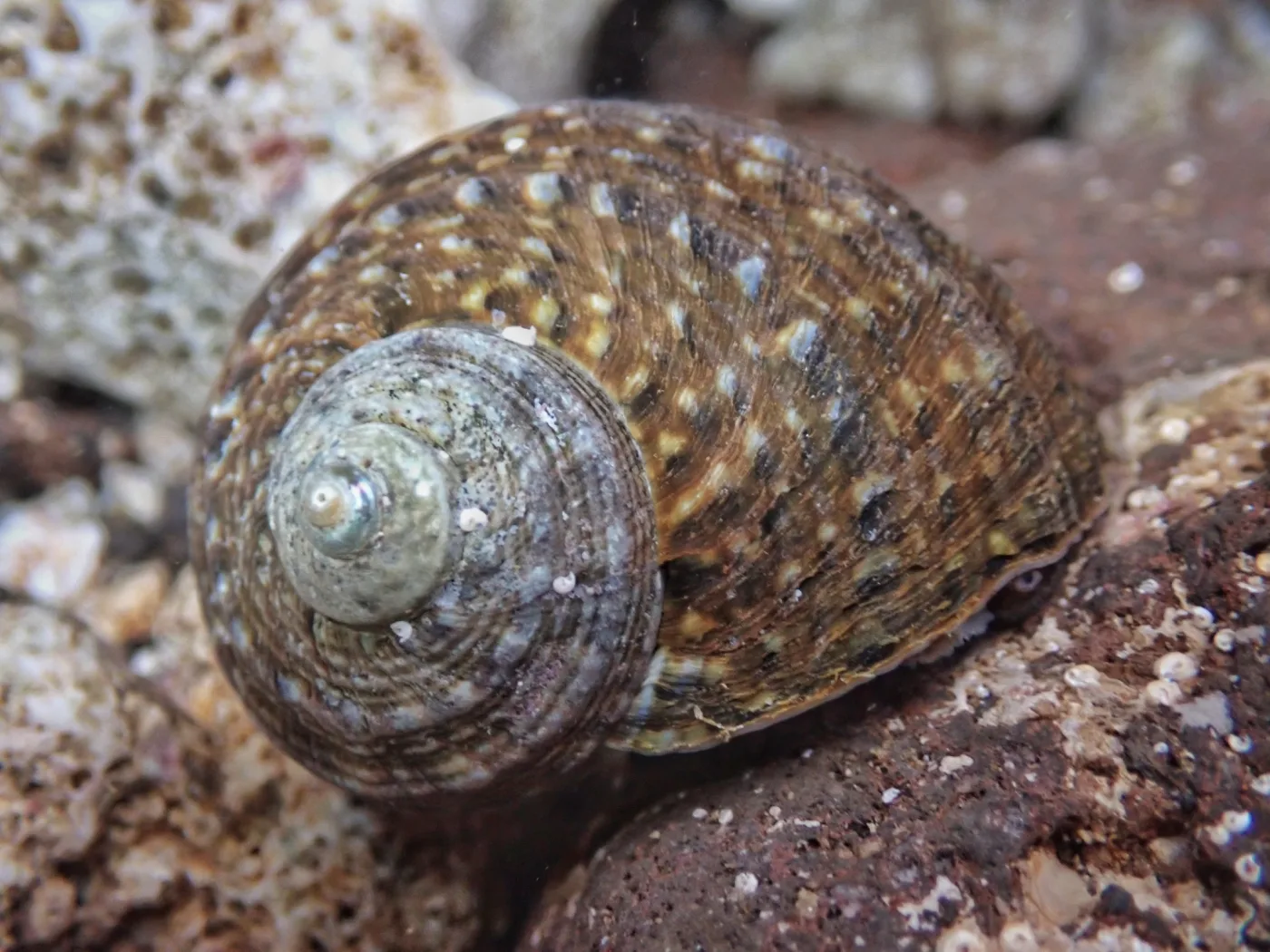
Turbo fluctuosus W. Wood, 1828 is a turban snail (family Turbinidae, subfamily Turbininae) and the type species of Callopoma, now used as a subgenus of Turbo. The shell is solid, imperforate and ovate-conic, with about five whorls that are angled and often knobby at the shoulder and carry spiral ridges ranging from fine threads to coarse, nodular cords. Shell length runs from about 25 to 86 mm. Colour is variable (olive, green, brown, grey, reddish or orange) and usually mottled or tessellated with white and dark brown. The aperture is large and round with an iridescent, nacreous interior and a white, grooved columella. Like other turbinids it seals the aperture with a thick, calcareous, rounded-oval operculum rather than the horny operculum of top snails.
The species lives in the subtropical to tropical eastern Pacific. It is well documented from the Pacific coast of Baja California (around Cedros Island) through the Gulf of California and south along mainland Mexico; some references extend the range to Peru and the Galapagos. It occurs from the intertidal zone to about 40 m on and under rocks and boulders, in crevices and on dead coral covered with algal turf. It is a herbivorous grazer that rasps diatoms, filamentous and turf algae and cyanobacterial films from hard surfaces with its radula, and it is most active at night. Sexes are separate and cannot be told apart externally; fertilisation is external, with gametes released into the water. Aquarium specimens are wild-collected in Mexico, and collection usually pauses in the hottest summer months.
- Appearance
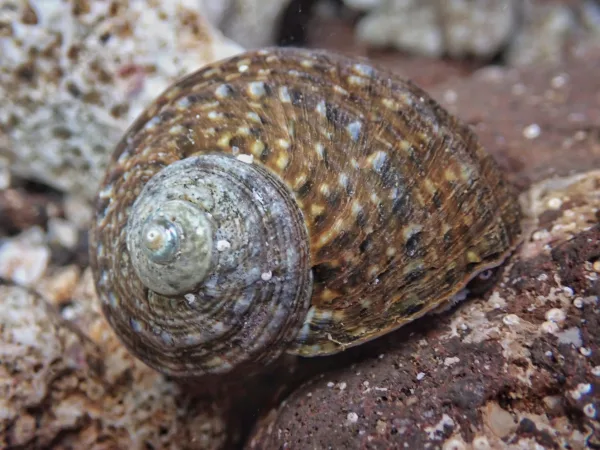
- A heavy, rounded, turban-shaped shell, usually 3/4-2 in in the trade and up to about 3 in in old animals. The outside is olive, brown, grey, greenish, reddish or orange-brown with white and dark mottling, with angled, knobby shoulders and spiral ridges; it is often crusted with coralline algae or covered in film algae. The round opening has a pearly, iridescent lining and is closed by a thick, round, chalky trapdoor (operculum); a closed operculum is a sign of a live snail. Look-alikes: other snails are also sold as 'turbos', including cone-shaped Astraea/Lithopoma 'Astraea turbos' and taller Trochus/Tectus 'giant turbos'; check the scientific name when buying.
- Native range
- Eastern Pacific: Pacific coast of Baja California (from about Cedros Island), throughout the Gulf of California (Sea of Cortez) and south along mainland Mexico. A Mexican shell survey places the southern limit near Puerto Vallarta, while Wikipedia (citing older literature) extends the range to Peru and the Galapagos.
- Habitat
- Rocky shores and reefs from the intertidal zone to about 40 m (Mexican Shells). Lives on and under rocks and boulders, in crevices, and on dead coral and rubble covered with algal turf, sometimes on adjacent sand or mud. Much of its range is subtropical rather than fully tropical, which is one reason hobbyists suspect warm reef tanks shorten its life.
- Size
- 2 in (5.1 cm). Shell length about 25-86 mm (Wikipedia; a Mexican shell survey gives 8.6 cm as the maximum). Trade specimens are usually 3/4-2 in (LiveAquaria), and most aquarium snails stay around 2 in.
- Lifespan
- Often only about 1-2 years in aquariums (hobby care guides); up to an estimated 3-5 years in the wild, though no formal ageing study was found.
- Conservation
- Not Evaluated. No IUCN Red List assessment found. Described as fairly common with a wide distribution; a Mexican shell survey suggests aquarium-trade demand could cause local over-collecting. Collection for export usually pauses in roughly July-September because of summer heat
In the aquarium vs in the wild
In your aquarium
Clean-up crew algae grazer: one of the most popular snails for hair algae, film algae and diatoms on rock and glass.
On the reef
A grazing herbivore of rocky shores and reefs in the eastern Pacific that keeps algal turf and films cropped on hard surfaces.
History
Described by the English naturalist William Wood in 1828 in his Supplement to the Index Testaceologicus. Several later names (Turbo fokkesi Jonas, 1843; T. assimilis Kiener, 1847; T. tessellatus Kiener, 1848; T. fluctuatus Reeve, 1848) are now treated as synonyms. It is the type species (by subsequent designation) of Callopoma, a genus J. E. Gray named in 1850 that WoRMS now treats as a subgenus of Turbo. In the reef hobby it became one of the standard clean-up crew snails, collected along Mexico's Pacific and Gulf of California coasts and sold as the 'Mexican turbo snail', usually under the spelling Turbo fluctuosa.
Evolution & relatives
Turbo belongs to the Vetigastropoda, an old branch of snails that also includes abalones, keyhole limpets and top snails; many vetigastropods line their shells with nacre, which is why the inside of a turbo shell shimmers. Within the superfamily Trochoidea, turban snails (Turbinidae) are told apart from top snails (Trochidae) by their thick, chalky operculum, and the family is thought to have originated in the Permian. A three-gene molecular study of Turbo (Williams 2007) found that the Indo-West Pacific species form a single lineage about 68 million years old and that temperate turban lineages diversified more slowly or suffered more extinction than tropical ones. Turbo fluctuosus is one of a small group of eastern Pacific species; it is probably closest to other eastern Pacific turbans such as T. saxosus, which some authors place with it in subgenus Callopoma, then the wider genus Turbo and other turban snails such as Lunella.
Family tree, from kingdom down
- Kingdom Animalia Animals Animals are living things made of many cells that must eat food to live. Fish, corals, crabs, snails and sea stars are all animals.
- Phylum Mollusca Molluscs Molluscs are soft-bodied animals, and many of them grow a hard shell. Snails, clams and octopuses are all molluscs.
- Class Gastropoda Snails and slugs Gastropods crawl on one big, slimy foot. Most carry a single coiled shell, but sea slugs have lost theirs.
- Subclass Vetigastropoda top snails, turban snails, abalones and kin
- Order Trochida Top and turban snails These sea snails have shells shaped like a spinning top or a turban. Many graze on algae on rocks.
- Superfamily Trochoidea
- Family Turbinidae Turban snails Turban snails have thick, rounded shells. They close the opening with a hard, round lid when they hide.
- Subfamily Turbininae
- Genus Turbo Turbo snails Turbo snails are turban snails with heavy shells and a thick, round lid. They scrape algae off rocks.
- Species Turbo fluctuosus
See it on the Tree of Life Compare with another species
Closest relatives
- Turbo saxosus Stony turban Same genus; eastern Pacific (Panama to Peru), sometimes placed with it in subgenus Callopoma
- Turbo castanea Chestnut turban Same genus; western Atlantic Read guide · Compare
- Turbo bruneus Brown Pacific turban Same genus; Indo-Pacific
- Turbo marmoratus Green turban Same genus; giant Indo-Pacific species raised in hatcheries for restocking
- Lunella cinerea Lunella turban snail Same subfamily (Turbininae); Indo-Pacific
- Lithopoma tectum West Indian starsnail Same family (Turbinidae); Caribbean star snail related to the hobby's 'Astraea' snails
Older scientific names: Turbo fluctuosa, Turbo (Callopoma) fluctuosus, Turbo fluctuatus, Callopoma fluctuatum, Turbo fokkesi, Turbo assimilis, Turbo tessellatus.
Fun facts
- The thick round trapdoor (operculum) of turban snails is so solid that polished ones, mostly from Turbo petholatus, are sold as 'cat's eye' or 'Shiva eye' shells.
- The shimmering lining of its shell is nacre, the same mother-of-pearl material found inside abalone shells.
- When turbos spawn in an aquarium they can turn the water milky for a while; it is eggs and sperm, not a disease.
- Collectors in Mexico usually stop harvesting turbos in the hottest months, so supply drops from about July to September.
- The hobby name 'Turbo fluctuosa' is widespread, but the accepted spelling in the World Register of Marine Species is Turbo fluctuosus.
Learn more
- WoRMS: Turbo fluctuosus W. Wood, 1828 marinespecies.org
- Mexican Shells: Fluctuating Turban Shell mexican-shells.org
- LiveAquaria: Mexican Turbo Snail liveaquaria.com
- Aquarium Breeder: Mexican Turbo Snail care guide aquariumbreeder.com
Sources
- WoRMS: Turbo fluctuosus taxon details and synonyms marinespecies.org
- Wikipedia: Turbo fluctuosus en.wikipedia.org
- Mexican Shells: Fluctuating Turban Shell (range, size, habitat) mexican-shells.org
- LiveAquaria: Mexican Turbo Snail care sheet liveaquaria.com
- Aquarium Breeder: Mexican Turbo Snail detailed guide aquariumbreeder.com
- Fishkeeper: Turbo snail (breeding, acclimation) fishkeeper.co.uk
- Practical Fishkeeping: Keeping turbo and friends practicalfishkeeping.co.uk
- FAO: Marine snails seed production manual, green snail biology fao.org
- Williams 2007, Evolutionary history and biogeography of turban shells (Biol. J. Linn. Soc.), abstract via marineinfo.org marineinfo.org
- WoRMS: Callopoma J. E. Gray, 1850 (type taxon Turbo fluctuosus) marinespecies.org
- Wikipedia: Turbinidae en.wikipedia.org
- Wikipedia: Turbo saxosus en.wikipedia.org
Care facts
The care facts on this guide and its product pages (care level, reef safety, temperament, size, tank, diet, flow, purpose, foods, acclimation and origin) combine 15 independent sources, checked October 25, 2026.
- Mexican Turbo Snail (Turbo fluctuosa) LiveAquaria
- 10 pack large Mexican turbo snail Turbo fluctuosa cleanup crew Saltwater Aquarium
- Turbo Snail Quality Marine
- Turbo Snail (Turbo fluctuosa) STL Marine Solutions
- Mexican Turbo Snail SaltwaterFish.com
- Comprehensive Guide to Turbo Snails for Your Aquarium Top Shelf Aquatics (author Larry Norris, 2025-06-26)
- Turbo Snail Care: Algae-Eating Reef Tank Cleaners Fish Tank Advisor (Peter Herzog)
- Mexican Turbo Snail - Detailed Guide: Care, Diet, and Breeding AquariumBreeder
- Turbo Snail Care Guide: Tank Setup, Diet, and What You Need to Know TankZen (Elena Vargas)
- Turbo Snail Fishkeeper (UK retailer)
- Turbo Snail (Turbo fluctuosus): Care, Placement & Flow | AquaLens AquaLens
- Zebra Turbo Snail (Turbo fluctuosa) Aquarium Arts
- Turbo fluctuosus - Turbo Snail - buy online White Corals
- Mexican Turbo Snails (Turbo fluctuosa): The Ultimate Cleanup Crew for Your Reef Tank AquAnswers
- Mexican Turbo Snail Aquatic Community
Scientific names and classification follow the World Register of Marine Species (AphiaID 413380). Last updated October 25, 2026.
Shop this species
Search the shop →Sold out right now. We restock weekly, so check back soon.
Sold out
 Sold out