Invertebrates · Snail
Chestnut Turbo Snail
Turbo castanea
Also called Chestnut Snail, Chestnut Turban, Orange Turbo Snail, Orange Cat Eye Snail, Turbo Grazer, Cateye Snail, Chevron Snail
- CareEasy
- Reef safeYes
- TemperamentPeacefulPeaceful; smaller than most turbos, rarely topples frags
- Favorite foods
- Film algae / diatoms
- Hair algae (some)
- Dried seaweed (nori)
- Max size2 in (5.1 cm)
- Min tank20 gal
- LifespanAbout 1-3+ years in aquariums
- IUCN statusNot Evaluated
Quick answers
- How big does the Chestnut Turbo Snail get?
- Up to 2 in (5.1 cm).
- What size tank does it need?
- At least 20 gallons.
- How hard is it to keep?
- Care level: Easy.
- Is it reef safe?
- Yes. Does not harm corals, fish or other invertebrates (Saltcorner, LiveAquaria, Top Shelf Aquatics).
- What does it eat?
- Film algae / diatoms
- Hair algae (some)
- Dried seaweed (nori)
- How long does it live?
- About 1-3+ years in aquariums (Top Shelf Aquatics); Saltcorner calls it generally not long-lived in the aquarium.
- What are good tankmates?
- Peaceful reef fish that do not eat invertebrates
- Cleaner and peppermint shrimp
- Other grazing snails in sensible numbers
- Corals that are glued down
The 30-second version
The chestnut turbo snail is a small sea snail with a round, bumpy shell. The shell is brown like a chestnut, often with orange, red or cream spots. It lives in warm, shallow water near the United States and all through the Caribbean Sea. In the wild it crawls over rocks, sand and sea grass. It eats the thin green and brown film that grows on hard things. Its tongue is covered in tiny teeth that scrape the film off. In a fish tank it does the same job on rocks and glass. It works hardest at night. It is smaller than most turbo snails, so it does not knock over rocks or corals as much. If a tank gets too clean, it can go hungry. Then it needs a piece of dried seaweed. A hard little door on its foot shuts the shell when it gets scared.
Water & care
A beginner snail as long as the tank is mature and has steady algae growth. It is sensitive to salinity swings because it comes from very shallow water, so acclimate it slowly. Feed dried seaweed or an algae wafer when algae runs low, keep calcium and alkalinity steady for shell growth, keep nitrate low, and never use copper in the tank.
| Parameter | Keep it at | Where that sits on the usual reef range |
|---|---|---|
| Temperature | 72–78 °F | |
| Salinity (SG) | 1.023–1.025 | |
| pH | 8.1–8.4 | |
| Alkalinity | 8–12 dKH |
LiveAquaria and Quality Marine give 72-78 F, SG 1.023-1.025, pH 8.1-8.4 and 8-12 dKH; Saltcorner gives 72-79 F and pH 8.0-8.4. LiveAquaria lists calcium and magnesium as supplements and says the snail prefers low nitrate, but no source gives species-specific numbers, so keep normal reef levels. Stable salinity matters most. No copper.
Feeding
DietHerbivore
Favorite foods
- Film algae and diatoms on rock and glass
- Hair algae and other soft algae (in moderation)
- Dried seaweed (nori)
- Algae wafers or vegetable-based tablets
Grazes rock and glass, mostly at night but also by day when hungry. Add it to a tank that already has algae. When algae runs short it becomes weak and drops off rocks and glass (Saltcorner); give a small piece of dried seaweed or an algae wafer near the snail, or move it to a tank with more algae before it dies. Quality Marine notes that chestnut turbos mostly eat film algae and detritus and will take some macroalgae. Saltcorner suggests at least one per ten gallons.
Tank & maintenance
- Minimum tank
- 20 gallons
- Aquascape
- Mature tank with plenty of live rock and glass to graze, and crevices to hide in. Glue down frags and light plugs. A lid or protected overflow helps if snails start climbing out.
- Lighting
- Any reef or fish-only lighting; enough light to grow some film algae helps feed it.
- Water flow
- Few sources state a preference; one store recommends moderate, indirect flow so snails can graze without being knocked off.
Routine upkeep
Check snails every week or two: flip any that are upside down, and remove any that have died (a strong smell is the sign), since a dead snail can cause an ammonia spike. Add dried seaweed when the glass stays clean for days, keep calcium and alkalinity steady, and re-secure any frags it knocks loose.
Temperament & tankmates
TemperamentPeaceful
Completely peaceful toward everything in the tank; when disturbed it pulls in and seals the shell with its operculum. It is usually the victim: snail-eating fish, large crabs and big hermit crabs may flip, harass or eat it.
Reef safeYes
Does not harm corals, fish or other invertebrates (Saltcorner, LiveAquaria, Top Shelf Aquatics). Because it stays smaller than most turbos, it is less likely to knock things over (Quality Marine), but it can still push loose frags or light plugs, so glue them down.
Good tankmates
- Peaceful reef fish that do not eat invertebrates
- Cleaner and peppermint shrimp
- Other grazing snails in sensible numbers
- Corals that are glued down
Avoid
- Triggerfish and pufferfish
- Large wrasses that hunt invertebrates
- Large hermit crabs and big crabs
- Copper-based medications
Help it thrive
- Add it only to an established tank with visible algae, and add snails a few at a time.
- Acclimate slowly, matching salinity carefully; it comes from very shallow water and reacts badly to salinity swings.
- When the rock and glass look spotless, feed dried seaweed or an algae wafer.
- Keep calcium and alkalinity steady so the shell keeps growing.
- Never dose copper in a tank with snails; treat fish in a separate tank.
Common ailments
Starvation
- Signs
- Snail becomes weak, drops off rocks and glass, and stays in one place in a very clean tank.
- Prevention
- Stock about one per ten gallons and only in tanks with algae; feed dried seaweed when algae runs short.
- Treatment
- Place dried seaweed or an algae wafer beside the snail, or move it to a tank with more algae.
Acclimation and salinity shock
- Signs
- Snail stays retracted, will not attach, or keeps falling after it is added.
- Prevention
- Acclimate slowly (drip, or add small amounts of tank water every few minutes) and match salinity closely.
- Treatment
- Set it upright on rock in stable water near algae; there is no medication.
Upside-down stranding
- Signs
- Snail lying on its back on the sand, foot waving, unable to turn over.
- Prevention
- Keep snail-flipping hermit crabs and fish out; avoid slick vertical drops in the rockwork.
- Treatment
- Turn it upright and place it against rock.
Copper poisoning
- Signs
- Sudden deaths of snails and other invertebrates after a medication was added.
- Prevention
- Never use copper-based medications in a tank with invertebrates.
- Treatment
- Move survivors to clean water and remove copper with carbon or a copper-removing resin and water changes.
This is general hobby guidance, not veterinary advice. Quarantine new arrivals and treat in a separate tank whenever you can.
Risks of owning one
- Starves in a tank with too little algae if not fed.
- A dead snail left in the tank can cause an ammonia spike.
- Often short-lived in aquariums (about 1-3 years).
- Very sensitive to copper and to sudden salinity changes.
- Sold under loose trade names; 'chestnut snail' is sometimes used for other snails.
Breeding
DifficultyVery hard Captive-bredRare or wild-caught
Males and females look the same (LiveAquaria), and LiveAquaria calls it extremely difficult to breed in an aquarium. One 1992 report to the Breeder's Registry describes a group of roughly 3-year-old adults (16-25 mm) that spawned in the afternoon, weekly to monthly, often after a large water change: they climbed to high points and waved their tentacles, then released tiny sea-green eggs in a loose mucus veil. Juveniles of 2-3 mm appeared 3-6 weeks later, white at first and turning orange or mottled brown and white by about 6 mm. Tanks were kept at 76-80 F, SG 1.022 and pH 8.3. No commercial captive breeding is known; trade animals are wild-collected.
- Keep a group of healthy adults together in a mature tank with plenty of algae-covered rock.
- Spawning may follow a large water change and shows as restless climbing to high points; eggs are released in a loose green mucus veil.
- Keep pumps and filter intakes gentle or screened and avoid filter feeders that eat larvae.
- Watch for tiny white juveniles on rock and glass 3-6 weeks later; leave them algae-covered surfaces to graze.
Deep dive The science, history and family tree
The science
Turbo castanea Gmelin, 1791, the chestnut turban, is a turban snail (family Turbinidae, subfamily Turbininae) of the tropical and warm-temperate western Atlantic. The shell is solid, ovate-conic and has no umbilicus, with a pointed spire and five to six whorls sculptured with spiral rows of beads, sometimes with small spines on the whorl shoulders. Colour is very variable: tan, light brown, orange or grey, often banded or patched with brown, reddish brown, cream or white. The aperture is white, and like other turbinids the animal closes it with a thick, chalky operculum that is white or brown-stained. SeaLifeBase gives a common length of 3.8 cm and a maximum of 5.0 cm; the largest recorded shell is 55 mm. The species ranges from North Carolina to Brazil, including the Gulf of Mexico and the Caribbean, and is abundant and variable across its range. It lives from the shoreline to 141 m, mostly in shallow subtidal water on sand, shell and coral rubble, in seagrass (including turtle-grass beds), algae and ascidian habitats, and in crevices on shallow rocky areas, and it is also known from seamounts and knolls. It is an herbivorous grazer of algal films, diatoms and other small algae, mostly at night. In a 1992 hobby report, captive adults spawned sea-green eggs in a loose mucus veil and small juveniles appeared in the tank weeks later. Aquarium specimens are wild-collected; in Florida it is a listed commercial marine-life species.
- Appearance
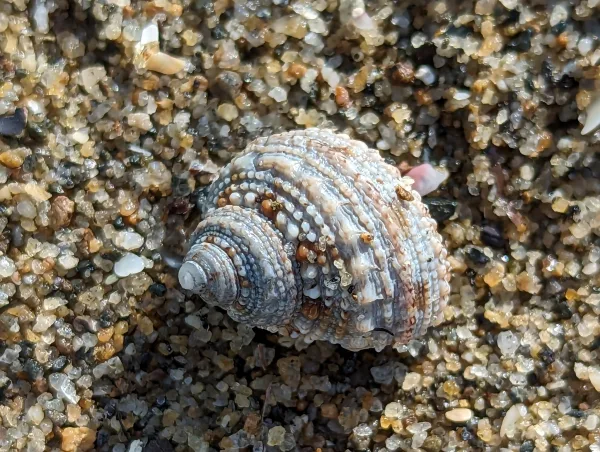
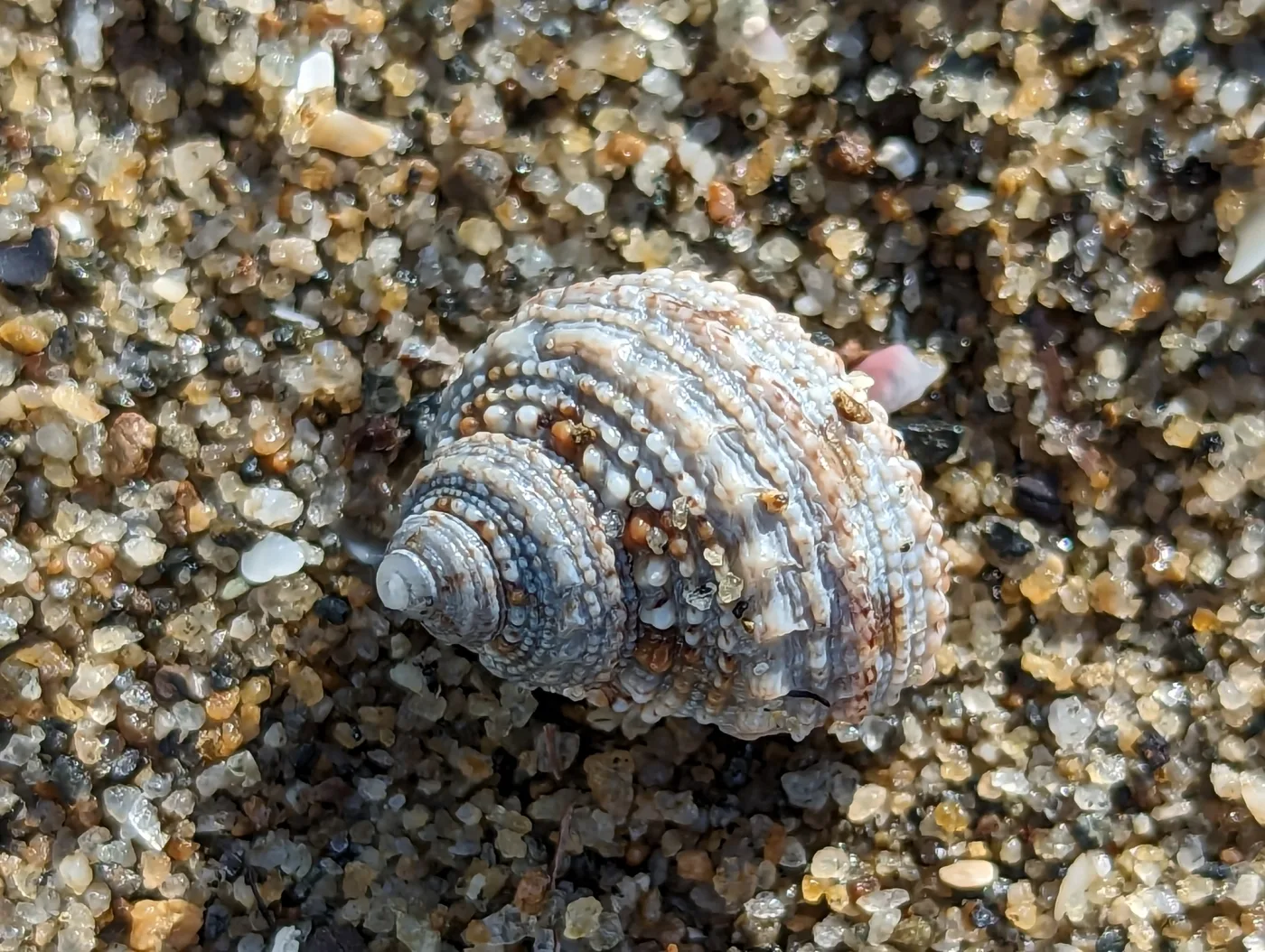
- A small, rounded, top-shaped shell, usually 3/4-1 1/2 in when sold and up to about 2 in. The whorls carry neat spiral rows of beads, and the colour ranges from chestnut brown and tan to orange or grey, patched or banded with reddish brown, cream or white; orange-shelled animals are sometimes sold separately as 'Orange Turbo Snails'. The opening is white and round, closed by a thick, chalky trapdoor (operculum). Look-alikes: the larger, smoother Mexican turbo (Turbo fluctuosus); cone-shaped Astraea/Lithopoma star snails; and Indo-Pacific top snails (Tectus fenestratus), which one Florida store's glossary also calls 'chestnut snails'. Check the scientific name when buying.
- Native range
- Western Atlantic: North Carolina to Brazil, including Florida, the Gulf of Mexico and the Caribbean (Cayman Islands, Cuba, Jamaica, Hispaniola, Puerto Rico, Belize, Costa Rica, Panama, Colombia, Venezuela, Aruba, Bonaire, Curacao). Saltcorner notes that most aquarium animals come from the Caribbean; it is also harvested commercially in Florida.
- Habitat
- Shallow subtidal sand, shell and coral rubble, seagrass and algae beds, often in crevices and holes in rock and reef where algae and diatoms build up (SeaLifeBase, Saltcorner, LiveAquaria). It turns up sporadically in turtle-grass beds and is often seen grazing the shells of larger whelks and horseshoe crabs (Gulf Specimen Marine Lab). Recorded from the intertidal to 141 m and from seamounts and knolls, but most live very shallow, which is why they are sensitive to salinity changes.
- Size
- 2 in (5.1 cm). Retailers (LiveAquaria, Quality Marine, Top Shelf Aquatics, SaltwaterFish.com) and Saltcorner give 2 in (5 cm) as the maximum. SeaLifeBase gives 5.0 cm maximum and 3.8 cm common length; the largest recorded shell is 55 mm (Wikipedia, citing Welch 2010). A Florida marine lab quotes 1-3 cm for local animals. Sold sizes are usually 3/4-1 1/2 in (LiveAquaria).
- Lifespan
- About 1-3+ years in aquariums (Top Shelf Aquatics); Saltcorner calls it generally not long-lived in the aquarium. The broodstock in a 1992 spawning report were about 3 years old.
- Conservation
- Not Evaluated. Not evaluated by the IUCN Red List and not CITES-listed (SeaLifeBase). In Florida it is a reported commercial marine-life species (FWC Marine Life Code 785, harvest requires a Saltwater Products License). Rhyne et al. (2009) showed that Florida's marine-life fishery landed about 6 million algae grazers for aquariums in 2007, with grazer landings rising quickly; that study covers all grazers, not this snail alone
In the aquarium vs in the wild
In your aquarium
Clean-up crew algae grazer for film algae, diatoms and some hair algae on rock and glass; a good choice where bigger turbos would bulldoze frags.
On the reef
A grazing herbivore of shallow rubble, seagrass and rocky bottoms in the western Atlantic that keeps algal films and diatoms cropped, even on the shells of larger snails and horseshoe crabs.
History
Described by Johann Friedrich Gmelin in 1791, in the 13th edition of Linnaeus's Systema Naturae. Because it is common and varies a lot in colour and sculpture, it was named many times: WoRMS treats names such as Turbo crenulatus Gmelin, 1791, T. hippocastanum Lamarck, 1822, T. virens Philippi, 1849, several of Nowell-Usticke's 1959 names and Aorotrema erraticum Pilsbry & McGinty, 1945 as synonyms, and the spelling 'castaneus' as an incorrect form. In the reef hobby it is sold as the chestnut turbo, turbo grazer, cateye or chevron snail, with misspellings such as 'castanae' and 'castenea' common on care sheets. Quality Marine lists it as one of the two turbos commonly seen in North America, beside the Mexican turbo (Turbo fluctuosus), and sells an orange form separately as the 'Orange Turbo Snail'.
Evolution & relatives
Turbo belongs to the Vetigastropoda, an old branch of snails that also includes abalones and top snails. Within the superfamily Trochoidea, turban snails (Turbinidae) are told apart from top snails (Trochidae) by their thick, chalky operculum instead of a horny one, and the family probably originated in the Permian. Turbo castanea has at times been placed in the subgenus Marmarostoma. It is one of the few Turbo species of the western Atlantic; its aquarium cousin the Mexican turbo comes from the eastern Pacific.
Family tree, from kingdom down
- Kingdom Animalia Animals Animals are living things made of many cells that must eat food to live. Fish, corals, crabs, snails and sea stars are all animals.
- Phylum Mollusca Molluscs Molluscs are soft-bodied animals, and many of them grow a hard shell. Snails, clams and octopuses are all molluscs.
- Class Gastropoda Snails and slugs Gastropods crawl on one big, slimy foot. Most carry a single coiled shell, but sea slugs have lost theirs.
- Subclass Vetigastropoda top snails, turban snails, abalones and kin
- Order Trochida Top and turban snails These sea snails have shells shaped like a spinning top or a turban. Many graze on algae on rocks.
- Superfamily Trochoidea
- Family Turbinidae Turban snails Turban snails have thick, rounded shells. They close the opening with a hard, round lid when they hide.
- Subfamily Turbininae
- Genus Turbo Turbo snails Turbo snails are turban snails with heavy shells and a thick, round lid. They scrape algae off rocks.
- Species Turbo castanea
See it on the Tree of Life Compare with another species
Closest relatives
- Turbo fluctuosus Mexican turbo snail Same genus; larger eastern Pacific species, the other turbo commonly sold in North America Read guide · Compare
- Lithopoma tectum Astraea snail Same family (Turbinidae); Caribbean star snail, listed as 'Astraea tectum' beside the chestnut turbo in Saltcorner's Astraea/Turbo group
- Tectus fenestratus Turban snail Not a Turbo; small Indo-Pacific grazer sold as 'Turban Snail' and labelled 'chestnut snail' in one store's glossary
Older scientific names: Turbo castaneus, Turbo castanae, Turbo castenea, Turbo crenulatus, Turbo hippocastanum, Turbo virens, Turbo versicolor, Aorotrema erraticum.
Fun facts
- Its Latin name castanea means chestnut, after the shell's usual colour.
- It has been recorded from the shoreline down to 141 m, though most live in very shallow water.
- In the wild it is often seen grazing algae off the shells of larger whelks and horseshoe crabs.
- Baby chestnut turbos in a 1992 hobby spawning were white at first and only turned orange or mottled brown at about 6 mm.
- WoRMS also lists the English name 'orange cat eye snail' for it.
Learn more
- Saltcorner (Bob Goemans): Turbo castenea mobile.saltcorner.com
- LiveAquaria: Chestnut Turbo Snail liveaquaria.com
- Quality Marine: The Scoop on Snails qualitymarine.com
- SeaLifeBase: Turbo castanea sealifebase.se
Sources
- WoRMS: Turbo castanea Gmelin, 1791 (taxon details, synonyms, vernaculars) marinespecies.org
- SeaLifeBase: Turbo castanea summary sealifebase.se
- Wikipedia: Turbo castanea en.wikipedia.org
- Wikipedia: Turbinidae en.wikipedia.org
- LiveAquaria: Chestnut Turbo Snail care sheet liveaquaria.com
- Quality Marine: Chestnut Turbo Snail qualitymarine.com
- Quality Marine: Orange Turbo Snail (Turbo castanea cf.) qualitymarine.com
- Quality Marine: The Scoop on Snails qualitymarine.com
- Top Shelf Aquatics: Chestnut Snail (Turbo castanea) topshelfaquatics.com
- Tier 1 Reefing: Chestnut Snails (castanea) tier1reefing.com
- Saltcorner (Bob Goemans): Turbo castenea mobile.saltcorner.com
- Gulf Specimen Marine Laboratory: Top Snail/Turbo Snail gulfspecimen.org
- Breeder's Registry: Turbo castanea spawning report (1992) breedersregistry.org
- Florida FWC: Chestnut turban snail marine life code myfwc.com
- Reeflex: Turbo castanea dk.reeflex.net
- Rhyne et al. 2009, Crawling to Collapse (PLoS ONE) journals.plos.org
Care facts
The care facts on this guide and its product pages (care level, reef safety, temperament, size, tank, diet, flow, purpose, foods, acclimation and origin) combine 13 independent sources, checked October 25, 2026.
- Chestnut Turbo Snail (Turbo castanea) LiveAquaria
- Chestnut Turbo Snail (Turbo castanea) Quality Marine
- Chestnut Turbo Snail (Turbo castanea) SaltwaterFish.com
- Chestnut Snail Top Shelf Aquatics
- Turbo castenea (Turbo Grazer, Chestnut Turban, Cateye Snail, Chevron Snail) Saltcorner (Bob Goemans)
- Chestnut Snails (castanea) Tier 1 Reefing
- Top Snail/ Turbo Snail (Turbo castanea) Gulf Specimen Marine Laboratory and Aquarium
- Turbo castanea, Chestnut turban SeaLifeBase
- Turbo castanea Wikipedia
- Turbo castanea (Chestnut Turban, Orange Cat Eye Snail) Reeflex
- Turbo castanea TURCAS-082492-MYKKAT-001 (spawning report) The Breeder's Registry
- Chestnut Snail Invertebrate Care Guide Top Shelf Aquatics
- Chestnut turban snail Florida Fish and Wildlife Conservation Commission
Scientific names and classification follow the World Register of Marine Species (AphiaID 528089). Last updated October 25, 2026.
Shop this species
Search the shop →