 Sold out
Aquacultured
Corals · LPS coral
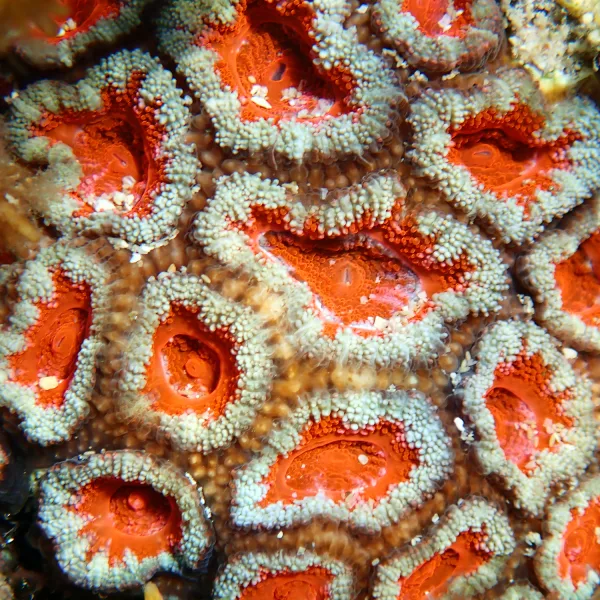
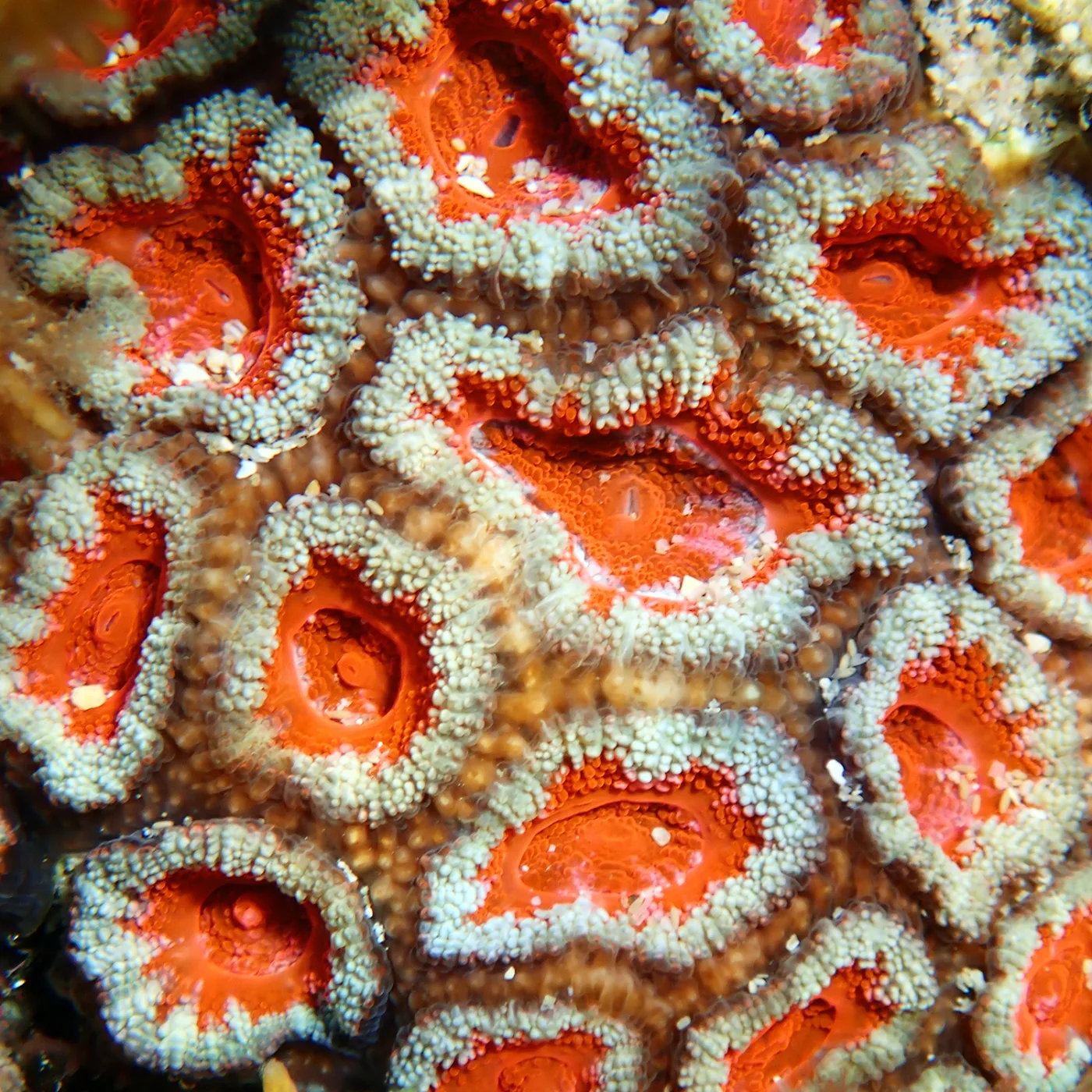
Acan Lord Coral
Micromussa lordhowensis
Also called Acan Lord, Rainbow Acan Lord, Lord, Micro Lord, Acan, Starry cup coral, Closed brain coral
- CareEasy
- Reef safeYes
- TemperamentSemi-aggressiveSemi-aggressive; stinging filaments reach neighbors
- Favorite foods
- Light (zooxanthellae)
- Mysis shrimp
- Brine shrimp
- Min tank20 gal
- LifespanNo fixed lifespan
- IUCN statusEndangered
Quick answers
- What size tank does it need?
- At least 20 gallons.
- How hard is it to keep?
- Care level: Easy.
- Is it reef safe?
- Yes. Harmless to fish and invertebrates and suitable for any reef, but it is a stinging coral.
- What does it eat?
- Light (zooxanthellae)
- Mysis shrimp
- Brine shrimp
- How long does it live?
- No fixed lifespan.
- What are good tankmates?
- Other Micromussa and Homophyllia, with a little space between colonies
- Blastomussa, chalice corals and other low-light LPS
- Zoanthids and mushrooms placed a few inches away
- Peaceful reef fish such as clownfish, gobies and cardinalfish
- Reef-safe snails and small hermit crabs
The 30-second version
The Acan Lord is a coral that looks like a pile of soft, shiny buttons. Each button is a polyp. A polyp is a tiny animal with a mouth in the middle. Lots of polyps live together. They build a hard stone base under them. Lords come in bright colors like red, green, orange, purple, blue and gold. Many have rings or stripes. Tiny living things called algae live inside the coral. They use light to make food for it, a bit like solar panels. At night the polyps puff up. They grab bits of food with short arms called tentacles. Lords like soft light and gentle water. Give them some space, because they can sting corals that grow too close. Their name comes from Lord Howe Island, a small island near Australia.
Water & care
One of the more forgiving LPS corals for a stable, established reef: it tolerates low to moderate light, modest nutrient levels and a range of flow. Its main needs are steady alkalinity and calcium, a spot out of strong direct flow, a little room from neighbors, and small meaty feedings, which visibly speed growth. Many keepers over-light it, and color can change dramatically within a day of a lighting change, so make changes slowly. Growth is slow compared with Duncans or Euphyllia. Ratings vary: LiveAquaria's main product page rates it Moderate (some of its Diver's Den listings say Easy) and Reef Builders calls it relatively easy. It is rated Moderate here because it assumes a cycled reef with stony-coral chemistry under control; it is not a first coral for a brand-new tank.
| Parameter | Keep it at | Where that sits on the usual reef range |
|---|---|---|
| Temperature | 75–78 °F | |
| Salinity (SG) | 1.025–1.026 | |
| pH | 8.1–8.4 | |
| Alkalinity | 8–12 dKH | |
| Calcium | 400–450 ppm | |
| Magnesium | 1,250–1,350 ppm | |
| Nitrate | 5–20 ppm | |
| Phosphate | 0.03–0.1 ppm |
Stability matters more than exact numbers; many keepers aim for the lower half of the alkalinity range (about 8-9.5 dKH). Tissue recession has been reported as nitrate climbs toward 30-50 ppm, while near-zero nitrate and phosphate tend to leave LPS pale and thin. LiveAquaria lists 72-78°F, pH 8.1-8.4, dKH 8-12 and SG 1.023-1.025; Reef Builders gives 75-78°F, 8-12 dKH, calcium 400-450 ppm and magnesium 1250-1350 ppm. The phosphate range and the lower nitrate bound are general LPS practice rather than species-specific data.
Feeding
DietPhotosynthetic
Favorite foods
- Mysis shrimp, chopped to polyp size
- Brine shrimp
- Fine coral foods such as Reef Roids
- LPS pellets (about one per polyp)
- Small pieces of krill
Most energy comes from its zooxanthellae, but Lords are eager eaters and grow faster with target feeding. Spot-feed small meaty foods 1-3 times a week after the lights dim, when the polyps and tentacles extend, and turn the pumps down briefly so food stays put. Keep portions small: overfeeding dry pellets can 'burn' the tissue, and uneaten food raises nitrate and phosphate. Avoid pieces too big for a polyp to swallow.
Tank & maintenance
- Minimum tank
- 20 gallons
- Aquascape
- Lower rockwork or the sand bed, on a stable rock or frag plug, with at least 2 in (5 cm) of open space around it so it can spread outward. Works well in an LPS 'garden' of other low-light corals. No species-specific minimum tank size is published; any stable, mature reef that can give it space will do.
- Lighting
- Low to moderate: roughly 50-150 PAR, and many thrive at only 25-50 PAR (Tidal Gardens). Blue-heavy spectrum brings out fluorescence. Start new frags low and raise light gradually; browning or fading after a move means it is unhappy with the new light.
- Water flow
- Low to moderate, indirect flow that keeps detritus from settling without pinning or tearing tissue. Reduce flow while feeding. Freshly cut frags benefit from slightly stronger flow to clear slime and film from the cut skeleton.
Routine upkeep
Routine reef upkeep: regular partial water changes, testing and dosing alkalinity, calcium and magnesium as the reef's stony coral load requires, and checking nitrate and phosphate whenever you increase feeding. Target-feed 1-3 times a week. Gently blow detritus off the colony with a turkey baster, keep neighbors trimmed back, and watch the outer rim of tissue: shrinking at the edge is an early warning sign.
Temperament & tankmates
TemperamentSemi-aggressive
Not a long-sweeper bully like torch or hammer corals, but it fights for space: night-time tentacles and digestive filaments sting and digest adjacent coral tissue. It is itself vulnerable to stronger stingers such as Euphyllia (torch, hammer, frogspawn) and Galaxea, so keep those well away.
Reef safeYes
Harmless to fish and invertebrates and suitable for any reef, but it is a stinging coral. At night the polyps extend feeding tentacles and can push out digestive filaments that damage corals within a few centimeters, so leave at least 2 in (5 cm) of space, more where flow is variable. Some angelfish and other LPS-picking fish may nip the fleshy polyps.
Good tankmates
- Other Micromussa and Homophyllia, with a little space between colonies
- Blastomussa, chalice corals and other low-light LPS
- Zoanthids and mushrooms placed a few inches away
- Peaceful reef fish such as clownfish, gobies and cardinalfish
- Reef-safe snails and small hermit crabs
Avoid
- Torch, hammer, frogspawn and Galaxea corals within sweeper reach
- Large angelfish and butterflyfish that pick at fleshy LPS
- Strong direct flow aimed at the colony
- Very intense light without slow acclimation
Help it thrive
- Start low: place new frags on the sand or low rock under modest light and only move them up if the color browns out.
- Feed after lights dim, when tentacles are out; a little mysis or fine coral food twice a week makes a visible difference to growth.
- Keep nitrate measurable (roughly 5-20 ppm) and phosphate low but not zero.
- Change lighting slowly; Lords can shift color within a day of a big change.
- Leave room to spread: colonies grow outward by budding new polyps around the edge.
Common ailments
Tissue recession
- Signs
- Tissue pulling back from the skeleton at the colony edge or around individual polyps, exposed white skeleton, shrunken or deflated polyps.
- Prevention
- Stable alkalinity, calcium and magnesium; nitrate kept well below 30 ppm; no strong direct flow; no stinging neighbors within reach.
- Treatment
- Find and fix the cause (parameter swing, high nitrate, sting damage or flow). If recession is spreading quickly, cut the healthy polyps away from the affected area, dip them in a coral-safe iodine dip, and place them in clean, moderate flow.
Light shock and bleaching
- Signs
- Colors fading to pale or white, or polyps shrinking and staying closed, within days of a lighting change or a move higher in the tank.
- Prevention
- Acclimate new corals low and raise intensity gradually; keep within about 50-150 PAR; keep temperature stable.
- Treatment
- Move the coral lower or reduce intensity, keep water stable, and offer light feedings to support recovery while the zooxanthellae recover.
Overfeeding burn and fouling
- Signs
- Polyps that stay closed or slough tissue after heavy pellet feeding, uneaten food rotting on the colony, and algae or cyanobacteria appearing around it.
- Prevention
- Feed small portions sized to each polyp; remove leftovers; test nitrate and phosphate when feeding more.
- Treatment
- Siphon leftover food, cut back feeding, and do a water change; resume with smaller portions once the polyps reopen.
Slime and infection after fragging
- Signs
- Heavy mucus for more than a couple of days, algae or film growing on the cut skeleton, or tissue breaking down along the cut edges.
- Prevention
- Use clean tools, cut between polyps rather than through them, dip frags in a coral-safe iodine solution, and give them medium flow.
- Treatment
- Remove dying tissue, re-dip the frag, clean the cut skeleton, and improve flow around it.
This is general hobby guidance, not veterinary advice. Quarantine new arrivals and treat in a separate tank whenever you can.
Risks of owning one
- Its slime can irritate skin and eyes: wear gloves and eye protection when handling or fragging.
- It stings nearby corals at night with tentacles and digestive filaments, so poor spacing can kill a neighbor or the Lord itself.
- Wild colonies come from a species now assessed as Endangered; captive-grown frags reduce collection pressure.
- Slow growth and high prices for named color morphs make losses expensive; quarantine and inspect new pieces.
- Colors in your tank may differ from photos taken under the seller's lighting.
Propagation & fragging
DifficultyModerate AquaculturedWidely available
Propagated by fragmentation. Colonies grow by budding new polyps, so frags are cut between polyps along the skeletal walls with a coral saw or band saw, mounted on plugs and dipped. Growth back to a colony is slow. The species is a broadcast spawner in the wild, but sexual reproduction plays no part in the aquarium supply.
- Choose a healthy colony with full, plump polyps; wear gloves and safety glasses.
- Cut through the skeleton between polyps along the walls, avoiding the centers of polyps.
- Rinse off debris and dip the frags in a coral-safe iodine dip as directed on the product.
- Glue each piece to a plug or disc with reef-safe gel glue or epoxy.
- Place frags in medium flow under low to moderate light; expect heavy slime for a day or two.
- Target-feed lightly once the polyps reopen; new polyps appear over months, not weeks.
Deep dive The science, history and family tree
The science
Micromussa lordhowensis is a colonial, zooxanthellate large-polyp stony coral in the family Lobophylliidae. Colonies are massive and cerioid, forming flat to domed clumps of tightly packed, laterally compressed corallites of uneven height. Corallite walls are acute, the septa are thick with large teeth, and the columella is weakly developed; corallites reach about 15 mm across. The living tissue forms a thick, fleshy mantle covered in fine papillae, which gives the finely beaded look aquarists know. Color is highly variable (red, purple, green, orange, blue and gold), usually with the walls in a contrasting shade, and single colonies often show several colors at once. The species was described from eastern Australia as Acanthastrea lordhowensis by Veron and Pichon (1982) and moved to Micromussa in 2016, after combined molecular and morphological analysis showed it was unrelated to the type species of Acanthastrea but nested among Micromussa species (Arrigoni et al. 2016). SeaLifeBase gives its range as the western Pacific from Malaysia to Melanesia, north to Japan and south to New South Wales, at 0-30 m, and notes it is especially found in subtropical localities such as Lord Howe Island; some sources give a wider Indo-Pacific range. It gets much of its energy from symbiotic dinoflagellates but is also a predator of zooplankton: polyps expand at night and can extrude digestive (mesenterial) filaments that attack neighboring corals. It is reported to be a hermaphroditic broadcast spawner. The IUCN Red List assesses it as Endangered (criteria A3ce), and like all stony corals it is listed on CITES Appendix II.
- Appearance
- Round to slightly angular polyps about 1-1.5 cm across, packed together like cobblestones over a solid skeleton. Each polyp has a central mouth surrounded by a fleshy, finely beaded disc and a rim (wall) in a contrasting color; short tentacles appear mainly at night or when food is present. 'Rainbow' Lords show three or more colors per polyp. Look-alikes: Micromussa amakusensis (the classic 'micro' acan) has smaller polyps; Homophyllia bowerbanki (sold as Acan bowerbanki or Acan hillae) has larger, more ridged polyps; Acanthastrea echinata has larger, spikier, usually duller polyps; Blastomussa has polyps on separate short tubes rather than a solid mass. Color can shift within days of a lighting change, so a Lord may not look exactly like the seller's photo.
- Native range
- Western Pacific: from Malaysia and Indonesia east to Melanesia, north to southern Japan, and south along eastern Australia to New South Wales and Lord Howe Island. Hobby sources also list Fiji, Tonga, the Solomon Islands and the Great Barrier Reef. Aquarium stock comes mainly from Australia and Indonesia. Some references (e.g. Wikipedia) extend the range west to East Africa and the Red Sea; those records may reflect the broader, pre-2016 concept of the species.
- Habitat
- Shallow reef environments from the surface to about 30 m, and notably present on subtropical, higher-latitude reefs such as those of New South Wales and Lord Howe Island. Grows as low massive colonies attached to hard substrate.
- Size
- . Polyps (corallites) reach about 1.5 cm (0.6 in) across. Wild colonies are massive; Wikipedia reports clumps up to about 2 m across, but no second source was found, so no maximum is given. Aquarium frags are usually sold as a few polyps and grow slowly by adding new polyps at the edge.
- Lifespan
- No fixed lifespan. A colony keeps adding polyps by budding and can persist for many years in a stable aquarium (much longer in the wild) as long as conditions stay good.
- Conservation
- Endangered. Listed as Endangered (A3ce) in recent IUCN Red List updates (assessment dated 11 July 2022); earlier Red List versions carried the 2008 Near Threatened listing. The 2024 IUCN reassessment of reef-building corals found 44% of species threatened, mainly by climate change. All stony corals are on CITES Appendix II, so wild colonies need export permits. Queensland's coral fishery has had species-level harvest limits for M. lordhowensis since 2022. Aquacultured or captive-grown frags are the most sustainable choice
In the aquarium vs in the wild
In your aquarium
A showpiece LPS for the lower reef, prized for multicolored 'rainbow' polyps, traded as named color morphs, and easy to cut into individual polyps for frag swaps.
On the reef
A reef-building stony coral that adds calcium carbonate structure, especially on subtropical reefs, feeds on small zooplankton, and competes for space by stinging and digesting neighboring corals.
History
Described in 1982 by J.E.N. Veron and M. Pichon as Acanthastrea lordhowensis, named after Lord Howe Island off eastern Australia. When large-polyp 'Acans' from Australia first reached the aquarium trade they were rare and costly; Tidal Gardens recalls baseball-sized red or green colonies selling for over $1000 on eBay before wider imports and aquaculture brought prices down and color variety up. In 2016 a combined DNA and skeleton study (Arrigoni et al., Contributions to Zoology) moved the species to Micromussa, so 'Acan Lords' became 'Micro Lords' on paper, though the old name stuck in shops. Because Lords are part of Australia's high-value 'specialty coral' exports, Queensland introduced species-level harvest limits for M. lordhowensis from 2022.
Evolution & relatives
Acan Lords belong to the Lobophylliidae, a family recognized in 2009-2012 after DNA studies showed that the old families Mussidae and Pectiniidae had been built on look-alike skeletons. The Indo-Pacific 'mussids' (Lobophyllia, Acanthastrea, Micromussa and relatives) turned out to be a separate lineage from the Atlantic Mussidae, and they absorbed former pectiniids such as the chalice corals (Echinophyllia, Oxypora). Lobophylliids sit on the 'robust' branch of stony corals (suborder Vacatina), one of the two great stony-coral lineages; molecular clocks suggest those branches separated hundreds of millions of years ago, before the first stony-coral fossils of the Middle Triassic (about 240 million years ago), although exact dates are debated. Within the family, Arrigoni et al. (2016) found M. lordhowensis groups with Micromussa amakusensis and M. multipunctata rather than with Acanthastrea echinata, the type of the genus it was first placed in. On the tree of life, Lords are therefore closer to brain-like and chalice corals than to torches, hammers or Duncans, which sit on the other ('complex', Refertina) branch.
Family tree, from kingdom down
- Kingdom Animalia Animals Animals are living things made of many cells that must eat food to live. Fish, corals, crabs, snails and sea stars are all animals.
- Phylum Cnidaria Cnidarians Cnidarians are soft animals with tentacles. The tentacles have tiny stinging cells. Corals, sea anemones and jellyfish all belong here.
- Subphylum Anthozoa Corals and sea anemones These cnidarians spend their whole lives as polyps: a tube with a mouth ringed by tentacles. Unlike jellyfish, they never swim around as a bell-shaped medusa.
- Class Hexacorallia Hexacorals In this group the tentacles and body parts come in sixes or multiples of six. It includes stony corals, sea anemones, mushroom corals and zoanthids.
- Order Scleractinia Stony corals Stony corals build hard skeletons out of limestone under their soft polyps. Over many years, these skeletons pile up and make coral reefs.
- Suborder Vacatina Robust corals
- Family Lobophylliidae Lobophylliid corals These stony corals have big, fleshy, colorful polyps over a hard skeleton. Acan and Lobo corals belong here.
- Genus Micromussa Micromussa corals Micromussa corals have big, soft, brightly colored polyps on a hard skeleton. The acan lord coral is one of them.
- Species Micromussa lordhowensis
See it on the Tree of Life Compare with another species
Closest relatives
- Micromussa amakusensis Micromussa (micro acan) Same genus; the original 'micro' acan of the hobby
- Micromussa multipunctata Same genus; moved from Montastraea in the same 2016 revision
- Micromussa pacifica Same genus; described as new in 2016 from the Gambier Islands (French Polynesia)
- Homophyllia bowerbanki Acan bowerbanki / Acan hillae Same family; the hobby's 'Acanthastrea hillae' was merged into this species and moved to Homophyllia in 2016
- Homophyllia australis Aussie Scolymia (Scoly) Same family, closely related genus
- Acanthastrea echinata Acan echinata Same family; type species of the genus Lords were originally placed in, but not a close relative
- Lobophyllia Lobo brain coral Same family (type genus of Lobophylliidae) Read guide · Compare
Older scientific names: Acanthastrea lordhowensis.
Fun facts
- Its species name honors Lord Howe Island, a small subtropical island in the Tasman Sea off eastern Australia.
- A Lord's colors can change surprisingly fast: Tidal Gardens reports a coral shifting from red to yellow in under 24 hours after a lighting change.
- At night the polyps can push out digestive filaments, essentially stomach tissue, to digest a neighbor's flesh.
- When Australian Acans first appeared in the trade, a baseball-sized colony could sell for over $1000.
- In 2016 DNA showed that Acan Lords were not really Acanthastrea at all, but the hobby still calls them Acans.
Learn more
- Reef Builders: Introduction to Acan (Micromussa lordhowensis) care reefbuilders.com
- Tidal Gardens: Micromussa coral care tidalgardens.com
- Wikipedia: Micromussa lordhowensis en.wikipedia.org
- WoRMS: Micromussa lordhowensis marinespecies.org
Sources
- WoRMS: Micromussa lordhowensis (Veron & Pichon, 1982) marinespecies.org
- SeaLifeBase: Micromussa lordhowensis sealifebase.se
- Wikipedia: Micromussa lordhowensis en.wikipedia.org
- Wikidata: Micromussa lordhowensis (IUCN status history) wikidata.org
- Coral Trait Database: IUCN category for Micromussa lordhowensis coraltraits.org
- Arrigoni et al. 2016, When forms meet genes: revision of Micromussa and Homophyllia (JCU record) researchonline.jcu.edu.au
- Reef Builders (2016): Acan Lords are now Micromussa lordhowensis reefbuilders.com
- Reef Builders (2025): Introduction to Acan care reefbuilders.com
- Tidal Gardens: Micromussa coral care tidalgardens.com
- Reef Builders (2021): Revised Queensland coral exports approved until 2024 reefbuilders.com
- IUCN (2024): Over 40% of coral species face extinction iucn.org
- Wikipedia: Lobophylliidae en.wikipedia.org
- Okubo 2016, Restructuring the traditional suborders in the order Scleractinia (Zoological Science) bioone.org
- LiveAquaria: Acan Lord Coral, Australia (care facts) liveaquaria.com
- Corals of the World: Acanthastrea lordhowensis factsheet (Veron et al.) coralsoftheworld.org
Care facts
The care facts on this guide and its product pages (care level, reef safety, temperament, size, tank, diet, flow, purpose, foods, acclimation and origin) combine 16 independent sources, checked October 25, 2026.
- Acan Lord Coral (Australia) LiveAquaria
- Grade A Acan Lords Frag Biota
- Acan Lord (Micromussa): Bi-Color Saltwater Aquarium Fish
- Green Acan Frag (Micromussa lordhowensis) Aquarium Depot
- Acan Lord (Micromussa lordhowensis) Reeflings
- Micromussa lordhowensis Coral Care Guide Reef Chasers
- Micromussa Coral Care Extreme Corals
- Micromussa Coral Care and Identification Guide Coral Identifier
- Introduction To Acan (Micromussa lordhowensis) Care Reef Builders
- Acan Coral Micromussa Lordhowensis Care Gensou
- Acan Coral Care Guide Whitlyn Aquatics
- Micromussa Lord Lord Coral is a must have for your reef aquarium Reef Supplies
- Micromussa lordhowensis Algae Barn
- Green Aussie Lord - World Wide Corals Bulk Reef Supply
- Bright Eye Micromussa Acan Coral Top Shelf Aquatics
- Micromussa Coral Care Tidal Gardens
Scientific names and classification follow the World Register of Marine Species (AphiaID 886929). Last updated October 25, 2026.
Shop this species
Search the shop →Sold out right now. We restock weekly, so check back soon.
Sold out
Aquacultured