 Sold out
Fish · Basslet
Royal Gramma
Gramma loreto
Also called Fairy Basslet, Royal Gramma Basslet
- CareEasy
- Reef safeYes
- TemperamentPeacefulTerritorial toward own kind and look-alikes
- Favorite foods
- Mysis shrimp
- Brine shrimp
- Marine pellets
- Max size3.5 in (8.9 cm)
- Min tank30 gal
- LifespanAbout 5-6 years in aquariums with good…
- IUCN statusLeast Concern
Quick answers
- How big does the Royal Gramma get?
- Up to 3.5 in (8.9 cm).
- What size tank does it need?
- At least 30 gallons.
- How hard is it to keep?
- Care level: Easy.
- Is it reef safe?
- Yes. Ignores corals and clams.
- What does it eat?
- Mysis shrimp
- Brine shrimp
- Marine pellets
- How long does it live?
- About 5-6 years in aquariums with good care (Aquariadise); not well documented beyond that.
- What are good tankmates?
- Clownfish
- Gobies
- Firefish
- Cardinalfish
- Chromis
The 30-second version
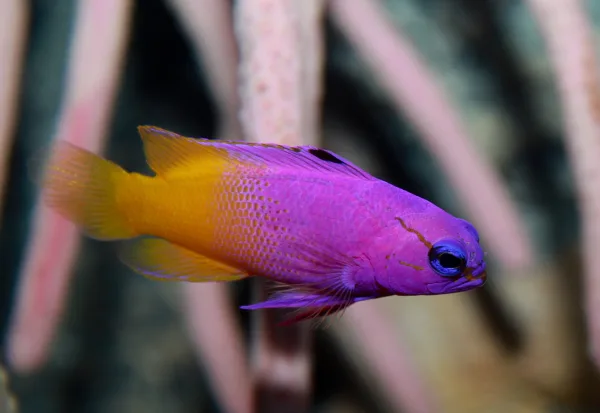
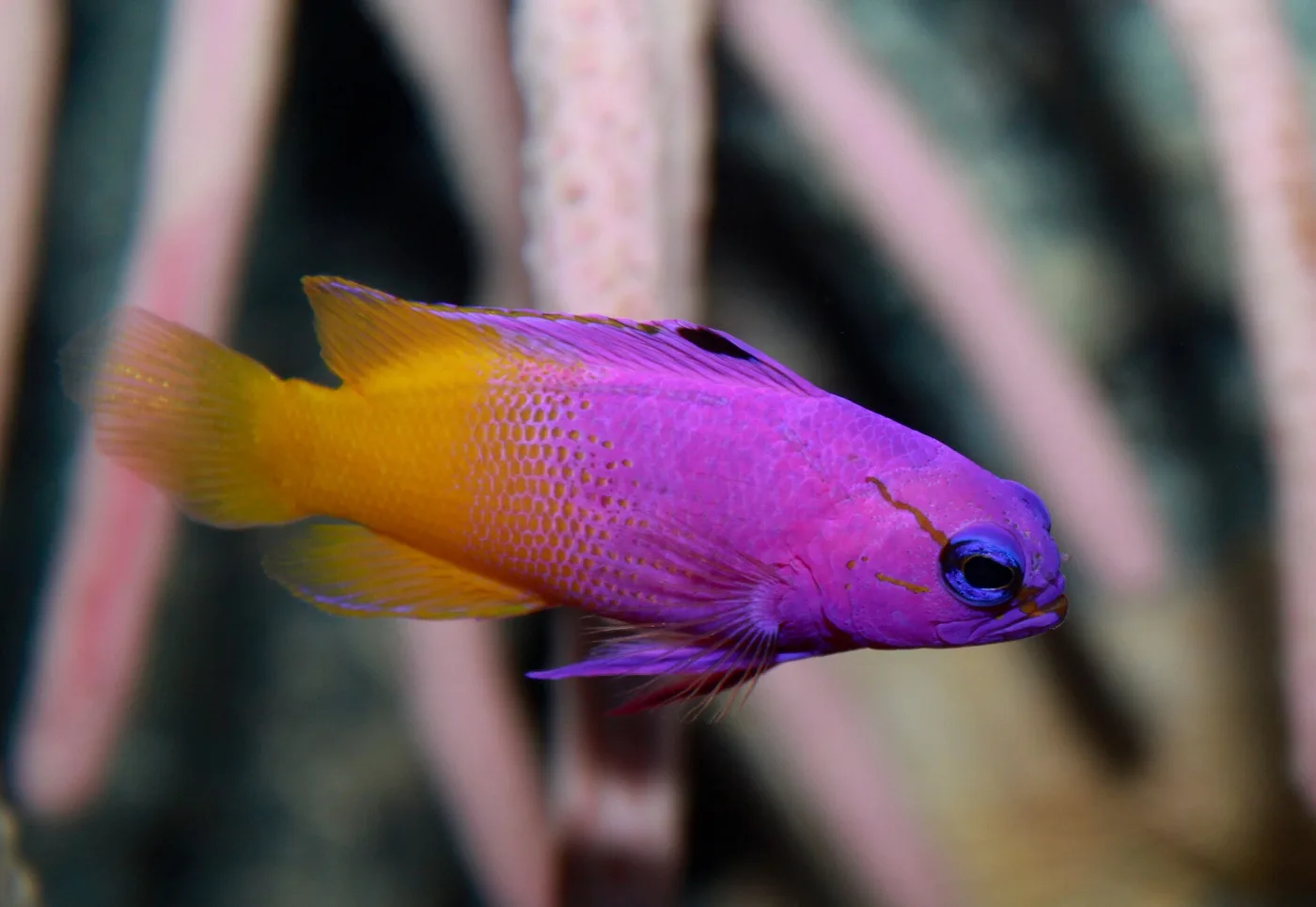
The Royal Gramma is a small fish from the Caribbean Sea that looks like it was dipped in two cans of paint. The front half is bright purple and the back half is sunny yellow. It has a thin black line through its eye and a black dot on the fin on its back. In the wild it lives in caves and under rocky ledges. Here is the funny part: it always keeps its belly toward the nearest rock, so under a ledge it swims upside down! That is normal, not a sign that it is sick. It snaps up tiny floating animals, and it sometimes picks pests off other fish, too. Dad grammas build nests out of bits of algae and guard the eggs. It is gentle and tough, which makes it a great first fish.
Water & care
Hardy, small and colorful: an excellent beginner and nano-reef fish once it has a cave of its own. It needs small meaty foods at least daily (ideally several times), rockwork with caves, a covered tank and tankmates that will not bully it. Its colors fade when water quality slips, which makes it a handy early warning.
| Parameter | Keep it at | Where that sits on the usual reef range |
|---|---|---|
| Temperature | 72–80 °F | |
| Salinity (SG) | 1.020–1.025 | |
| pH | 8.1–8.4 | |
| Alkalinity | 8–12 dKH |
LiveAquaria gives 72-78 F and Aquariadise 72-80 F; FishBase records 22-27 C (about 72-81 F) in the wild. In a reef, follow your corals' targets for salinity, calcium, magnesium and nutrients. Ammonia and nitrite must stay at zero; fading color is a sign that water quality is slipping.
Feeding
DietCarnivore
Favorite foods
- Mysis shrimp
- Enriched brine shrimp
- Copepods (live or frozen)
- Small marine pellets
- Quality marine flake food
- Finely chopped seafood
Feed small meaty foods two or three times a day if possible; once a day is acceptable. It grabs food drifting past its cave in the middle of the water column, so feed where it can reach and avoid letting faster fish take everything.
Tank & maintenance
- Minimum tank
- 30 gallons
- Aquascape
- Rockwork with plenty of caves, overhangs and crevices; each gramma needs its own cave. Pieces of PVC pipe work as caves in breeding setups.
- Lighting
- Prefers subdued light or shaded areas under ledges (LiveAquaria); it does fine under reef lighting as long as shade and caves are available.
- Water flow
- Low to moderate around its cave so it can hover and pick food from the water.
Routine upkeep
Test weekly and change about 10 percent of the water weekly (Aquariadise). Keep the lid secure, watch its color as a water-quality indicator, and make sure it is getting food past faster tankmates.
Temperament & tankmates
TemperamentPeaceful
Peaceful toward similar-sized fish of other kinds, but very territorial over its cave. It fights with other royal grammas (except a mated pair, or a planned group in a large tank with many caves), other basslets and dottybacks, and may chase fish that try to take its spot.
Reef safeYes
Ignores corals and clams. It picks at tiny crustaceans and worms, so it helps keep small benthic critters in check, but it does not bother typical cleanup-crew invertebrates.
Good tankmates
- Clownfish
- Gobies
- Firefish
- Cardinalfish
- Chromis
- Small reef-safe wrasses
Avoid
- Another royal gramma, unless a pair or a large tank with many caves
- Dottybacks, such as the Royal and Orchid Dottybacks
- Other basslets and look-alike purple fish, including the Bicolor Blenny
- Large predators: lionfish, groupers, eels and snappers
Help it thrive
- Give it a cave before adding other fish so it has a home to settle into.
- Add it before, or instead of, dottybacks and other cave-guarding fish.
- Feed mysis and other small meaty foods at least twice a day where it can reach them.
- Use a lid: it will jump.
- Plan a pair, or a group in a large tank with many caves, rather than adding two random fish.
Common ailments
Marine ich (Cryptocaryon irritans)
- Signs
- White salt-grain spots, scratching on rocks, rapid breathing, hanging at the surface and cloudy eyes.
- Prevention
- Quarantine new fish for several weeks and avoid stress from bullies or unstable water.
- Treatment
- Treat in a hospital tank, never the reef, with a copper-based medication (follow the product's directions and test copper levels) or carefully monitored hyposalinity, for the full course. Leave the display without fish for several weeks so the parasite dies off.
Bacterial infections (fin rot and similar)
- Signs
- Frayed or reddened fins, red patches or sores, cloudy eyes and loss of appetite.
- Prevention
- Good water quality, regular water changes and peaceful tankmates.
- Treatment
- Move it to a hospital tank, improve water quality and use an antibiotic labeled for marine fish as directed.
Stress and color loss
- Signs
- Faded purple and yellow, constant hiding, refusing food.
- Prevention
- Stable, clean water, its own cave, and no aggressive or look-alike tankmates.
- Treatment
- Test and correct the water, remove bullies, add caves and feed a varied meaty diet; color usually returns once the cause is fixed.
This is general hobby guidance, not veterinary advice. Quarantine new arrivals and treat in a separate tank whenever you can.
Risks of owning one
- It jumps out of uncovered tanks.
- Territorial fights with its own kind, other basslets and dottybacks.
- Easy to confuse with the more aggressive Royal (Bicolor) Dottyback when buying.
- It can be bullied out of food by fast, boisterous fish, or eaten by large predators.
Breeding
DifficultyModerate Captive-bredWidely available
The male builds a nest in a cave or crevice, lines it with bits of algae and lures the female inside. She lays small clutches, reported from about 5-40 eggs up to 100 or more, often daily. The roughly 1 mm eggs carry sticky threads that tie them to the nest material, and the male guards and cleans the nest. The eggs hatch after about 5-7 days, usually after dusk. Larvae are reared on rotifers or copepods, then newly hatched Artemia, and metamorphose into juveniles at about 21-30 days. C-Quest called it easy to spawn and a good species to try after clownfish; the hard part is rearing the larvae.
- Obtain a pair (males are larger, with longer pelvic fins) and house them in a stable tank with one cave with a small entrance, or a PVC pipe.
- Feed heavily with varied meaty foods; offer algae fragments for nest building.
- Watch for the male lining the nest and courting the female; spawns may come daily.
- Collect the larvae at hatching (after dark) into a separate rearing tank.
- Feed enriched rotifers or copepods first, then enriched newly hatched Artemia.
- Expect juveniles to settle and color up at about three to four weeks; survival of 25 percent is a good result.
Deep dive The science, history and family tree
The science
Gramma loreto is a small basslet (Grammatidae) of the tropical western Atlantic, ranging from Bermuda and the Bahamas through the Caribbean and Central America to northern South America. It reaches about 8 cm total length and matures at around 3 cm. The body is fusiform and strikingly bicoloured: violet to purple in front (appearing blue underwater), grading into golden yellow behind, with a dark oblique line from the lower lip through the eye and a small black spot at the front of the dorsal fin (12 spines, 10 soft rays). Like other grammatids it has a broken lateral line. It is reef-associated at about 1-60 m, usually 1-40 m, in water of about 22-27 C. Individuals hover in caves and under ledges, orienting the belly toward the nearest surface so that fish under overhangs swim upside down, and retreat into recesses when alarmed. The diet consists mainly of zooplankton and small crustaceans picked from the water near the shelter, and the species also removes ectoparasites from other fishes. Before spawning, males establish nests in small holes and crevices, line them with pieces of algae and court females, which visit to lay small clutches of eggs bearing adhesive threads; the male guards and maintains the nest, and the eggs hatch after about 5-7 days, usually after dark. The species is assessed as Least Concern and has been bred in captivity for decades.
- Appearance
- Front half purple to violet, blending smoothly into a golden yellow rear half; a dark line runs from the lower lip through the eye, and a black spot sits on the front of the dorsal fin. Males are usually larger, with longer pelvic fins. Look-alikes: the Royal (Bicolor) Dottyback, Pictichromis paccagnellae, has a sharp break between magenta and yellow instead of a fade, clear fins and a much feistier temper. The Bicolor Blenny shares the two-tone look but perches on rocks instead of hovering.
- Native range
- Tropical western Atlantic: Bermuda and the Bahamas through the Caribbean (including the Antilles) and Central America to northern South America (Venezuela).
- Habitat
- Caves, crevices and the undersides of ledges on coral reefs at about 1-60 m (3-197 ft), usually 1-40 m. Each fish holds its own hole or overhang and hovers near it, often upside down, darting inside when alarmed.
- Size
- 3.5 in (8.9 cm). FishBase gives 8 cm (3.1 in) total length as the maximum, with maturity from about 3 cm. Retailers list 3 in; males grow slightly larger than females.
- Lifespan
- About 5-6 years in aquariums with good care (Aquariadise); not well documented beyond that.
- Conservation
- Least Concern. Least Concern; widespread and common. Not CITES-listed. Many specimens in the trade are still collected in the Caribbean, but captive-bred fish are produced (C-Quest in Puerto Rico in the early 1990s; Batavia Coast Maritime Institute in 2016; ProAquatix fish sold through LiveAquaria today)
In the aquarium vs in the wild
In your aquarium
A colorful, hardy beginner and nano-reef fish that brings color to the lower rockwork and may pick off small benthic worms and crustaceans.
On the reef
A small cave-dwelling plankton feeder on Caribbean reefs that also acts as a part-time cleaner, removing parasites from other fish; prey for larger reef predators.
History
Felipe Poey described Gramma loreto in 1868 in his Synopsis piscium cubensium; TFH gives Matanzas, Cuba as the type locality. It has been bred in captivity for decades. C-Quest in Puerto Rico reported routine spawning and rearing from 35 broodstock pairs in a 1993 Breeders Registry report, and in 2016 Australia's Batavia Coast Maritime Institute reported its first large settlement of captive-bred juveniles; Quality Marine received some but offered them only to public aquariums and educational facilities. Captive-bred fish from ProAquatix are now sold by retailers such as LiveAquaria. Its color, small size and hardiness have made it a staple beginner fish for decades.
Evolution & relatives
Grammatidae, the basslets, contains just two genera found only in the western Atlantic: Gramma, with five species, and Lipogramma. Basslets were once lumped with the perch-like fishes (Perciformes). Molecular studies now place them in Ovalentaria, a large branch of spiny-rayed fishes united by eggs attached to the bottom; WoRMS lists the family as incertae sedis (position not settled) within Ovalentaria, while the Catalog of Fishes includes it in an expanded Blenniiformes alongside dottybacks, jawfishes, damselfishes and blennies. On a tree of life, the royal gramma therefore sits near the dottybacks and not far from clownfish and blennies, but far from gobies and from the anthias and groupers (Serranidae) that are sometimes also called basslets. The Indo-Pacific dottybacks fill a similar cave-dwelling role, and some, like the Royal Dottyback, wear strikingly similar purple and yellow colors although they belong to a different family. Its closest relatives are the other four Gramma species.
Family tree, from kingdom down
- Kingdom Animalia Animals Animals are living things made of many cells that must eat food to live. Fish, corals, crabs, snails and sea stars are all animals.
- Phylum Chordata Chordates Chordates have a stiff rod running down their back at some point in their lives. In fish and people, this rod is replaced by a backbone.
- Subphylum Vertebrata Vertebrates Vertebrates are animals with a backbone and a skull. Fish, frogs, birds and people are all vertebrates.
- Infraphylum Gnathostomata jawed vertebrates
- Parvphylum Osteichthyes bony fishes
- Gigaclass Actinopterygii ray-finned fishes
- Superclass Actinopteri
- Class Teleostei Teleost fishes Teleosts are bony fishes with thin, bendy fin rays and jaws that can push forward. Almost all of the fish in the world are teleosts.
- Order Ovalentaria (unplaced) Unplaced ovalentarian fishes Ovalentaria is a big group of fish with spiny fins. Scientists found it by studying DNA, and most of its fish lay eggs that stay stuck to the bottom. 'Incertae sedis' means 'place not sure': scientists have not settled which order damselfishes, dottybacks and basslets belong in.
- Family Grammatidae Basslets Basslets are small, brightly colored fish from the western Atlantic. They often hang upside down under ledges.
- Genus Gramma Grammas Grammas are small, colorful basslets from the Caribbean. The royal gramma is purple in front and yellow at the back.
- Species Gramma loreto
See it on the Tree of Life Compare with another species
Closest relatives
- Gramma melacara Blackcap Basslet Same genus
- Gramma dejongi Golden Basslet Same genus; a Cuban species first captive-bred by Todd Gardner (reported 2017)
- Gramma linki Yellowlined Basslet Same genus
- Gramma brasiliensis Brazilian Basslet Same genus; the Brazilian member of the genus
- Pictichromis paccagnellae Royal Dottyback Look-alike in a different family (Pseudochromidae) on the same broad Ovalentaria branch
Fun facts
- It keeps its belly toward the nearest surface, so under a ledge it cruises upside down.
- It works part-time as a cleaner, picking parasites off other fish.
- Its eggs have tiny threads that tie them into the algae nest; one breeder said they look like World War II sea mines.
- Its colors fade when the water quality drops, so it can warn you that something is wrong.
- Fathers build the nest from bits of algae and guard the eggs until they hatch, usually after dark.
Learn more
- FishBase: Gramma loreto fishbase.se
- Wikipedia: Royal gramma en.wikipedia.org
- TFH Magazine: Gramma loreto tfhmagazine.com
- Breeders Registry: Gramma loreto spawning report (C-Quest) breedersregistry.org
Sources
- FishBase species summary: Gramma loreto fishbase.se
- WoRMS: Gramma loreto Poey, 1868 marinespecies.org
- Wikipedia: Royal gramma en.wikipedia.org
- Wikipedia: Gramma (fish) en.wikipedia.org
- Wikipedia: Grammatidae en.wikipedia.org
- LiveAquaria: Royal Gramma Basslet liveaquaria.com
- TFH Magazine: Gramma loreto tfhmagazine.com
- Aquariadise: Royal Gramma care aquariadise.com
- Fish Profiles: Gramma loreto fishprofiles.com
- Breeders Registry: Gramma loreto spawning report (C-Quest) breedersregistry.org
- Reef Builders: Captive bred royal gramma (2016) reefbuilders.com
- Reef Builders: Gramma dejongi successfully captive bred (2017) reefbuilders.com
- CORAL Magazine: Quality Marine offers captive-bred Royal Grammas (2016) coralmagazine.com
- Wikipedia: Ovalentaria en.wikipedia.org
- LiveAquaria: ProAquatix Royal Gramma Basslet (captive-bred) liveaquaria.com
Care facts
The care facts on this guide and its product pages (care level, reef safety, temperament, size, tank, diet, flow, purpose, foods, acclimation and origin) combine 16 independent sources, checked October 25, 2026.
- Royal Gramma Basslet - LiveAquaria LiveAquaria
- Gramma loreto summary - FishBase FishBase
- Royal Gramma Aquariadise (Alison Page)
- Royal Gramma Care Guide (with Tank Setup, Mates & Diet) Fish Tank Advisor
- Royal Gramma Care Guide: The Perfect Reef-Safe Basslet for Community Tanks Top Shelf Aquatics
- Royal Gramma Reef Builders (Jeff Kurtz)
- Fish Guide - Gramma loreto SeaScape Studio
- Royal Gramma Basslet (Captive Bred) - Biota Biota
- Royal Gramma 101: Care, Compatibility, Lifespan & More Aquarium Source (Alison Yang)
- Royal Gramma (Gramma loreto) Tidal Arc
- Royal Gramma Care Guide: Tank Size, Food, Lifespan & Tank Mates FishPotter
- Royal Gramma 101: Care, Compatibility, Lifespan & More OceanBitez
- Royal Gramma Care Guide (2026) ReefBay
- Royal Gramma Care Guide Gensou
- Royal Gramma Saltwater Aquarium Blog
- Captive-bred Royal Grammas make an appearance at Quality Marine CORAL Magazine
Scientific names and classification follow the World Register of Marine Species (AphiaID 280932). Last updated October 25, 2026.
Shop this species
Search the shop →Sold out right now. We restock weekly, so check back soon.
Sold out