 Sold out
Invertebrates · Starfish
Red Fromia Starfish
Fromia milleporella
Also called Red Fromia, Red Starfish, Red Sea Star, Black Spotted Starfish
- CareModerate
- Reef safeYes
- TemperamentPeacefulPeaceful; ignores corals and fish
- Favorite foods
- Film algae and biofilm
- Detritus / microorganisms
- Mussel, fish or shrimp pellets
- Max size5.5 in (14 cm)
- Min tank55 gal
- LifespanNo published lifespan data were found
- IUCN statusNot Evaluated
Quick answers
- How big does the Red Fromia Starfish get?
- Up to 5.5 in (14 cm).
- What size tank does it need?
- At least 55 gallons.
- How hard is it to keep?
- Care level: Moderate.
- Is it reef safe?
- Yes. Ignores corals, clams, fish and other invertebrates; it only grazes biofilm.
- What does it eat?
- Film algae and biofilm
- Detritus / microorganisms
- Mussel, fish or shrimp pellets
- How long does it live?
- No published lifespan data were found.
- What are good tankmates?
- Mature reef tanks with lots of live rock
- Peaceful fish
- Corals and clams
- Cleaner and fire shrimp
- Small snails and other clean-up crew
The 30-second version
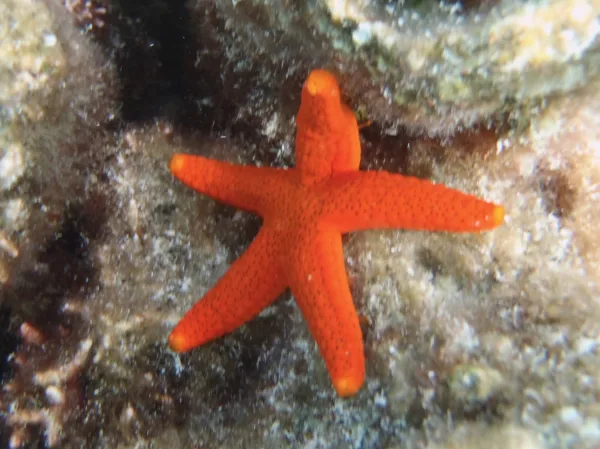
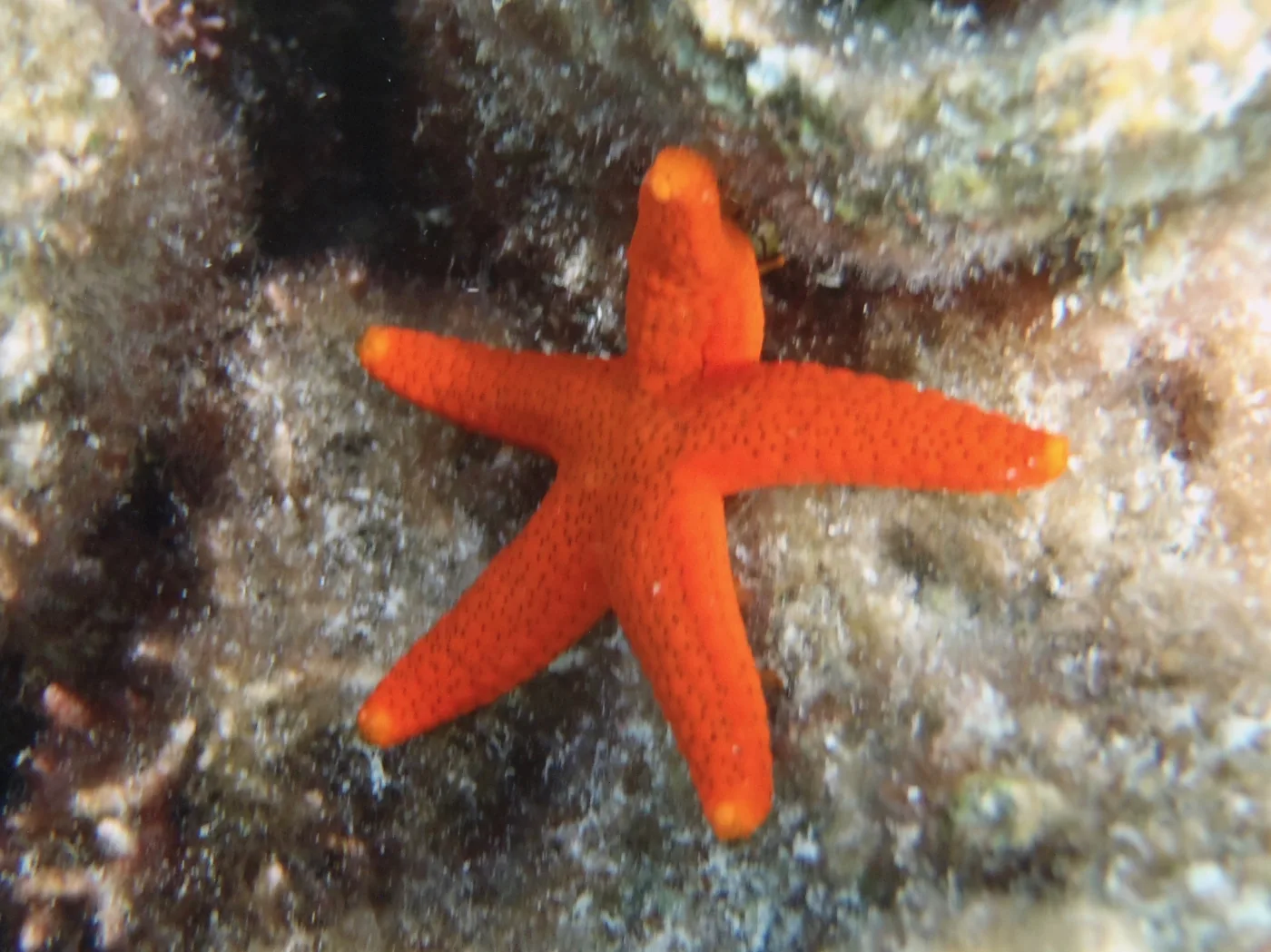
The red Fromia starfish is a small, bright red sea star with five arms. Its back is covered in tiny bumps. It also has lots of little dark dots. These are holes where soft bits of skin poke out to help it breathe. It lives on coral reefs in the warm Indian and Pacific Oceans. It moves slowly on hundreds of tiny tube feet under its arms. It eats a very thin film of tiny living things that grows on rocks. The film is so thin you can barely see it. So it needs an old tank with lots of rock to graze on. You cannot feed it like a fish. Quick changes in the water can hurt it, so it must be moved into a new tank very slowly. If it loses an arm, it can grow a new one.
Water & care
Regarded as one of the hardier sea stars, but still sensitive to changes in pH, temperature and salinity. Drip-acclimate very slowly (at least 2.5 hours) and keep salinity stable around 1.025; lower salinity shortens its life. Add it only to a tank that has been running for at least a year with plenty of live rock covered in biofilm. Target feeding helps little because its food is microscopic, so the tank itself has to feed it.
| Parameter | Keep it at | Where that sits on the usual reef range |
|---|---|---|
| Temperature | 72–78 °F | |
| Salinity (SG) | 1.024–1.026 | |
| pH | 8.1–8.4 | |
| Alkalinity | 8–12 dKH |
Keep salinity stable near 1.025 (Blue Zoo); avoid swings in pH, temperature and salinity, which sea stars tolerate poorly. Temperature, pH and alkalinity are standard reef care ranges; calcium, magnesium and nutrient targets are not species-specific, so they are left blank. Keep nitrate low, ammonia and nitrite at zero, and copper absent.
Feeding
DietOmnivore
Favorite foods
- Biofilm and microscopic film algae on live rock
- Microorganisms and fine detritus on rock surfaces
Grazes continuously over rock and glass. It cannot be reliably fed with prepared foods, so the size and maturity of the rockwork decide whether it can survive; keep stocking of sea stars and other biofilm grazers low. Watch its body: a well-fed Fromia is plump and firm, while shrinking arms and a sunken disc indicate starvation.
Tank & maintenance
- Minimum tank
- 55 gallons
- Aquascape
- Plenty of mature live rock in a tank at least a year old, with open rock surfaces for grazing.
- Lighting
- Any; normal reef lighting is fine.
- Water flow
- Any normal reef flow.
Routine upkeep
Keep salinity steady with daily fresh-water top-off. Check the star daily for movement and body condition. Do not scrub every rock clean, since the biofilm is its food. Remove a dying or disintegrating star promptly to protect water quality.
Temperament & tankmates
TemperamentPeaceful
Completely peaceful. It is vulnerable to fish and crustaceans that pick at or tear sea stars.
Reef safeYes
Ignores corals, clams, fish and other invertebrates; it only grazes biofilm. It is not an algae eater and does nothing for nuisance-algae control, and Blue Zoo warns it may die in a tank overgrown with algae.
Good tankmates
- Mature reef tanks with lots of live rock
- Peaceful fish
- Corals and clams
- Cleaner and fire shrimp
- Small snails and other clean-up crew
Avoid
- Harlequin shrimp (they eat sea stars)
- Large hermit crabs, crabs and coral banded shrimp that may tear at it
- Triggerfish, puffers and other fish that pick at starfish
- New or young tanks
- Copper and other invertebrate-unsafe medications
Help it thrive
- Wait until your tank is at least a year old before adding one.
- Drip-acclimate for 2.5 hours or more and never expose it to sudden salinity changes.
- Keep stocking low so sea stars do not outgraze the biofilm.
- Avoid harlequin shrimp, large crabs and fish known to pick at starfish.
- Buy only active specimens with firm bodies and visible tube feet, with no white, dark or sunken patches; a healthy star rights itself quickly when turned over.
Common ailments
Acclimation shock
- Signs
- Limp body, curled arms, tube feet retracted, and no movement or righting for a day or more after arrival.
- Prevention
- Very slow drip acclimation (at least 2.5 hours) with exact salinity matching.
- Treatment
- Keep it in stable water and avoid handling; there is no medication.
Tissue necrosis (wasting or disintegration)
- Signs
- White or dark lesions, holes or sunken areas in the skin, arms softening and falling apart or dropping off.
- Prevention
- Stable water quality, careful acclimation, and buying uninjured specimens.
- Treatment
- Often fatal. Check salinity and water quality, and remove the star if it is disintegrating.
Starvation
- Signs
- Gradual shrinking over months: thinner arms, a sunken disc and less activity.
- Prevention
- Mature tank (one year or older) with plenty of live rock and few competing grazers.
- Treatment
- Move it to a larger, older system with more rock surface.
Injury and predation
- Signs
- Missing arm tips, tears or bite marks.
- Prevention
- Do not house it with harlequin shrimp, large crabs, coral banded shrimp or starfish-picking fish.
- Treatment
- Lost arms usually heal over and can regrow in good water; watch for infection and remove the cause.
This is general hobby guidance, not veterinary advice. Quarantine new arrivals and treat in a separate tank whenever you can.
Risks of owning one
- Often dies after import or slowly starves in young tanks.
- Very sensitive to salinity and chemistry swings, and easily killed by copper and many medications.
- A dead starfish fouls the water quickly.
- It is not an algae controller; buying one to clean algae usually ends badly.
- Wild-collected, so every loss removes an animal from a reef.
Breeding
DifficultyNot achieved Captive-bredRare or wild-caught
No captive breeding or spawning of this species has been documented in the sources reviewed. Most sea stars release eggs and sperm into the water and have drifting larvae that spend weeks in the plankton, which would be very hard to rear. Fromia can regrow lost arms, but asexual reproduction by splitting has not been reported for this species in the sources reviewed.
- No breeding protocol exists; all specimens are wild-collected.
- Lost arms can regenerate if water quality is excellent and the star is well fed.
Deep dive The science, history and family tree
The science
Fromia milleporella (Lamarck, 1816) is a small reef sea star of the family Goniasteridae (order Valvatida) and the type species of the genus Fromia. It has five arms around a small central disc and a flattish body that lacks the raised tubercles of some relatives. The upper surface is made of small, closely set granular plates, and the pores between them, through which the thin-walled respiratory papulae protrude, show as tiny dark dots, hence the name 'black spotted starfish'. Colour in life is usually a fairly uniform red, ranging from orange-red to deep red. Aquarium specimens are usually a few inches across; Blue Zoo gives about 5 in as mature size and Wikipedia a maximum diameter of about 15 cm.
It is widespread in the tropical Indo-West and central Pacific, from the Red Sea and East Africa (including Madagascar) through the Maldives, Sri Lanka, the Bay of Bengal and Indonesia to the Philippines, China, southern Japan, northern Australia, New Caledonia and the islands of the South Pacific. It is benthic on coral reefs and nearby hard bottoms, mostly from the shallows to about 30 m, with records to about 73 m. It feeds on the thin, almost invisible film of microalgae, microorganisms and detritus coating rock surfaces, which is why it needs a mature aquarium and why supplemental feeding does little. Its reproductive biology and larval development have not been described in the sources reviewed, and it has not been bred in captivity. Similar red species, especially F. indica (often sold as F. elegans), are easily confused with it.
- Appearance
- A small, flat, five-armed star in solid red to orange-red, with a finely granular surface and many tiny dark pores visible on top; it lacks large bumps or tubercles. Look-alikes: Fromia indica (sold as F. elegans or 'little red starfish') is reddish with dark lines or markings across the upper surface; Fromia monilis (orange marble starfish) is orange with a marbled pattern. Check the scientific name when buying, because red Fromia species are often mixed up in the trade.
- Native range
- Indo-West and central Pacific: Red Sea and East Africa (Madagascar) east through the Maldives, Sri Lanka, the Bay of Bengal, Indonesia, the Philippines, China and southern Japan to northern Australia, New Caledonia, Saipan and the South Pacific islands as far as Polynesia.
- Habitat
- Benthic on coral reefs, reef flats and other hard bottoms from the shallows to about 30 m (Rowe & Gates 1995, via WoRMS); Wikipedia gives a depth range of 0-73 m. Grazes the surfaces of rock and coral rubble.
- Size
- 5.5 in (14 cm). Blue Zoo gives a mature size of about 5 in (13 cm); Wikipedia gives a maximum diameter of about 15 cm (5.9 in). Most aquarium specimens are smaller.
- Lifespan
- No published lifespan data were found. Most losses happen in the first weeks after import (shipping and acclimation stress) or months later from starvation in tanks without enough biofilm.
- Conservation
- Not Evaluated. No IUCN Red List assessment found and no CITES listing. All aquarium specimens are wild-collected
In the aquarium vs in the wild
In your aquarium
Colourful display animal (showpiece) for mature reef tanks; it does no meaningful cleaning.
On the reef
A small grazer of reef surface films, part of the community of micro-grazers that processes biofilm and detritus on coral reefs.
History
Lamarck described it in 1816 as Asterias milleporella in his Histoire naturelle des animaux sans vertèbres, giving the doubtful locality 'European seas'; the syntypes are in the Paris museum. It is the type species of Fromia, the genus John Edward Gray established in 1840. Müller and Troschel's Scytaster pistorius of 1842 is now treated as the same species. In the aquarium trade it is sold as the red Fromia or red sea star and is one of the few sea stars generally regarded as reef safe.
Evolution & relatives
Fromia is a valvatidan sea star in the Goniasteridae, the 'biscuit stars', which with about 260 living species in 70 genera is the most diverse sea star family; its fossil record reaches back about 182 million years, to the Early Jurassic. Most goniasterids live on deep continental shelves, but Fromia and relatives such as Neoferdina are shallow-reef specialists of the Indo-Pacific, where many species share bright red or orange colours and are hard to tell apart. Several of these reef genera, including Neoferdina and Ferdina, were moved into Goniasteridae from Ophidiasteridae in recent revisions (Mah & Foltz 2011; Mah 2017). Its closest relatives are other Fromia such as F. indica, F. monilis, F. nodosa and the Red Sea F. ghardaqana. More distantly it is related to Linckia and Nardoa (family Ophidiasteridae) and to Archaster, which are also in the order Valvatida, while the sand-sifting Astropecten belongs to the separate burrowing order Paxillosida.
Family tree, from kingdom down
- Kingdom Animalia Animals Animals are living things made of many cells that must eat food to live. Fish, corals, crabs, snails and sea stars are all animals.
- Phylum Echinodermata Echinoderms Echinoderms are sea animals whose bodies are usually built in five matching parts. They move on hundreds of tiny tube feet, and many have spiny skin.
- Subphylum Asterozoa Sea stars and brittle stars These echinoderms have star-shaped bodies with arms spreading out from the middle. The group includes sea stars and brittle stars.
- Class Asteroidea Sea stars Sea stars, or starfish, usually have five arms joined to a central disc. Most can grow back an arm they lose.
- Subclass Ambuloasteroidea
- Infraclass Neoasteroidea
- Superorder Valvatacea Biscuit stars, sand stars and kin
- Order Valvatida Cushion and biscuit stars This order of sea stars includes cushion stars, biscuit stars and blue Linckia stars. Many have stiff bodies covered in neat plates.
- Family Goniasteridae Biscuit stars Biscuit stars have stiff, flat bodies edged with big, neat plates, a bit like a cookie. Many are brightly colored.
- Genus Fromia Fromia sea stars Fromia are small, colorful sea stars from the Indian and Pacific Oceans. They graze on thin films on rocks.
- Species Fromia milleporella
See it on the Tree of Life Compare with another species
Closest relatives
- Fromia indica Indian sea star, sold as Fromia elegans or little red starfish Same genus; F. elegans is a synonym
- Fromia monilis Orange marble starfish Same genus
- Fromia nodosa an Indian Ocean Fromia Same genus; western Indian Ocean (Seychelles, Aldabra)
- Fromia ghardaqana Red Sea Fromia Same genus; Red Sea endemic
- Linckia laevigata Blue Linckia (azure sea star) Same order (Valvatida), different family (Ophidiasteridae)
- Astropecten polyacanthus Sand sifting starfish Same class (Asteroidea), different order (Paxillosida) Read guide · Compare
Older scientific names: Asterias milleporella, Scytaster milleporellus, Fromia pistoria, Linckia pistoria, Scytaster pistorius.
Fun facts
- It is the type species of Fromia, the species that officially anchors the whole genus name.
- The tiny dark dots on its back are pores where soft, thin-walled 'skin gills' poke out to take in oxygen.
- Lamarck's 1816 description said it came from 'European seas', a mistake, since it lives in the tropical Indo-Pacific.
- Like most sea stars it can regrow a lost arm.
- It eats a food film so thin you can barely see it, which is why brand-new, very clean tanks starve it.
Learn more
- Wikipedia: Fromia milleporella en.wikipedia.org
- Wet Web Media: Sea Stars part 3 (genus Fromia) wetwebmedia.com
- Wet Web Media: Fromia sea star FAQs wetwebmedia.com
- WoRMS: Fromia milleporella marinespecies.org
Sources
- WoRMS: Fromia milleporella taxon details, distribution and depth marinespecies.org
- Wikipedia: Fromia milleporella en.wikipedia.org
- Blue Zoo Aquatics: Red Fromia Starfish care bluezooaquatics.com
- Wet Web Media: Sea Stars part 3 (genus Fromia) wetwebmedia.com
- Wet Web Media: Sea Stars part 1 (selection and health) wetwebmedia.com
- Wet Web Media: Fromia sea star FAQs wetwebmedia.com
- Wikipedia: Fromia en.wikipedia.org
- Wikipedia: Goniasteridae en.wikipedia.org
Care facts
The care facts on this guide and its product pages (care level, reef safety, temperament, size, tank, diet, flow, purpose, foods, acclimation and origin) combine 13 independent sources, checked October 25, 2026.
- Red Sea Star (Fromia milleporella) LiveAquaria
- Red Reef Starfish - Fromia milleporella That Pet Place
- Invertebrate reference id 104 (Fromia sp) Seascape Studio
- Red Fromia Sea Star Quality Marine
- Red (Fromia) Starfish - Central Pacific Saltwater Fish (saltwaterfish.com)
- Red Fromia Starfish Care Fantasea Aquariums
- Red Starfish (Fromia milleporella) Salty Underground
- Red Fromia Starfish (Fromia milleporella) STL Marine Solutions
- Red Fromia Sea Star Frag Box Corals
- Fromia milleporella (Thousand-Pores Sea Star) Reeflex
- Fromia milleporella - Florent's Guide Florent's Guide to Tropical Reef (reefguide.org)
- Sea Star Fromia milleporella Belombrepedia
- Fromia milleporella Wikipedia
Scientific names and classification follow the World Register of Marine Species (AphiaID 213299). Last updated October 25, 2026.
Shop this species
Search the shop →Sold out right now. We restock weekly, so check back soon.
Sold out