 Sold out
Invertebrates · Starfish
Sand Sifting Starfish
Astropecten polyacanthus
Also called Sand Sifting Star, Comb Sea Star, Comb Star, Sand Star
- CareModerate
- Reef safeYes
- TemperamentPeacefulPeaceful; hunts small sand-bed critters
- Favorite foods
- Sand-bed worms and microfauna
- Detritus / leftover food
- Small snails and clams
- Max size11 in (27.9 cm)
- Min tank125 gal
- LifespanWild lifespan unknown
- IUCN statusNot Evaluated
Quick answers
- How big does the Sand Sifting Starfish get?
- Up to 11 in (27.9 cm).
- What size tank does it need?
- At least 125 gallons.
- How hard is it to keep?
- Care level: Moderate.
- Is it reef safe?
- Yes. Does not touch corals, fish or rock-dwelling invertebrates, but it is a predator of the sand bed: it swallows worms, small crustaceans, small clams and snails whole and can wipe out the beneficial infauna of a deep sand bed, including small burrowing snails such as nassarius.
- What does it eat?
- Sand-bed worms and microfauna
- Detritus / leftover food
- Small snails and clams
- How long does it live?
- Wild lifespan unknown.
- What are good tankmates?
- Very large reef or fish-only tanks with a deep, mature sand bed
- Corals
- Fish and invertebrates that do not depend on the sand bed
The 30-second version
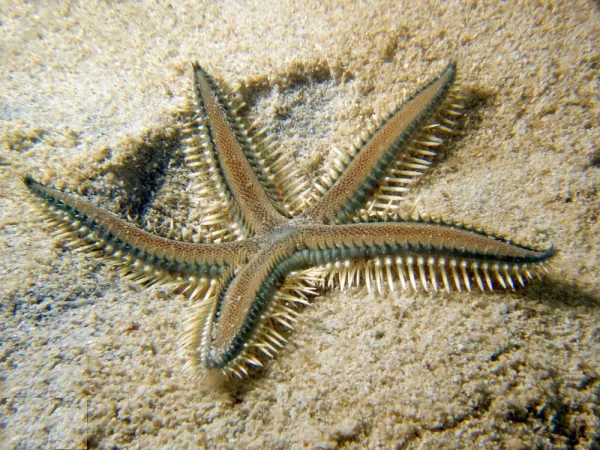
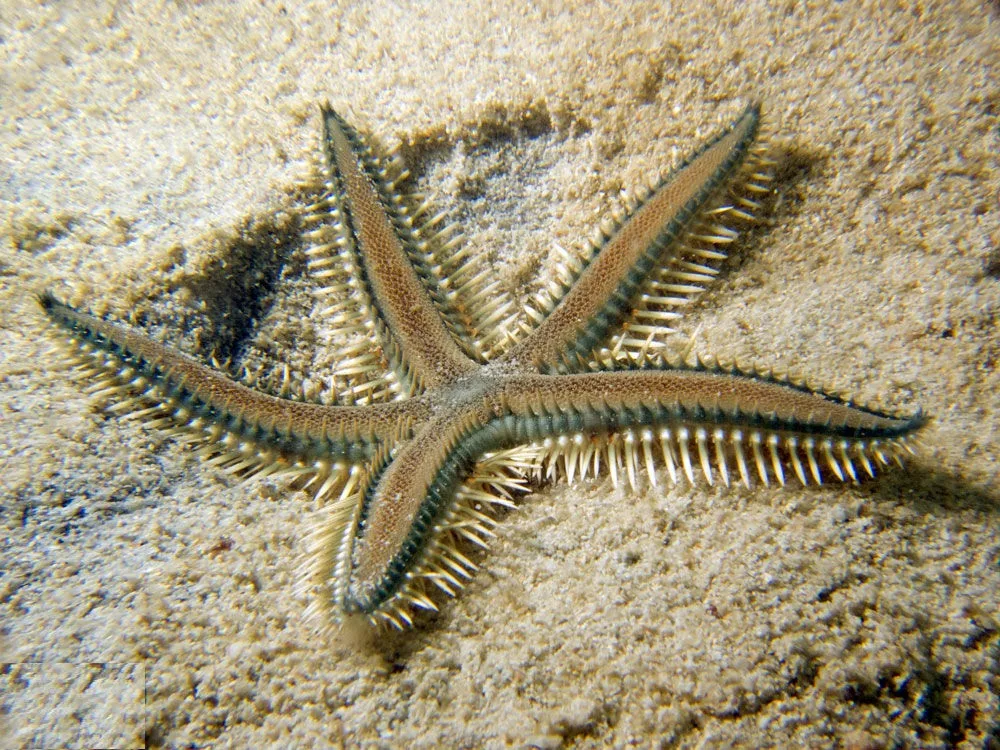
The sand sifting starfish is a flat sea star with five pointy arms and a row of sharp spines along the edges, like the teeth of a comb. It lives on sandy and muddy sea floors in the warm Indian and Pacific Oceans. Instead of suction cups, its feet are pointed, which helps it dig. It spends most of the day buried and comes out at night. It does not chew. It swallows tiny clams, snails, worms and bits of food whole, then pushes the empty shells back out of its mouth. In a fish tank it can eat almost every little creature living in the sand, and when those are gone it often starves. That is why it only does well in a very big tank with lots of sand. Its body can also hold a strong poison, so it must never be eaten.
Water & care
Easy to keep alive for a few weeks, very hard to keep for years. It eats the living fauna of the sand bed (worms, copepods, small snails and clams) faster than most aquariums can replace it, then slowly starves. Realistic long-term candidates are tanks of about 125 gallons or more with a large, deep, mature sand bed and no competing sand-sifters. Some keepers bury small pieces of meaty food for it, but there is no good evidence that this alone sustains it. It needs a long drip acclimation (at least 2.5 hours) and stable salinity around 1.025; low salinity shortens its life.
| Parameter | Keep it at | Where that sits on the usual reef range |
|---|---|---|
| Temperature | 72–78 °F | |
| Salinity (SG) | 1.024–1.026 | |
| pH | 8.1–8.4 | |
| Alkalinity | 8–12 dKH |
Keep salinity stable near 1.025; Blue Zoo notes that lower salinity significantly shortens its life. Sea stars tolerate swings in salinity, temperature and pH poorly. Temperature, pH and alkalinity are standard reef care ranges; there are no species-specific data for calcium, magnesium or nutrients, so those are left blank. Keep nitrate low, ammonia and nitrite at zero, and copper absent.
Feeding
DietOmnivore
Favorite foods
- Small clams and snails, swallowed whole
- Worms, copepods and other sand-bed fauna
- Detritus and biofilm on sand grains and pebbles
- Meaty foods such as mysis or chopped shrimp placed under the star
Mostly feeds on live animals in the sand at night. You can try burying a small piece of thawed shrimp or clam, or a sinking pellet, next to the star once or twice a week and watch for it to settle over the spot. Keep an eye on its body: a healthy star is firm with full arms, while thinning arms and a shrinking, sagging disc mean it is starving.
Tank & maintenance
- Minimum tank
- 125 gallons
- Aquascape
- A large open area of deep (about 4 in or more), fine, mature sand bed teeming with life, ideally fed by a refugium. Rock should rest on the bottom glass so burrowing cannot undermine it.
- Lighting
- Any; it is nocturnal and buried during the day.
- Water flow
- Moderate; avoid currents strong enough to strip the sand bed.
Routine upkeep
Check daily that it is buried or moving, and check its condition weekly (arm thickness, firmness). Never vacuum deep into the sand bed it depends on, and replenish sand-bed life from a refugium or with live sand. Keep salinity constant with daily fresh-water top-off. Remove a dead star promptly, since a decomposing starfish fouls water quickly.
Temperament & tankmates
TemperamentPeaceful
No aggression toward fish or corals; its impact comes from feeding on small sand-dwelling animals. Two or more in one tank compete for the same limited food and starve sooner.
Reef safeYes
Does not touch corals, fish or rock-dwelling invertebrates, but it is a predator of the sand bed: it swallows worms, small crustaceans, small clams and snails whole and can wipe out the beneficial infauna of a deep sand bed, including small burrowing snails such as nassarius. It also carries tetrodotoxin.
Good tankmates
- Very large reef or fish-only tanks with a deep, mature sand bed
- Corals
- Fish and invertebrates that do not depend on the sand bed
Avoid
- Small or new tanks
- Other sand sifting stars
- Nassarius, cerith and other small burrowing snails (prey)
- Starfish predators such as harlequin shrimp, triggerfish and puffers
Help it thrive
- Only buy one if the tank is very large (about 125 gallons or more) with a deep, mature sand bed full of life.
- Keep just one per tank, and skip other sand-bed predators.
- Drip-acclimate for at least 2.5 hours and keep salinity steady near 1.025.
- A refugium that exports copepods and small worms helps restock the sand bed.
- Bury small meaty foods near it and watch its body condition; act at the first sign of thinning arms.
Common ailments
Starvation
- Signs
- Arms become thin and soft, the central disc shrinks or sags, and the star stays on the surface and moves less; death follows over weeks to months.
- Prevention
- Keep it only in a large tank with a mature, deep sand bed, one star per tank, ideally with a refugium.
- Treatment
- Bury meaty foods next to it; if it keeps declining, rehome it to a much larger system.
Tissue necrosis (disintegration)
- Signs
- White or dark patches and lesions on the skin, arms dropping off, and tissue falling apart, often within days.
- Prevention
- Slow acclimation, stable salinity and good water quality; avoid buying injured specimens.
- Treatment
- Usually fatal. Test and correct water quality, and remove the star if it is disintegrating to protect the tank.
Acclimation and salinity shock
- Signs
- Limp body, curled arms, and no burrowing or righting within a day of arrival.
- Prevention
- Drip-acclimate for at least 2.5 hours and match salinity exactly.
- Treatment
- Keep it in stable water and avoid further handling; there is no medication.
This is general hobby guidance, not veterinary advice. Quarantine new arrivals and treat in a separate tank whenever you can.
Risks of owning one
- Very likely to starve within about a year in tanks smaller than about 125 gallons.
- Wipes out sand-bed infauna (worms, copepods, small clams and snails), reducing the sand bed's biological value.
- Can contain tetrodotoxin (TTX), a potent nerve toxin with no antidote. It is dangerous only if eaten, but wash your hands after handling and keep it away from children and pets.
- Sharp marginal spines can prick hands.
- A dead star buried in the sand can go unnoticed and pollute the tank.
Breeding
DifficultyNot achieved Captive-bredRare or wild-caught
Not bred in aquariums. Like other sea stars of its order it releases eggs and sperm into the water; paxillosid sea stars skip the brachiolaria larval stage and settle using their larval tube feet. Nothing of this cycle has been reproduced in captivity, and every specimen in the trade is wild-collected.
- No captive breeding protocol exists for this species.
- Lost arms can regrow in good conditions, but that is healing, not reproduction.
- All specimens in the trade are wild-collected.
Deep dive The science, history and family tree
The science
Astropecten polyacanthus Müller & Troschel, 1842 is a comb star (family Astropectinidae, order Paxillosida) and the most widespread member of its genus. It has a small disc and five fairly broad, tapering arms up to about 9 cm long, giving an arm span of about 20 cm. The upper surface is covered with paxillae, small pillar-shaped ossicles with flat, spinulose tops; colour is variable, from cream through grey-green to brown, often with a darker central or chevron pattern, and some individuals are dark purple above and orange below. Each arm is edged by conspicuous marginal plates bearing long, sharp spines with brownish bases and pale tips. The tube feet are pointed and lack suckers, an adaptation for digging rather than clinging.
It ranges across the tropical and subtropical Indo-Pacific from the Red Sea and East Africa to Hawaii, and from southern Japan to Australia and New Zealand, on sand and silty mud from the shallows to about 185 m, including harbours and estuaries. It spends much of the day buried and forages mainly at night. Like other paxillosids it swallows prey whole: small bivalves, gastropods and other infauna, plus detritus and pebbles coated in biofilm, with the indigestible shells ejected through the mouth because adult paxillosids lack an anus. Japanese studies found tetrodotoxin (TTX) in most individuals tested from the Seto Inland Sea. Molecular work suggests that A. polyacanthus as currently recognised is a complex of cryptic species.
- Appearance
- A flat, stiff, five-armed star with a neat fringe of long, sharp, pale-tipped spines along every arm edge. The top looks finely granular (paxillae) in cream, grey, tan or brown, often with a darker central pattern; some are purplish on top and orange underneath. The tube feet are pointed and have no suckers, so it cannot climb glass. Look-alike: Archaster typicus, also sold as 'sand sifting star', has a distinct central row of plates along each arm, flat blunt spines and suckered tube feet (Echinoblog), which let it cling to and climb hard surfaces.
- Native range
- Tropical and subtropical Indo-Pacific: Red Sea and East Africa (Zanzibar), the Persian Gulf and southeast Arabia, the Maldives, Sri Lanka, the Bay of Bengal, Indonesia, the Philippines, China, southern Japan, Australia (from Cape Naturaliste around the north coast to Sydney), New Zealand, the South Pacific islands and Hawaii. Type locality: Red Sea.
- Habitat
- Soft bottoms of sand, silty sand and mud from the shallows to about 185 m, including sheltered harbours and estuaries. Spends much of the day buried just below the surface and emerges to forage, mainly at night.
- Size
- 11 in (27.9 cm). Arm span up to about 20 cm (8 in), with arms up to about 9 cm long (Wikipedia). Specimens in the trade are usually smaller.
- Lifespan
- Wild lifespan unknown. In home aquariums most die within about a year, usually from starvation, unless kept in very large systems with a mature deep sand bed (Wet Web Media).
- Conservation
- Not Evaluated. No IUCN Red List assessment found. All aquarium specimens are wild-collected. It appears to be a complex of cryptic species (Zulliger & Lessios 2010), so regional populations may turn out to be separate species
In the aquarium vs in the wild
In your aquarium
Sold as a sand-bed cleaner, but in practice it is a sand-bed predator best treated as a display animal for very large systems.
On the reef
A nocturnal predator and scavenger of soft bottoms that eats small molluscs and other infauna and processes detritus; it is itself eaten by predators such as trumpet shells, which can accumulate its tetrodotoxin.
History
Johannes Müller and Franz Hermann Troschel described it in 1842 in their System der Asteriden, from the Red Sea; polyacanthus means 'many-thorned'. Several later names, including Astropecten chinensis, A. edwardsi and A. ensifer, are treated as synonyms. In 1985 Miyazawa and colleagues reported tetrodotoxin in this species and in A. scoparius from Japan's Seto Inland Sea, in work connected to a paralytic poisoning traced to a trumpet shell that had picked up the toxin through its food chain. In the aquarium trade it is one of two different starfish sold as 'sand sifting stars', the other being Archaster typicus, and the two are often confused.
Evolution & relatives
Sea stars (Asteroidea) are echinoderms, related to sea urchins, brittle stars and sea cucumbers. Astropecten belongs to the Paxillosida, a burrowing order whose members have pointed, suckerless tube feet, no anus as adults and no brachiolaria larval stage. These traits were once read as signs that paxillosids were the most primitive living sea stars, but newer analyses suggest a more derived position, possibly as the sister group of the Valvatida, the order that contains Archaster, Fromia and Linckia. Astropecten has about 100 species worldwide and fossils from at least the Jurassic. Its resemblance to Archaster is convergent: both evolved flattened, spine-fringed bodies for digging in sand, but they belong to different orders. A global molecular study of the genus (Zulliger & Lessios 2010) found widespread morphological convergence and suggested that A. polyacanthus is a species complex with possible cryptic species.
Family tree, from kingdom down
- Kingdom Animalia Animals Animals are living things made of many cells that must eat food to live. Fish, corals, crabs, snails and sea stars are all animals.
- Phylum Echinodermata Echinoderms Echinoderms are sea animals whose bodies are usually built in five matching parts. They move on hundreds of tiny tube feet, and many have spiny skin.
- Subphylum Asterozoa Sea stars and brittle stars These echinoderms have star-shaped bodies with arms spreading out from the middle. The group includes sea stars and brittle stars.
- Class Asteroidea Sea stars Sea stars, or starfish, usually have five arms joined to a central disc. Most can grow back an arm they lose.
- Subclass Ambuloasteroidea
- Infraclass Neoasteroidea
- Superorder Valvatacea Biscuit stars, sand stars and kin
- Order Paxillosida Burrowing sea stars These sea stars live on sand and mud and often dig in. Their tube feet are pointed instead of having suckers.
- Family Astropectinidae Comb stars Comb stars are flat sea stars with stiff spines along the edges of their arms, like a comb. They bury in sand and swallow small animals whole.
- Genus Astropecten Sand stars Sand stars are fast sea stars that bury themselves in sand. They swallow snails, clams and other small animals whole.
- Species Astropecten polyacanthus
See it on the Tree of Life Compare with another species
Closest relatives
- Astropecten indicus an Indo-Pacific sand star Same genus; also identified as a species complex
- Astropecten scoparius a Japanese comb star Same genus; also found to contain tetrodotoxin
- Astropecten articulatus Royal sea star Same genus; western Atlantic
- Astropecten aranciacus Red comb star Same genus; Mediterranean and eastern Atlantic
- Luidia Luidia sea stars Same order (Paxillosida), different family (Luidiidae)
- Archaster typicus Sand sifting star (Archaster) Look-alike in a different order (Valvatida); the resemblance is convergent
Older scientific names: Astropecten hystrix, Astropecten chinensis, Astropecten edwardsi, Astropecten ensifer.
Fun facts
- It has no suction cups: its pointed tube feet are built for digging, so it cannot climb the aquarium glass.
- It swallows clams and snails whole and spits the empty shells back out of its mouth, because adults of its order have no anus.
- Its body can carry tetrodotoxin, the same nerve poison found in pufferfish.
- Two unrelated starfish are sold as 'sand sifting stars'; they look alike because they evolved for the same digging lifestyle.
- Its name, polyacanthus, means 'many-thorned'.
Learn more
- Wikipedia: Astropecten polyacanthus en.wikipedia.org
- Echinoblog: Telling apart sand stars, Archaster vs Astropecten echinoblog.blogspot.com
- Wet Web Media: Sand-sifting star FAQs wetwebmedia.com
- WoRMS: Astropecten polyacanthus marinespecies.org
Sources
- WoRMS: Astropecten polyacanthus taxon details, distribution and depth marinespecies.org
- Wikipedia: Astropecten polyacanthus (description, diet, tetrodotoxin) en.wikipedia.org
- Echinoblog: Telling apart sand stars, Archaster vs Astropecten echinoblog.blogspot.com
- Blue Zoo Aquatics: Sand sifting starfish care bluezooaquatics.com
- Wet Web Media: Sand-sifting star FAQs (starvation, tank size) wetwebmedia.com
- Wet Web Media: Sea Stars, Class Asteroidea part 1 wetwebmedia.com
- Wikipedia: Paxillosida en.wikipedia.org
- Wikipedia: Astropecten en.wikipedia.org
Care facts
The care facts on this guide and its product pages (care level, reef safety, temperament, size, tank, diet, flow, purpose, foods, acclimation and origin) combine 10 independent sources, checked October 25, 2026.
- Sand Sifting Sea Star - LiveAquaria LiveAquaria
- Sand Sifting Sea Star: Care Guide Fish Tank Advisor
- Sand Sifting Starfish Astropecten Care Guide Gensou Aquascaping (Singapore)
- White Sandsifting Starfish - Astropecten polycanthus That Pet Place
- Sand Sifting Starfish Top Shelf Aquatics
- Starfish Sand Sifting Reef Exclusive
- Sand sifting starfish: a job too well done Reef Builders
- Astropecten polyacanthus, Brown spotted combstar SeaLifeBase
- Sand Sifting Sea Star Quality Marine
- Astropecten polyacanthus Australian Museum
Scientific names and classification follow the World Register of Marine Species (AphiaID 213245). Last updated October 25, 2026.
Shop this species
Search the shop →Sold out right now. We restock weekly, so check back soon.
Sold out