 Sold out
Fish · Firefish
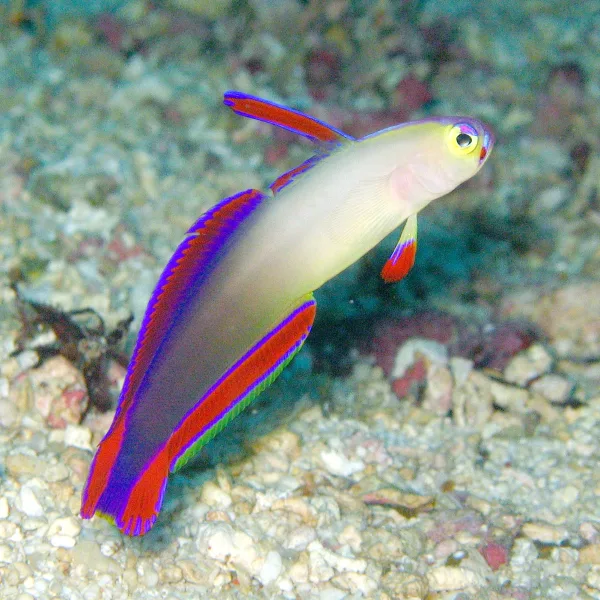
Purple Firefish
Nemateleotris decora
Also called Elegant Firefish, Decorated Firefish, Purple Dartfish, Decorated Dartfish, Flame Firefish, Elegant Firegoby
- CareEasy
- Reef safeYes
- TemperamentPeacefulShy and peaceful; may squabble with its own kind
- Favorite foods
- Mysis shrimp
- Copepods / zooplankton
- Enriched brine shrimp
- Max size3.5 in (9 cm)
- Min tank20 gal
- LifespanNot scientifically documented
- IUCN statusLeast Concern
Quick answers
- How big does the Purple Firefish get?
- Up to 3.5 in (9 cm).
- What size tank does it need?
- At least 20 gallons.
- How hard is it to keep?
- Care level: Easy.
- Is it reef safe?
- Yes. Does not nip corals, clams or ornamental invertebrates.
- What does it eat?
- Mysis shrimp
- Copepods / zooplankton
- Enriched brine shrimp
- How long does it live?
- Not scientifically documented; a hobby guide gives about 3 years, and longer is possible with good care.
- What are good tankmates?
- Clownfish
- Royal gramma and other basslets
- Cardinalfish
- Small peaceful gobies and blennies
- Small peaceful wrasses (fairy and flasher wrasses)
The 30-second version
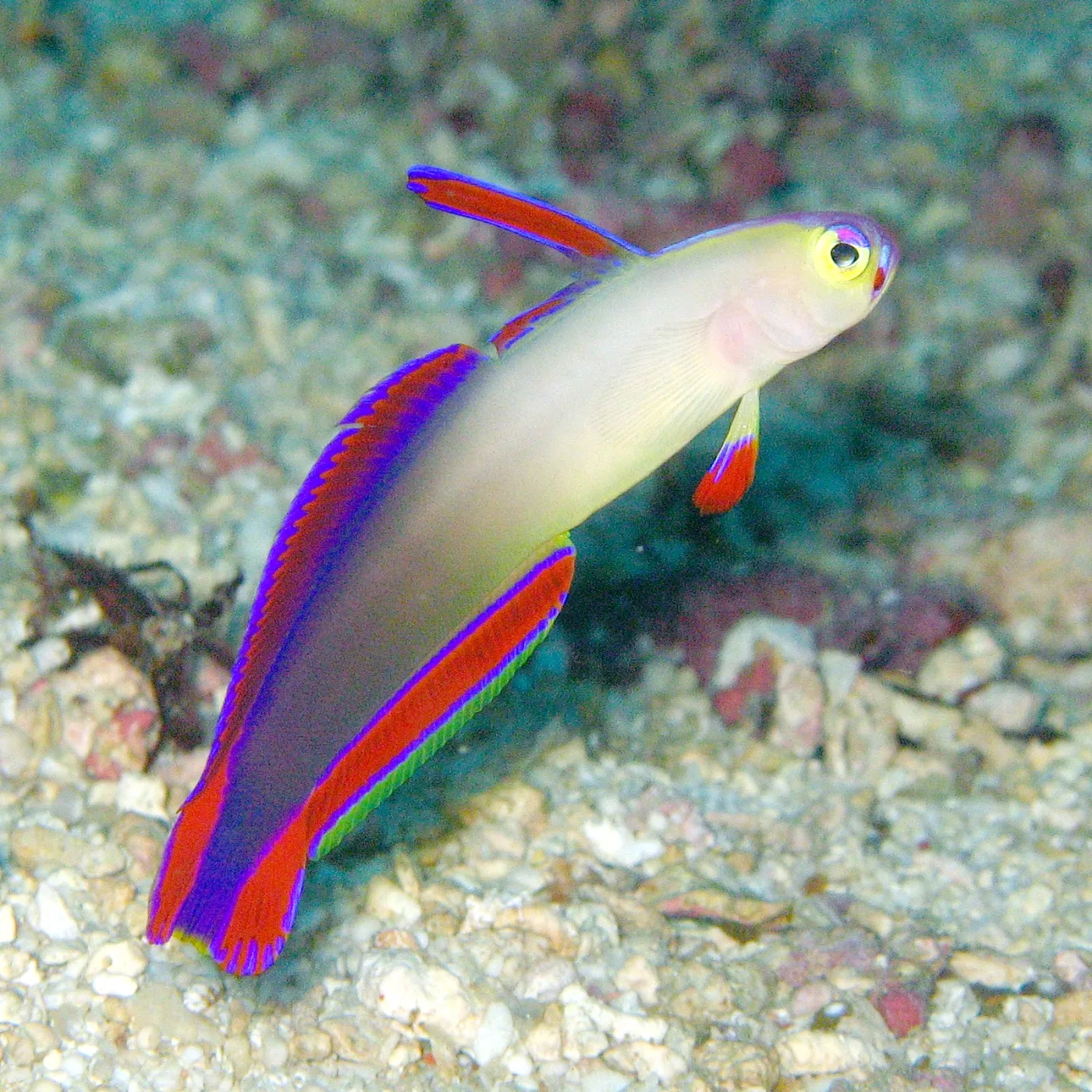
The purple firefish is a slim little fish dressed like a sunset. Its face is purple. Its body is pale yellow or white. Its back fins have stripes of purple, red and orange. It is a close cousin of the red firefish, but it lives much deeper in the sea. It often lives deeper than an eight-story building is tall. Down there it floats near the bottom, most of the time with its mate. It snaps up tiny animals that drift by in the moving water. When it gets scared, it dives into a hole. In a fish tank it is gentle and leaves corals alone. It needs caves to hide in and small meals a few times a day. It also needs a lid on the tank, because a scared firefish can leap right out of the water.
Water & care
Hardy once settled and accepts frozen and prepared foods. Like all firefish it needs a tight lid, plenty of rockwork with bolt-holes, peaceful tankmates, and small meaty meals two or three times a day. It is often shyer than the common firefish at first, so give it shaded caves and make sure it is eating. Use vitamin-enriched foods or the purple and orange colours fade. Keep one per tank or a mated pair; small groups have been kept only in larger aquariums.
| Parameter | Keep it at | Where that sits on the usual reef range |
|---|---|---|
| Temperature | 72–78 °F | |
| Salinity (SG) | 1.020–1.025 | |
| pH | 8.1–8.4 | |
| Alkalinity | 8–12 dKH | |
| Nitrate | 0–20 ppm |
Standard marine-fish ranges from Quality Marine's care sheet (LiveAquaria lists no water ranges for this species); FishBase gives a wild temperature of 23-27 °C (73-81 °F). No special calcium, magnesium or phosphate needs; set those for your corals. In the CMFRI breeding study pairs spawned at 28-29 °C.
Feeding
DietCarnivore
Favorite foods
- Frozen mysis shrimp
- Vitamin-enriched brine shrimp
- Frozen copepods or Calanus
- Finely chopped or shaved seafood
- Frozen carnivore blends
- Small slow-sinking pellets
Feed small meals two or three times a day into the current; it mostly takes food from the water column but will pick some from the bottom. Smaller, more frequent meals are better than one large one. Use vitamin-enriched foods to keep its colour. Make sure faster tankmates are not taking everything.
Tank & maintenance
- Minimum tank
- 20 gallons
- Aquascape
- Plenty of rockwork with caves, cracks and bolt-holes, plus loose coral rubble and a sand patch, with open water in front for hovering. A tight-fitting lid or mesh screen with no gaps is essential.
- Lighting
- Any reef lighting; it comes from deeper, dimmer water, so give it shaded caves and expect it to be bolder under moderate light.
- Water flow
- Moderate; it faces into the current to catch food. Avoid violent flow around its cave.
Routine upkeep
Normal reef upkeep: regular partial water changes, stable temperature and salinity, and a weekly check of the lid, screens and overflow covers for gaps. Watch that it comes out to eat at every feeding.
Temperament & tankmates
TemperamentPeaceful
Rarely bothers other species but is territorial toward its own kind and may squabble with other firefish in confined tanks, unless they are a mated pair. Easily intimidated by dottybacks, aggressive damselfish and greedy feeders.
Reef safeYes
Does not nip corals, clams or ornamental invertebrates. The only concern is that it may be eaten or harassed by large predatory fish or invertebrates.
Good tankmates
- Clownfish
- Royal gramma and other basslets
- Cardinalfish
- Small peaceful gobies and blennies
- Small peaceful wrasses (fairy and flasher wrasses)
- Corals, clams and reef invertebrates
Avoid
- Another purple firefish or other firefish, unless a known pair
- Dottybacks and aggressive damselfish
- Large predators that can swallow it (groupers, lionfish, eels, large hawkfish, triggerfish)
- Fast, competitive feeders that leave it no food
Help it thrive
- Cover every gap in the lid and overflow; jumping is the most common way firefish are lost.
- Add it to a calm tank before boisterous fish so it can claim a cave.
- Feed small, vitamin-enriched meals two or three times a day to keep its purple and orange bright.
- Give it shaded caves and dim the lights for its first day; deep-water firefish start out shy.
- Keep one per tank unless you have a mated pair.
Common ailments
Marine ich (Cryptocaryon irritans)
- Signs
- White salt-grain spots, scratching, fast breathing, hiding.
- Prevention
- Quarantine new fish for several weeks; keep stress low and water stable.
- Treatment
- Treat in a separate hospital tank (for example a copper medication used exactly as the product's directions say, with daily copper tests, or tank-transfer); never medicate the reef. Leave the display fishless for about 10-12 weeks.
Marine velvet (Amyloodinium ocellatum)
- Signs
- Dusty gold or grey sheen, very rapid breathing, clamped fins, sudden deaths across several fish.
- Prevention
- Quarantine every new fish; velvet spreads through the water and kills quickly.
- Treatment
- Move all fish to a hospital tank and treat promptly with a copper medication, following the product's directions and testing copper daily; leave the display fishless for at least 10-12 weeks.
Colour loss and wasting from poor diet or bullying
- Signs
- Faded purple and orange, pinched belly, constant hiding, refusing food.
- Prevention
- Vitamin-enriched, varied meaty foods two or three times a day; peaceful tankmates; plenty of caves.
- Treatment
- Remove bullies, target-feed enriched mysis and copepods, and watch any fin damage for bacterial infection.
This is general hobby guidance, not veterinary advice. Quarantine new arrivals and treat in a separate tank whenever you can.
Risks of owning one
- Jumping: it leaps when frightened and is known for 'carpet surfing', so a tight lid or netting is a must.
- Fights with other firefish unless they are a mated pair; sexes are hard to tell apart.
- Shy deep-water fish that can hide and starve in a tank of aggressive or fast-feeding fish.
- Costs more than the common firefish and is wild-caught, so a loss from a missing lid is expensive.
Breeding
DifficultyHard Captive-bredRare or wild-caught
The first scientific captive breeding was reported by Madhu and Madhu (CMFRI, India) in Aquaculture (2014). Pairs formed after about 6 months in group tanks at 29 ± 1 °C and began spawning about 6 months after being moved to their own tanks. Each spawn held 400-500 elliptical eggs about 1.1 mm long, guarded mostly by the male; they hatched after about 96 hours at 28 ± 1 °C with 93-98% hatching. Larvae reared in green water on ciliates then rotifers, followed by Artemia nauplii, reached 66% survival and became juveniles at 35-40 days after hatching. Hobbyists have seen pairs spawn adhesive eggs in a substrate depression at dusk, but eggs are often eaten by tankmates. Captive-bred fish are not commonly sold.
- Form pairs by keeping several fish (60-100 mm) together; in the CMFRI study four pairs formed in about 6 months, with males (90-100 mm) larger than females (60-90 mm).
- Move each pair to its own tank (250 L in the study) with a 14 h light / 10 h dark cycle.
- Condition heavily: the study fed cooked squid, shrimp, mussel and raw fish roe at about 10% of body weight in four meals a day, plus live adult Artemia.
- Expect spawns of 400-500 eggs about 1.1 mm long; the male does most of the guarding.
- Hatch the eggs (about 96 hours at 28 °C) away from tankmates that would eat them.
- Rear larvae in green water (Nannochloropsis and Chlorella) on ciliates (Euplotes) for days 1-7, then rotifers (Brachionus rotundiformis) to day 18; this diet gave the best survival (66%).
- Feed Artemia nauplii from about day 19 to 40; larvae metamorphose into juveniles at 35-40 days.
Deep dive The science, history and family tree
The science
Nemateleotris decora is a dartfish (Gobiidae: Ptereleotrinae) described by Randall and Allen in 1973. The body is elongate, with 7 dorsal spines and 27-32 soft dorsal rays and 1 anal spine with 28-31 soft rays; the first dorsal spine is lengthened into a tall pennant. The head and nape are purple to violet, the front of the body whitish to yellowish, darkening to grey toward the tail, and the dorsal, anal and tail fins carry lengthwise bands of purple, red, black and orange. FishBase gives a maximum of about 9 cm total length, while the largest specimen measured by Randall and Connell (2013) was 49.5 mm standard length. The species lives in the western Pacific, from the Ryukyu Islands south to New Caledonia and east to Samoa. Older accounts that extend it into the western Indian Ocean and Red Sea partly refer to N. exquisita, described in 2013, which has a more slender body, longer snout, usually shorter first dorsal spine and more yellow on the front of the body. N. decora is a deeper-water fish than the common firefish, recorded at 25-100 m and usually 25-70 m, over hard open bottoms at the base of reefs, sand and rubble patches and outer-reef drop-offs with moderate to strong currents. It is usually seen in pairs hovering above a hole and feeding on zooplankton, especially copepods and crustacean larvae; when alarmed it darts into the hole. The species is monogamous, harmless to people, and assessed as Least Concern by the IUCN.
- Appearance
- Purple-violet head, pale yellow to white front half shading to grey or purplish grey at the rear, a tall first dorsal spine, and rear fins banded in purple, red, black and orange with maroon tips. Look-alikes: the exquisite firefish (Nemateleotris exquisita, Indian Ocean and Red Sea) is slimmer, with yellow reaching further back along the body, and may be sold under similar names; the common firefish (N. magnifica) has a yellow head and orange-red rear; Helfrich's and lavender-blushed firefish are lavender with yellowish heads. Colour fades on a poor diet.
- Native range
- Western Pacific: Ryukyu Islands (Japan) south to New Caledonia and east to Samoa. FishBase still lists Mauritius as the western limit, but Indian Ocean and Red Sea firefish of this type were described as Nemateleotris exquisita in 2013.
- Habitat
- Deeper reef habitats at 25-100 m (usually 25-70 m): hard, open bottoms at the base of reefs, sand and rubble patches, and outer-reef drop-offs with moderate to strong currents. Usually seen in pairs hovering above a hole, into which it darts when alarmed. Water temperature in its range is about 23-27 °C (73-81 °F).
- Size
- 3.5 in (9 cm). FishBase lists 9 cm (3.5 in) total length; the largest specimen measured in the 2013 revision was 49.5 mm standard length (about 2 in without the tail). Trade specimens are usually 2-3 in.
- Lifespan
- Not scientifically documented; a hobby guide gives about 3 years, and longer is possible with good care.
- Conservation
- Least Concern. IUCN Least Concern (assessed 2015, published 2016). Not listed by CITES or CMS. Because it lives deeper than the common firefish it is collected less often and costs more. Aquarium specimens are wild-caught; captive breeding has been achieved by researchers but captive-bred fish are not commonly sold
In the aquarium vs in the wild
In your aquarium
A colourful, peaceful display fish for nano and community reefs, kept as a more elegant (and pricier) alternative to the common firefish.
On the reef
A zooplankton picker over deeper reef bases and rubble slopes, and prey for larger reef predators.
History
John E. Randall and Gerald R. Allen described Nemateleotris decora in 1973 in a revision of the firefish genus published in the Quarterly Journal of the Taiwan Museum, in which they also named Helfrich's firefish, N. helfrichi. The name decora is Latin for elegant and beautiful. It became a popular, more expensive alternative to the common firefish in the reef hobby, and hobbyists reported pairs spawning in aquariums by the early 1990s. In 2013 Randall and Connell described N. exquisita for the Indian Ocean and Red Sea fish that had been called N. decora, noting a probable hybrid between the two photographed in the Maldives in 1988. In 2014 scientists at the Central Marine Fisheries Research Institute in India published the first scientific report of its captive breeding, and later aquaculture work on other firefish has drawn on research with this species.
Evolution & relatives
The purple firefish is a dartfish, one of the hovering, plankton-eating gobies placed in the subfamily Ptereleotrinae within Gobiidae. Its closest relative is the exquisite firefish (N. exquisita) of the Indian Ocean and Red Sea, which was treated as the same species until 2013; a probable hybrid between the two was photographed in the Maldives. The other members of the genus are the common firefish (N. magnifica), Helfrich's firefish (N. helfrichi) of French Polynesia and the Cook Islands, and the lavender-blushed firefish (N. lavandula), split from N. helfrichi in 2023. Ptereleotris dartfishes are the next branch out. Shrimp gobies such as the yellow watchman goby belong to the same family but a different branch (Gobiinae). Gobies and their relatives, including cardinalfishes, form the order Gobiiformes, an early branch of the percomorph fishes thought to date back to the Cretaceous, with goby skeletons known from the Early Eocene.
Family tree, from kingdom down
- Kingdom Animalia Animals Animals are living things made of many cells that must eat food to live. Fish, corals, crabs, snails and sea stars are all animals.
- Phylum Chordata Chordates Chordates have a stiff rod running down their back at some point in their lives. In fish and people, this rod is replaced by a backbone.
- Subphylum Vertebrata Vertebrates Vertebrates are animals with a backbone and a skull. Fish, frogs, birds and people are all vertebrates.
- Infraphylum Gnathostomata jawed vertebrates
- Parvphylum Osteichthyes bony fishes
- Gigaclass Actinopterygii ray-finned fishes
- Superclass Actinopteri
- Class Teleostei Teleost fishes Teleosts are bony fishes with thin, bendy fin rays and jaws that can push forward. Almost all of the fish in the world are teleosts.
- Order Gobiiformes Gobies and kin This order includes gobies and sleepers. Most are small fish that live on the bottom, and many share burrows or perch on rocks.
- Suborder Gobioidei gobies and sleepers
- Family Gobiidae Gobies Gobies are one of the biggest families of fish. Most are small and live on the bottom, and many share burrows with shrimp.
- Subfamily Ptereleotrinae dartfishes
- Genus Nemateleotris Firefishes Firefishes are slim, colorful fish with a tall front fin that they flick up and down. They dive into a burrow when scared.
- Species Nemateleotris decora
See it on the Tree of Life Compare with another species
Closest relatives
- Nemateleotris exquisita Exquisite Firefish Same genus; closest relative, the Indian Ocean and Red Sea counterpart split off in 2013
- Nemateleotris magnifica Firefish Goby Same genus; shallower-water, red-tailed species Read guide · Compare
- Nemateleotris helfrichi Helfrich's Firefish Same genus; described alongside N. decora in 1973
- Nemateleotris lavandula Lavender-blushed Dartfish Same genus; described in 2023
- Ptereleotris evides Blackfin Dartfish Same subfamily (dartfishes)
- Ptereleotris zebra Zebra Dartfish Same subfamily (dartfishes)
Fun facts
- Its species name, decora, is Latin for elegant and beautiful.
- It usually lives 25-70 m deep, much deeper than most reef aquarium fish.
- In 1988 a photographer in the Maldives captured a probable hybrid between the purple firefish and its Indian Ocean twin, the exquisite firefish.
- In a breeding study the father did most of the egg-guarding, and the eggs hatched in about four days.
- It is usually seen in pairs, and the species is considered monogamous.
Learn more
- FishBase: Nemateleotris decora fishbase.se
- WoRMS taxon record marinespecies.org
- Wikipedia: Nemateleotris decora en.wikipedia.org
- Randall & Connell 2013: the exquisite firefish split oceansciencefoundation.org
- CMFRI repository: captive spawning of the purple firefish (2014) eprints.cmfri.org.in
Sources
- FishBase: Nemateleotris decora summary fishbase.se
- WoRMS: Nemateleotris decora Randall & Allen, 1973 marinespecies.org
- Wikipedia: Nemateleotris decora en.wikipedia.org
- Wikipedia: Nemateleotris exquisita en.wikipedia.org
- Wikipedia: Nemateleotris en.wikipedia.org
- Randall & Connell 2013, J. Ocean Sci. Found. 8: 18-29 oceansciencefoundation.org
- Madhu & Madhu 2014, Aquaculture (CMFRI repository abstract) eprints.cmfri.org.in
- Breeder's Registry spawning report NEMDEC-100792 breedersregistry.org
- LiveAquaria: Purple Firefish liveaquaria.com
- Quality Marine: Purple Firefish qualitymarine.com
- Saltwater Aquarium Blog: Purple firefish saltwateraquariumblog.com
- Quality Marine: Meet Nemateleotris lavandula qualitymarine.com
- Rising Tide Conservation: UF/IFAS fire goby aquaculture (cites purple firefish work) risingtideconservation.org
- Wikipedia: Gobiiformes en.wikipedia.org
- Reef Builders: Purple firefish, shy, small and peaceful (2014) reefbuilders.com
Care facts
The care facts on this guide and its product pages (care level, reef safety, temperament, size, tank, diet, flow, purpose, foods, acclimation and origin) combine 11 independent sources, checked October 25, 2026.
- Purple Firefish Care: Diet, Size, Mates, Diseases and Reefs Aquarium Source
- Nemateleotris decora (Purple Firefish) Reef App encyclopedia
- Purple Firefish | Nemateleotris Decora Care Guide Aquariadise
- Purple Firefish - LiveAquaria LiveAquaria
- Purple Firefish :: 18521 Quality Marine
- Purple Firefish: A Shy Beauty for the Small, Peaceful Aquarium Reef Builders
- Nemateleotris decora, Elegant firefish : fisheries, aquarium (FishBase) FishBase
- Purple Firegoby, Nemateleotris decora Randall & Allen 1973 Fishes of Australia
- Purple Firefish (Nemateleotris Decora) Reef Exclusive
- Purple Firefish Nemateleotris Decora Sims Tropical Fish
- Purple Firefish Goby Care Guide Reef Chasers
Scientific names and classification follow the World Register of Marine Species (AphiaID 219612). Last updated October 25, 2026.
Shop this species
Search the shop →Sold out right now. We restock weekly, so check back soon.
Sold out