 Sold out
Fish · Cardinalfish
Pajama Cardinalfish
Sphaeramia nematoptera
Also called Pajama Cardinal
- CareEasy
- Reef safeYes
- TemperamentPeacefulPeaceful; chases its own kind if cramped
- Favorite foods
- Mysis shrimp
- Brine shrimp / krill
- Marine pellets
- Max size3.5 in (8.9 cm)
- Min tank30 gal
- LifespanPoorly documented
- IUCN statusLeast Concern
Quick answers
- How big does the Pajama Cardinalfish get?
- Up to 3.5 in (8.9 cm).
- What size tank does it need?
- At least 30 gallons.
- How hard is it to keep?
- Care level: Easy.
- Is it reef safe?
- Yes. Does not touch corals, clams or other sessile invertebrates.
- What does it eat?
- Mysis shrimp
- Brine shrimp / krill
- Marine pellets
- How long does it live?
- Poorly documented.
- What are good tankmates?
- Clownfish
- Gobies and firefish
- Royal Gramma
- Other peaceful cardinalfish
- Most peaceful wrasses
The 30-second version
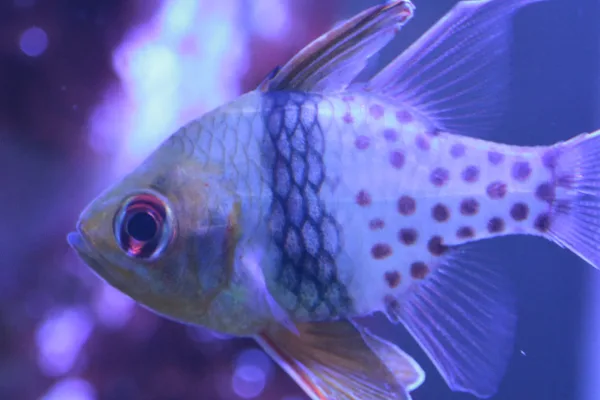
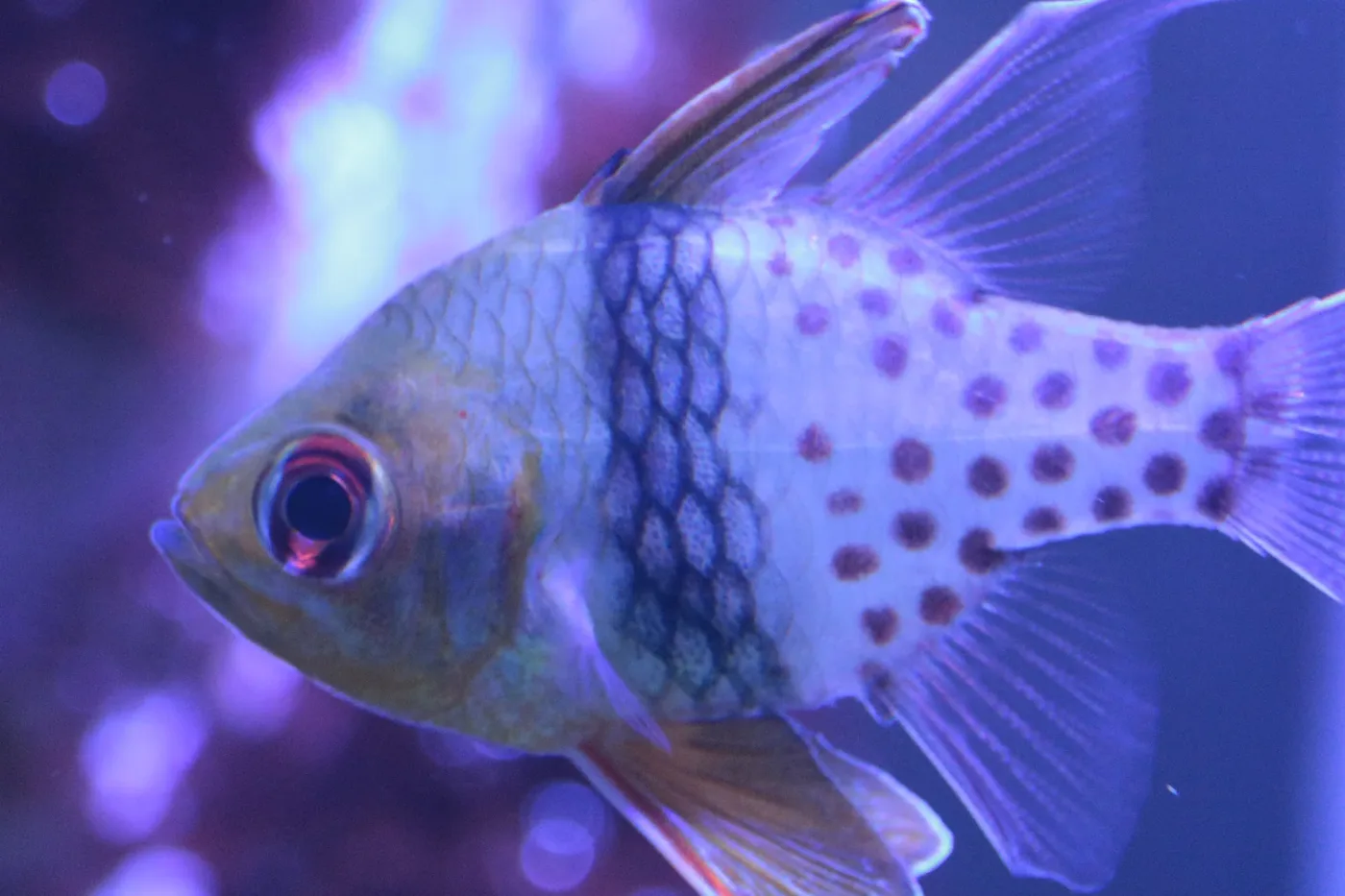
The pajama cardinalfish looks like it got dressed in three outfits at once! Its face is yellow and green. It wears a wide dark belt around its middle. Its back half is silver with orange-red dots, just like pajamas. It also has big red eyes. Big eyes help it see in the dark. That is when it comes out to catch tiny animals to eat. In the day, groups of them float quietly between the branches of corals. They are gentle fish that do not bother their neighbors. The dad keeps the eggs safe in his mouth. After about a week, the babies hatch. They swim away as tiny see-through babies called larvae. That makes them very hard for people to raise.
Water & care
Hardy, peaceful and easy to feed. Best kept in a small group of three to five or more with plenty of cover. They are slow and shy at first and can lose out at feeding time to faster tankmates. Many become active during the day once they learn when food arrives, but they look most natural in dim light around dawn, dusk and after the main lights go out.
| Parameter | Keep it at | Where that sits on the usual reef range |
|---|---|---|
| Temperature | 72–78 °F | |
| Salinity (SG) | 1.020–1.025 | |
| pH | 8.1–8.4 | |
| Alkalinity | 8–12 dKH | |
| Nitrate | 0–10 ppm |
Temperature, SG, pH and dKH from LiveAquaria's care sheet; nitrate from a Singapore husbandry guide, which also gives 25-28 C (77-82 F) and SG 1.024-1.026. No species-specific calcium, magnesium or phosphate target.
Feeding
DietCarnivore
Favorite foods
- Frozen mysis shrimp
- Enriched brine shrimp
- Small marine pellets
- Frozen bloodworms
- Chopped clam and crustacean meat
Feed small portions of suitably sized meaty foods twice a day. Some keepers add a feeding in dim light or just after lights-out so the shy group eats well. Watch that every fish is getting food.
Tank & maintenance
- Minimum tank
- 30 gallons
- Aquascape
- Branching corals, branching rockwork or seagrass to hover among, plus caves, with open water in the middle and upper levels.
- Lighting
- No special needs; they appreciate shaded areas and a dim moonlight period.
- Water flow
- Low to moderate; they struggle in strong powerhead currents.
Routine upkeep
Standard reef or fish-only upkeep with regular partial water changes. Quarantine new arrivals for 2-4 weeks, since ich after shipping is the most common problem, and check at each feeding that every fish in the group is eating.
Temperament & tankmates
TemperamentPeaceful
Peaceful with other species. Groups form a loose hierarchy with some fin-flaring, but this rarely causes injury; a dominant fish may claim the best shelter or push a weaker one away from food.
Reef safeYes
Does not touch corals, clams or other sessile invertebrates. Its large mouth can swallow very small crustaceans (amphipods, tiny shrimp) and fish fry.
Good tankmates
- Clownfish
- Gobies and firefish
- Royal Gramma
- Other peaceful cardinalfish
- Most peaceful wrasses
Avoid
- Aggressive dottybacks and large angelfish, which keep them hiding
- Aggressive damselfish such as blue devils
- Lionfish, groupers, eels and other fish-eaters
Help it thrive
- Keep a group of three to five or more; odd-numbered groups tend to be more stable.
- Give them branching coral or rock to hover among, like the Porites thickets they live in on the reef.
- Feed in dim light or in the evening at first, until they learn your feeding routine.
- Avoid boisterous or aggressive tankmates.
- Quarantine new fish and offer enriched foods to keep them in good condition.
Common ailments
Marine ich (Cryptocaryon irritans)
- Signs
- White salt-grain spots on the body and fins, scratching, faster breathing and loss of appetite, usually soon after shipping or acclimation.
- Prevention
- Quarantine new arrivals for 2-4 weeks and keep conditions stable.
- Treatment
- Treat all fish in a hospital tank with copper or chloroquine phosphate (never copper in a reef), and leave the display fishless for the full fallow period.
Bacterial infections (cloudy eye, fin rot)
- Signs
- A cloudy or swollen eye, frayed or reddened fins, lethargy and weight loss.
- Prevention
- Good water quality, careful handling and peaceful tankmates; these infections usually follow injury or poor water.
- Treatment
- Improve water quality; if it spreads or worsens, move the fish to a hospital tank and use an appropriate antibiotic as directed by the label or a vet.
Starvation from being outcompeted
- Signs
- A fish that hangs back at feeding time, a pinched belly and gradual weight loss.
- Prevention
- Avoid fast, greedy tankmates and feed some meals in dim light, when cardinals are most confident.
- Treatment
- Target-feed the thin fish or move it to a quiet tank until it recovers.
This is general hobby guidance, not veterinary advice. Quarantine new arrivals and treat in a separate tank whenever you can.
Risks of owning one
- Will eat tiny shrimp, amphipods and fish fry.
- Shy fish can starve or hide constantly when kept with aggressive tankmates.
- Most are wild-collected, so new fish need quarantine.
- Fry are very hard to raise; spawning is common, but rearing needs a dedicated larval setup.
Breeding
DifficultyHard Captive-bredWidely available
Paternal mouthbrooder with planktonic larvae. Pairs form within a group and spawn in the evening; the male holds the egg mass for about a week, and the larvae swim out of his mouth soon after hatching. ORA calls them among the most challenging larvae it rears. Hobbyist David Watson (TFH) reared them on enriched rotifers, then HUFA-enriched brine shrimp from about day 12, with metamorphosis at about 30-36 days.
- Keep a group and let a pair form; a brooding male holds his mouth closed and refuses food.
- Start rotifer and phytoplankton cultures 3-4 weeks before you plan to collect larvae.
- Around day 7-8, gently move the brooding male to a small hatching tank; larvae hatch over the next day or so.
- Feed enriched rotifers, switch to HUFA-enriched rotifers by day 5, add newly hatched brine shrimp after day 12, and introduce a fine larval powder in week three.
- Keep ammonia at zero with daily cleaning and a slow drip of clean water; a small light left on helps the larvae feed.
- Metamorphosis is complete at about 30-36 days; move juveniles to a grow-out tank at 7-8 weeks.
Deep dive The science, history and family tree
The science
Sphaeramia nematoptera is a cardinalfish (Apogonidae) that reaches about 8.5 cm total length. It has a deep, compressed body, large eyes with a red iris, and two separate dorsal fins, the second broad and transparent with a trailing filament. The head and front of the body are greenish-yellow to golden, a broad dark band runs vertically from the first dorsal fin to the belly, and the silvery rear half is covered in red-orange spots.
It occurs in the western Pacific from Java to Fiji (with a recent record from Tonga), north to the Ryukyu Islands and south to the Great Barrier Reef, at 1-14 m. By day it hovers in aggregations among the branches of corals such as Porites cylindrica and P. nigrescens in sheltered bays and lagoons, dispersing at night to feed on small animals close to the bottom.
The species is a paternal mouthbrooder. Pairs form distinctly during courtship and are socially monogamous across several breeding cycles, although genetic studies have found extra-pair fertilizations and males brooding eggs that are not their own. The male carries the egg mass in his mouth for about a week. Unlike the Banggai cardinalfish, the young hatch as tiny planktonic larvae that leave the mouth soon after hatching, which makes captive rearing difficult. It is a popular aquarium fish and the IUCN lists it as Least Concern (assessed 2021).
- Appearance
- Greenish-yellow to golden head and front half, large red to orange eyes, a broad dark vertical band at mid-body, and a silvery rear half with red-orange polka dots; the second dorsal fin trails a long filament. Unlikely to be confused with other aquarium fish; the Banggai Cardinalfish has three black bars and white spots instead.
- Native range
- Western Pacific: Java to Fiji, north to the Ryukyu Islands and south to the Great Barrier Reef; recently recorded from Tonga.
- Habitat
- Sheltered bays, lagoons and inner reefs at 1-14 m, in groups hovering among branching corals, especially Porites cylindrica and P. nigrescens; some shelter near long-spined urchins or seagrass. Disperses at night to feed close to the bottom.
- Size
- 3.5 in (8.9 cm). FishBase maximum 8.5 cm TL; aquarium adults usually reach about 3 in (LiveAquaria lists 3.5 in).
- Lifespan
- Poorly documented. One hobby guide estimates 2-5 years in aquariums; no reliable published maximum was found.
- Conservation
- Least Concern. IUCN Least Concern (assessed 2021). Not listed by CITES. Most aquarium specimens are wild-collected; ORA reports being the first hatchery to breed it commercially, so captive-bred fish are sometimes available
In the aquarium vs in the wild
In your aquarium
A peaceful, colorful group fish for reef and community tanks that adds activity to the middle water column, especially in the evening.
On the reef
A nocturnal feeder on small animals near the bottom that shelters in branching coral by day, and prey for larger reef fish.
History
Pieter Bleeker described the species in 1856 as Apogon nematopterus. It was later placed in Sphaeramia (Fowler & Bean, 1930), a genus with only two species. It has long been a hobby staple thanks to its striking pattern and peaceful nature, and it is often recommended as one of the better candidates for home breeding projects. ORA in Florida reports being the first hatchery to breed it commercially, although most fish in the trade are still wild-caught.
Evolution & relatives
As a cardinalfish (Apogonidae), the pajama cardinal belongs to a lineage whose closest living relatives are the nurseryfishes (Kurtus) and, a little further out, the gobies, not the damselfishes and clownfishes it often shares tanks with. WoRMS places cardinalfishes and nurseryfishes in the order Apogoniformes, and other classifications put them in Gobiiformes next to the gobies. The family's fossil record reaches back at least to the Eocene, including Eosphaeramia from Italy, a fossil genus named after Sphaeramia, and otoliths that may belong to cardinalfishes date to the end of the Cretaceous. Its only congener is the Orbiculate Cardinalfish (S. orbicularis), and it shares the subfamily Apogoninae with the Banggai Cardinalfish.
Family tree, from kingdom down
- Kingdom Animalia Animals Animals are living things made of many cells that must eat food to live. Fish, corals, crabs, snails and sea stars are all animals.
- Phylum Chordata Chordates Chordates have a stiff rod running down their back at some point in their lives. In fish and people, this rod is replaced by a backbone.
- Subphylum Vertebrata Vertebrates Vertebrates are animals with a backbone and a skull. Fish, frogs, birds and people are all vertebrates.
- Infraphylum Gnathostomata jawed vertebrates
- Parvphylum Osteichthyes bony fishes
- Gigaclass Actinopterygii ray-finned fishes
- Superclass Actinopteri
- Class Teleostei Teleost fishes Teleosts are bony fishes with thin, bendy fin rays and jaws that can push forward. Almost all of the fish in the world are teleosts.
- Order Apogoniformes Cardinalfishes and nurseryfishes In this order of fishes, the parents carry their eggs. Male cardinalfish hold the eggs in their mouths until they hatch.
- Family Apogonidae Cardinalfishes Cardinalfishes are small fish with big eyes that are most active at night. The males carry the eggs in their mouths.
- Subfamily Apogoninae Typical cardinalfishes
- Genus Sphaeramia Pajama cardinalfishes These cardinalfish have round bodies and big eyes. The pajama cardinal looks like it is wearing striped pajamas.
- Species Sphaeramia nematoptera
See it on the Tree of Life Compare with another species
Closest relatives
- Sphaeramia orbicularis Orbiculate Cardinalfish Same genus; the only other Sphaeramia species
- Pterapogon kauderni Banggai Cardinalfish Same subfamily (Apogoninae) Read guide · Compare
- Quinca mirifica Sailfin Cardinalfish Same subfamily (Apogoninae)
- Kurtus gulliveri Nurseryfish Same order in WoRMS (Apogoniformes); closest relatives of cardinalfishes
Older scientific names: Apogon nematopterus.
Fun facts
- Its species name, nematoptera, combines Greek words for "thread" and "fin", which fits the long filament trailing from its second dorsal fin.
- Pairs stay together for several breeding cycles, but DNA tests found some males brooding eggs that were not their own: about 18% of the clutch, on average, in those cases.
- The dad holds the eggs in his mouth for about a week and does not eat while brooding.
- On the reef they spend the day hiding in branching Porites corals and come out at night to feed.
- An Eocene fossil cardinalfish from Italy is called Eosphaeramia, after this fish's genus.
Learn more
- FishBase: Sphaeramia nematoptera (Pajama cardinalfish) fishbase.se
- Wikipedia: Pajama cardinalfish en.wikipedia.org
- Reef Builders: Dig those crazy pajama cardinalfish (2014) reefbuilders.com
- TFH Magazine: Breeding the Pajama Cardinalfish (David Watson) tfhmagazine.com
- ORA: Pajama Cardinal orafarm.com
Sources
- WoRMS: Sphaeramia nematoptera marinespecies.org
- FishBase: Sphaeramia nematoptera (Pajama cardinalfish) fishbase.se
- Wikipedia: Pajama cardinalfish en.wikipedia.org
- LiveAquaria: Pajama Cardinalfish liveaquaria.com
- Reef Builders: Dig those crazy pajama cardinalfish (2014) reefbuilders.com
- TFH Magazine: Breeding the Pajama Cardinalfish (David Watson) tfhmagazine.com
- ORA: Pajama Cardinal orafarm.com
- Gensou: Pajama cardinalfish care guide gensou.sg
- Saltwater Aquarium Blog: Pajama Cardinalfish saltwateraquariumblog.com
- Wikipedia: Cardinalfish (Apogonidae) en.wikipedia.org
- Wikipedia: Gobiiformes en.wikipedia.org
Care facts
The care facts on this guide and its product pages (care level, reef safety, temperament, size, tank, diet, flow, purpose, foods, acclimation and origin) combine 13 independent sources, checked October 25, 2026.
- Pajama Cardinalfish: Saltwater Aquarium Fish – LiveAquaria LiveAquaria
- Pajama cardinalfish: A peaceful, reef safe community saltwater fish Saltwater Aquarium Blog (Albert B Ulrich III)
- Pajama Cardinalfish (Sphaeramia Nematoptera) Reef Exclusive
- Pajama Cardinal - Sphaeramia nematoptera - Small That Pet Place
- Pyjama Cardinalfish | Kraken Corals Kraken Corals
- Sphaeramia nematoptera summary - FishBase FishBase
- Pajama Cardinal Fish Care Guide Coralife (Central Aquatics)
- Pajama Cardinal - Sphaeramia nematoptera – Top Shelf Aquatics Top Shelf Aquatics
- ORA Pajama Cardinal - Bulk Reef Supply Bulk Reef Supply (ORA captive-bred)
- Pajama Cardinalfish Sphaeramia nematoptera | Fishmetry Fishmetry
- Pajama Cardinalfish (Sphaeramia nematoptera) Fancy Reef
- Pajama Cardinal Aqua Marine Power
- Pajama Cardinalfish Sea Life Planet
Scientific names and classification follow the World Register of Marine Species (AphiaID 278349). Last updated October 25, 2026.
Shop this species
Search the shop →Sold out right now. We restock weekly, so check back soon.
Sold out
 Sold out