 Sold out
Aquacultured
Fish · Cardinalfish
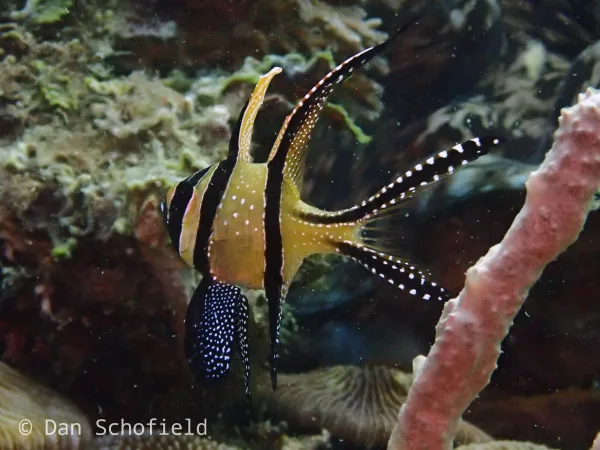
Banggai Cardinalfish
Pterapogon kauderni
Also called Banggai Cardinal, Banner Cardinal, High-fin Cardinal
- CareEasy
- Reef safeYes
- TemperamentPeacefulPeaceful to other fish; fights its own kind
- Favorite foods
- Mysis shrimp
- Enriched brine shrimp
- Copepods / zooplankton
- Max size3 in (7.6 cm)
- Min tank40 gal
- LifespanAbout 4 years in good captive…
- IUCN statusEndangered
Quick answers
- How big does the Banggai Cardinalfish get?
- Up to 3 in (7.6 cm).
- What size tank does it need?
- At least 40 gallons.
- How hard is it to keep?
- Care level: Easy.
- Is it reef safe?
- Yes. Coral safe and leaves sessile invertebrates alone.
- What does it eat?
- Mysis shrimp
- Enriched brine shrimp
- Copepods / zooplankton
- How long does it live?
- About 4 years in good captive conditions and perhaps only 1-2 years in the wild, according to published estimates summarized on Wikipedia.
- What are good tankmates?
- Clownfish
- Gobies and blennies
- Firefish
- Other peaceful cardinalfish
- Peaceful wrasses
The 30-second version
The Banggai cardinalfish is a silver fish with three bold black stripes. It has long pointy fins and tiny white dots. It comes from a small group of islands in Indonesia and nowhere else. In the wild, young ones hide between the long, sharp spines of sea urchins. Hungry fish cannot reach them there. The dads take care of the babies in an amazing way. The mom lays a small bunch of eggs. The dad keeps them safe inside his mouth for about three weeks. He does not eat the whole time! Then he spits out tiny babies that look just like their mom and dad. People took so many from the wild that this fish is now endangered. That is why it is best to buy ones raised by people.
Water & care
Captive-bred Banggais are hardy, slow-moving and readily eat frozen foods; wild-caught fish often die after import (iridovirus, shipping stress) and should be avoided. Keep a single fish, a known pair, or a group only in a large tank, because adults pair off and an established pair attacks, and can kill, other Banggais. Provide calm water, some shade and a home to hover over, such as branching rock, a long-spined urchin or an anemone.
| Parameter | Keep it at | Where that sits on the usual reef range |
|---|---|---|
| Temperature | 77–81 °F | |
| Salinity (SG) | 1.021–1.025 | |
| pH | 8.1–8.3 | |
| Nitrate | 0–10 ppm |
Temperature, pH and nitrate from a Singapore breeding guide (25-27 C, pH 8.1-8.3, nitrate under 10 ppm, SG 1.025); Frank Marini's breeding pair lived at SG 1.021 and tolerated 72 to over 85 F, and a 1999 breeding report used about 83 F. Cardinalfish are sensitive to sudden pH drops, so keep alkalinity stable. No species-specific calcium, magnesium or phosphate target.
Feeding
DietCarnivore
Favorite foods
- Frozen mysis shrimp
- Enriched brine shrimp
- Frozen copepods or cyclops
- Chopped krill, shrimp and clam
- Small marine pellets (captive-bred fish)
Feed small portions one to three times a day and rotate meaty foods. Make sure these slow eaters get their share, and target feed if needed. A brooding male will not eat for about three to four weeks, so keep males well fed beforehand.
Tank & maintenance
- Minimum tank
- 40 gallons
- Aquascape
- Rockwork with caves, overhangs and branching structure; a long-spined urchin or an anemone gives them a natural refuge. Sand areas and (live or artificial) seagrass suit them. More than one established pair needs well over 100 gallons.
- Lighting
- Moderate; they like shaded spots to hover in.
- Water flow
- Low to moderate; they are slow swimmers that hover in one place.
Routine upkeep
Standard reef or fish-only upkeep with stable pH and low nitrate. Quarantine new fish. If a pair is breeding, check the tank daily around the expected release date and remove the juveniles before tankmates eat them.
Temperament & tankmates
TemperamentPeaceful
Peaceful toward other species and easily bullied or outcompeted by pushy fish such as aggressive dottybacks, hawkfish and larger damselfish. With its own kind it is a different story: maturing males fight, and a bonded pair will chase and can kill other Banggais in the same tank.
Reef safeYes
Coral safe and leaves sessile invertebrates alone. It will eat anything small enough to swallow: copepods, amphipods, tiny shrimp and fish fry. Adult cleaner and peppermint shrimp are generally fine.
Good tankmates
- Clownfish
- Gobies and blennies
- Firefish
- Other peaceful cardinalfish
- Peaceful wrasses
- Long-spined urchins (Diadema) and anemones as hiding places
Avoid
- Lionfish, groupers, eels and other fish-eaters
- Aggressive dottybacks, hawkfish and large damselfish
- More than one Banggai pair in an average-size tank
- Fast, greedy feeders that leave them hungry
Help it thrive
- Buy captive-bred fish only: they are healthier, already eat frozen food and put no pressure on an endangered species.
- Keep one fish or a pair; to get a pair, grow up a group of juveniles and rehome the extras before fighting starts.
- Give them a home to hover over, such as a long-spined urchin, an anemone or branching rock.
- Choose calm tankmates and feed so the slow Banggais get their share.
- Fatten up a male before he broods, because he fasts for weeks.
Common ailments
Banggai cardinalfish iridovirus (megalocytivirus, ISKNV)
- Signs
- Nonspecific: lethargy, darkening, loss of appetite, labored breathing and sudden deaths, mainly in wild-caught fish in the weeks after import.
- Prevention
- Buy captive-bred fish, quarantine all arrivals, and do not mix them with newly imported wild Banggais.
- Treatment
- There is no cure. Isolate affected fish, disinfect nets and equipment, and ask an aquatic veterinarian for diagnosis (it needs histology or PCR).
Marine ich and velvet (Cryptocaryon, Amyloodinium)
- Signs
- White salt-grain spots (ich) or a fine gold-grey dusting (velvet), rapid breathing, scratching and refusing food, usually after shipping or other stress.
- Prevention
- Quarantine new fish for several weeks and keep conditions stable.
- Treatment
- Treat all fish in a hospital tank with copper or chloroquine phosphate (copper is unsafe for invertebrates) and leave the display fishless for the full fallow period.
Brooding stress (spat or eaten broods, thin males)
- Signs
- A male spits out or swallows his eggs early, or ends a brood visibly thin.
- Prevention
- Feed males heavily before spawning, keep tankmates calm, and avoid moving a brooding male.
- Treatment
- Give the male a break to regain condition (separate the pair if needed) before the next spawn.
Fighting injuries between Banggais
- Signs
- Torn fins, a fish hiding at the top or in a corner, or one fish being chased constantly.
- Prevention
- Keep a single pair, or a group only in a large tank, and remove extra adults early.
- Treatment
- Separate the injured fish and rehome extras; established pairs do not accept newcomers.
This is general hobby guidance, not veterinary advice. Quarantine new arrivals and treat in a separate tank whenever you can.
Risks of owning one
- Endangered in the wild: wild-caught fish add to the decline and often die in captivity.
- Established pairs injure or kill other Banggais.
- Eats tiny shrimp, pods and fish fry, including its own babies.
- Wild-caught imports may carry a deadly iridovirus that can spread to other Banggais.
- Listed as Threatened under the U.S. Endangered Species Act, and a 2023 NOAA proposal would restrict U.S. import and export; check current federal rules before buying, selling or shipping Banggais, wild-caught or captive-bred.
Breeding
DifficultyEasy Captive-bredWidely available
Paternal mouthbrooder with direct development. After courtship led by the female, she releases a small clutch (usually about 20-50 large eggs, rarely up to about 90), which the male takes into his mouth. He broods for about 3-4 weeks (21-28 days reported) without eating; the eggs hatch inside his mouth and the young stay there until he releases about 15-40 fully formed juveniles roughly 8 mm long. The juveniles can eat newly hatched brine shrimp right away, so no rotifer culture is needed.
- Grow up five or six juveniles together and let a pair form; rehome the others before aggression escalates.
- Condition the pair with frequent, varied meaty foods.
- Watch for courtship (circling, shimmying, flank nipping), then for a male with a bulging throat who refuses food.
- Leave him undisturbed for about 3-4 weeks; moving a brooding male can make him spit or eat the brood.
- Collect the released juveniles quickly, because adults and tankmates will eat them.
- Feed the fry enriched baby brine shrimp several times a day, then move them on to frozen cyclops and mysis; separate larger fry from smaller ones to stop bullying.
Deep dive The science, history and family tree
The science
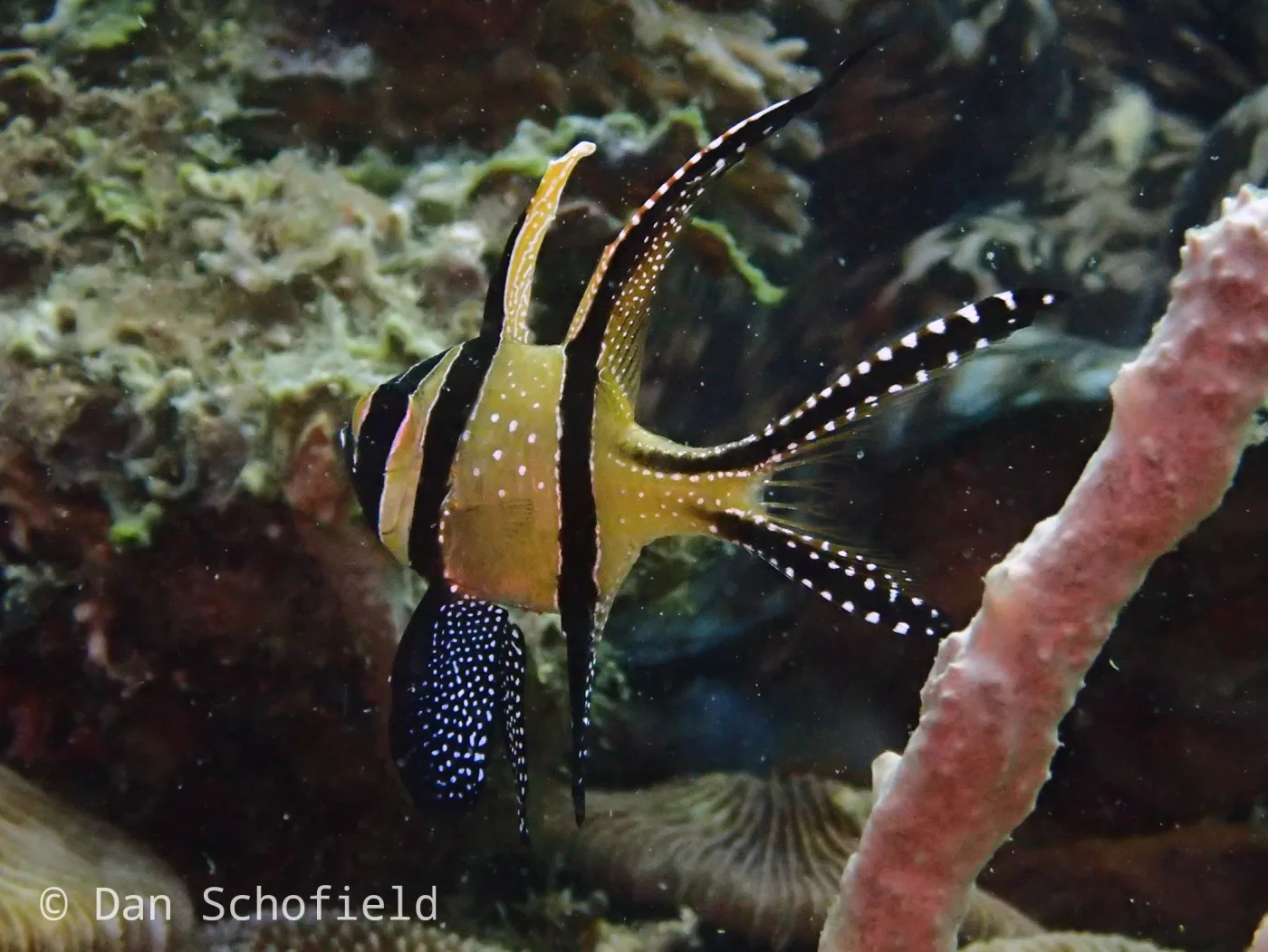
Pterapogon kauderni is a small cardinalfish (Apogonidae) that reaches about 8 cm total length (8.6 cm maximum recorded). The body is silvery and laterally compressed, crossed by three bold black bars across the head and body. The fins are elongate and edged in black: a tall, tasseled first dorsal fin, long second dorsal and anal fins, and a deeply forked tail. The rear of the body and the fins are sprinkled with white, pearl-like spots. Males have an enlarged mouth cavity that is obvious only while brooding.
The species is endemic to the Banggai Archipelago off central Sulawesi, Indonesia, with a natural range of only about 5,500 km2 and a small population near Luwuk. Fish lost or released by the aquarium trade founded an introduced population in the Lembeh Strait around 2000. It lives in calm, very shallow water (0-16 m, mostly 1-2.5 m) on sand and seagrass (Enhalus acoroides) and around jetties, hovering in small groups above long-spined sea urchins (Diadema setosum), sea anemones and branching corals, and retreating among the spines when threatened. It eats small planktonic and bottom-dwelling crustaceans, mostly copepods.
Reproduction is unusual. The female starts courtship and passes a small clutch of large eggs (2-3 mm) to the male, who broods them in his mouth for about three to four weeks without feeding. Development is direct, with no drifting larval stage, so juveniles settle in their parents' habitat and populations hardly mix. Heavy collection for the aquarium trade since the mid-1990s caused steep declines, and the IUCN lists the species as Endangered.
- Appearance
- Silver body with three bold black vertical bars, black-edged elongated fins, a tall tasseled first dorsal fin, a deeply forked tail and white polka dots on the rear of the body and fins. Juveniles look like miniature adults. Males and females are hard to tell apart: males tend to have a longer second dorsal fin, a larger jaw and a squarer head profile, and a brooding male's throat visibly bulges. It is hard to confuse with other aquarium fish; the Pajama Cardinalfish has a single dark mid-body band, red eyes and orange-red spots.
- Native range
- Endemic to the Banggai Archipelago, Central Sulawesi, Indonesia (including small islands off eastern Taliabu and the Luwuk area), roughly 5,500 km2. Introduced by the aquarium trade to the Lembeh Strait, North Sulawesi, around 2000; small groups have also been seen at Secret Bay, Bali (2014).
- Habitat
- Calm, very shallow water (0-16 m, usually 1-2.5 m) over sand and seagrass beds (Enhalus acoroides), around jetties and reef edges. Groups hover above long-spined urchins (Diadema setosum), anemones and branching corals and dive among the spines or tentacles when threatened; juveniles stay closest to urchins and anemones.
- Size
- 3 in (7.6 cm). FishBase maximum 8.6 cm TL (a female); typical adults are about 3 in, and most fish sold are 1-2 in.
- Lifespan
- About 4 years in good captive conditions and perhaps only 1-2 years in the wild, according to published estimates summarized on Wikipedia. Long-term captive records are scarce.
- Conservation
- Endangered. IUCN Red List: Endangered (first listed 2007; the 2025 amended assessment keeps it Endangered). Listed as Threatened under the U.S. Endangered Species Act (final rule January 2016; no critical habitat designated because the range is outside U.S. jurisdiction). In August 2023 NOAA Fisheries proposed protective regulations under ESA section 4(d) that would restrict U.S. import and export of the species; the final rule was scheduled for May 2026 but had not been published in the Federal Register as of October 2026. Proposals to list it on CITES Appendix II in 2007 and 2016 were both withdrawn, and it is not listed by CITES. Indonesia gave it limited protection in 2018 (Decree 49/KEPMEN-KP/2018), which protects it in the Banggai Islands during the February-March and October-November spawning peaks. Wild exports reached 700,000-900,000 fish a year in 2001-2004, and some local populations crashed or disappeared. Captive-bred fish make up most of today's market; buy captive-bred only
In the aquarium vs in the wild
In your aquarium
An elegant centerpiece for calm reef and nano tanks, one of the easiest marine fish to breed at home, and a flagship for captive breeding as a conservation tool.
On the reef
A small predator of copepods and other tiny crustaceans in shallow seagrass and urchin habitats, and prey for lionfish, groupers and sea kraits.
History
Koumans described the species in 1933, naming it after Walter Kaudern, a Swedish zoologist who explored Sulawesi in 1916-1921. It was then almost unknown until ichthyologist Gerald Allen rediscovered it in the mid-1990s (accounts give 1994 or 1995) and showed photos to aquarists. It quickly became a trade sensation, and exports reached 600,000-700,000 fish a year by 2001. Some local populations crashed and one, off Limbo Island, disappeared. Hobbyists bred it almost at once (Frank Marini published a breeding account in 1996), and it became a model for conservation through captive breeding. In 2000 about 50 fish escaped or were released from an exporter's holding pen in the Lembeh Strait and founded a wild population there. The IUCN listed it as Endangered in 2007 and the U.S. as Threatened in 2016; by 2018 captive-bred fish sold for as little as US$14 and made up most of the market.
Evolution & relatives
Cardinalfishes (Apogonidae, about 370 species) are small, mostly nocturnal reef fishes famous for males that brood eggs in their mouths. DNA studies unexpectedly found that their closest relatives are the nurseryfishes (Kurtus), whose males carry eggs on a hook on the forehead, and, a little further out, the gobies. WoRMS groups cardinalfishes and nurseryfishes in the order Apogoniformes, while other classifications place them in Gobiiformes next to the gobies. So on the fish tree a Banggai is much closer to a goby than to a clownfish or damselfish, which belong to Ovalentaria. Pterapogon now contains only this species; the Australian Pterapogon mirifica was moved to Quinca. Its direct development, with no drifting larvae, helps explain why it never spread beyond the Banggai Islands on its own and why depleted local populations are slow to recover.
Family tree, from kingdom down
- Kingdom Animalia Animals Animals are living things made of many cells that must eat food to live. Fish, corals, crabs, snails and sea stars are all animals.
- Phylum Chordata Chordates Chordates have a stiff rod running down their back at some point in their lives. In fish and people, this rod is replaced by a backbone.
- Subphylum Vertebrata Vertebrates Vertebrates are animals with a backbone and a skull. Fish, frogs, birds and people are all vertebrates.
- Infraphylum Gnathostomata jawed vertebrates
- Parvphylum Osteichthyes bony fishes
- Gigaclass Actinopterygii ray-finned fishes
- Superclass Actinopteri
- Class Teleostei Teleost fishes Teleosts are bony fishes with thin, bendy fin rays and jaws that can push forward. Almost all of the fish in the world are teleosts.
- Order Apogoniformes Cardinalfishes and nurseryfishes In this order of fishes, the parents carry their eggs. Male cardinalfish hold the eggs in their mouths until they hatch.
- Family Apogonidae Cardinalfishes Cardinalfishes are small fish with big eyes that are most active at night. The males carry the eggs in their mouths.
- Subfamily Apogoninae Typical cardinalfishes
- Genus Pterapogon Banggai cardinalfishes These cardinalfish have tall fins and white spots. The males carry the eggs and babies in their mouths.
- Species Pterapogon kauderni
See it on the Tree of Life Compare with another species
Closest relatives
- Quinca mirifica Sailfin Cardinalfish Formerly in the same genus (as Pterapogon mirifica); endemic to Australia
- Sphaeramia nematoptera Pajama Cardinalfish Same subfamily (Apogoninae); popular hobby cardinalfish Read guide · Compare
- Sphaeramia orbicularis Orbiculate Cardinalfish Same subfamily (Apogoninae)
- Kurtus gulliveri Nurseryfish Same order in WoRMS (Apogoniformes); closest relatives of cardinalfishes
Fun facts
- The dad broods the eggs in his mouth for about three weeks and does not eat the whole time.
- Babies come out as tiny copies of their parents, skipping the drifting larval stage most reef fish have.
- Young Banggais hide among the spines of long-spined sea urchins.
- Its whole natural range is one small island group covering only about 5,500 square kilometers (about 2,100 square miles).
- About 50 escaped fish in the Lembeh Strait in 2000 grew to more than 600 within a year.
Learn more
- Wikipedia: Banggai cardinalfish en.wikipedia.org
- FishBase: Pterapogon kauderni (Banggai cardinalfish) fishbase.se
- NOAA Fisheries: Listing the Banggai cardinalfish under the ESA fisheries.noaa.gov
- CORAL Magazine: Banggai Breeding I (Frank Marini, 1996) coralmagazine.com
- DAN Alert Diver: A Beautiful Invasion (Banggai cardinalfish in Lembeh) dan.org
Sources
- WoRMS: Pterapogon kauderni marinespecies.org
- FishBase: Pterapogon kauderni (Banggai cardinalfish) fishbase.se
- Wikipedia: Banggai cardinalfish en.wikipedia.org
- NOAA Fisheries: Listing the Banggai cardinalfish under the ESA fisheries.noaa.gov
- Mongabay Indonesia: Banggai cardinal fish, protection status (2021, Indonesian) mongabay.co.id
- DAN Alert Diver: A Beautiful Invasion (Banggai cardinalfish in Lembeh) dan.org
- CORAL Magazine: Banggai Breeding I (Frank Marini, 1996) coralmagazine.com
- The Breeder's Registry: Pterapogon kauderni spawning report (1999) breedersregistry.org
- Gensou: Banggai cardinalfish breeding guide gensou.sg
- Top Shelf Aquatics: Banggai Cardinalfish care topshelfaquatics.com
- Koda et al. 2023, ISKNV (iridovirus) in Banggai cardinalfish, J Fish Dis (record) experts.umn.edu
- Wikipedia: Cardinalfish (Apogonidae) en.wikipedia.org
- Wikipedia: Gobiiformes en.wikipedia.org
- Wikipedia: Nurseryfish (Kurtus) en.wikipedia.org
- FishBase: Quinca mirifica (Sailfin cardinalfish) fishbase.se
- Wikipedia: Walter Kaudern en.wikipedia.org
- Federal Register 88 FR 55431 (2023): Proposed protective regulations for the threatened Banggai cardinalfish govinfo.gov
- Reginfo.gov Unified Agenda RIN 0648-BL87: Banggai cardinalfish 4(d) rule status reginfo.gov
Care facts
The care facts on this guide and its product pages (care level, reef safety, temperament, size, tank, diet, flow, purpose, foods, acclimation and origin) combine 12 independent sources, checked October 25, 2026.
- Banggai Cardinalfish care guide Saltwater Aquarium Blog (Albert B Ulrich III)
- Pterapogon kauderni (Banggai cardinal fish) ReefApp encyclopedia
- Banggai Cardinal - Pterapogon kauderni - Captive Bred | ThatPetPlace.com ThatPetPlace
- Captive-Bred Banggai Cardinalfish - Pterapogon kauderni Top Shelf Aquatics
- Banggai Cardinalfish (Pterapogon Kauderni) Reef Exclusive
- CARDINAL - BANGGAI CAPTIVE BRED Pterapogon kauderni - Aquatics Unlimited Aquatics Unlimited
- Banggai Cardinalfish-Pterapogon kauderni Fishkeeper (UK)
- Banggai Cardinalfish Are Full Of Personality To Quickly Fill A Small Tank Reef Builders (Nicole Helgason)
- Banggai Cardinalfish Care Guide: Striking Stripes and Easy Breeding - Gensou Premium Aquascaping Gensou (Singapore)
- Banggai Cardinalfish (Pterapogon kauderni): A Striking Addition to Your Reef Aquarium Reef Supplies Canada
- Pterapogon kauderni summary FishBase
- Cardinalfish Care Guide: Pairs vs Groups, Feeding and Behavior Top Shelf Aquatics
Scientific names and classification follow the World Register of Marine Species (AphiaID 282494). Last updated October 25, 2026.
Shop this species
Search the shop →Sold out right now. We restock weekly, so check back soon.
Sold out
Aquacultured