 Sold out
Aquacultured
Fish · Dottyback
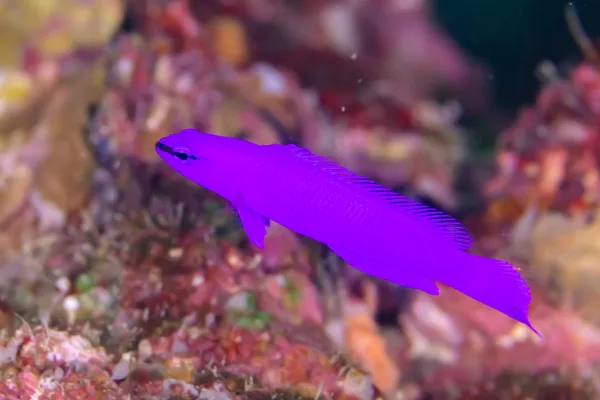
Orchid Dottyback
Pseudochromis fridmani
Also called Fridmani Dottyback, Fridmani
- CareEasy
- Reef safeYes
- TemperamentSemi-aggressiveChases smaller and look-alike fish; guards its cave
- Favorite foods
- Frozen mysis shrimp
- Frozen brine shrimp / krill
- Meaty pellets
- Max size3 in (7.6 cm)
- Min tank30 gal
- LifespanNot well documented
- IUCN statusLeast Concern
Quick answers
- How big does the Orchid Dottyback get?
- Up to 3 in (7.6 cm).
- What size tank does it need?
- At least 30 gallons.
- How hard is it to keep?
- Care level: Easy.
- Is it reef safe?
- Yes. Safe with corals, but it preys on small ornamental shrimp, fanworms and bristleworms (Fishkeeper, ReefApp), and Quality Marine notes it has been known to eat mantis shrimp.
- What does it eat?
- Frozen mysis shrimp
- Frozen brine shrimp / krill
- Meaty pellets
- How long does it live?
- Not well documented; no reliable published captive lifespan was found during research.
- What are good tankmates?
- Tangs
- Larger angelfish
- Hawkfish
- Larger damselfish
- Clownfish
The 30-second version
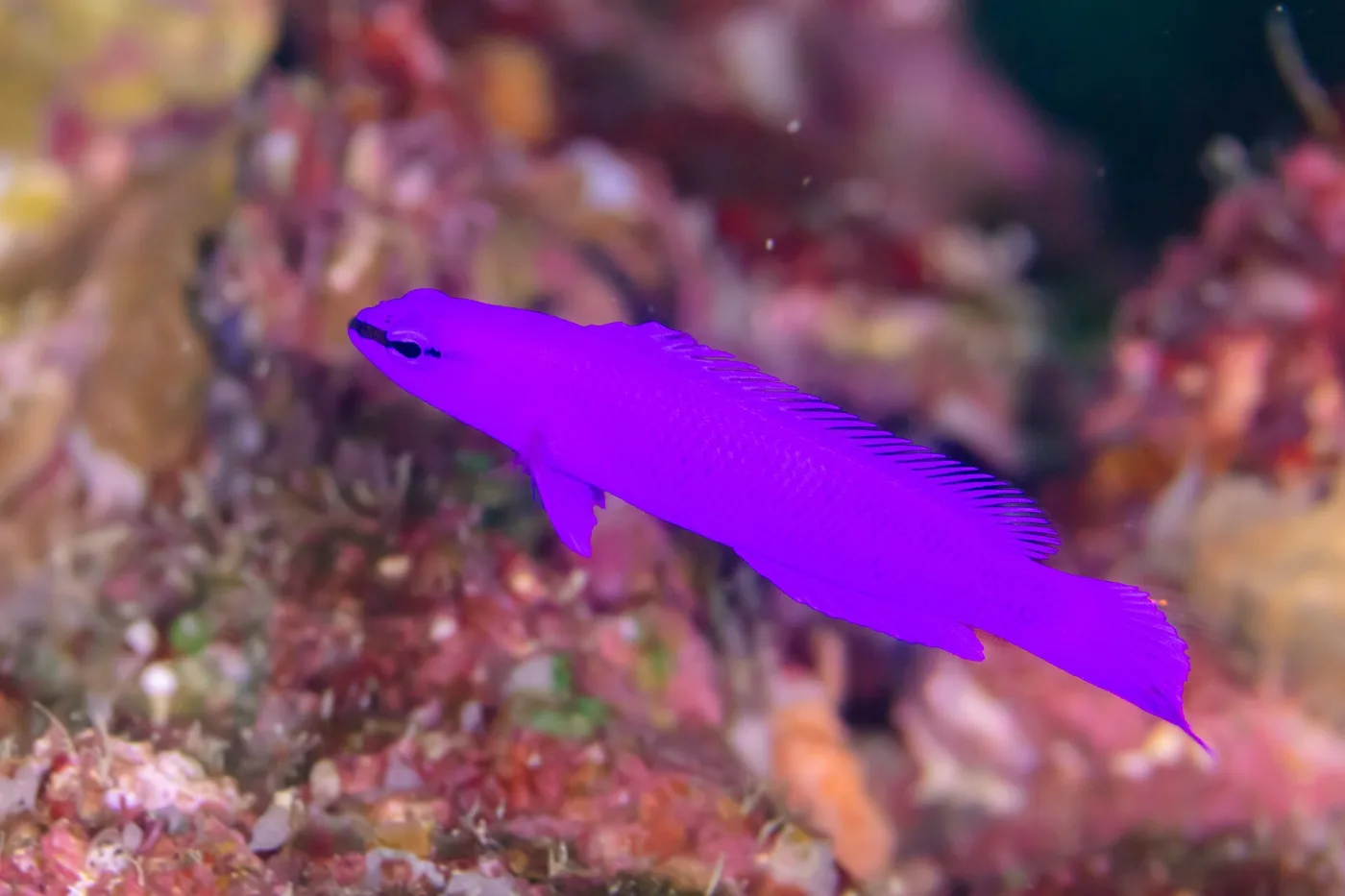
The Orchid Dottyback is a small fish that is bright purple all over, like a purple flower. A thin dark line runs from its nose through its eye, like a tiny mask. In the wild, it lives only in the Red Sea. There it hides in small holes on steep rock walls. It eats tiny shrimp and worms. In a home tank, it will even hunt the bristle worms that hide in the rocks. Most of these fish sold today were born on fish farms, not caught on reefs. That makes them tough and easy to feed. They can be a bit bossy about their favorite cave. So they do best with fish that can stand up for themselves. Dad dottybacks guard a ball of eggs until the babies hatch.
Water & care
Captive-bred fish are hardy and eat almost anything. The main challenges are its territorial streak and its taste for small shrimp and worms. Give it plenty of caves, add it last, and keep a tight lid on the tank.
| Parameter | Keep it at | Where that sits on the usual reef range |
|---|---|---|
| Temperature | 72–78 °F | |
| Salinity (SG) | 1.020–1.025 | |
| pH | 8.1–8.4 | |
| Alkalinity | 8–12 dKH |
Retailer care ranges (Quality Marine, The Biota Group); Fishkeeper gives 24-27 C (about 75-81 F). Captive breeding studies kept the fish at about 27 C (81 F). In a reef, follow your corals' targets for calcium, magnesium and nutrients; ammonia and nitrite must stay at zero.
Feeding
DietCarnivore
Favorite foods
- Mysis shrimp
- Vitamin-enriched brine shrimp
- Calanus and other copepods
- Small meaty pellets
- Finely shaved krill, mussel, cockle or clam
- Bristleworms (it hunts them in the rockwork)
Small meaty foods several times a day in small amounts; most captive-bred fish also accept pellets and flakes. A varied diet keeps its purple color intense.
Tank & maintenance
- Minimum tank
- 30 gallons
- Aquascape
- A mature tank with plenty of rockwork full of caves, crevices and overhangs; it will claim one as home. Add it last so it does not claim the whole tank before others settle.
- Lighting
- No special needs; normal reef or fish-only lighting.
- Water flow
- Any typical reef flow, with sheltered caves out of the strongest current.
Routine upkeep
Standard upkeep: regular partial water changes, stable salinity and temperature, and a secure lid. Watch for bullying of newer or smaller fish, and feed small meals often.
Temperament & tankmates
TemperamentSemi-aggressive
One of the mildest dottybacks, but still territorial: it defends its cave, especially when breeding, and harasses newcomers, look-alikes and small docile fish such as firefish, small gobies, anthias and fairy wrasses. Quality Marine lists it as aggressive. Add it last. Keeping several needs a large tank with many visual barriers.
Reef safeYes
Safe with corals, but it preys on small ornamental shrimp, fanworms and bristleworms (Fishkeeper, ReefApp), and Quality Marine notes it has been known to eat mantis shrimp. Larger shrimp and crabs are generally safe. Count it as a coral-safe fish that is a risk to small crustaceans and worms.
Good tankmates
- Tangs
- Larger angelfish
- Hawkfish
- Larger damselfish
- Clownfish
- Robust wrasses
Avoid
- Other dottybacks, especially look-alike purple ones
- Royal Gramma and other basslets
- Small, timid fish: firefish, small gobies, anthias, fairy wrasses
- Small ornamental shrimp and fanworms
- Seahorses and pipefish
- Large predators that can swallow it
Help it thrive
- Buy captive-bred: it is hardier, already eats prepared food and avoids wild collection.
- Make it the last fish added so it cannot claim the whole tank first.
- Give it more caves than it needs; it will pick a favorite and defend that one.
- Feed small meaty meals several times a day with variety to keep its color strong.
- Fit a tight lid: dottybacks are expert jumpers.
Common ailments
Marine ich (Cryptocaryon) and velvet (Amyloodinium)
- Signs
- White salt-grain spots (ich) or a fine gold-gray dust (velvet), fast breathing, scratching, hiding and refusing food.
- Prevention
- Quarantine new fish for several weeks; captive-bred fish carry much less risk than wild ones.
- Treatment
- Treat in a separate hospital tank with an established parasite treatment such as copper, following the product directions and testing levels; never treat in the reef display.
Fight wounds and torn fins
- Signs
- Split fins, missing scales or bite marks on it or its tankmates, constant chasing.
- Prevention
- One dottyback per tank, no look-alikes, plenty of caves, and add it last.
- Treatment
- Separate the fighters, keep the water very clean so fins regrow, and watch for secondary infection.
Faded color from stress or poor diet
- Signs
- Dull, washed-out purple, hiding more than usual, reduced appetite.
- Prevention
- Varied, vitamin-enriched meaty foods, stable water and a secure cave.
- Treatment
- Correct water quality, vary and enrich the diet, and remove sources of stress; color usually returns.
This is general hobby guidance, not veterinary advice. Quarantine new arrivals and treat in a separate tank whenever you can.
Risks of owning one
- It eats small ornamental shrimp, fanworms and other small invertebrates.
- It bullies small, peaceful fish and other dottybacks or look-alikes.
- It jumps out of uncovered tanks.
- Easy to confuse with the more aggressive Strawberry Dottyback when buying; check for the dark line through the eye.
Breeding
DifficultyModerate Captive-bredWidely available
Pairs spawn readily in captivity: after a courtship dance at the cave or PVC pipe entrance, the female lays a ball of several hundred eggs held together by sticky threads, and the male guards it. In a James Cook University study pairs spawned year-round every 5-11 days (mostly every 6-8), eggs hatched after about 96 hours at 27 C, and larvae became juveniles at 31-56 days. Parents ate on average 55 percent of their eggs each month even when well fed, so producers often remove eggs or larvae. Larvae are first fed enriched rotifers and later moved on to Artemia; the JCU work found the first two weeks after hatching to be the key larval stage.
- Form a pair; most dottybacks are protogynous hermaphrodites, so two young fish raised together often become a male and a female.
- Provide a small-diameter PVC pipe or cave as a spawning site.
- Feed the pair heavily with varied, enriched meaty foods.
- Watch for the male guarding an egg ball; hatching follows about four days later at 27 C.
- Move the eggs or newly hatched larvae to a rearing tank to avoid cannibalism.
- Feed enriched rotifers from first feeding, move on to newly hatched Artemia as the larvae grow, and expect the first juveniles from about 31 days.
Deep dive The science, history and family tree
The science
Pseudochromis fridmani is a small dottyback (Pseudochromidae: Pseudochrominae) endemic to the Red Sea. It reaches about 6.3 cm total length and has the elongate body, long single dorsal fin and incomplete lateral line typical of the family. The colour is a uniform, vivid violet to magenta, with a dark line running from the snout through the eye, a mark that separates it from similar purple dottybacks such as the strawberry (magenta) dottyback, Pictichromis porphyrea. It is reef-associated from about 1 to 60 m and generally common, usually on vertical rock faces or under overhangs, where it shelters in small holes. It feeds on small invertebrates (trophic level about 3.5). As in other dottybacks, the female lays a ball of eggs held together by sticky threads inside a crevice and the male guards it until hatching, and most members of the family are protogynous hermaphrodites that start life as females. Captive studies at James Cook University found pairs spawning year-round every 5-11 days (most often every 6-8 days), eggs hatching after about 96 hours at 27 C, and larvae becoming juveniles between 31 and 56 days after hatching; the same study recorded heavy filial cannibalism of eggs. The species was described by Wolfgang Klausewitz in 1968 from the Gulf of Aqaba and named for David Fridman of the Maritime Museum in Eilat, Israel, who collected the type specimen. It is assessed as Least Concern and is one of the most widely aquacultured marine ornamental fishes.
- Appearance
- Solid, electric purple-violet from nose to tail, with a dark line from the snout through the eye. Sexes look alike; in dottybacks males are often slightly larger. Look-alikes: the Strawberry (Magenta) Dottyback, Pictichromis porphyrea, is a similar purple but lacks the dark eye line and is more aggressive; the Royal Dottyback (Pictichromis paccagnellae) and Royal Gramma are purple only on the front half.
- Native range
- Red Sea endemic; the type specimen came from the Gulf of Aqaba.
- Habitat
- Vertical rock and reef faces and the undersides of overhangs at about 1-60 m (3-197 ft), sheltering in small holes; generally common.
- Size
- 3 in (7.6 cm). FishBase gives 6.3 cm (2.5 in) total length as the maximum. Fishkeeper lists 7 cm, and retailers about 3 in.
- Lifespan
- Not well documented; no reliable published captive lifespan was found during research.
- Conservation
- Least Concern. Assessed Least Concern by the IUCN (2019). Not CITES-listed. A Red Sea endemic, but captive-bred fish dominate the trade, so buying captive-bred avoids wild collection entirely
In the aquarium vs in the wild
In your aquarium
A hardy, eye-catching color fish for reefs and fish-only tanks; it also hunts bristleworms and other small pests in the rockwork.
On the reef
A small cave-dwelling predator of tiny invertebrates on Red Sea reef walls, and prey for larger reef fishes.
History
Wolfgang Klausewitz described Pseudochromis fridmani in 1968 in Senckenbergiana Biologica from the Gulf of Aqaba, naming it after David Fridman of the Maritime Museum in Eilat, who collected the type specimen. It was soon prized by aquarists for its solid purple color. Today it is one of the most commonly produced marine ornamental fish in aquaculture, alongside the neon and splendid dottybacks, and James Cook University has published detailed studies of its spawning, egg cannibalism and larval rearing to improve production.
Evolution & relatives
Dottybacks (Pseudochromidae) are a family of about 152 species in 24 genera from the tropical and subtropical Indo-Pacific. They are split into four subfamilies: the colorful reef dottybacks (Pseudochrominae, which holds Pseudochromis and Pictichromis), the small Pseudoplesiopinae, the single-genus Anisochrominae and the eel-like eel-blennies (Congrogadinae), whose largest member reaches 45 cm. Long treated as perch-like fishes of uncertain position, dottybacks are now placed in Ovalentaria, a large branch of spiny-rayed fishes united by eggs attached to the bottom; WoRMS lists them as incertae sedis (position not settled) there, while the Catalog of Fishes puts them at the base of an expanded Blenniiformes, with basslets, jawfishes, damselfishes and blennies. On a tree of life, an orchid dottyback therefore sits near the Atlantic Royal Gramma and not far from clownfish and blennies, but well away from gobies. Its closest relatives are other Pseudochromis dottybacks, such as the striped and bluestriped dottybacks.
Family tree, from kingdom down
- Kingdom Animalia Animals Animals are living things made of many cells that must eat food to live. Fish, corals, crabs, snails and sea stars are all animals.
- Phylum Chordata Chordates Chordates have a stiff rod running down their back at some point in their lives. In fish and people, this rod is replaced by a backbone.
- Subphylum Vertebrata Vertebrates Vertebrates are animals with a backbone and a skull. Fish, frogs, birds and people are all vertebrates.
- Infraphylum Gnathostomata jawed vertebrates
- Parvphylum Osteichthyes bony fishes
- Gigaclass Actinopterygii ray-finned fishes
- Superclass Actinopteri
- Class Teleostei Teleost fishes Teleosts are bony fishes with thin, bendy fin rays and jaws that can push forward. Almost all of the fish in the world are teleosts.
- Order Ovalentaria (unplaced) Unplaced ovalentarian fishes Ovalentaria is a big group of fish with spiny fins. Scientists found it by studying DNA, and most of its fish lay eggs that stay stuck to the bottom. 'Incertae sedis' means 'place not sure': scientists have not settled which order damselfishes, dottybacks and basslets belong in.
- Family Pseudochromidae Dottybacks Dottybacks are small, brightly colored fish that live in cracks in the reef. They can be bold and bossy for their size.
- Subfamily Pseudochrominae
- Genus Pseudochromis Dottybacks This is the main group of dottybacks. They are small, colorful fish that hide in rocks and guard their space.
- Species Pseudochromis fridmani
See it on the Tree of Life Compare with another species
Closest relatives
- Pseudochromis sankeyi Striped Dottyback Same genus
- Pseudochromis springeri Bluestriped Dottyback Same genus
- Pseudochromis aldabraensis Neon Dottyback Same genus; also widely captive-bred
- Pictichromis porphyrea Strawberry (Magenta) Dottyback Same subfamily (Pseudochrominae); purple look-alike without the eye line
- Gramma loreto Royal Gramma Different family (Grammatidae) on the same broad Ovalentaria branch; an Atlantic fish with a similar cave-dwelling life Read guide · Compare
Fun facts
- Its scientific name honors David Fridman of the Maritime Museum in Eilat, Israel, who collected the first specimen.
- In a captive study, pairs spawned all year long, about once a week.
- Parents in that study ate on average more than half of their own eggs each month, even when well fed.
- Most dottybacks start life as females and can later change into males.
- It hunts bristleworms, one of the most common hitchhikers in reef tanks.
Learn more
- FishBase: Pseudochromis fridmani fishbase.se
- Chen, Zeng and Cobcroft (2023): Year-round spawning, filial cannibalism and development of the orchid dottyback researchonline.jcu.edu.au
- UF/IFAS: Overview of commonly cultured marine ornamental fish ask.ifas.ufl.edu
- Fishkeeper: Orchid Dottyback fishkeeper.co.uk
Sources
- FishBase species summary: Pseudochromis fridmani fishbase.se
- WoRMS: Pseudochromis fridmani Klausewitz, 1968 marinespecies.org
- Wikipedia: Orchid dottyback en.wikipedia.org
- Wikipedia: Pseudochromidae en.wikipedia.org
- Chen, Zeng and Cobcroft (2023), Fishes 8(9): 451 researchonline.jcu.edu.au
- Chen (2021): Captive breeding of orchid dottyback, PhD thesis, James Cook University researchonline.jcu.edu.au
- UF/IFAS EDIS FA224: Overview of commonly cultured marine ornamental fish ask.ifas.ufl.edu
- Fishkeeper: Orchid Dottyback fishkeeper.co.uk
- Quality Marine: Fridmani Dottyback qualitymarine.com
- The Biota Group: Fridmani Dottyback shop.thebiotagroup.com
- ReefApp: Pseudochromis fridmani reefapp.net
- Wikipedia: Ovalentaria en.wikipedia.org
Care facts
The care facts on this guide and its product pages (care level, reef safety, temperament, size, tank, diet, flow, purpose, foods, acclimation and origin) combine 12 independent sources, checked October 25, 2026.
- Pseudochromis fridmani Tropical Fish Hobbyist
- Fridmani Dottyback Biota
- Orchid Dottyback LiveAquaria
- ORA Orchid Dottyback Bulk Reef Supply (ORA captive-bred)
- Orchid Dottyback - Pseudochromis fridmani - Captive Bred That Pet Place
- Orchid Dottyback (Pseudochromis fridmani): care, compatibility, breeding Aquahoy (author Milthon Lujan, 2025-10-01)
- Orchid Dottyback Fishkeeper (UK)
- Orchid Dottyback Care Guide: Pseudochromis Fridmani in Reef Tanks Gensou (Singapore)
- Pseudochromis fridmani, Orchid dottyback FishBase
- Orchid Dottyback Top Shelf Aquatics
- 9 Easy Steps to Drip Acclimating New Saltwater Fish Bulk Reef Supply
- How to Drip Acclimation Quality Marine
Scientific names and classification follow the World Register of Marine Species (AphiaID 218336). Last updated October 25, 2026.
Shop this species
Search the shop →Sold out right now. We restock weekly, so check back soon.
Sold out
Aquacultured