 Sold out
Aquacultured
Corals · SPS coral
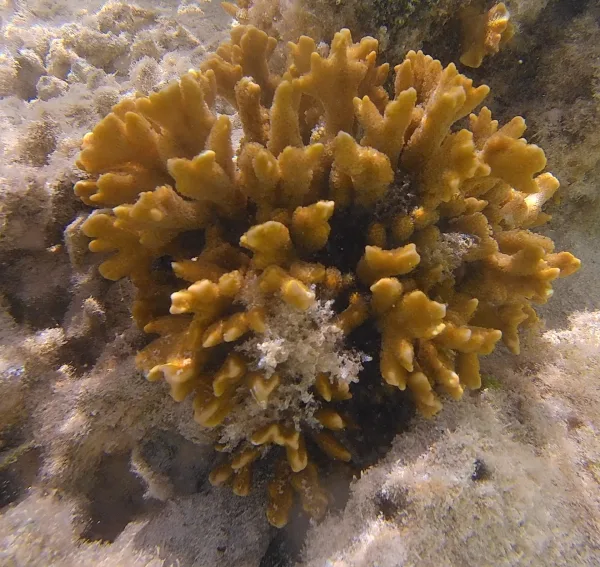
Montipora Digitata
Montipora digitata
Also called Monti Digi, Digitata, Orange Monti Digi, Orange Montipora Digitata, Finger coral, Velvet finger montipora, Pore coral
- CareModerate
- Reef safeYes
- TemperamentPeacefulPeaceful; branches shade and overgrow neighbors
- Favorite foods
- Light (zooxanthellae)
- Small-particle foods
- Amino acids (optional)
- Max size16 in (40 cm)
- Min tank40 gal
- LifespanColonies are clonal and can keep…
- IUCN statusEndangered
Quick answers
- How big does the Montipora Digitata get?
- Up to 16 in (40 cm).
- What size tank does it need?
- At least 40 gallons.
- How hard is it to keep?
- Care level: Moderate.
- Is it reef safe?
- Yes. It is a reef coral and harms nothing but neighbors it physically touches.
- What does it eat?
- Light (zooxanthellae)
- Small-particle foods
- Amino acids (optional)
- How long does it live?
- Colonies are clonal and can keep growing indefinitely; individual colonies live for many years in a stable reef, and captive strains are kept going for decades by fragging.
- What are good tankmates?
- Other Montipora and Acropora (with spacing)
- Clownfish, gobies, blennies, cardinalfish and other reef-safe fish
- Tangs and rabbitfish for algae control
- Snails, hermit crabs and cleaner shrimp
- Birdsnest, Stylophora and other SPS
The 30-second version
Montipora digitata looks like a little bush made of stony fingers. Each finger is covered in tiny animals called polyps. They are so small you have to look close to see them. A coral is an animal, but it lives a bit like a plant. Tiny algae live inside it. They use sunlight to make food, so the coral needs bright light. At night the polyps poke out to catch tiny bits of food. The coral builds its hard skeleton from stuff in the water. So the tank needs the right minerals each week. If a branch breaks off, it can grow into a new coral. That is how reef shops grow more of them. They do not need to take them from the sea. Orange ones glow like campfire coals under blue lights.
Water & care
Among the most forgiving SPS corals and a classic first SPS, but it still needs what all SPS need: a mature, stable reef (several months old), reef-grade lighting around 150-300 PAR, good flow and steady alkalinity, calcium and magnesium that you test and dose. It tolerates higher nutrients than Acropora (it just turns browner) and recovers from small swings, but sudden alkalinity or temperature changes, light shock and Montipora-eating nudibranchs are the usual killers. Green morphs handle lower light (about 120 PAR); orange colors best around 200-280 PAR under blue-heavy light. Rated Easy-to-moderate by some sellers; we rate it Moderate because it is not a beginner's first coral, only a beginner's first SPS.
| Parameter | Keep it at | Where that sits on the usual reef range |
|---|---|---|
| Temperature | 75–80 °F | |
| Salinity (SG) | 1.025–1.026 | |
| pH | 8.1–8.4 | |
| Alkalinity | 7.5–9.5 dKH | |
| Calcium | 400–450 ppm | |
| Magnesium | 1,250–1,400 ppm | |
| Nitrate | 2–10 ppm | |
| Phosphate | 0.02–0.08 ppm |
Stability matters more than the exact number: keep daily alkalinity swings under about 0.5 dKH and temperature swings under about 1 F. Sources differ (Top Shelf suggests 7-8 dKH and warns that tissue necrosis follows alkalinity above about 10 dKH; others allow 8-12 dKH). It tolerates nitrate up to about 15 ppm and phosphate up to about 0.1 ppm, but higher nutrients brown it, while ultra-low nutrients pale it. Ammonia and nitrite must be zero.
Feeding
DietPhotosynthetic
Favorite foods
- Light (photosynthesis by its symbiotic algae)
- Dissolved organics and amino acids
- Fine zooplankton such as rotifers and copepod nauplii
No target feeding is needed: it gets most of its energy from its zooxanthellae and picks up fine plankton and dissolved organics from the water. If you feed, broadcast a small amount of fine zooplankton or a low dose of amino acids in the evening when polyps extend. Do not squirt chunky foods onto it; uneaten particles rot on the branches. Overfeeding the tank shows up as brown coloration.
Tank & maintenance
- Minimum tank
- 40 gallons
- Aquascape
- Any stable SPS-capable reef; larger water volumes are easier to keep stable. Glue frags to a plug or rock in the middle to upper rockwork where water can pass through the branches, with room to grow into a bush.
- Lighting
- Medium to high: about 150-300 PAR (orange morphs color best around 200-280 PAR; green tolerates about 120). Acclimate new frags at about 100-150 PAR for a week or two, then raise intensity gradually over 2-4 weeks.
- Water flow
- Moderate to strong, turbulent and random so water moves through the branches and keeps detritus off; avoid a constant direct jet.
Routine upkeep
Test alkalinity, calcium and magnesium at least weekly (more often while it is growing fast) and dose to replace what it uses. Do regular water changes, keep flow pumps clean, inspect the branch bases and undersides for nudibranchs, egg spirals and bare patches, and prune or frag the colony when it starts to shade or touch neighbors.
Temperament & tankmates
TemperamentPeaceful
Coexists with most SPS and other Montipora; leave about 10 cm (4 in) between it and neighbors so growing branches do not touch. Keep it well away from long-tentacled LPS such as Euphyllia (torch, hammer, frogspawn) and galaxea, which will sting it.
Reef safeYes
It is a reef coral and harms nothing but neighbors it physically touches. It has weak sweeper tentacles and little chemical aggression, so it loses fights with most LPS and soft corals. As colonies grow they can shade corals below them.
Good tankmates
- Other Montipora and Acropora (with spacing)
- Clownfish, gobies, blennies, cardinalfish and other reef-safe fish
- Tangs and rabbitfish for algae control
- Snails, hermit crabs and cleaner shrimp
- Birdsnest, Stylophora and other SPS
Avoid
- Butterflyfish (many eat Montipora polyps)
- Coral-nipping angelfish and triggerfish
- Euphyllia, galaxea and other LPS with long sweeper tentacles within reach
- Unquarantined Montipora frags that may carry Montipora-eating nudibranchs
Help it thrive
- Quarantine or at least dip and inspect every new Montipora frag; look for tiny white egg spirals and slugs at the base and on the plug.
- Add it only after the tank has been stable for several months and you are already holding alkalinity steady.
- Start new frags low or under reduced light and move them up over a few weeks to avoid light shock.
- Give it turbulent flow through the branches and room to grow into a bush.
- Aim for moderate, stable nutrients (some nitrate and phosphate) rather than chasing zero, which pales the color.
- Frag it before it touches neighbors; broken branches grow into new colonies.
Common ailments
Montipora-eating nudibranchs (Phestilla subodiosa, described as P. subodiosus)
- Signs
- Pale or bare patches of skeleton that spread, often starting at the base or the underside of branches; tiny white to translucent slugs 1.5-4 mm long with brown-speckled cerata, and small spiral egg masses on the coral or plug.
- Prevention
- Buy aquacultured stock from a trusted source, quarantine new Montipora for about 30 days and dip every new frag in a reef coral pest dip, checking plugs and bases for eggs.
- Treatment
- Remove the colony, dip it, pick or blow off visible slugs and siphon egg masses, then repeat dips weekly for several weeks to catch newly hatched slugs; frag and save healthy branches. Some wrasses are reported to eat them, but no control method has been scientifically tested.
Tissue necrosis (STN and RTN)
- Signs
- Tissue peels away to leave white skeleton, slowly from the base (slow tissue necrosis) or over a whole branch within a day or two (rapid tissue necrosis).
- Prevention
- Keep alkalinity, calcium, salinity and temperature stable, avoid alkalinity above about 10 dKH or sudden jumps, and keep flow strong enough to stop detritus settling.
- Treatment
- Find and correct the parameter or flow problem. Frag healthy branches well above the dying edge and remount them; remove dead sections, which grow algae.
Bleaching and light shock
- Signs
- The coral turns pale or white, often on the upper, brightest surfaces, shortly after being placed under stronger light or after a heat spike.
- Prevention
- Acclimate new frags at lower PAR and raise light gradually; avoid sudden lighting changes and keep temperature steady.
- Treatment
- Move it lower or reduce intensity, check temperature and nutrients, and give it stable conditions; mildly bleached tissue often recolors over weeks.
Browning
- Signs
- Bright orange or green fades to tan or brown.
- Prevention
- Avoid overfeeding the tank and let nitrate and phosphate settle in a moderate range.
- Treatment
- Reduce feeding and nutrients gradually and give it adequate light; color returns slowly. Do not strip nutrients suddenly.
This is general hobby guidance, not veterinary advice. Quarantine new arrivals and treat in a separate tank whenever you can.
Risks of owning one
- Montipora-eating nudibranchs brought in on one frag can spread to every Montipora in the tank and are hard to eradicate because their eggs survive dips.
- It depletes alkalinity and calcium as it grows, so you must test and dose; a missed dosing schedule can cause tissue loss.
- Branches are brittle and snap easily during cleaning or rock work.
- Expensive designer morphs can lose their color after a move to different lighting or nutrients.
- Wear gloves and eye protection when fragging; skeleton shards are sharp.
Propagation & fragging
DifficultyEasy AquaculturedWidely available
Propagated by fragging: any branch tip snapped off grows into a new colony. In the wild it also reproduces sexually as a hermaphroditic broadcast spawner whose eggs carry algae, but this is not done at home. Almost all aquarium stock is aquacultured.
- Wait until the colony is healthy and at least a few inches across.
- With clean bone cutters or wire cutters, snap off a 3-5 cm (1-2 in) branch tip.
- Dip the new frag briefly in a reef coral dip and rinse it in tank water.
- Glue or putty the cut end onto a plug or rock with cyanoacrylate gel or epoxy.
- Place the frag in moderate light and good flow; it should encrust onto the plug within about 10-14 days.
- Raise it to brighter light over the following weeks as it grows new branches.
Deep dive The science, history and family tree
The science
Montipora digitata (Dana, 1846) is a zooxanthellate stony coral in the family Acroporidae. Colonies are digitate to arborescent, built from upright branches that frequently anastomose (fuse together), and they can form hemispherical, bushy mounds 40 cm or more across. As in other Montipora, the corallites are very small and immersed in a porous coenosteum, which in this species is smooth, so the branch surface looks finely pitted rather than polyp-studded; unlike Acropora there is no larger axial corallite at the branch tips. Wild colonies are usually pale cream, yellowish or brown and sometimes pink or blue; the vivid orange, green, purple and red forms in the aquarium trade are selected color strains. Polyps extend mainly at night to capture plankton, but most of the colony's energy comes from symbiotic dinoflagellates living in its tissues. The species ranges across the Indo-West Pacific, from East Africa (Kenya, Mozambique, Rodrigues) to Fiji, the Great Barrier Reef and the central Pacific, in shallow reef habitats from the surface to about 33 m, and it can be the dominant coral on shallow muddy reef flats and in lagoons. It is a simultaneous hermaphrodite that broadcast-spawns once a year, and, like all Montipora studied, its eggs already carry symbiotic algae (vertical transmission). Corals of the World treats M. digitata as a species complex whose boundaries with the nominal species M. tortuosa still need study. It is assessed as Endangered on the IUCN Red List and, like all stony corals, is listed on CITES Appendix II.
- Appearance
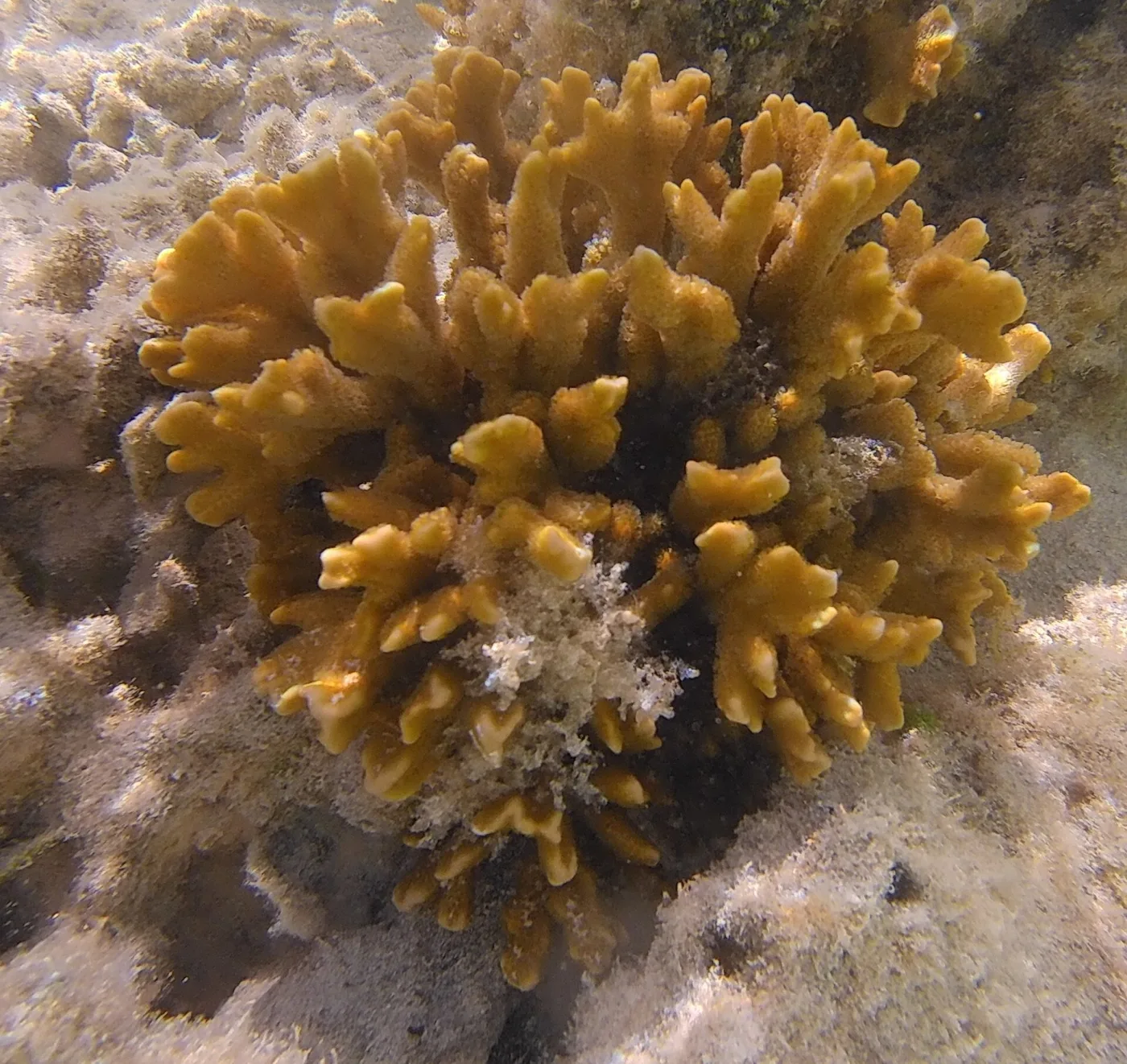
- A bushy clump of upright, finger-like branches with rounded tips that often fuse where they touch. The surface looks smooth and finely porous, like velvet or fine sandpaper; the polyps are tiny and usually only visible as a fuzz at night or under close inspection. Branch tips have no larger 'leading' corallite, which separates it from Acropora. Common aquarium morphs are orange (often with lighter tips), green, purple, pink and the premium orange-red 'forest fire'; wild colonies are mostly cream to brown. Look-alikes: finger Porites (Porites cylindrica and relatives) have larger, clearly visible polyps that are often open by day; Montipora samarensis and M. altasepta are similar branching species that need skeletal detail to separate; Stylophora and Pocillopora have larger corallites and blunter, lumpier branches.
- Native range
- Indo-West Pacific: roughly 29 N to 27 S and 39 E to 180 E, from East Africa (Kenya, Mozambique) and the western Indian Ocean islands (including Rodrigues) east through Southeast Asia and northern Australia (including the Great Barrier Reef) to Fiji, its type locality. The genus Montipora does not occur in the Atlantic.
- Habitat
- Shallow reef environments from the intertidal to about 33 m: reef flats, back reefs and lagoons, often in turbid, sediment-rich water. It can dominate shallow muddy reef flats, where its fused branches form dense thickets that shelter small fish and invertebrates.
- Size
- 16 in (40 cm). Wild colonies form mounds 40 cm (16 in) or more across. In aquariums a frag typically grows a few centimeters of branch per year (about 3-5 cm per Gensou, 3-4 in per Top Shelf Aquatics) and can become a 10-15 cm colony in 12-18 months in a stable system. Fragging keeps colonies to size.
- Lifespan
- Colonies are clonal and can keep growing indefinitely; individual colonies live for many years in a stable reef, and captive strains are kept going for decades by fragging.
- Conservation
- Endangered. IUCN Red List: Endangered under criteria A3ce (assessed 27 April 2023), meaning a large population decline is projected over coming decades from reef habitat loss and other threats; a 2008 assessment had rated it Least Concern. All stony corals are on CITES Appendix II, so wild-collected colonies need export permits. Aquarium stock of this species is overwhelmingly aquacultured or captive-fragged, which is the responsible choice
In the aquarium vs in the wild
In your aquarium
Ornamental SPS coral and the usual 'first SPS' for reefers moving beyond soft corals and LPS. Its fast, forgiving growth makes it a staple for fragging, trading and filling the middle to upper rockwork with color.
On the reef
A reef builder of shallow flats and lagoons, where its dense, fused branching thickets add calcium carbonate to the reef, shelter small fish and invertebrates, and feed corallivores such as butterflyfish.
History
James Dwight Dana described the species in 1846 as Manopora digitata in the zoophyte volume of the United States Exploring Expedition (1838-1842); Veron (1986) gives Fiji as the type locality. Because branching Montipora vary so much with light and wave exposure, it was re-described under about 18 other names over the following decades (WoRMS lists 19 synonyms, from Bernard, Quelch, Verrill and others), all now merged into M. digitata. In the reef hobby it became one of the most widely kept SPS corals, recommended as a first SPS because it tolerates mistakes that kill Acropora; orange and green aquacultured strains are now standard in reef shops, with premium morphs such as purple and 'forest fire'. Its conservation status was raised from Least Concern (2008) to Endangered in the 2023 IUCN reassessment of reef corals.
Evolution & relatives
Montipora belongs to the Acroporidae, the family of Acropora, Anacropora and Astreopora, which sits in the 'complex coral' branch of the stony coral tree that WoRMS ranks as suborder Refertina. The Montipora and Acropora lineages are estimated to have split about 125 million years ago, in the Early Cretaceous (figure cited in the Montipora comparative genomics study of Yoshioka et al. 2022). Montipora is the second most species-rich coral genus after Acropora (about 85 species) and stands out in its family: all known species pass their symbiotic algae directly into their eggs, and the genus shows relatively low sensitivity to heat and acidification stress. Its closest genus is Anacropora, which appears to have evolved from within Montipora relatively recently (Wallace et al. 2007). M. digitata itself is treated as a species complex, so what hobbyists call 'digitata' may include more than one closely related lineage. On the AquaFrenzy tree it sits on the same genus branch as Montipora capricornis, one step from Acropora, and far from the 'robust' corals such as birdsnest (Pocilloporidae).
Family tree, from kingdom down
- Kingdom Animalia Animals Animals are living things made of many cells that must eat food to live. Fish, corals, crabs, snails and sea stars are all animals.
- Phylum Cnidaria Cnidarians Cnidarians are soft animals with tentacles. The tentacles have tiny stinging cells. Corals, sea anemones and jellyfish all belong here.
- Subphylum Anthozoa Corals and sea anemones These cnidarians spend their whole lives as polyps: a tube with a mouth ringed by tentacles. Unlike jellyfish, they never swim around as a bell-shaped medusa.
- Class Hexacorallia Hexacorals In this group the tentacles and body parts come in sixes or multiples of six. It includes stony corals, sea anemones, mushroom corals and zoanthids.
- Order Scleractinia Stony corals Stony corals build hard skeletons out of limestone under their soft polyps. Over many years, these skeletons pile up and make coral reefs.
- Suborder Refertina Complex corals
- Family Acroporidae Acroporid corals This is the biggest family of stony corals and includes some of the fastest growers on the reef. Branching staghorns and plating Montipora belong here.
- Genus Montipora Pore corals Montipora corals have tiny polyps sitting in little pores. They grow as plates, crusts or branches and come in many colors.
- Species Montipora digitata
See it on the Tree of Life Compare with another species
Closest relatives
- Montipora capricornis Montipora Cap Same genus; the plating 'monti cap' of the hobby Read guide · Compare
- Montipora samarensis Branching montipora Same genus; similar branching species listed as a look-alike in Corals of the World
- Montipora altasepta Montipora Same genus; listed as a similar species in Corals of the World
- Montipora capitata Rice coral Same genus; a Hawaiian branching-to-plating Montipora
- Anacropora Anacropora corals Closest genus; thought to have evolved from within Montipora
- Acropora Acropora (staghorn and table corals) Same family Acroporidae; lineages split about 125 million years ago
Older scientific names: Manopora digitata, Manopora tortuosa, Montipora levis, Montipora divaricata, Montipora palmata.
Fun facts
- Montipora have some of the smallest corallites (polyp cups) of any stony coral, which is why the surface looks like velvet.
- Montipora mothers pack their eggs with symbiotic algae, so baby corals start life with a built-in food factory; most other corals in the family, including Acropora, must pick up their algae from the water.
- A tiny nudibranch that eats nothing but Montipora was only formally described in 2020, after aquarists had been fighting it in their tanks for about two decades.
- Dana's original 1846 description came from the U.S. Exploring Expedition, the same voyage that collected thousands of specimens for the Smithsonian.
- In the wild it can be the dominant coral on muddy reef flats where many other corals struggle.
Learn more
- Corals of the World: Montipora digitata factsheet coralsoftheworld.org
- WoRMS: Montipora digitata (Dana, 1846) marinespecies.org
- SeaLifeBase: Montipora digitata sealifebase.se
- Wang et al. 2020, Phestilla subodiosus: a corallivorous pest in the aquarium trade (ZooKeys) pmc.ncbi.nlm.nih.gov
Sources
- WoRMS: Montipora digitata (Dana, 1846) marinespecies.org
- Wikipedia: Montipora digitata en.wikipedia.org
- SeaLifeBase: Montipora digitata sealifebase.se
- Corals of the World: Montipora digitata factsheet coralsoftheworld.org
- Wikipedia: Montipora en.wikipedia.org
- Yoshioka et al. 2022, Comparative genomics of the coral genus Montipora (BMC Ecology and Evolution) pmc.ncbi.nlm.nih.gov
- Wang et al. 2020, Phestilla subodiosus sp. nov. (ZooKeys) pmc.ncbi.nlm.nih.gov
- Reeflex: Phestilla subodiosa reeflex.net
- Top Shelf Aquatics: Coral Care Series, Montipora topshelfaquatics.com
- Gensou: Montipora Digitata Care Guide gensou.sg
Care facts
The care facts on this guide and its product pages (care level, reef safety, temperament, size, tank, diet, flow, purpose, foods, acclimation and origin) combine 12 independent sources, checked October 25, 2026.
- Montipora Digitata Care Guide: Branching Beginner SPS Gensou
- ORA Neon Green Montipora digitata Bulk Reef Supply
- Bubblegum Digitata Montipora Coral Top Shelf Aquatics
- Red Thin Branch Montipora Biota
- ORA Green Digitata Algae Barn (ORA product)
- Red Montipora Digitata Fragbox
- Montipora digitata (Velvet Coral) Reeflex
- Montipora digitata (Velvet Finger Montipora, Finger Coral) Salt Corner
- Pore coral (Montipora digitata) Reeflings
- Red Montipora Digitata AquariumFish.com
- Bubblegum Digi (Montipora digitata) The Reef Farm
- Montipora Coral Extreme Corals
Scientific names and classification follow the World Register of Marine Species (AphiaID 207185). Last updated October 25, 2026.
Shop this species
Search the shop →Sold out right now. We restock weekly, so check back soon.
Sold out
Aquacultured