 Sold out
Aquacultured
Corals · SPS coral
Montipora Capricornis
Montipora capricornis
Also called Monti Cap, Montipora Cap, Red Monti Cap, Red Montipora Cap, Plating montipora, Leaf plate montipora, Vase coral, Cap coral, Pore coral
- CareModerate
- Reef safeYes
- TemperamentPeacefulPeaceful; plates shade and fight touching corals
- Favorite foods
- Light (zooxanthellae)
- Zooplankton / micro-plankton
- Amino acids (optional)
- Max size39 in (100 cm)
- LifespanColonies are clonal and can keep…
- IUCN statusEndangered
Quick answers
- How big does the Montipora Capricornis get?
- Up to 39 in (100 cm).
- How hard is it to keep?
- Care level: Moderate.
- Is it reef safe?
- Yes. It is a reef coral that harms nothing except neighbors it grows into.
- What does it eat?
- Light (zooxanthellae)
- Zooplankton / micro-plankton
- Amino acids (optional)
- How long does it live?
- Colonies are clonal and can keep growing indefinitely; individual colonies live for many years in a stable reef, and named captive strains are kept going for decades by fragging.
- What are good tankmates?
- Other Montipora (different cap strains can even be grown side by side)
- Acropora, birdsnest and other SPS placed so they are not shaded
- Clownfish, gobies, blennies, cardinalfish and other reef-safe fish
- Tangs and rabbitfish for algae control
- Snails, hermit crabs and cleaner shrimp
The 30-second version
Montipora capricornis is a coral that grows in flat plates. They look like a stack of thin pancakes or a swirl of open cups. The plates have lots of tiny holes. Very small animals called polyps live in them. Tiny algae live inside the coral and turn light into food. So it needs bright reef lights. The edges grow out a little bit each month. In a good tank, new plates stack up like shelves. The plates are wide, so they can shade the corals below, like a big umbrella. If a piece of plate snaps off, it can grow into a whole new coral. That is how reef shops grow red, green and orange caps. They do not need to take them from the sea.
Water & care
One of the easier SPS corals, often recommended as a beginner's first or second SPS, but it still needs a mature, stable reef with SPS-grade lighting (about 150-250 PAR), steady alkalinity, calcium and magnesium, and flow that keeps detritus off the plates. Red and orange morphs hold color best around 200-280 PAR under blue-heavy light. The main ways it fails are light shock, detritus or cyanobacteria under the plates, alkalinity swings and Montipora-eating nudibranchs. Sellers disagree on whether it is beginner friendly; we rate it Moderate.
| Parameter | Keep it at | Where that sits on the usual reef range |
|---|---|---|
| Temperature | 75–80 °F | |
| Salinity (SG) | 1.025–1.026 | |
| pH | 8.1–8.4 | |
| Alkalinity | 7.5–9.5 dKH | |
| Calcium | 400–450 ppm | |
| Magnesium | 1,250–1,400 ppm | |
| Nitrate | 2–10 ppm | |
| Phosphate | 0.02–0.08 ppm |
Keep parameters stable: daily alkalinity swings under about 0.5 dKH and temperature swings under about 1 F. Sources range from 7-8 dKH (Top Shelf) to 8-9.5 dKH (BRS) for alkalinity, and some allow nitrate up to about 25 ppm. Higher nutrients deepen and brown the color; very low nutrients increase fluorescence but can pale the coral. Ammonia and nitrite must be zero.
Feeding
DietPhotosynthetic
Favorite foods
- Light (photosynthesis by its symbiotic algae)
- Dissolved organics and amino acids
- Fine zooplankton such as rotifers and copepod nauplii
No target feeding is needed. It lives mainly on its zooxanthellae and on fine plankton and dissolved organics in the water. Occasional broadcast feeding of fine plankton or a low dose of amino acids can support growth and color, but overfeeding browns the plates and feeds cyanobacteria in the dead spaces beneath them.
Tank & maintenance
- Aquascape
- Any stable SPS-capable reef. Mount it on a vertical rock face or a downward-sloping ledge in the middle to upper rockwork so plates can grow horizontally into open water, and leave the space below free of light-hungry corals.
- Lighting
- Medium to high: about 150-250 PAR (red and orange morphs color best around 200-280 PAR). Lower light gives broader, flatter plates; higher light gives tighter plates and stronger color. Acclimate new frags at about 100-150 PAR and raise intensity over 1-3 weeks.
- Water flow
- Moderate, turbulent cross-flow that reaches both the top and the underside of the plates to stop detritus and cyanobacteria building up; avoid a direct laminar jet, which curls and damages plate edges.
Routine upkeep
Test alkalinity, calcium and magnesium weekly and dose to keep up with growth. Check the underside of the plates for detritus, cyanobacteria, nudibranchs and egg spirals, and adjust flow as the colony widens. Trim plate edges with bone cutters before the colony shades or touches neighbors.
Temperament & tankmates
TemperamentPeaceful
No significant sweeper tentacles, but it will compete with any coral it physically touches and can overgrow slower corals beneath it. Allow about 15 cm (6 in) of clearance and plan for horizontal spread. Keep it away from LPS with long sweeper tentacles, which will sting the plate edges.
Reef safeYes
It is a reef coral that harms nothing except neighbors it grows into. Its biggest impact is shading: wide plates growing above other corals cut off their light and can stunt or kill them.
Good tankmates
- Other Montipora (different cap strains can even be grown side by side)
- Acropora, birdsnest and other SPS placed so they are not shaded
- Clownfish, gobies, blennies, cardinalfish and other reef-safe fish
- Tangs and rabbitfish for algae control
- Snails, hermit crabs and cleaner shrimp
Avoid
- Butterflyfish and coral-nipping angelfish
- Triggerfish
- Corals directly underneath the plates
- Euphyllia and other LPS with long sweeper tentacles within reach
- Unquarantined Montipora frags that may carry Montipora-eating nudibranchs
Help it thrive
- Dip and inspect new frags and quarantine valuable ones; check the underside of every plate for tiny white slugs and egg spirals.
- Mount it so the plate can grow out horizontally into open water.
- Make sure flow sweeps under the plates as well as over them.
- Start under moderate light and move it up gradually; red strains color best in the 200-280 PAR range under blue-heavy light.
- Keep alkalinity steady and avoid chasing ultra-low nutrients.
- Plan ahead: trim edges before it shades the corals below.
Common ailments
Montipora-eating nudibranchs (Phestilla subodiosa, described as P. subodiosus)
- Signs
- Spreading bare patches, especially on the underside of plates where the slugs hide by day; tiny white to translucent slugs 1.5-4 mm long and small spiral egg masses on the plate or plug.
- Prevention
- Buy aquacultured stock, dip every new Montipora frag and inspect the underside, and quarantine new Montipora for about 30 days.
- Treatment
- Remove affected plates, dip thoroughly, pick off visible slugs with a pipette and scrape or siphon egg masses; repeat dips weekly for several weeks. Some wrasses reportedly eat them, but no control has been scientifically tested.
Tissue recession under the plates
- Signs
- Dead, white or algae-covered patches spreading from the underside or base of the plates, often with cyanobacteria or trapped detritus.
- Prevention
- Provide turbulent flow that reaches beneath the plates and keep the space under the colony clean.
- Treatment
- Improve flow, siphon detritus, remove cyanobacteria, and frag healthy plate edges if recession keeps advancing.
Tissue necrosis (STN and RTN)
- Signs
- Tissue sloughing off to bare white skeleton, slowly from the base or rapidly across the plate.
- Prevention
- Keep alkalinity, calcium, salinity and temperature stable; avoid alkalinity above about 10 dKH or sudden jumps.
- Treatment
- Correct the underlying problem, frag healthy tissue well away from the dying edge and remount it.
Light shock and bleaching
- Signs
- Plates turning pale or white soon after a move to brighter light or a temperature spike.
- Prevention
- Acclimate gradually and avoid sudden lighting or temperature changes.
- Treatment
- Lower the coral or reduce light intensity and keep conditions stable; mildly bleached plates often recover color over weeks.
This is general hobby guidance, not veterinary advice. Quarantine new arrivals and treat in a separate tank whenever you can.
Risks of owning one
- Wide plates shade and can kill corals growing beneath them.
- Montipora-eating nudibranchs introduced on one frag can spread to every Montipora in the tank.
- It consumes calcium and alkalinity as it grows, so you will need to test and dose.
- Thin plates snap easily during rock work or cleaning.
- Trade names are unreliable: a 'monti cap' may be a different Montipora species with different growth and needs.
- Wear gloves and eye protection when fragging; plate edges and shards are sharp.
Propagation & fragging
DifficultyEasy AquaculturedWidely available
Propagated by fragging plate edges. In the wild it is a hermaphroditic broadcast spawner whose eggs already carry symbiotic algae, but sexual reproduction is not attempted in home tanks. Nearly all aquarium stock is captive-fragged or maricultured.
- Use bone cutters to snap a 2-3 cm (about 1 in) piece from a healthy plate edge; no power tools are needed.
- Dip the frag briefly in a reef coral dip and rinse it in tank water.
- Glue it to a plug or rock with cyanoacrylate gel, ideally with the plate angled so it can grow horizontally.
- Place it in moderate light and good flow; frags usually encrust onto the plug within about two weeks.
- New plate growth typically starts within 4-6 weeks; raise it to brighter light gradually.
Deep dive The science, history and family tree
The science
Montipora capricornis Veron, 1985 is a zooxanthellate stony coral in the family Acroporidae, described by J.E.N. Veron from Australian reefs. Corals of the World characterizes colonies as flat plates arranged in tiers or whorls, sometimes with columns, encrusting areas or irregularly contorted laminae. Corallites are immersed, tuberculae and papillae are absent, and the coenosteum is coarse. Similar species include M. turgescens, which has smaller corallites and a finer coenosteum, and M. florida and M. friabilis, which have much thinner, more delicate fronds. Wild colonies are uniform purple, blue or brown; a field observer on the Great Barrier Reef describes the true species as thick (about 8-10 mm) with wide cups that can approach 1 m across. It occurs in the Indo-West Pacific, mostly in lagoons and on subtidal reefs and boulder substrata at about 7-25 m, and has been seen in an inshore Great Barrier Reef lagoon from about 8 m to beyond 30 m. Polyps extend mainly at night to feed on plankton, while symbiotic dinoflagellates supply most of its energy. Like all Montipora studied, it is a hermaphroditic broadcast spawner whose eggs carry symbiotic algae. In the aquarium trade, 'Monti Cap' is applied loosely to many plating and cupping Montipora, and many hobby colonies grow as thin plates unlike wild M. capricornis, so the true identity of individual trade strains is often uncertain. The species is assessed as Endangered on the IUCN Red List and listed on CITES Appendix II.
- Appearance
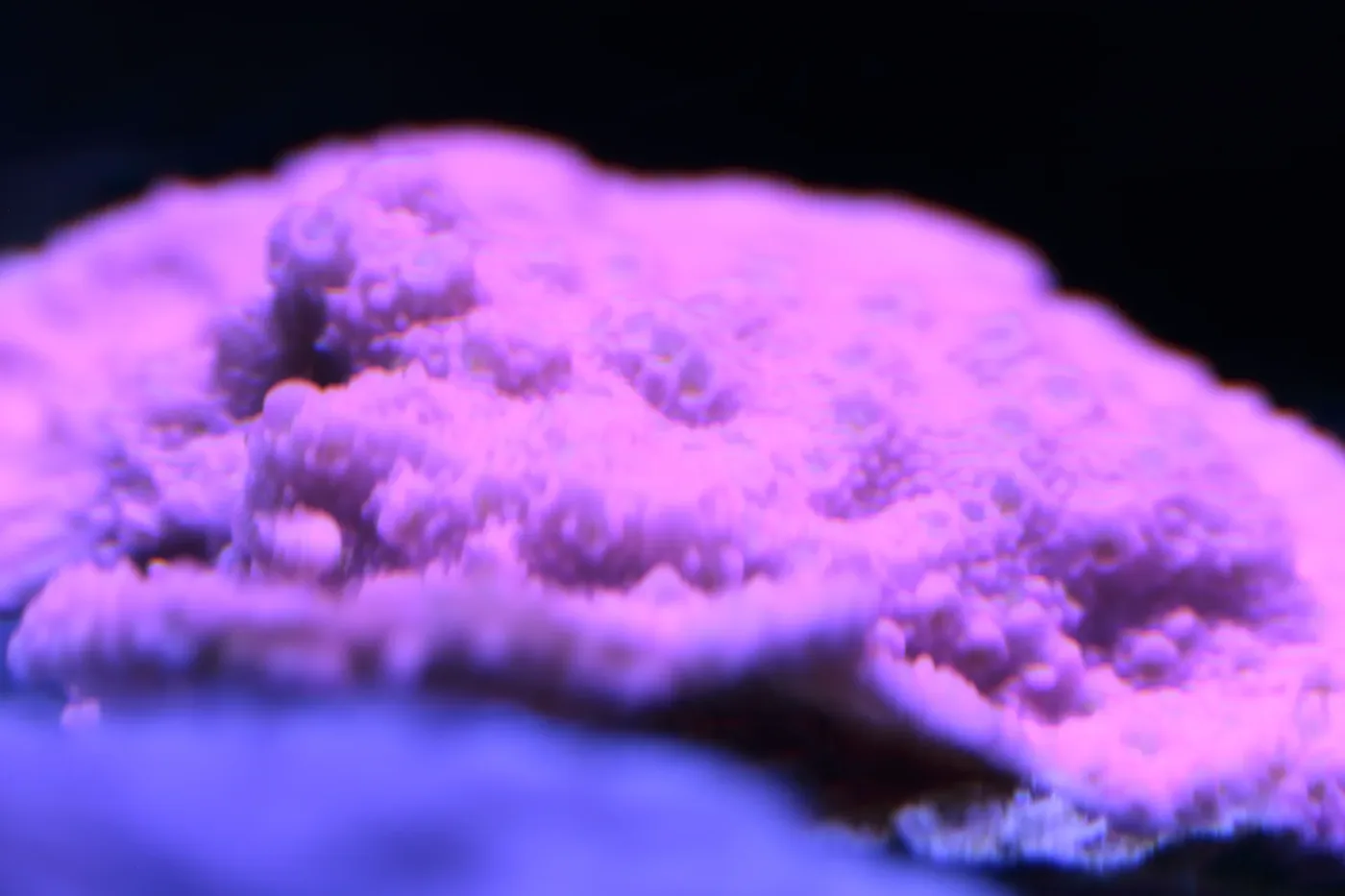
- Thin, flat to gently cupped plates that grow outward from the attachment point and stack in tiers or whorls; in tanks it usually forms horizontal shelves, and in the wild the true species forms thick, wide cups. The surface is finely porous with no raised bumps (papillae or tubercles), and the growing edge is often a lighter or contrasting color. Aquarium strains are red, orange, green, purple or two-tone, often with contrasting blue, green or yellow polyps; the 'Red Monti Cap' is a deep red to orange plate that glows under blue light. Look-alikes: many other plating Montipora (M. foliosa, M. florida, M. aequituberculata and others) are sold as 'monti caps'; M. aequituberculata has a bumpy (tuberculate) surface, and M. florida and M. friabilis have thinner, more delicate fronds. Plating Pavona and young Turbinaria have larger, clearly visible polyps.
- Native range
- Indo-West Pacific. It was described from Australian reefs (Veron 1985) and has been confirmed in Great Barrier Reef lagoons; because the name is widely misapplied, published range limits beyond Australia are less certain.
- Habitat
- Mostly lagoons and sheltered subtidal reefs, on reef slopes and boulder substrata at about 7-25 m, occasionally shallower in rock pools. On inshore reefs its wide cups act as particle traps in murky, plankton-rich water carried by tides.
- Size
- 39 in (100 cm). Wild cup-shaped colonies of the true species can approach 1 m (about 3 ft) across (Reef Builders field observation). In aquariums, plates grow roughly 5-10 cm (2-4 in) per year once established, and colonies commonly reach 20-40 cm (8-16 in) across in about two years if not fragged.
- Lifespan
- Colonies are clonal and can keep growing indefinitely; individual colonies live for many years in a stable reef, and named captive strains are kept going for decades by fragging.
- Conservation
- Endangered. IUCN Red List: Endangered under criteria A3ce (assessed 27 April 2023), reflecting projected population decline from reef habitat loss and other threats. Listed on CITES Appendix II like all stony corals. Aquarium 'monti caps' are overwhelmingly aquacultured or captive-fragged, and many may be other Montipora species
In the aquarium vs in the wild
In your aquarium
Ornamental SPS coral prized for colorful swirling plates that fill open space in the mid to upper reef, and a common first SPS. Easy to frag, so it is widely aquacultured, traded and swapped.
On the reef
A plating reef builder of lagoons and sheltered reef slopes; its wide cups trap plankton and particles on inshore reefs and create overhangs that shelter small fish and invertebrates.
History
John (Charlie) Veron described Montipora capricornis in 1985 in 'New Scleractinia from Australian Coral Reefs' (Records of the Western Australian Museum), one of eleven new species in that paper. In the reef hobby, 'Monti Cap' became one of the most common SPS corals, valued for fast, swirling plate growth and for tolerating conditions that Acropora will not, and red, green, orange, purple-rim and rainbow strains are now widely aquacultured. In 2019 a Reef Builders field report argued that the name had been applied for years to many different plating and cupping Montipora (including M. foliosa, M. florida and M. aequituberculata), and that the true M. capricornis seen on the Great Barrier Reef is a much thicker, cup-forming coral. In the 2023 IUCN reassessment of reef corals the species was listed as Endangered.
Evolution & relatives
Montipora belongs to the Acroporidae, the family of Acropora, Anacropora and Astreopora, within the 'complex coral' branch of the stony coral tree that WoRMS ranks as suborder Refertina. The Montipora and Acropora lineages are estimated to have diverged about 125 million years ago, in the Early Cretaceous (figure cited in the Montipora comparative genomics study of Yoshioka et al. 2022). With about 85 species, Montipora is the second most species-rich coral genus after Acropora, and all known species pass their symbiotic algae directly into their eggs, unusual for the family. Growth form is very plastic within the genus: closely related Montipora can be branching, encrusting or plating, which is why plating species are hard to tell apart and why trade 'caps' are often misidentified. Its closest genus is Anacropora, thought to have evolved from within Montipora (Wallace et al. 2007). On the AquaFrenzy tree it shares a genus branch with Montipora digitata, sits one step from Acropora, and is distant from 'robust' corals such as birdsnest (Pocilloporidae).
Family tree, from kingdom down
- Kingdom Animalia Animals Animals are living things made of many cells that must eat food to live. Fish, corals, crabs, snails and sea stars are all animals.
- Phylum Cnidaria Cnidarians Cnidarians are soft animals with tentacles. The tentacles have tiny stinging cells. Corals, sea anemones and jellyfish all belong here.
- Subphylum Anthozoa Corals and sea anemones These cnidarians spend their whole lives as polyps: a tube with a mouth ringed by tentacles. Unlike jellyfish, they never swim around as a bell-shaped medusa.
- Class Hexacorallia Hexacorals In this group the tentacles and body parts come in sixes or multiples of six. It includes stony corals, sea anemones, mushroom corals and zoanthids.
- Order Scleractinia Stony corals Stony corals build hard skeletons out of limestone under their soft polyps. Over many years, these skeletons pile up and make coral reefs.
- Suborder Refertina Complex corals
- Family Acroporidae Acroporid corals This is the biggest family of stony corals and includes some of the fastest growers on the reef. Branching staghorns and plating Montipora belong here.
- Genus Montipora Pore corals Montipora corals have tiny polyps sitting in little pores. They grow as plates, crusts or branches and come in many colors.
- Species Montipora capricornis
See it on the Tree of Life Compare with another species
Closest relatives
- Montipora digitata Montipora Digitata Same genus; the branching 'monti digi' of the hobby Read guide · Compare
- Montipora turgescens Montipora Same genus; similar species with smaller corallites and finer coenosteum
- Montipora florida Plating montipora Same genus; thinner-fronded look-alike often sold as 'monti cap'
- Montipora aequituberculata Plating montipora Same genus; bumpy-surfaced plating species often sold as 'monti cap'
- Anacropora Anacropora corals Closest genus; thought to have evolved from within Montipora
- Acropora Acropora (staghorn and table corals) Same family Acroporidae; lineages split about 125 million years ago
Fun facts
- Many corals sold as 'Monti Caps' are probably other Montipora species; the true M. capricornis forms thick cups that can be nearly a meter wide.
- On the Great Barrier Reef the true species looks pale blue to grey, nothing like the red and orange strains sold in reef shops.
- Lower light makes broader, flatter plates; brighter light makes tighter plates and stronger color.
- Hobbyists have grafted different cap strains together so they fuse into one multicolored colony.
- Like all Montipora, its eggs come pre-loaded with symbiotic algae.
Learn more
- Corals of the World: Montipora capricornis factsheet coralsoftheworld.org
- Reef Builders: Is this the 'True' Montipora capricornis? reefbuilders.com
- WoRMS: Montipora capricornis Veron, 1985 marinespecies.org
- Wikipedia: Leaf plate montipora en.wikipedia.org
Sources
- WoRMS: Montipora capricornis Veron, 1985 marinespecies.org
- SeaLifeBase: Montipora capricornis sealifebase.se
- Corals of the World: Montipora capricornis factsheet coralsoftheworld.org
- Wikipedia: Leaf plate montipora en.wikipedia.org
- Reef Builders: Is this the 'True' Montipora capricornis? (2019) reefbuilders.com
- Western Australian Museum: New Scleractinia from Australian coral reefs (Veron 1985) museum.wa.gov.au
- Wikipedia: Montipora en.wikipedia.org
- Yoshioka et al. 2022, Comparative genomics of the coral genus Montipora (BMC Ecology and Evolution) pmc.ncbi.nlm.nih.gov
- Wang et al. 2020, Phestilla subodiosus sp. nov. (ZooKeys) pmc.ncbi.nlm.nih.gov
- Gensou: Montipora Capricornis Care Guide gensou.sg
- Bulk Reef Supply: ECC Red Cap Montipora bulkreefsupply.com
- Top Shelf Aquatics: Coral Care Series, Montipora topshelfaquatics.com
- Fragbox Coral Wiki: Montipora capricornis fragbox.ca
Care facts
The care facts on this guide and its product pages (care level, reef safety, temperament, size, tank, diet, flow, purpose, foods, acclimation and origin) combine 9 independent sources, checked October 25, 2026.
- Green Apple Cap Coral - LiveAquaria LiveAquaria
- ECC Red Cap Montipora - Bulk Reef Supply Bulk Reef Supply
- Red Montipora Cap Coral Care Guide | Top Shelf Aquatics Top Shelf Aquatics
- Montipora Capricornis Care Guide: Plating SPS Beginner Gensou Premium Aquascaping
- Montipora Capricornis - Frag Box Corals Frag Box Corals
- Montipora capricornis - Practical Fishkeeping Practical Fishkeeping
- Is this the 'True' Montipora capricornis? Reef Builders
- ORA Blue Polyp Capricornis Coral Bulk Reef Supply
- Leaf plate montipora Wikipedia
Scientific names and classification follow the World Register of Marine Species (AphiaID 287698). Last updated October 25, 2026.
Shop this species
Search the shop →Sold out right now. We restock weekly, so check back soon.
Sold out
Aquacultured