 Sold out
Fish · Wrasse
Melanurus Wrasse
Halichoeres melanurus
Also called Tail-spot Wrasse, Tailspot Wrasse, Hoeven's Wrasse, Neon Wrasse, Pinstripe Wrasse, Yellow-lined Wrasse, Orange-tipped Rainbowfish, Dusky-tail Rainbowfish
- CareEasy
- Reef safeWith caution
- TemperamentPeacefulChases timid fish; eats small shrimp and crabs
- Favorite foods
- Mysis shrimp
- Brine shrimp
- Marine pellets
- Max size5 in (12.7 cm)
- Min tank55 gal
- LifespanNot well documented
- IUCN statusLeast Concern
Quick answers
- How big does the Melanurus Wrasse get?
- Up to 5 in (12.7 cm).
- What size tank does it need?
- At least 55 gallons.
- How hard is it to keep?
- Care level: Easy.
- Is it reef safe?
- With caution. Reliable with corals, but it hunts small mobile invertebrates.
- What does it eat?
- Mysis shrimp
- Brine shrimp
- Marine pellets
- How long does it live?
- Not well documented.
- What are good tankmates?
- Tangs
- Dwarf angelfish
- Clownfish
- Chromis and anthias
- Gobies and blennies in a roomy tank
The 30-second version
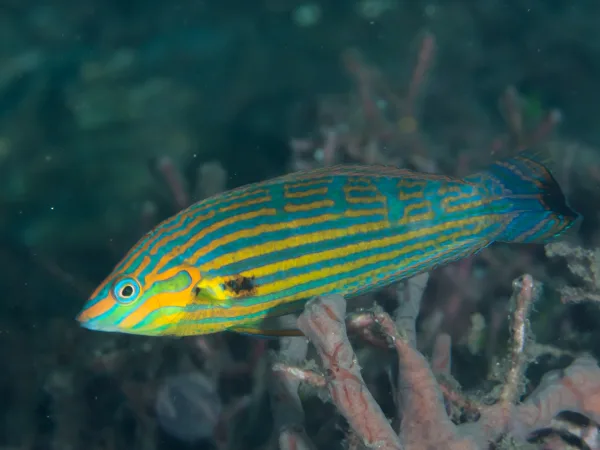
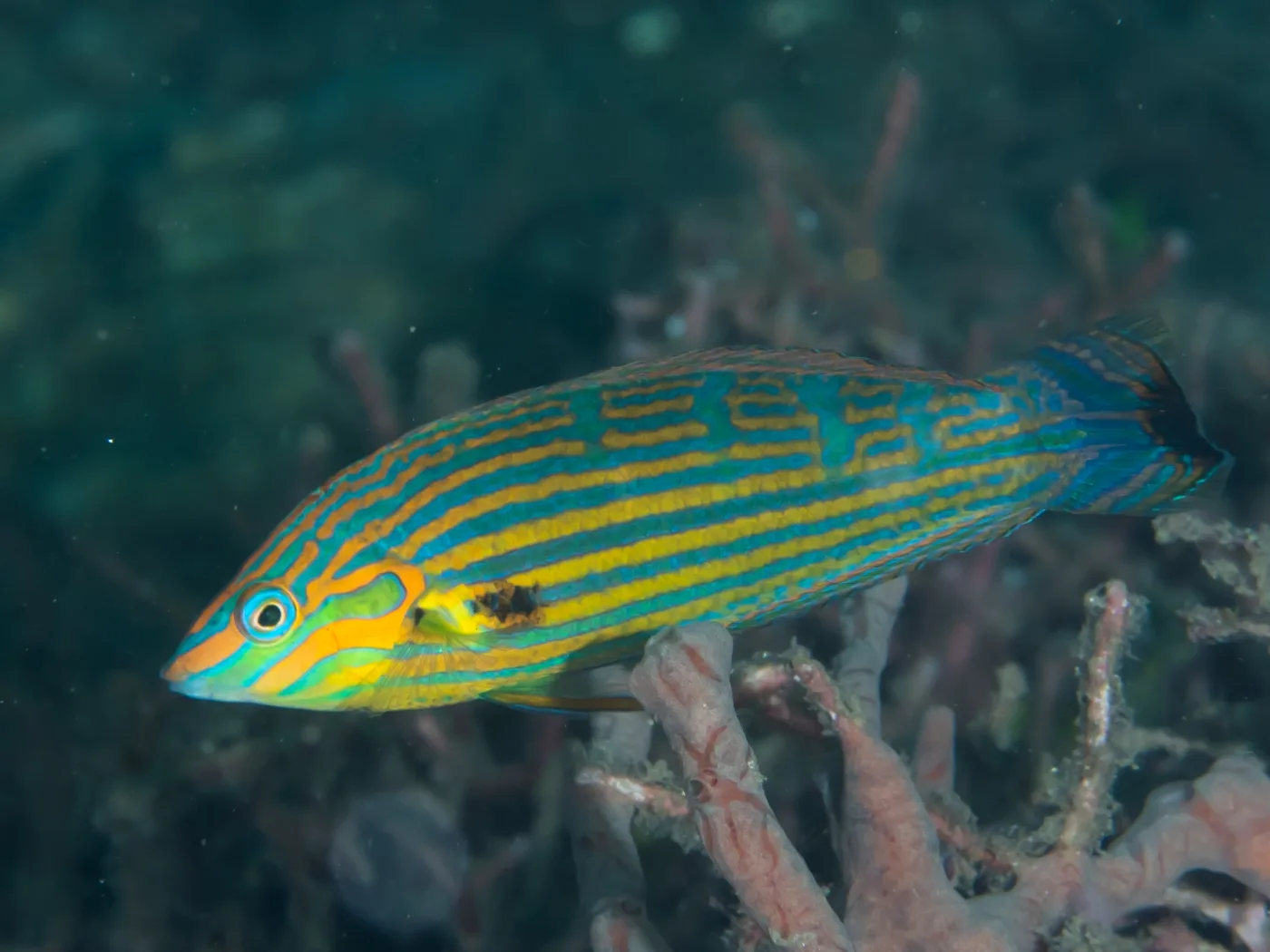
The melanurus wrasse is a slim, fast fish that looks like a neon sign. It has blue-green and orange-pink stripes from its nose to its tail. Its name means 'black tail', because the boys have a black tip on the tail. The girls have black spots on their fins that look like eyes. It lives on reefs and rocky shores in the Pacific Ocean, from Japan down to Australia. At night, or when it gets scared, it dives into the sand and hides. So a home tank needs a soft, sandy bottom. In the day it zooms around hunting tiny worms, snails and other small animals. People like it because it eats some tank pests. Like many wrasses, a girl can turn into a boy as she grows up. It can jump, so the tank needs a lid.
Water & care
Very hardy and an eager eater once it accepts non-living food, which most do quickly with meaty frozen foods. The two must-haves are a fine sand bed deep enough to bury in (at least 2 in; 3-4 in is better) and a tight-fitting lid, because it jumps when startled. A new fish may stay buried for a few days after it is added; this is normal. Feed small meals several times a day, because a hungry wrasse is more likely to go after invertebrates. Provide sand in quarantine too, as a bare-bottom tank stresses sand-sleeping wrasses.
| Parameter | Keep it at | Where that sits on the usual reef range |
|---|---|---|
| Temperature | 74–80 °F | |
| Salinity (SG) | 1.020–1.025 | |
| pH | 8.1–8.4 | |
| Alkalinity | 8–12 dKH |
Ranges from Top Shelf Aquatics (74-80°F, SG 1.020-1.025, pH 8.1-8.4, 8-12 dKH), cross-checked with Gensou (75-82°F, SG 1.024-1.026, pH 8.1-8.4, 7-11 dKH). In a reef tank keep normal reef targets for the corals; the fish has no special calcium, magnesium or phosphate needs. Keep nitrate low with regular water changes; no species-specific limit is published.
Feeding
DietCarnivore
Favorite foods
- Frozen mysis shrimp
- Vitamin-enriched brine shrimp
- Krill and chopped seafood
- Marine pellets and flake
- Live copepods, amphipods and small worms from the rock and sand
- Pest flatworms and pyramidellid snails
Feed small amounts two to four times a day; this active wrasse has a fast metabolism and a short gut. A varied, meaty diet with vitamin-enriched frozen foods keeps its color bright. A hungry melanurus is more likely to eat ornamental invertebrates, but overfeeding fouls the water, so feed little and often.
Tank & maintenance
- Minimum tank
- 55 gallons
- Aquascape
- A fine, soft sand bed (fine aragonite) at least 2 in deep, ideally 3-4 in, over part of the tank so it can bury itself at night; avoid crushed coral or gravel, which can scrape its mouth and gills. Plenty of live rock to hunt through and open swimming space. A tight-fitting lid or mesh cover is essential.
- Lighting
- No special requirement; any reef or fish-only lighting.
- Water flow
- Moderate, varied flow, as on a normal reef. It is a strong swimmer.
Routine upkeep
Routine reef or fish-only upkeep with regular partial water changes. When vacuuming or stirring the sand, remember the fish may be buried in it, especially at night or early in the morning. Keep the lid sealed, including gaps around plumbing. Keep an eye on small shrimp, crabs and snails, and expect it to be very hard to catch once settled, since it dives into the sand.
Temperament & tankmates
TemperamentPeaceful
Peaceful toward most fish that look different from it, but it can be openly aggressive toward wrasses of similar size and shape, especially other Halichoeres or wrasses added after it has claimed territory, and toward another melanurus. Aggression can increase as the fish grows and becomes male. Keep one per tank (or a male with females in a large tank), and do not keep it with very small, timid tankmates in a small tank.
Reef safeWith caution
Reliable with corals, but it hunts small mobile invertebrates. Sexy shrimp, small anemone shrimp, small crabs, snails, feather dusters, tubeworms and decorative nudibranchs may be eaten. Top Shelf Aquatics advises treating small cleanup-crew shrimp as expendable, and the risk grows as the wrasse matures. On the plus side, it often eats flatworms, bristleworms, pyramidellid snails that parasitize giant clams, and Montipora-eating nudibranchs, though this pest control is not guaranteed.
Good tankmates
- Tangs
- Dwarf angelfish
- Clownfish
- Chromis and anthias
- Gobies and blennies in a roomy tank
- Tridacnid clams (it eats parasitic pyramidellid snails)
Avoid
- Other Halichoeres and similar-shaped wrasses added after it
- A second melanurus in a small tank
- Sexy shrimp, small anemone shrimp, small hermit crabs and porcelain crabs
- Feather dusters, tubeworms and ornamental nudibranchs
- Mandarin dragonets in small tanks (it competes for copepods)
- Predators large enough to eat it
- Bare-bottom or crushed-coral tanks
Help it thrive
- Give it a fine sand bed at least 2 in deep, ideally 3-4 in, in both the display and the quarantine tank.
- Use a tight-fitting lid or mesh cover; it jumps when startled.
- Feed small meaty meals several times a day; a well-fed wrasse leaves more invertebrates alone.
- Add it before other similar-shaped wrasses rather than after, and keep only one unless the tank is large.
- Do not panic if a new fish stays buried for a few days; it will come out once it feels safe.
- Deworm with praziquantel during quarantine; wild wrasses often carry flukes and gut worms.
Common ailments
Marine ich and velvet (Cryptocaryon irritans, Amyloodinium ocellatum)
- Signs
- White, salt-like spots (ich) or a fine dusty sheen (velvet), scratching, rapid breathing, cloudy eyes, staying buried, and loss of appetite. Velvet can kill within 12 to 48 hours.
- Prevention
- Quarantine new fish for several weeks in a tank with a sand-filled container so the wrasse can bury itself, and keep water stable.
- Treatment
- Treat in a hospital tank, never in a reef display, with copper, chloroquine phosphate or the tank-transfer method; give velvet a temperature- and pH-matched freshwater dip first for quick relief. Leave the display without fish for about 11 weeks, because the ich cyst stage can last up to 72 days.
Flukes and intestinal worms
- Signs
- Rapid breathing, scratching, cloudy eyes, thinning despite eating well, and stringy white feces.
- Prevention
- Treat new wild-caught wrasses with praziquantel during quarantine.
- Treatment
- Praziquantel in quarantine (in the water for flukes, in food for gut worms), repeated as the product directs to catch newly hatched parasites.
Stress and injury from missing or coarse substrate
- Signs
- Frantic swimming or hiding in corners, scraped snout or skin, loss of color, and repeated disease outbreaks in bare-bottom or crushed-coral tanks.
- Prevention
- Always provide fine, soft sand at least 2 in deep, including in quarantine (a sand-filled container works).
- Treatment
- Move the fish to a tank with proper sand, keep the water clean and watch any scrapes for infection; treat secondary bacterial infections in a hospital tank if needed.
This is general hobby guidance, not veterinary advice. Quarantine new arrivals and treat in a separate tank whenever you can.
Risks of owning one
- May eat small ornamental shrimp, small crabs, tiny snails, feather dusters, tubeworms and nudibranchs.
- Jumps out of uncovered tanks.
- Can bully other wrasses of similar shape, especially those added later.
- Needs a fine sand bed; it does poorly in bare-bottom or crushed-coral tanks.
- Pest control is unreliable, and once settled it is very hard to catch because it dives into the sand.
Breeding
DifficultyVery hard Captive-bredRare or wild-caught
A protogynous harem spawner with floating eggs. In 2015, Kevin Barden of Rising Tide Conservation reported the first captive breeding. The University of Florida Tropical Aquaculture Laboratory then described spawning by a group of one male and three females, with courtship at sunset and batches of hundreds to several thousand eggs about 0.66 mm across. Larvae were raised on cultured copepod nauplii and Otohime micro-diets and settled into sand as early as 22 days after hatching. Only small numbers have been raised, and no commercial supply exists.
- Keep a harem of one male and several females in a large tank with a deep sand bed; a dominant female will turn into a male if no male is present.
- Condition them with frequent feedings of varied meaty foods.
- Watch at sunset for courtship: the male displays and chases until a receptive female joins him in a spawning rush.
- Collect the floating eggs with an overflow egg collector and move them to a small, static larval tank (an 18 L tank darkened with microalgae was used in the published trial).
- From about day 3 after hatching, feed the larvae Parvocalanus copepod nauplii at about 2 per mL, adding Otohime-A micro-diet from about day 14.
- Keep the lights on around the clock until about day 12, then shorten the day length gradually to 14 hours of light.
- Add a layer of sand at flexion (around day 15). The larvae settle into the sand around day 22-35 and come out as juveniles about a day later.
Deep dive The science, history and family tree
The science
Halichoeres melanurus is a small julidine wrasse (family Labridae) of the western Pacific. The body is elongate and fusiform, blue to blue-green with narrow orange to reddish longitudinal stripes from snout to tail and yellow and green accents on the head. In males the stripes are blue-green and orange, becoming salmon pink and green toward the front, and a dark spot behind the eye lies within a brown band that splits toward the rear. Females carry black ocelli on the dorsal fin, one on the first interspinous membrane and another between the second and third soft rays, plus a spot at the upper base of the caudal fin; juveniles are duller. The dorsal fin has 9 spines and 11-12 soft rays, the anal fin 3 spines and 11-12 soft rays. Adults reach about 12-14 cm total length. The range extends from Bali and Western Australia east to Micronesia, Samoa and Tonga, north to Japan and south to the Great Barrier Reef. It inhabits shallow coral reefs and rocky shores, usually at 1-15 m, alone or in small groups, and is sometimes found deeper on sheltered reefs. Like other Halichoeres, it buries itself in sand to sleep and to escape danger. It feeds on small benthic invertebrates, including polychaete worms, copepods, isopods and foraminiferans. It is a protogynous hermaphrodite: a terminal-phase male holds a harem of females, and males flash intensified color during courtship. In captivity courtship begins at sunset, and the pelagic eggs measure about 0.66 mm. It is assessed as Least Concern by the IUCN.
- Appearance
- Slim, cigar-shaped wrasse with a blue-green body and narrow orange, pink or yellow horizontal stripes, plus yellow and green on the face. Males are brighter, with salmon-pink and green stripes toward the head and a dark spot behind the eye, and they 'flash' even brighter color near females. Females and juveniles are more muted and have black eyespots on the dorsal fin and a dark spot at the top of the tail base (the 'tail spot' in its common name). Stores often sell males and females separately. Compare with other striped Halichoeres, which differ in their stripe colors and fin spots.
- Native range
- Western Pacific: from Bali (Indonesia) and Western Australia east to Micronesia, Samoa and Tonga, north to southern Japan and south to the Great Barrier Reef. Type locality: Banda Islands, Indonesia. Aquarium fish are mostly collected in Fiji and Indonesia.
- Habitat
- Shallow coral reefs and rocky shores, usually 1-15 m, sometimes deeper on sheltered reefs. Usually seen alone or in small groups, swimming close to the bottom; it dives into sand to sleep at night and to hide from danger.
- Size
- 5 in (12.7 cm). FishBase gives 14 cm total length; Wikipedia and TFH give about 12 cm (4.7-5 in). Hobby sources quote 4.5-5 in for aquarium fish. Males are larger than females.
- Lifespan
- Not well documented. One retailer care guide (Gensou) suggests about 5-7 years with good care; no published longevity study found.
- Conservation
- Least Concern. Assessed Least Concern by the IUCN. Not listed by CITES. Aquarium fish are wild-collected, mainly in Fiji and Indonesia. It has been bred experimentally (University of Florida Tropical Aquaculture Laboratory), but no commercial captive-bred supply is known
In the aquarium vs in the wild
In your aquarium
A colorful, active community wrasse for reef and fish-only tanks, widely used for biological control of flatworms, bristleworms and pyramidellid snails.
On the reef
A micro-predator of small bottom-living invertebrates (worms, copepods, isopods and forams) on shallow western Pacific reefs and rocky shores.
History
Pieter Bleeker described the fish in 1851 from the Banda Islands of Indonesia. In the same year he gave it two names, Julis melanurus and Julis hoevenii; the second explains the trade name Hoeven's wrasse. It was later placed in Platyglossus and then Halichoeres, and melanurus became the accepted name. The species name means 'black tail'. In the aquarium hobby it became popular as a colorful, hardy wrasse that hunts pests such as flatworms and the pyramidellid snails that attack giant clams. In 2015, Kevin Barden reported the first captive breeding through Rising Tide Conservation. At the time, Reef Builders counted it as only the second tropical wrasse raised in captivity, after Bali Aquarich's largely accidental rearing of the cleaner wrasse. The University of Florida Tropical Aquaculture Laboratory later set up broodstock and published its rearing methods.
Evolution & relatives
Wrasses (Labridae) are one of the largest marine fish families, with about 600 species in around 80 genera, and the parrotfishes turn out to be a branch inside the wrasse family. Fossil wrasses are known from the Early Eocene of Monte Bolca in Italy. Westneat and Alfaro's 2005 DNA study found that the large tropical group called julidines (WoRMS subfamily Julidinae) is the crown radiation of the family. This group includes Halichoeres, Thalassoma, Coris and the cleaner wrasses (Labroides), which are nested inside it. The study also showed that Halichoeres, a genus of more than 80 species, is not a natural group, so it will probably be split in future revisions. On the site's tree, the melanurus sits on the julidine wrasse branch with other Halichoeres, Coris and cleaner wrasses. That branch is separate from the six line and fairy wrasses (Cirrhilabrinae), and much farther from tangs and angelfish (Acanthuriformes) and clownfish (Ovalentaria).
Family tree, from kingdom down
- Kingdom Animalia Animals Animals are living things made of many cells that must eat food to live. Fish, corals, crabs, snails and sea stars are all animals.
- Phylum Chordata Chordates Chordates have a stiff rod running down their back at some point in their lives. In fish and people, this rod is replaced by a backbone.
- Subphylum Vertebrata Vertebrates Vertebrates are animals with a backbone and a skull. Fish, frogs, birds and people are all vertebrates.
- Infraphylum Gnathostomata jawed vertebrates
- Parvphylum Osteichthyes bony fishes
- Gigaclass Actinopterygii ray-finned fishes
- Superclass Actinopteri
- Class Teleostei Teleost fishes Teleosts are bony fishes with thin, bendy fin rays and jaws that can push forward. Almost all of the fish in the world are teleosts.
- Order Eupercaria (unplaced) Unplaced eupercarian fishes Eupercaria is a huge group of fish with spiny fins. Scientists found it by studying DNA, and it holds wrasses, grunts, butterflyfishes and many more. 'Incertae sedis' means 'place not sure': scientists have not yet agreed which order wrasses belong in.
- Family Labridae Wrasses Wrasses are a huge family of colorful fish that swim by flapping their front fins. Many change color, and some change from female to male.
- Subfamily Julidinae Julidine wrasses
- Genus Halichoeres Halichoeres wrasses This is a large group of wrasses that hunt small animals on reefs. Many bury themselves in sand to sleep at night.
- Species Halichoeres melanurus
See it on the Tree of Life Compare with another species
Closest relatives
- Halichoeres chrysus Canary Wrasse (Yellow Coris) Same genus; a popular yellow Halichoeres in the hobby
- Halichoeres leucoxanthus Canary-top Wrasse Same genus
- Halichoeres ornatissimus Ornate Wrasse (Ornamented Wrasse) Same genus
- Halichoeres hortulanus Checkerboard Wrasse Same genus
- Halichoeres vrolikii Pinstriped Wrasse Same genus
- Halichoeres cosmetus Adorned Wrasse Same genus
- Labroides dimidiatus Bluestreak Cleaner Wrasse Same subfamily (Julidinae); cleaner wrasses are nested within the julidine radiation Read guide · Compare
Older scientific names: Julis melanurus, Platyglossus melanurus, Julis hoevenii, Halichoeres hoevenii, Halichoeres hoeveni.
Fun facts
- It sleeps buried under the sand every night and dives into the sand in a flash when frightened.
- Melanurus means 'black tail', after the black tip on the male's tail fin; females have a separate black spot at the top of the tail base.
- Males 'flash' their colors much brighter when they are near females.
- When it was first bred in 2015, Reef Builders counted it as only the second tropical wrasse ever raised in captivity.
- In the published trial, larvae settled into the sand just 22 days after hatching, remarkably fast for a reef fish with floating eggs.
Learn more
- FishBase: Halichoeres melanurus, Tail-spot wrasse fishbase.se
- WoRMS: Halichoeres melanurus (Bleeker, 1851) marinespecies.org
- TFH Magazine: Halichoeres melanurus tfhmagazine.com
- Saltwater Aquarium Blog: 7 reasons to keep the melanurus wrasse saltwateraquariumblog.com
- Reef Builders: Melanurus wrasse bred in captivity reefbuilders.com
Sources
- FishBase species summary: Halichoeres melanurus fishbase.se
- WoRMS taxon record 275776 marinespecies.org
- Wikipedia: Tail-spot wrasse en.wikipedia.org
- Wikipedia: Halichoeres en.wikipedia.org
- Wikipedia: Labridae en.wikipedia.org
- LiveAquaria: Melanurus Wrasse liveaquaria.com
- LiveAquaria: Melanurus Wrasse (product 2285) liveaquaria.com
- TFH Magazine: Halichoeres melanurus tfhmagazine.com
- Top Shelf Aquatics: Melanurus Wrasse care topshelfaquatics.com
- Top Shelf Aquatics: Melanurus Wrasse (male) topshelfaquatics.com
- Saltwater Aquarium Blog: 7 reasons to keep the melanurus wrasse saltwateraquariumblog.com
- Reef Chasers: Melanurus Wrasse guide reefchasers.com
- Gensou: Melanurus Wrasse care guide gensou.sg
- Reef Builders: Melanurus wrasse bred in captivity (2015) reefbuilders.com
- Reef Builders: Rising Tide updates melanurus wrasse breeding success (2015) reefbuilders.com
- Fishes of Australia: Hoeven's Wrasse fishesofaustralia.net.au
- Barden et al., First record of captive spawning and larval rearing of the melanurus wrasse (World Aquaculture Society abstract) was.org
- Westneat and Alfaro 2005, Phylogenetic relationships and evolutionary history of the Labridae (PubMed) pubmed.ncbi.nlm.nih.gov
- Wikipedia: Cryptocaryon irritans en.wikipedia.org
- Wikipedia: Amyloodinium ocellatum en.wikipedia.org
Care facts
The care facts on this guide and its product pages (care level, reef safety, temperament, size, tank, diet, flow, purpose, foods, acclimation and origin) combine 12 independent sources, checked October 25, 2026.
- Halichoeres melanurus summary FishBase
- Halichoeres melanurus Tropical Fish Hobbyist
- Melanurus Wrasse LiveAquaria
- Tail-spot Wrasse - Halichoeres melanurus That Pet Place
- Melanurus Wrasse Care Guide: Halichoeres Melanurus Pest Controller Gensou Premium Aquascaping (Singapore)
- 7 reasons to keep the Melanurus wrasse Saltwater Aquarium Blog
- Melanurus Wrasse - Male Top Shelf Aquatics
- Melanurus Wrasse (halichoeres melanurus) Salty Underground
- Wrasse - Melanurus Aquatics Unlimited
- Halichoeres melanurus - Rainbow Wrasse AquaInfo
- Wrasse Care Guide: Reef-Safe Wrasses For Modern Reef Tanks Top Shelf Aquatics
- Melanurus Wrasse Top Shelf Aquatics
Scientific names and classification follow the World Register of Marine Species (AphiaID 275776). Last updated October 25, 2026.
Shop this species
Search the shop →Sold out right now. We restock weekly, so check back soon.
Sold out