Fish · Wrasse
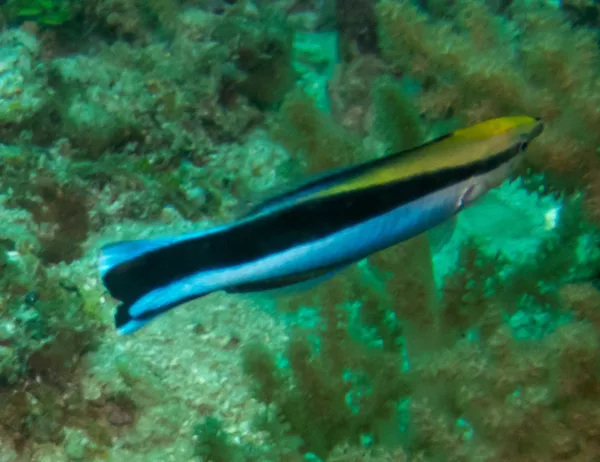
Bluestreak Cleaner Wrasse
Labroides dimidiatus
Also called Cleaner Wrasse, Blue Streak Cleaner Wrasse, Blue-streak Cleaner Wrasse, Common Cleanerfish, Common Cleaner Wrasse, Cleaner Fish, Bridled Beauty, Gadfly Fish
Reviewed by admin on October 29, 2026 · Meet the team
- CareExpert
- Reef safeYes
- TemperamentPeacefulPeaceful; males fight; may pester fish
- Favorite foods
- Mysis shrimp
- Enriched brine shrimp
- Tiny marine pellets
- Max size5.5 in (14 cm)
- Min tank90 gal
- LifespanFishBase gives a maximum reported age…
- IUCN statusLeast Concern
Quick answers
- How big does the Bluestreak Cleaner Wrasse get?
- Up to 5.5 in (14 cm).
- What size tank does it need?
- At least 90 gallons.
- How hard is it to keep?
- Care level: Expert.
- Is it reef safe?
- Yes. Leaves corals and most invertebrates alone; LiveAquaria and Aquatic Sunlimited list it as reef compatible.
- What does it eat?
- Mysis shrimp
- Enriched brine shrimp
- Tiny marine pellets
- How long does it live?
- FishBase gives a maximum reported age of 4 years, and Saltwater Aquarium Blog quotes about 4 years in aquariums.
- What are good tankmates?
- Tangs, angelfish and other medium to large community fish
- Larger, robust fish such as Picasso triggerfish and dogface puffers
- Corals and most reef invertebrates
The 30-second version
The bluestreak cleaner wrasse is a small, thin fish. It grows to about as long as your hand. It has a pale head, a blue tail end and a thick black stripe down its side. Babies are black with a bright blue line. This fish is like a doctor on the reef. Big fish come to its spot and hold still. The wrasse picks tiny bugs called parasites off their skin and gills. It even swims into the mouths of big fish that hunt! It does a little wiggle dance to say hello. A sneaky blenny copies its colors and dance, and then bites the fish that trust it. Scientists showed the wrasse a mirror. It seemed to know that the fish in the mirror was itself. In a tank it often starves, because it wants to clean fish and not eat fish food. That is why it is a fish for experts.
Water & care
Recommended only for experienced aquarists (LiveAquaria rates it Difficult). The problem is food: in the wild it eats parasites, mucus and dead skin from other fish, and many wild-caught fish never accept prepared foods; Saltwater Aquarium Blog says most starve within a few weeks of purchase. Buy only a fish you have seen eating frozen food, and keep it in a large (90 gal or more), mature tank with plenty of fish. Feed small amounts of vitamin-enriched frozen mysis and brine shrimp several times a day, adding flake and tiny pellets once it feeds. It will not cure ich, and it is sensitive to copper. Use a tight lid. Captive-bred fish, when available, eat pellets and frozen foods.
| Parameter | Keep it at | Where that sits on the usual reef range |
|---|---|---|
| Temperature | 72–78 °F | |
| Salinity (SG) | 1.020–1.025 | |
| pH | 8.1–8.4 | |
| Alkalinity | 8–12 dKH |
LiveAquaria and Aquatic Sunlimited agree on 72-78°F, SG 1.020-1.025, pH 8.1-8.4 and 8-12 dKH. Saltwater Aquarium Blog suggests 76-82°F, and FishBase gives 24-28°C (75-82°F) for its wild habitat. In a reef tank keep normal reef targets for the corals; no species-specific calcium, magnesium, nitrate or phosphate values are published.
Feeding
DietCarnivore
Favorite foods
- Parasites, mucus and dead skin from other fish (wild diet)
- Vitamin-enriched frozen mysis shrimp
- Enriched brine shrimp
- Pieces of mussel or clam
- Marine flake and tiny pellets, once it is feeding
Feed small amounts several times a day; it cannot eat large meals at once, and one meal a day is not enough. Soak frozen foods in a vitamin and fatty acid supplement. Aquatic Sunlimited suggests keeping flake and pellets to about 20% of the diet. Do not count on tankmates' parasites to feed it.
Tank & maintenance
- Minimum tank
- 90 gallons
- Aquascape
- A large, mature reef or fish tank with rockwork and crevices and plenty of open swimming space, stocked with enough fish to give it work. A sand bed is recommended. A tight-fitting lid is essential, and overflow boxes should be covered too, because it can jump into them.
- Lighting
- No special requirement; any reef or fish-only lighting.
- Water flow
- Good water movement and high oxygen levels.
Routine upkeep
Routine reef or fish-only upkeep with regular partial water changes. Check every day that it is eating and that its belly is not pinched, especially in the first weeks. Keep the lid and overflow covered. Never dose copper in its display, and treat sick fish in a separate hospital tank.
Temperament & tankmates
TemperamentPeaceful
Peaceful toward other fish, and even large predators usually accept it as a cleaner. Some tankmates find its constant cleaning a nuisance. Males tend to fight each other, so keep one, or add a group at the same time. Saltwater Aquarium Blog reports aggression toward some other wrasses, such as the melanurus wrasse.
Reef safeYes
Leaves corals and most invertebrates alone; LiveAquaria and Aquatic Sunlimited list it as reef compatible. Saltwater Aquarium Blog mentions reports of it picking at clam mantles, so watch it around tridacnid clams.
Good tankmates
- Tangs, angelfish and other medium to large community fish
- Larger, robust fish such as Picasso triggerfish and dogface puffers
- Corals and most reef invertebrates
Avoid
- A second male cleaner wrasse
- Other wrasses that may fight with it, such as the melanurus wrasse
- Small or lightly stocked tanks with few fish to clean
- Tridacnid clams if it starts picking at the mantle
- Copper treatment in its display
Help it thrive
- Buy only a fish you have watched eat frozen food in the store, and ask how long it has been there.
- Choose a captive-bred cleaner wrasse when one is available; they eat pellets and frozen foods.
- Keep it in a large, mature, well-stocked tank (90 gal or more) so it has fish to clean.
- Feed small, vitamin-enriched meals several times a day.
- Use a tight-fitting lid and cover the overflow.
Common ailments
Starvation (failure to accept prepared food)
- Signs
- A pinched belly and thinning body, constant attempts to clean tankmates, and ignoring frozen and dry foods.
- Prevention
- Buy a fish that is already eating frozen food, or a captive-bred fish, and keep it in a large, well-stocked tank. Feed small meals several times a day.
- Treatment
- Offer tiny portions of vitamin-enriched frozen mysis and brine shrimp several times a day and keep competing fish from stealing them. There is no reliable fix for a wild fish that refuses prepared food.
Marine ich and velvet (Cryptocaryon irritans, Amyloodinium ocellatum)
- Signs
- White, salt-like spots (ich) or a dusty sheen (velvet), scratching, rapid breathing, cloudy eyes and loss of appetite. Heavy velvet infections can kill in under 12 hours. The cleaner wrasse is not immune and cannot clear an outbreak.
- Prevention
- Quarantine all new fish before they go into the display, and keep water stable.
- Treatment
- Treat in a hospital tank, never in a reef display. Because cleaner wrasses are sensitive to copper, hyposalinity (SG 1.009) or the tank-transfer method is gentler; use copper only with careful dosing. Leave the display without fish for longer than the ich cyst stage, which can last up to 72 days.
This is general hobby guidance, not veterinary advice. Quarantine new arrivals and treat in a separate tank whenever you can.
Risks of owning one
- Many wild-caught fish never accept prepared food and starve within weeks.
- It will not prevent or cure ich or velvet, and it can catch them itself.
- Jumps out of open tanks and into uncovered overflow boxes.
- May pick at clam mantles, and some tankmates are bothered by its cleaning.
- Collection affects reefs: removing cleaners left fewer fish and fewer fish species in field experiments.
Breeding
DifficultyVery hard Captive-bredRare or wild-caught
Pairs or a male with a harem spawn pelagic eggs: the pair rises toward the surface, releasing eggs that drift in the current, and the larval stage lasts about three weeks. Hobbyists in Germany and the US recorded spawns without raising larvae, and a 53-day rearing success was reported in Taiwan in 2010. In 2013 Bali Aquarich raised juveniles by accident while rearing angelfish larvae from a system where cleaner pairs spawned daily, with a high share of deformed fish. Roger Williams University later studied broodstock conditions for spawning, and in 2022 The Biota Group offered captive-bred bluestreak cleaner wrasses in very limited quantities.
- Keep a pair, or a male with females, in a large tank with open water above the rockwork; one hobby pair spawned over a rock outcrop with at least 1.5 ft of water above it.
- Condition the fish with three or four feedings a day of frozen foods such as mysis.
- Watch in the evening for the male hovering over the female, back-arching displays and a fast dash to the surface.
- Collect the floating eggs with an overflow egg collector and move them to a larval tank. Rearing the larvae through about three weeks of planktonic life needs cultured live foods and has only been done by specialist facilities.
Deep dive The science, history and family tree
The science
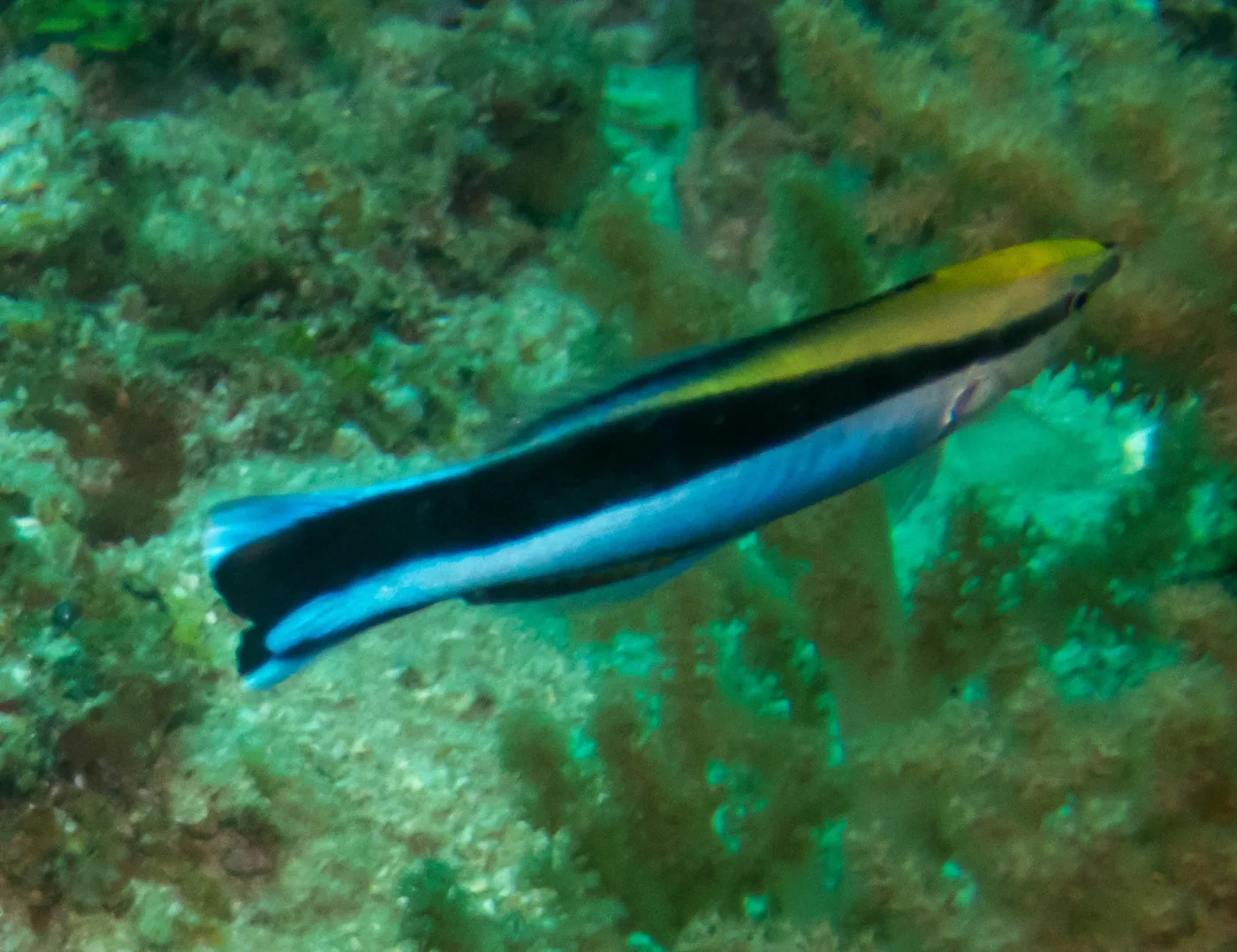
Labroides dimidiatus is a small julidine wrasse (family Labridae) and the best-known cleaner fish of Indo-Pacific coral reefs. The body is elongate and compressed. Adults have a pale head and forebody, blue on the rear body and tail, and a broad black lateral stripe from snout to tail that widens toward the rear; juveniles are black with an electric-blue stripe. The dorsal fin has 9 spines and 10-11 soft rays, the anal fin 3 spines and 10 soft rays, and the maximum recorded length is 14 cm TL. It ranges from the Red Sea, Persian Gulf and East Africa to the Line, Marquesas and Ducie Islands, north to southern Japan and south to Lord Howe and Rapa, usually at 1-30 m. Pairs, groups of juveniles, or harems of one male with up to five females hold cleaning stations, where posing clients have crustacean ectoparasites (especially gnathiid isopod larvae), mucus and dead tissue removed. It is a protogynous hermaphrodite with pelagic eggs. Field experiments show that cleaners reduce client parasite loads and that removing them lowers local fish abundance and richness. IUCN status: Least Concern.
- Appearance
- Slender, pointed fish with a pale (white to yellowish) head and front half, shading to bright blue toward the tail, and a broad black stripe running from the snout through the eye to the tail fin, widening as it goes back. Juveniles are black with a single electric-blue line. Color varies by region: Indian Ocean fish have different stripe widths from western Pacific fish, and adults in deep water often have a yellow back. The sexes look alike. Look-alikes: the false cleanerfish (Aspidontus taeniatus), a blenny that copies its colors and dance but has an underslung mouth instead of the wrasse's mouth at the tip of the snout; and the bluestreak fangblenny (Plagiotremus rhinorhynchos), which resembles juveniles. Other Labroides species, such as the bicolor cleaner wrasse, are colored differently.
- Native range
- Indo-Pacific: from the Persian Gulf, Red Sea and East Africa east to the Line, Marquesas and Ducie Islands, north to southern Japan and south to Lord Howe and Rapa Islands. In Australia it occurs from about Perth around the tropical north to Sydney, and at Christmas, Cocos (Keeling) and Lord Howe Islands. A record from the Kermadec Islands, north of New Zealand, was documented from 2015 footage. LiveAquaria sells fish collected in the western Indian Ocean (Africa and the Maldives).
- Habitat
- Coral-rich areas of inner lagoons and subtidal reef flats out to seaward reefs, usually at 1-30 m (recorded from the surface to about 100 m), in tropical water of about 24-28°C. Pairs, groups of juveniles or a dominant male with several females hold a cleaning station at a prominent site such as a large coral outcrop, where larger fishes gather to be cleaned. Some adults are solitary and territorial.
- Size
- 5.5 in (14 cm). FishBase and LiveAquaria give 14 cm (5.5 in) total length; Fishes of Australia gives 12 cm. Aquarium fish are usually sold well below adult size.
- Lifespan
- FishBase gives a maximum reported age of 4 years, and Saltwater Aquarium Blog quotes about 4 years in aquariums. Many wild-caught aquarium fish die much sooner because they fail to feed.
- Conservation
- Least Concern. Assessed Least Concern by the IUCN; not evaluated under CITES. Wild populations are abundant. It is one of the most commonly imported marine aquarium fish in the US (a Roger Williams University abstract ranks it 13th). Waldie et al. (2011) removed cleaners from small patch reefs at Lizard Island for 8.5 years: resident fish were 37% less abundant and resident species richness 23% lower than on control reefs, and the authors recommend considering protection of this heavily exported species. Captive-bred fish have been sold, but only in very limited numbers
In the aquarium vs in the wild
In your aquarium
Kept for its fascinating cleaning behavior in large, well-stocked tanks; it is not a disease-control tool and cannot live on its tankmates' parasites alone.
On the reef
A dedicated cleaner that holds a station and removes gnathiid isopods and other ectoparasites, mucus and dead tissue from a large number of client fish each day; reefs without cleaners hold fewer fish and fewer species.
History
Achille Valenciennes described the fish in 1839 as Cossyphus dimidiatus, in Cuvier and Valenciennes' Histoire naturelle des poissons. Pieter Bleeker created the genus Labroides in 1851 for Labroides paradiseus, a name now treated as the same species. The species name comes from the Latin for 'halved', for the dark stripe that divides the body into two parts. It became a model animal for research on cleaning: Grutter (1999) showed that cleaners really do reduce client parasites, and Bshary and Grutter (2005) showed that clients punish cheating cleaners. In 2019 Kohda and colleagues reported that cleaner wrasses pass the mirror mark test, and a 2023 follow-up found they recognize their own face in photographs. In the aquarium hobby it has long been a popular, low-priced import, but its poor survival put it on many 'should not harvest' lists. Bali Aquarich raised the first captive-bred juveniles in 2013, and The Biota Group sold small numbers in 2022.
Evolution & relatives
Wrasses (Labridae) are one of the largest marine fish families, with about 600 species in around 80 genera, and include the parrotfishes. Fossil wrasses are known from the Early Eocene of Monte Bolca in Italy. Westneat and Alfaro's 2005 DNA study found that the cleaner wrasses are nested within the julidine radiation, the large crown group of the family, and WoRMS places Labroides in the subfamily Julidinae with Halichoeres, Thalassoma and Gomphosus. WoRMS now accepts eight Labroides species, two of them (L. inopinatus, a deep mesophotic species, and L. flammulatus from Christmas Island) described in 2026 in a revision of the L. phthirophagus and L. bicolor complexes. L. dimidiatus itself may hide more than one species: Sims et al. (2013) found two mitochondrial clades that partly match Indian Ocean and western Pacific color forms, and L. pectoralis and L. bicolor fell inside the L. dimidiatus clade. On the site's tree it sits on the julidine wrasse branch with the melanurus wrasse, apart from the six line and fairy wrasses (Cirrhilabrinae).
Family tree, from kingdom down
- Kingdom Animalia Animals Animals are living things made of many cells that must eat food to live. Fish, corals, crabs, snails and sea stars are all animals.
- Phylum Chordata Chordates Chordates have a stiff rod running down their back at some point in their lives. In fish and people, this rod is replaced by a backbone.
- Subphylum Vertebrata Vertebrates Vertebrates are animals with a backbone and a skull. Fish, frogs, birds and people are all vertebrates.
- Infraphylum Gnathostomata jawed vertebrates
- Parvphylum Osteichthyes bony fishes
- Gigaclass Actinopterygii ray-finned fishes
- Superclass Actinopteri
- Class Teleostei Teleost fishes Teleosts are bony fishes with thin, bendy fin rays and jaws that can push forward. Almost all of the fish in the world are teleosts.
- Order Eupercaria (unplaced) Unplaced eupercarian fishes Eupercaria is a huge group of fish with spiny fins. Scientists found it by studying DNA, and it holds wrasses, grunts, butterflyfishes and many more. 'Incertae sedis' means 'place not sure': scientists have not yet agreed which order wrasses belong in.
- Family Labridae Wrasses Wrasses are a huge family of colorful fish that swim by flapping their front fins. Many change color, and some change from female to male.
- Subfamily Julidinae Julidine wrasses
- Genus Labroides Cleaner wrasses
- Species Labroides dimidiatus
See it on the Tree of Life Compare with another species
Closest relatives
- Labroides bicolor Bicolor Cleaner Wrasse Same genus; fell inside the L. dimidiatus clade in a 2013 DNA study
- Labroides pectoralis Blackspot Cleaner Wrasse Same genus; also fell inside the L. dimidiatus clade
- Labroides phthirophagus Hawaiian Cleaner Wrasse Same genus; has been captive-bred
- Labroides inopinatus Goldenrod Cleaner Wrasse Same genus; deep-reef species described in 2026
Older scientific names: Cossyphus dimidiatus, Fissilabrus dimidiatus.
Fun facts
- In a 2019 study, cleaner wrasses with a colored mark on the throat that they could only see in a mirror tried to scrape it off, a classic test of self-recognition.
- Client fish keep cleaners honest: cleaners prefer to eat mucus over parasites, and clients chase or swim away from cleaners that bite them.
- In a classic field experiment, fish with access to cleaners carried 4.5 times fewer parasites within 12 hours.
- The species name dimidiatus means 'halved', after the black stripe that splits its body into two color zones.
- The false cleanerfish, a blenny, copies its colors and dance to get close to fish and bite off bits of fin.
Learn more
- Fishes of Australia: Common Cleanerfish fishesofaustralia.net.au
- Saltwater Aquarium Blog: Bluestreak cleaner wrasse care guide saltwateraquariumblog.com
- Kohda et al. 2019, If a fish can pass the mark test (PLOS Biology) journals.plos.org
- Bshary and Grutter 2005, Punishment and partner switching cause cooperative behaviour in a cleaning mutualism (PMC) pmc.ncbi.nlm.nih.gov
Sources
- FishBase species summary: Labroides dimidiatus fishbase.se
- WoRMS taxon record 219014 marinespecies.org
- Wikipedia: Bluestreak cleaner wrasse en.wikipedia.org
- LiveAquaria: Bluestreak Cleaner Wrasse liveaquaria.com
- Aquatic Sunlimited: Bluestreak Cleaner Wrasse aquaticsunlimited.com
- CORAL Magazine: Available again, captive-bred cleaner wrasse (2022) coralmagazine.com
- Reef Builders: Bali Aquarich floors us with captive-bred cleaner wrasses (2013) reefbuilders.com
- Waldie et al. 2011, Long-term effects of the cleaner fish Labroides dimidiatus on coral reef fish communities (PMC) pmc.ncbi.nlm.nih.gov
Scientific names and classification follow the World Register of Marine Species (AphiaID 219014). Checked by our team. Last updated October 29, 2026.
Shop this species
Search the shop →