Invertebrates · Snail
Humped Conch
Gibberulus sp.
Also called Tongan Fighting Conch, Tonga Fighting Conch, Indo-Pacific Fighting Conch, Humpbacked Conch, Gibbose Stromb
Reviewed by admin on October 29, 2026 · Meet the team
- CareEasy
- Reef safeYes
- TemperamentPeacefulPeaceful; males may spar with other males
- Favorite foods
- Algae and detritus on sand
- Nori
- Sinking herbivore pellets
- Max size2.8 in (7 cm)
- Min tank10 gal
- LifespanNo published lifespan data were found…
- IUCN statusNot Evaluated
Quick answers
- How big does the Humped Conch get?
- Up to 2.8 in (7 cm).
- What size tank does it need?
- At least 10 gallons.
- How hard is it to keep?
- Care level: Easy.
- Is it reef safe?
- Yes. Reef safe: it does not eat corals or other invertebrates (saltwaterfish.com, LiveAquaria, Top Shelf).
- What does it eat?
- Algae and detritus on sand
- Nori
- Sinking herbivore pellets
- How long does it live?
- No published lifespan data were found in the sources checked.
- What are good tankmates?
- Corals, if frags are glued down
- Peaceful reef fish
- Other sand-bed snails, where there is enough food
The 30-second version
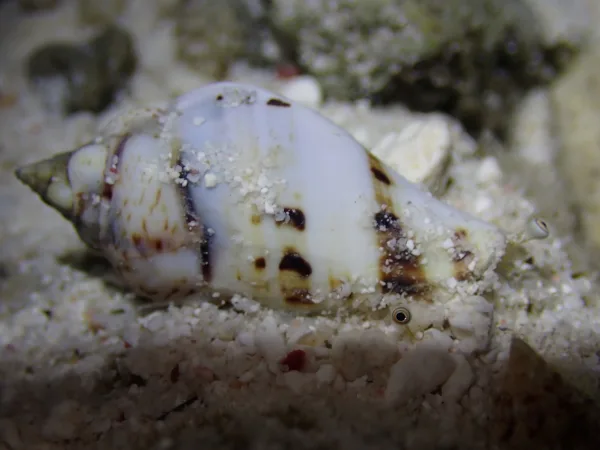
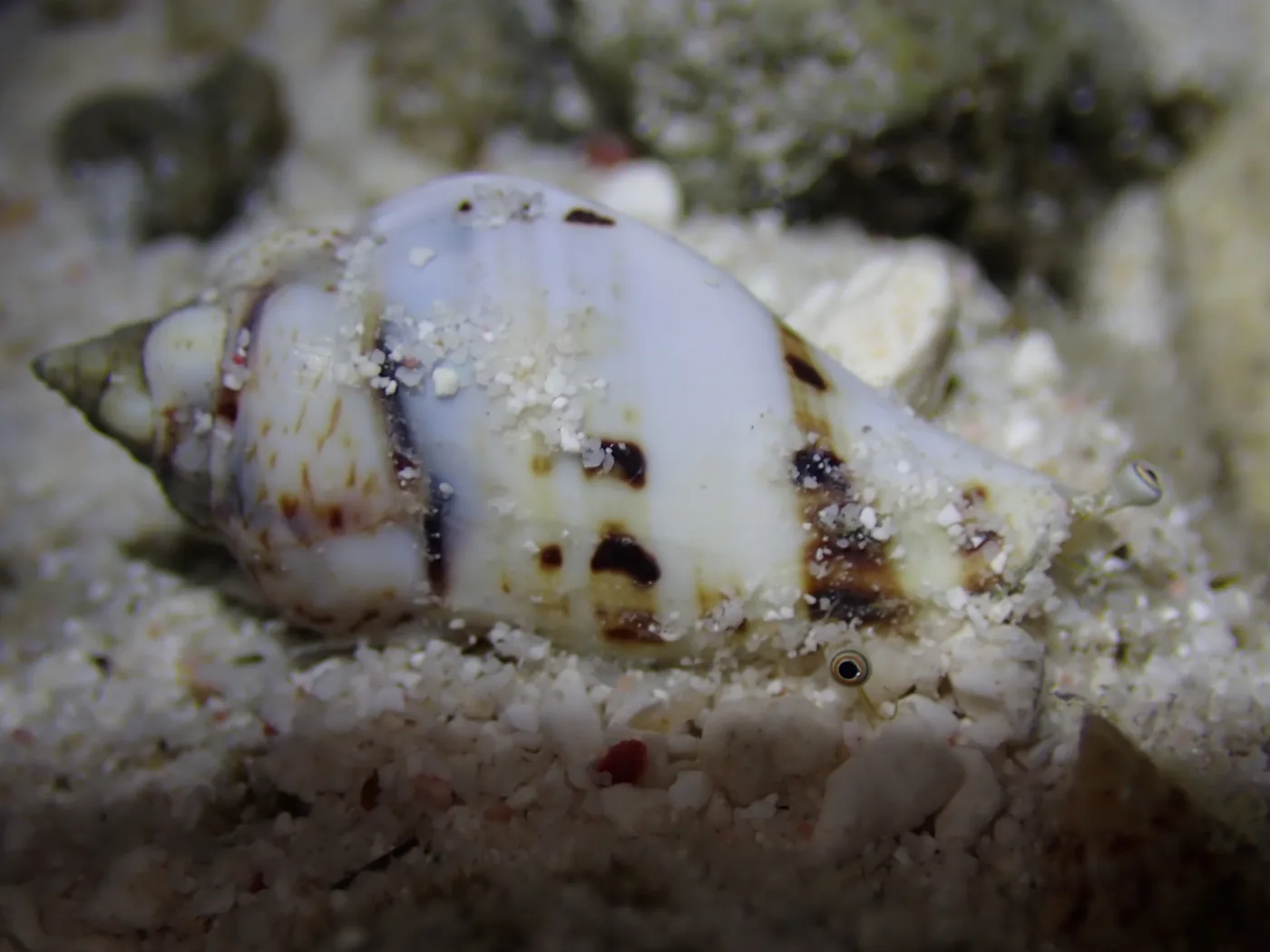
The humped conch is a small sea snail from the warm Indian and Pacific Oceans. Stores often call it the Tongan fighting conch. Its shell has a bump on top, like a little hump. Inside, the opening is often purple. This snail has two eyes on long stalks. It can peek out of its shell to look around! It does not crawl like most snails. It jumps! It digs a hard, pointy hook on its foot into the sand and flips itself forward. At night it moves over the sand and eats algae and bits of old food. In the day it often hides under the sand. It is a gentle snail that is safe with corals.
Water & care
An easy, peaceful sand grazer once settled. It needs an established tank with open sand of fine to medium grain, generally 2-3 in deep or more (Top Shelf, for fighting conchs in general). It grazes algae and detritus from the sand with its trunk-like proboscis, so feed it in new or very clean tanks: aquariumfish.com suggests dried seaweed wrapped around a rock, and LiveAquaria recommends supplementing with dried seaweed, fresh fish and frozen foods. Drip-acclimate for two hours or more (saltwaterfish.com); it is sensitive to high nitrate and copper (LiveAquaria). Keep a lid on the tank, since conchs can climb out (Top Shelf).
| Parameter | Keep it at | Where that sits on the usual reef range |
|---|---|---|
| Temperature | 72–78 °F | |
| Salinity (SG) | 1.023–1.025 | |
| pH | 8.1–8.4 | |
| Alkalinity | 8–12 dKH |
LiveAquaria's fighting conch ranges; saltwaterfish.com gives 72-78°F and pH 8.1-8.5, and Top Shelf 75-79°F and SG 1.024-1.026 for fighting conchs. Sensitive to high nitrate and copper (LiveAquaria) and to quick salinity and temperature changes (Top Shelf). Keep calcium and alkalinity stable for shell growth.
Feeding
DietHerbivore
Favorite foods
- Algae and diatom film on the sand
- Detritus
- Dried seaweed (nori)
- Sinking herbivore pellets
Grazes algae and detritus from the sand surface with its proboscis, mostly at night (aquariumfish.com, Top Shelf); strombids are specialized herbivores that occasionally eat detritus (Wikipedia). In a mature tank with enough algae it may need no extra food. In new or very clean tanks offer nori wrapped around a rock or sinking pellets, or the dried seaweed, fresh fish and frozen foods LiveAquaria suggests; LiveAquaria warns that conchs have a large appetite and that smaller tanks need supplemental feeding.
Tank & maintenance
- Minimum tank
- 10 gallons
- Aquascape
- Open, fine to medium sand at least 2-3 in deep for burrowing and cruising (Top Shelf), plus some rock; LiveAquaria stresses open, deep sand beds. Glue frags down and use a lid, because conchs can climb the glass and leave the tank (Top Shelf).
- Lighting
- No special needs; saltwaterfish.com lists moderate lighting.
- Water flow
- saltwaterfish.com suggests moderate flow (the same page elsewhere says strong current, so it is inconsistent); no other source gives a preference.
Routine upkeep
Check that it is active and eating, especially in a new tank, and offer nori when the sand looks spotless. Warning signs are long inactivity, repeatedly flipping over, or eyes kept retracted (Top Shelf). Remove a conch with a gaping operculum or a foul smell at once. Keep the tank covered.
Temperament & tankmates
TemperamentPeaceful
Peaceful with tankmates despite the 'fighting' name; LiveAquaria notes that males may be territorial toward other males of their own kind. Hermit crabs can kill conchs (saltwaterfish.com), and predatory crabs, large hermits, puffers, triggers and some wrasses may attack them (Top Shelf).
Reef safeYes
Reef safe: it does not eat corals or other invertebrates (saltwaterfish.com, LiveAquaria, Top Shelf). As it plows through the sand it can bulldoze loose frags or light decorations, so glue them down.
Good tankmates
- Corals, if frags are glued down
- Peaceful reef fish
- Other sand-bed snails, where there is enough food
Avoid
- Hermit crabs, especially large ones
- Pufferfish, triggerfish and snail-eating wrasses
- Predatory crabs
- Heavy sand-sifting starfish and gobies in small tanks, which compete for food
- Copper-based medications
Help it thrive
- Give it open sand at least 2-3 in deep.
- Drip-acclimate for two hours or more.
- Offer nori or sinking pellets when the sand bed is very clean.
- Use a lid and guard overflows and intakes; conchs can climb out.
- In a small tank keep only one or two, since males may squabble and many conchs starve each other out.
Common ailments
Starvation
- Signs
- Inactive for long periods, wanders the glass or climbs out, eyes retracted, slowly weakens.
- Prevention
- Add it to a mature tank with algae on the sand, and supplement with nori or pellets in clean tanks.
- Treatment
- Place food beside it and reduce competing sand grazers.
Acclimation (osmotic) shock
- Signs
- Stays shut in its shell or lies still with eyes retracted after purchase.
- Prevention
- Drip-acclimate for two hours or more and match salinity and temperature.
- Treatment
- Keep conditions stable; there is no medication.
Predation by hermits or fish
- Signs
- Empty shell found, often with a hermit crab moved in, or damaged eye stalks.
- Prevention
- Avoid large hermit crabs, puffers, triggers and snail-eating wrasses.
- Treatment
- None; rehome the predator.
This is general hobby guidance, not veterinary advice. Quarantine new arrivals and treat in a separate tank whenever you can.
Risks of owning one
- It can starve in new or very clean tanks.
- It may bulldoze loose frags and light decorations on the sand.
- Hermit crabs and snail-eating fish may kill it.
- It can climb out of an open tank or into an overflow.
- The exact species of Tongan stock has not been confirmed.
Breeding
DifficultyVery hard Captive-bredRare or wild-caught
Strombids lay eggs in long gelatinous strands (Wikipedia; saltwaterfish.com), and adults grow their flared lip when sexually mature. No aquarium breeding of Gibberulus was found, and details of its larval life were not found in the sources checked.
- Keep several adults with flared lips in a mature sand-bed tank.
- Egg strands, if laid, appear as long jelly-like strings on the sand.
- Larvae would need a separate rearing system; no tested protocol was found.
Deep dive The science, history and family tree
The science
Gibberulus Jousseaume, 1888 is a small genus of true conchs (Littorinimorpha: Strombidae) from the Indo-Pacific, long treated as a subgenus of Strombus. WoRMS accepts four species: G. gibberulus (Linnaeus, 1758), G. gibbosus (Röding, 1798), G. albus (Mörch, 1850) and G. dekkersi, described in 2021; Wikipedia still lists albus and gibbosus as subspecies of G. gibberulus. Retailers sell the Tongan fighting conch as Strombus gibberulus, an old name for G. gibberulus, but the species of Tongan animals has not been confirmed under the current four-species split, so this guide covers the genus. The humped conch has a smooth, swollen (gibbous) shell 30-70 mm long with an occasionally varicose spire, mottled yellowish brown and white in broken bands, and a radially striped aperture tinged violet, scarlet or dark purplish brown. Like other strombids it has long eye stalks, one of which rests in a notch in the shell (the stromboid notch), grows a flared lip when mature, and moves by leaping, levering itself forward with a pointed, sickle-shaped, horny operculum. Strombids are specialized herbivores and occasional detritivores of shallow reefs and seagrass meadows, and they lay their eggs in long gelatinous strands. The family's fossil record reaches back to the Lower Jurassic.
- Appearance
- A small, solid conch, usually 3/4-1 in when sold and up to about 2-3 in (aquariumfish.com, Florent's Guide). The shell is smooth and swollen, with an occasionally varicose spire, a body whorl grooved at the base and a mottled pattern of yellowish brown and white in broken bands; the inside of the long, narrow opening is striped and tinged violet, scarlet or dark purplish brown (Wikipedia). Adults develop a flared lip. When it is active, two long eye stalks and a claw-like operculum on the foot are visible. Look-alike: Caribbean fighting conchs (Strombus pugilis, often sold as S. alatus) are larger; LiveAquaria sells them at 2-4 in.
- Native range
- Indo-Pacific. Wikipedia lists the Red Sea, the western Indian Ocean (Aldabra, Chagos, Kenya, Madagascar, Mauritius, Mozambique, the Seychelles and Tanzania) and northern Australia for G. gibberulus, and Florent's Guide adds French Polynesia. Store animals labeled Tongan are collected in Tonga (aquariumfish.com, LiveAquaria).
- Habitat
- Shallow tropical water on sand among reefs and seagrass, like other strombids (Wikipedia; saltwaterfish.com). In aquariums it buries itself in the sand to rest and is most active at night (aquariumfish.com).
- Size
- 2.8 in (7 cm). Wikipedia gives an adult shell length of 30-70 mm for G. gibberulus, and Florent's Guide up to 3 in (7 cm). aquariumfish.com lists a 2 in maximum for Tongan stock and ships 3/4-1 in animals; saltwaterfish.com gives 1-2 in in its specs and 2-3 in in its text.
- Lifespan
- No published lifespan data were found in the sources checked.
- Conservation
- Not Evaluated. No IUCN or CITES listing was found for Gibberulus in the sources checked. Store animals are wild-collected; saltwaterfish.com's care box says 'Aquacultured', but its own text says most conchs in the trade are wild-caught
In the aquarium vs in the wild
In your aquarium
A sand-bed grazer that keeps the sand surface free of algae and turns it over as it moves (aquariumfish.com, LiveAquaria).
On the reef
A grazer of algae and detritus on shallow sand flats near reefs and seagrass.
History
Linnaeus described the humped conch in 1758 as Strombus gibberulus, and Röding named the form now called G. gibbosus in 1798, as Lambis gibbosa. Jousseaume created Gibberulus in 1888, and it was long used as a subgenus of Strombus, which is why the trade still sells it as Strombus gibberulus. A fourth species, G. dekkersi, was described by Maxwell and colleagues in 2021. Retailers sell Tongan animals as 'fighting conchs', a name originally used for Caribbean Strombus.
Evolution & relatives
True conchs (Strombidae) are medium to very large sea snails in the superfamily Stromboidea, with 31 living genera, most diverse in the Indo-West Pacific. Their fossil record runs from the Lower Jurassic, a molecular hypothesis puts the family's origin in the Cretaceous, and the number of genera grew during the Miocene (Wikipedia). Nineteenth-century authors wrongly called them carnivores; field work shows they are herbivores. The old catch-all genus Strombus, which once held nearly 40 Indo-Pacific species, has been split into several genera such as Gibberulus and Conomurex, while WoRMS keeps Strombus for species such as the West Indian fighting conch S. pugilis.
Family tree, from kingdom down
- Kingdom Animalia Animals Animals are living things made of many cells that must eat food to live. Fish, corals, crabs, snails and sea stars are all animals.
- Phylum Mollusca Molluscs Molluscs are soft-bodied animals, and many of them grow a hard shell. Snails, clams and octopuses are all molluscs.
- Class Gastropoda Snails and slugs Gastropods crawl on one big, slimy foot. Most carry a single coiled shell, but sea slugs have lost theirs.
- Subclass Caenogastropoda
- Order Littorinimorpha Periwinkles, conchs, cowries and kin This is a huge group of sea snails. It includes periwinkles, cowries and the jumping conchs.
- Superfamily Stromboidea
- Family Strombidae True conchs True conchs have eyes on long stalks. They move by jumping with a hooked foot, and most of them eat algae.
- Genus Gibberulus
See it on the Tree of Life Compare with another species
Closest relatives
- Gibberulus gibberulus Humped Conch Same genus; the species named on most retail labels (as Strombus gibberulus)
- Gibberulus gibbosus (no common name) Same genus; listed by Wikipedia as a subspecies of G. gibberulus
- Conomurex luhuanus (no common name) Same family (Strombidae); another Indo-Pacific conch formerly in Strombus
- Strombus pugilis West Indian Fighting Conch Same family (Strombidae); the Caribbean fighting conch, sold as S. alatus
Older scientific names: Strombus (Gibberulus), Strombus gibberulus, Gibberulus sp..
Fun facts
- Conchs do not glide like other snails; they leap forward by digging a sickle-shaped hook on the foot into the sand.
- Its eyes sit on long stalks, and one of them peeks out through a special notch in the shell.
- In the 1800s, scientists wrongly thought conchs ate meat; they mostly eat algae.
- People have used conch shells as trumpets since before the Age of Discovery.
- True conchs have a fossil record that goes back to the Jurassic, the age of dinosaurs.
Learn more
- Wikipedia: Strombidae (true conchs) en.wikipedia.org
- Wikipedia: Gibberulus gibberulus en.wikipedia.org
- Top Shelf Aquatics: Fighting conch care guide topshelfaquatics.com
- WoRMS: Gibberulus Jousseaume, 1888 marinespecies.org
Sources
- WoRMS taxon record 531657 (Gibberulus) and accepted species marinespecies.org
- Wikipedia: Gibberulus gibberulus en.wikipedia.org
- Wikipedia: Strombidae en.wikipedia.org
- Florent's Guide: Humped Conch reefguide.org
- AquariumFish.com: Tonga Fighting Conch aquariumfish.com
- Saltwaterfish.com: Fighting Conch, Indo-Pacific saltwaterfish.com
- LiveAquaria: Fighting Conch liveaquaria.com
- Top Shelf Aquatics: Fighting conch care guide topshelfaquatics.com
Scientific names and classification follow the World Register of Marine Species (AphiaID 531657). Checked by our team. Last updated October 29, 2026.
Shop this species
Search the shop →